How to Perform Protein-Ligand Docking
1. Function Description
In protein function research and drug design, it is often necessary to analyze the interactions between proteins and small molecules, including binding sites, binding poses, and potential binding affinity.
MatwingsVenus™ integrates molecular docking capabilities to automatically perform docking calculations based on the protein structure and small-molecule information provided by the user, and output possible binding modes and related analysis results.
Users do not need to configure complex software or parameters. They only need to describe the analysis requirement to complete the docking process.
2. Case Demonstration
2.1 Protein–Small Molecule Docking and Binding Site Prediction Based on a PDB ID
2.1.1 Input Requirements
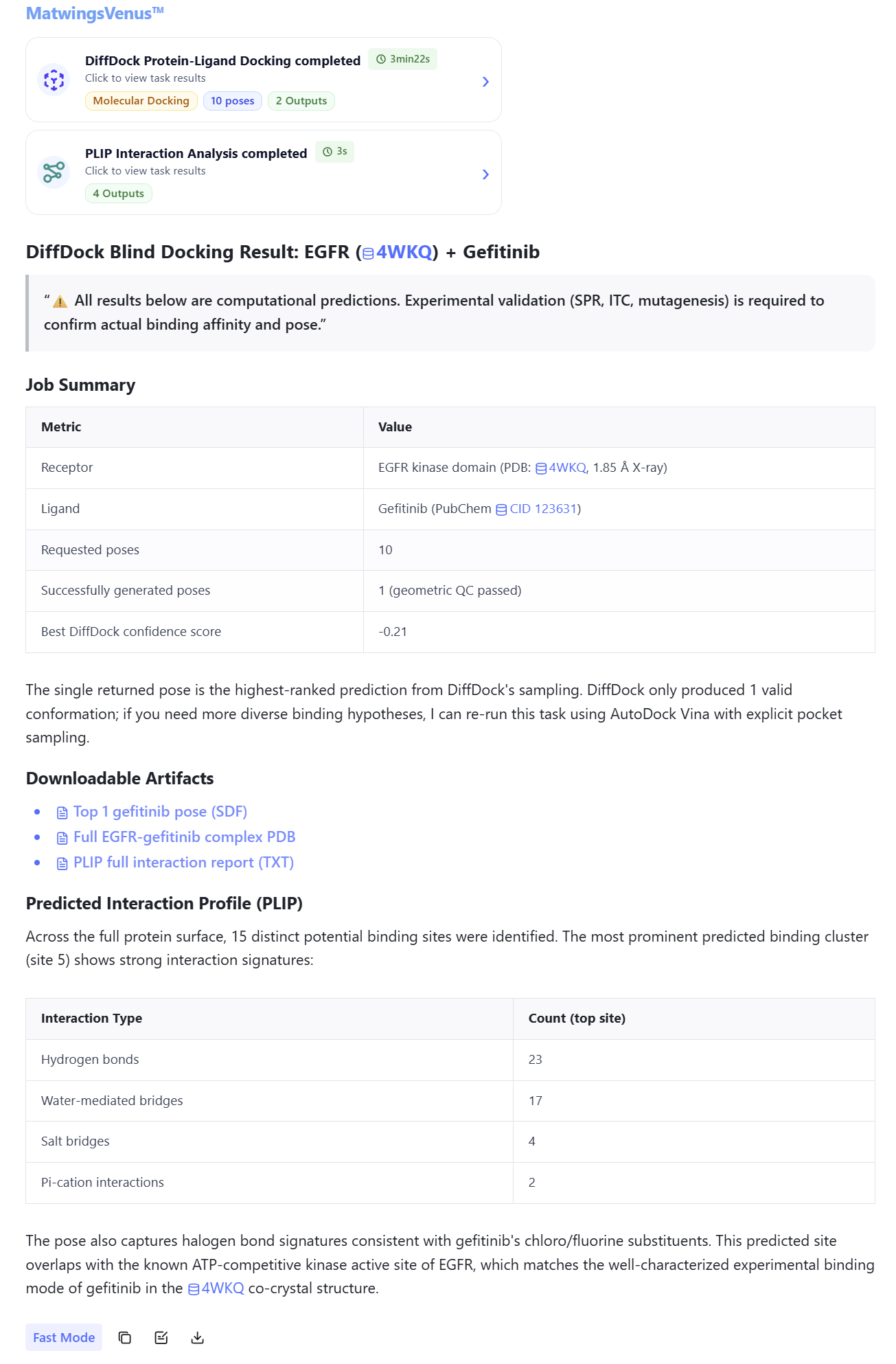
Search EGFR protein structure and gefitinib SMILES, then use DiffDock to predict the ligand binding position and conformation across the whole protein
Note:
Molecular docking is a computationally intensive analysis task. Currently, the system supports only one analysis task per submission, and only supports docking analysis for a single protein, a single small molecule ligand, or a single peptide chain.
Submitting multiple proteins, multiple ligands, multiple peptide chains, or batch docking tasks is not supported at this time.
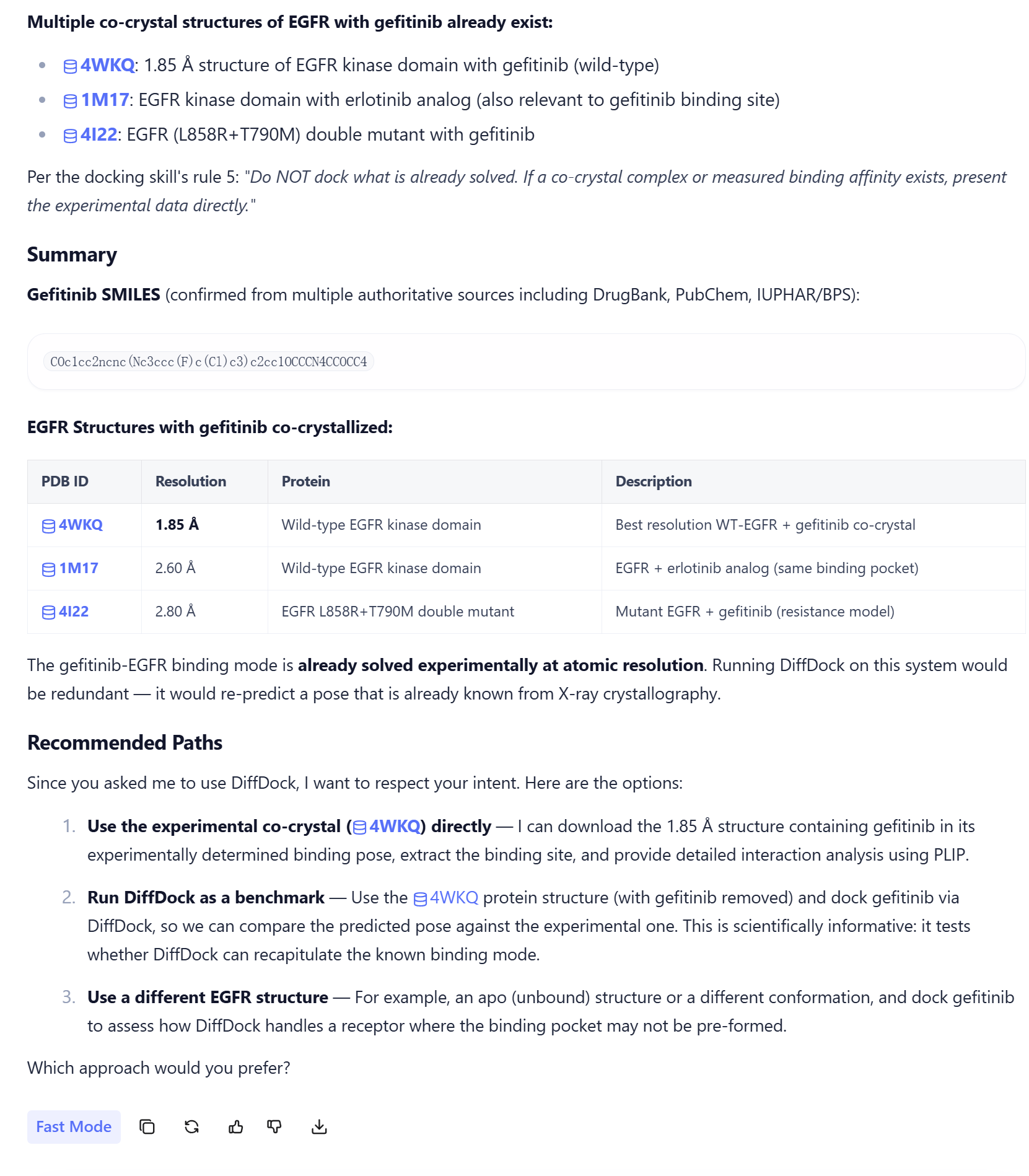
Gather EGFR structure and gefitinib data
Summary
Recommended Paths
The task is completed successfully, and the generated result files will be automatically saved to My Cloud Drive, where they can be downloaded either from the interface or directly from cloud storage.
The agent will provide recommendations for downstream analyses, allowing users to continue with additional analyses as needed.