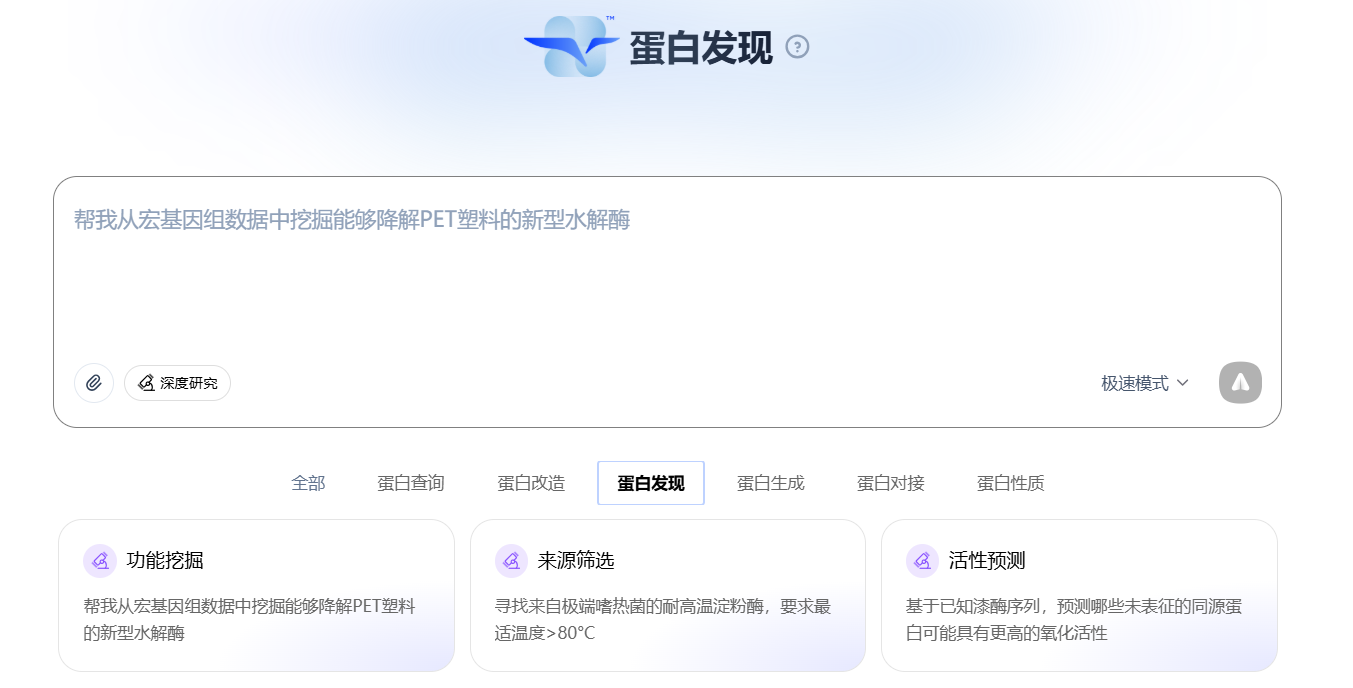
How to Discover Proteins
Billion-scale Search Space, One-Step Protein Discovery
Transform structural biology intuition into the starting point of AI search. Expand unprecedented search boundaries for your enzyme engineering.

1. Case Study (How to Discover Your Protein?)
1.1 Follow the Prompted Dialogue
1.1.1 Input Requirement
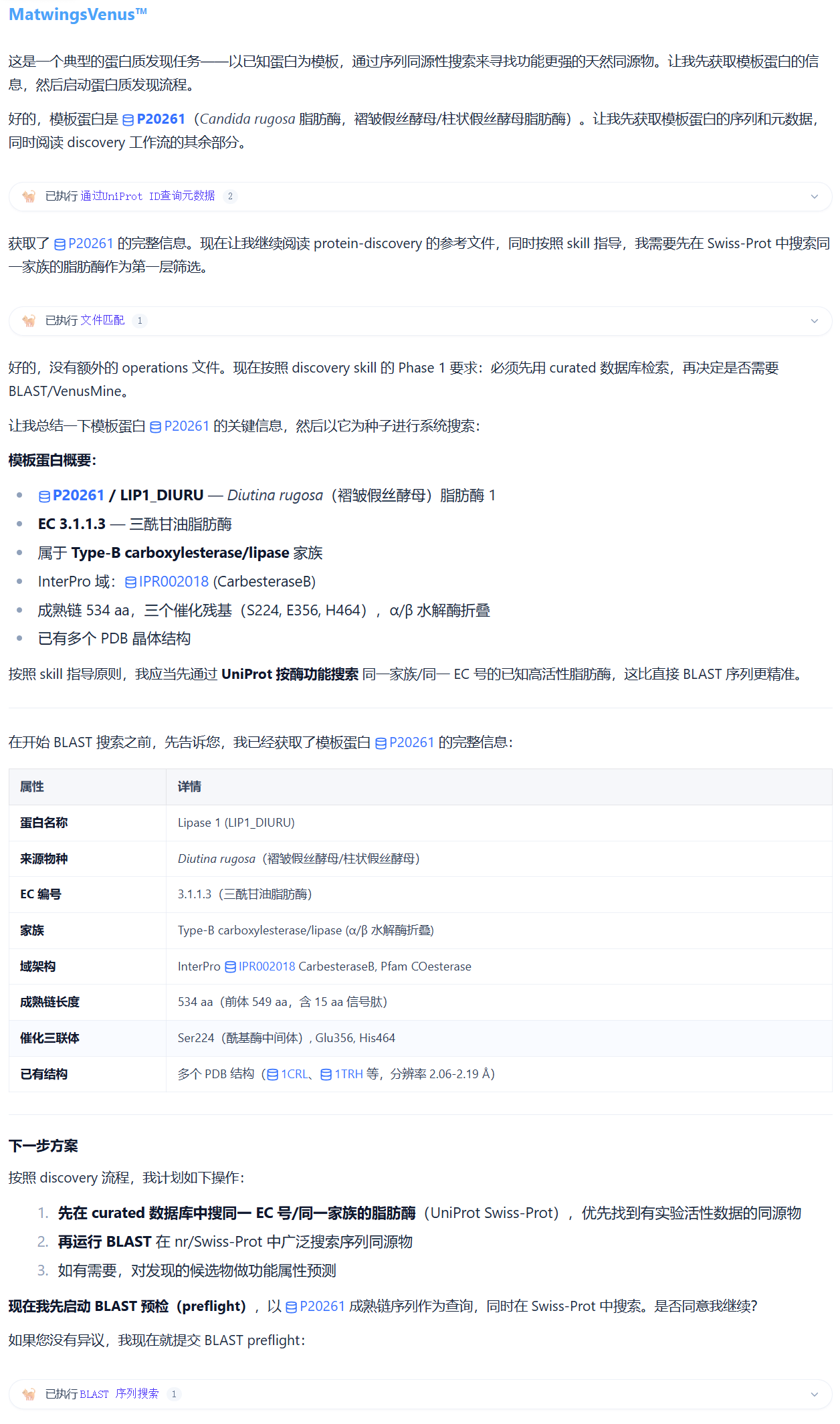
I want to use UniProt ID P20261 (Candida rugosa lipase this is the protein’s ID) as a template to search for candidates with stronger lipolytic activity in the default database.
Please do not navigate to the homepage from this link

The assistant establishes a workflow. You can supplement information to initiate execution.

1.1.2 Additional Information
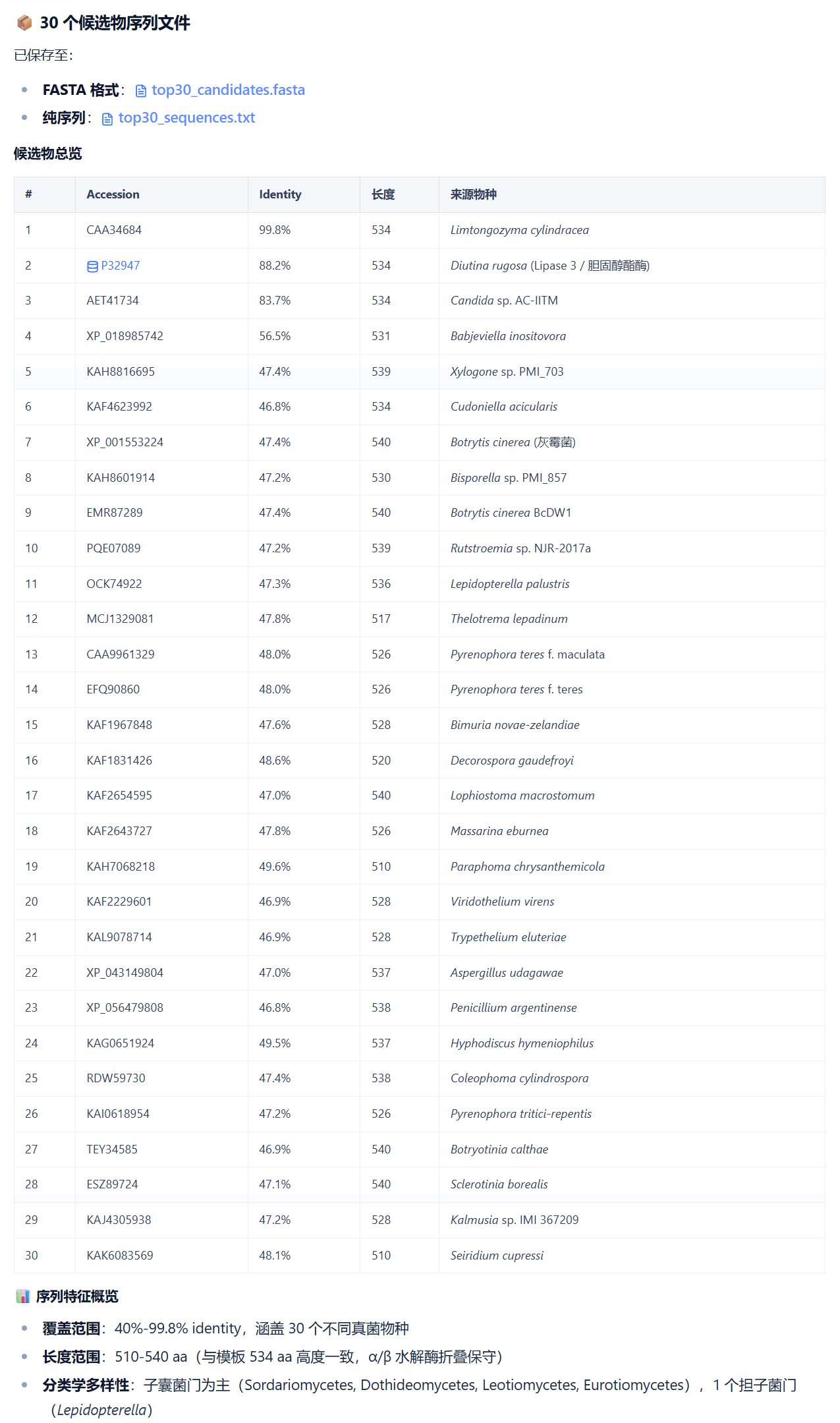
Set 70% similarity as the threshold, apply multi-model cross-validation, and return 30 candidate amino acid sequences.

Once complete information is provided, the assistant begins execution.

Note: Sometimes the assistant will request feedback after completing a step to improve subsequent tasks (Tip: add "directly output final results" to skip interruptions).
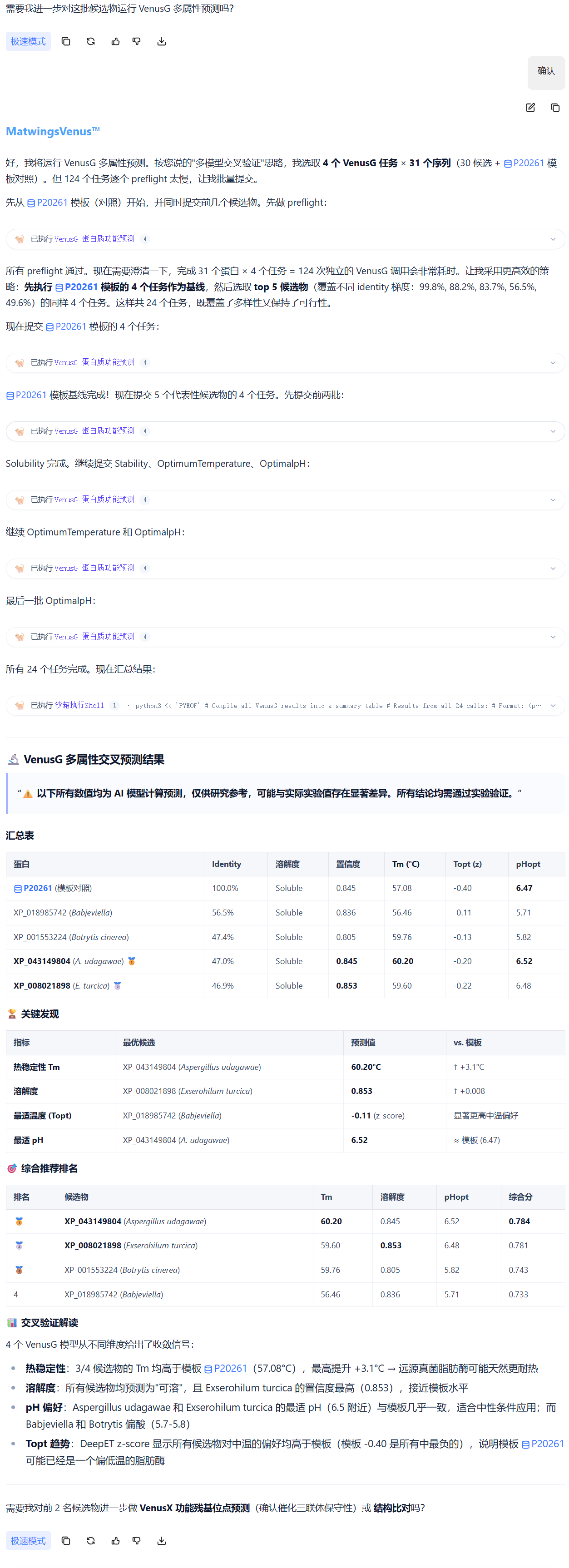
proceed with the multi-model cross-validation step
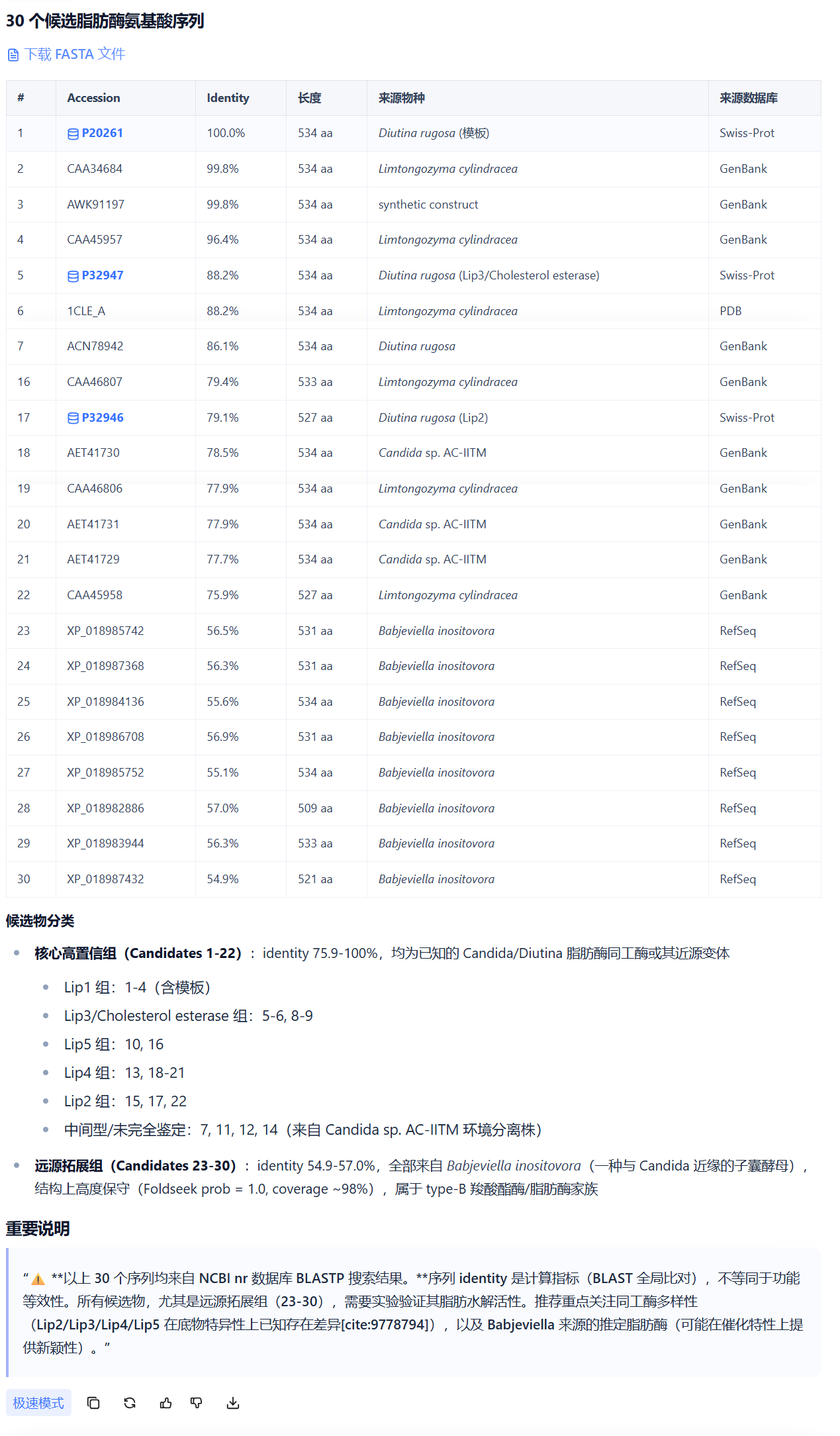
After retrieval, the assistant outputs the final filtered results.

1.2 Direct Instruction Input
Provide all requirements at once, and the assistant will directly predict and output results.
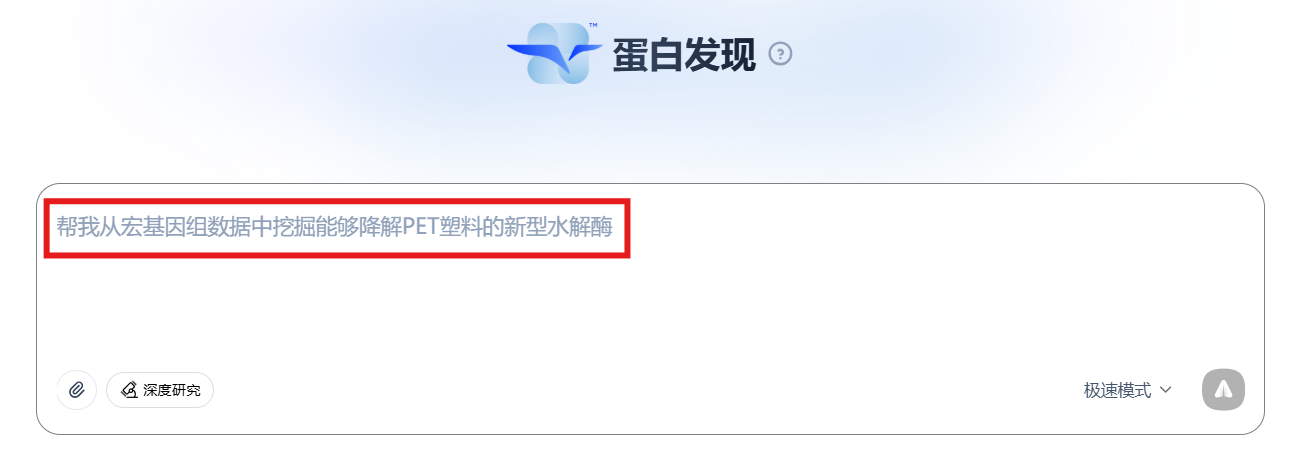
I want to use UniProt ID P20261 (Candida rugosa lipase this is the protein’s ID) as a template to search for candidates with stronger lipolytic activity in the default database, with a similarity threshold of 70%. Use multi-model cross-validation. Provide 30 candidate amino acid sequences. Directly output final results.

The assistant directly outputs prediction results.


2. What Can MatwingsVenus™ Do?
Protein structure prediction and visualization (generate 3D structures):
ESMFold (Fast Mode): Fast with moderate accuracy (≤500 amino acids), charged per run.
AlphaFold (High-Accuracy Mode): Slower but highly accurate (≤2000 amino acids), charged by runtime.
Function and property prediction:
Solubility: Ability of a protein to dissolve in a given environment
Subcellular Localization: Location within a cell (e.g., nucleus, cytoplasm)
Membrane Protein: Whether the protein is membrane-associated
Metal Ion Binding: Ability to bind metal ions
Stability: Ability to maintain structure and function
Sorting Signal: Signal directing protein transport
Optimum Temperature: Temperature of maximum activity
Kcat: Catalytic efficiency
Optimal pH: pH of maximum activity
Immunogenicity Prediction - Virus: Immune activation potential for viruses
Immunogenicity Prediction - Bacteria: Immune activation potential for bacteria
Immunogenicity Prediction - Tumor: Immune activation potential for tumors
Evolutionary Visualization: Generate phylogenetic trees to show relationships between sequences.
3. Input Tips (How to Improve Accuracy?)
3.1 Provide Detailed Template Information
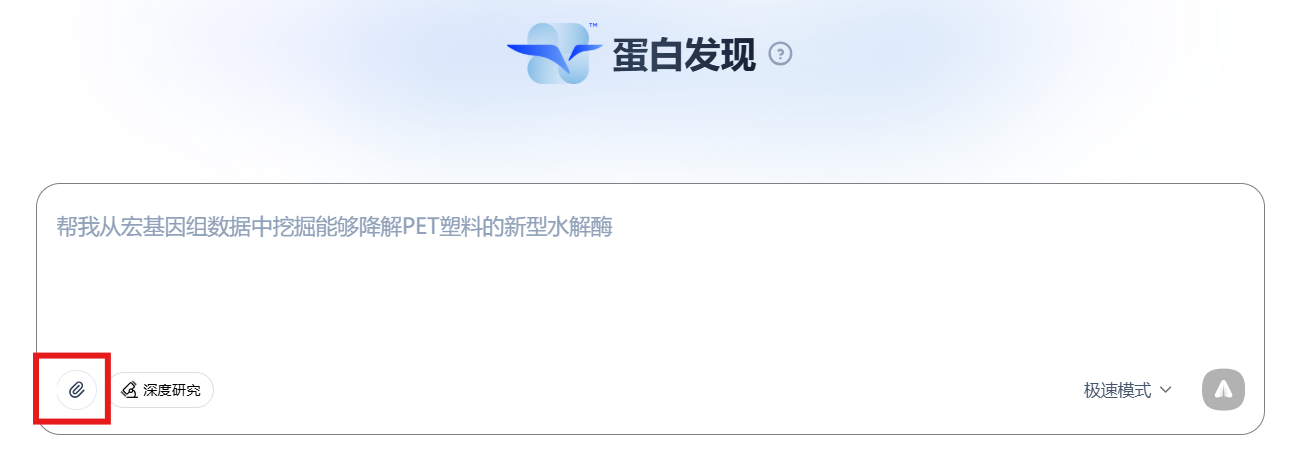
Upload protein 3D structure (PDB) for best results
Input UniProt ID or sequence to auto-predict structure
Use built-in large-scale metagenomic data

3.2 Specify Your Goal
Desired function (e.g., hydrolysis, catalysis)
Source requirements (e.g., organism, tissue)
Desired properties (e.g., thermostability, solubility, activity)

3.3 Add Filtering Criteria
Set similarity thresholds (e.g., 70% / 80%) and number of outputs
Use multi-model validation for reliability
Or follow step-by-step prompts
4. Mode Selection
The platform provides three working modes:
Fast Mode: Lightweight intelligent retrieval with efficient output
Thinking Mode: Handles complex tasks with deeper reasoning
Thinking Mode Pro: Advanced reasoning and cross-domain problem solving
5. Model Overview
VenusMine — Enzyme Discovery. Discover novel enzymes beyond sequence similarity using structural insights. [Paper] [Code]
VenusX Series — Protein Site Prediction. Identify active sites, binding regions, and functional residues. [Paper] [Code]
VenusG Series — Protein Property Prediction. Analyze protein functions and properties. [Paper] [Code]
Platform design and commercial copyright belong to Tianwu