Protein Purification Resin Design from Microscopic Pores to a Robust Process
Published on September 27, 2026
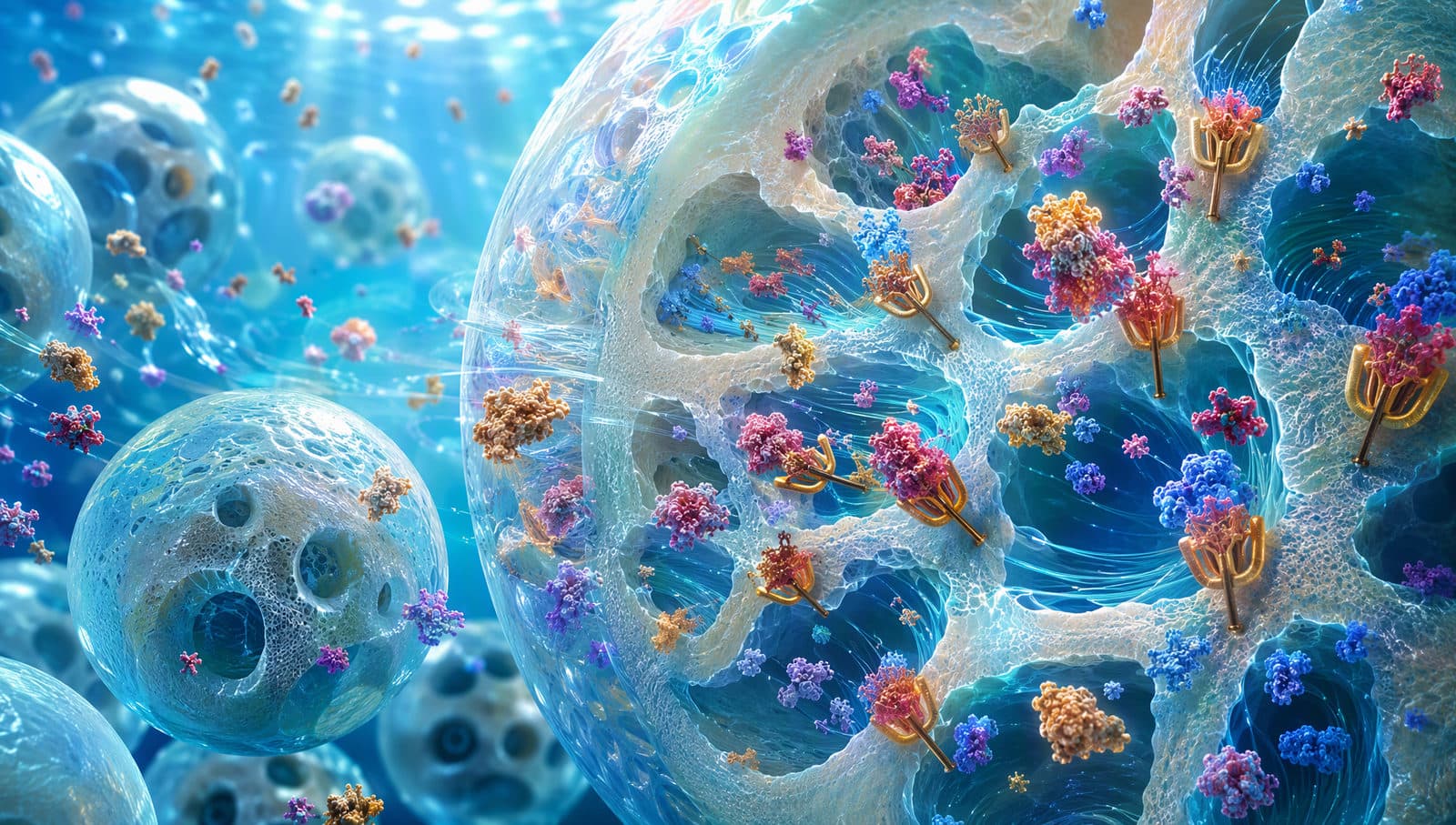
Porous matrices combine mass transfer and ligands for selective capture
Category: Protein Purification / Bioprocessing / Chromatography Materials
The same target protein faces different impurity environments in clarified supernatant, cell lysate, and an intermediate pool. The same resin can also behave differently in a slow laboratory experiment and a scaled process with greater bed height and flow. Choosing a protein purification resin is therefore not a search for the product with the highest isolated number. It is the task of matching material properties with the target molecule, feed composition, purity objective, operating conditions, and cleaning strategy.
A protein purification resin is a set of interacting process variables
At the microscopic level, chromatography media contain at least three functional layers. The matrix determines mechanical strength, hydrophilicity, and basic flow behavior. The pore structure influences whether a protein can access internal surface area and how quickly it moves. The ligand supplies affinity, electrostatic, hydrophobic, or another interaction that establishes selectivity.
These layers do not operate independently. Increasing ligand density may add theoretical binding sites, but operating capacity may not increase if a large protein cannot reach them efficiently. Smaller particles may shorten diffusion paths while increasing pressure. Stronger interactions may improve capture yet require harsher elution. A mature selection process replaces “How much can it bind?” with “What can it deliver under the intended flow, feed, and reuse conditions?”
Protein purification also needs an assay that tracks the integrity or activity of the target during successive steps. A reduction in total protein does not show whether the desired molecule retained its conformation and function. Affinity, ion exchange, hydrophobic interaction, and size-based media solve different separation problems and are commonly assigned to capture, intermediate, or polishing roles rather than treated as interchangeable products.
Five factors determine whether a resin works in practice
Selectivity determines whether the first separation is meaningful. Affinity ligands rely on specific recognition and can capture a target from a complex feed. Ion exchange responds to net and local charge. Hydrophobic interaction depends on solution conditions and exposed hydrophobic surfaces. Size-based separation reflects hydrodynamic size. Before selecting a mechanism, define the tag or binding motif, isoelectric behavior, aggregation risk, stable pH window, and dominant impurities.
Dynamic binding capacity is closer to operating reality than a static number. It describes effective capture under flow at a defined breakthrough point and depends on residence time, mass-transfer rate, feed concentration, and pore accessibility. Capacity values should always be interpreted with the sample, flow, and detection conditions used to produce them.
Pressure and mass transfer determine scalability. A protein purification resin that performs well at low laboratory flow may show rising pressure, earlier breakthrough, or broader peaks at higher velocity or bed height. Particle strength, size distribution, packing quality, and buffer viscosity all contribute.
The elution window determines whether the product remains safe. Strong capture is not always beneficial. A protein sensitive to low pH, high salt, or additives may aggregate or lose activity during harsh release. Ligand selectivity must therefore be evaluated together with the conditions the target molecule can tolerate.
Cleaning tolerance shapes lifecycle economics. A reusable process must validate cleaning-agent concentration, contact time, cycle count, and ligand leakage. High first-cycle capacity does not automatically reduce cost if performance declines rapidly.

Pore architecture, ligands, and solution conditions jointly shape selectivity
Choose a protein purification resin by working backward from the feed and objective
Four questions provide a useful starting point: How much target is present? Which impurity is hardest to remove? Which conditions threaten the target? What role must this step play? Capture emphasizes enrichment from a complex feed. Intermediate purification separates closely related impurities. Polishing may focus on aggregates, fragments, charge variants, or residual contaminants.
After selecting a mechanism, do not move directly to a large purchase. Design a comparable small-scale evaluation. Candidates should be tested with the same feed under consistent load, residence time, and analytical methods. Compare recovery, purity, breakthrough behavior, pressure, and elution volume. If reuse is planned, examine capacity retention and impurity clearance after cleaning cycles.
The final choice is not a single-metric ranking; it is the width of the process window. A resin that performs only within a narrow pH, salt, or flow range may be difficult to transfer or scale even if one peak result is impressive. A more tolerant operating window often supports robustness and batch consistency.
Protein A affinity media must balance capture, elution, and cleaning
Protein A binds specifically to the Fc region of antibodies and is widely used for antibody capture. Peer-reviewed literature identifies resin cost and lifetime, ligand engineering, resin characterization, and acid or alkali stability as continuing process considerations. For developers, the practical questions are whether capture remains consistent after cleaning and whether elution protects the target antibody.
MatwingsVenus Mall product page describes a Protein A affinity resin with immobilized Protein A ligand for antibody capture and states tolerance to 0.5–1.0 M NaOH. The page also offers support for product selection, process adaptation, and experimental validation. The stated alkali range defines a product boundary for cleaning design, while dynamic capacity, cycle life, recovery, and purity still require testing with the intended feed.
For low-pH-sensitive antibodies, elution may matter more than peak capacity. MatwingsVenus Mall also lists a mild-elution Protein A affinity resin with an official stated elution pH of 5.0 and positioning for low-pH-sensitive antibodies and complex bispecific formats. Suitability for a specific project should be confirmed through aggregation, activity, recovery, and impurity-clearance studies.

Capture, elution, and cleaning together define affinity-resin value
MatwingsVenus™(晓鹜™)connects product selection with process verification
Product information becomes useful only when it is translated into experimental conditions. The official MatwingsVenus™(晓鹜™) website and mall protein R&D, purification tools, and wet-lab services in one business environment, allowing product discussions to begin with the target protein, feed, and purification scale rather than only a catalog number.
A useful inquiry should include target-protein type, expression system, feed volume and concentration, existing purification steps, acceptable pH and salt ranges, purity goal, and intended reuse cycles. Better input narrows the protein purification resin shortlist and identifies the risks that require testing. Official product pages provide quotation and customized-support channels; current specifications, supply, process parameters, and service scope should be confirmed through the latest page and formal technical documents.
Conclusion: the best resin is the best match, not the highest single number
A protein purification resin compresses material science, molecular recognition, and fluid transport into a microscopic particle. Matrix and pores govern access, the ligand determines retention, flow and pressure control scalability, and elution plus cleaning affect product quality and resin lifetime. Selection becomes robust only when these variables are interpreted in the context of the feed, step objective, and lifecycle cost. With Protein A affinity options, a mild-elution product, and process-adaptation support from MatwingsVenus™(晓鹜™), researchers can begin from explicit product boundaries and use small-scale evidence to build a repeatable purification process.