Protein Inverse Folding from Backbone Blueprint to Candidate Sequence
Published on September 29, 2026
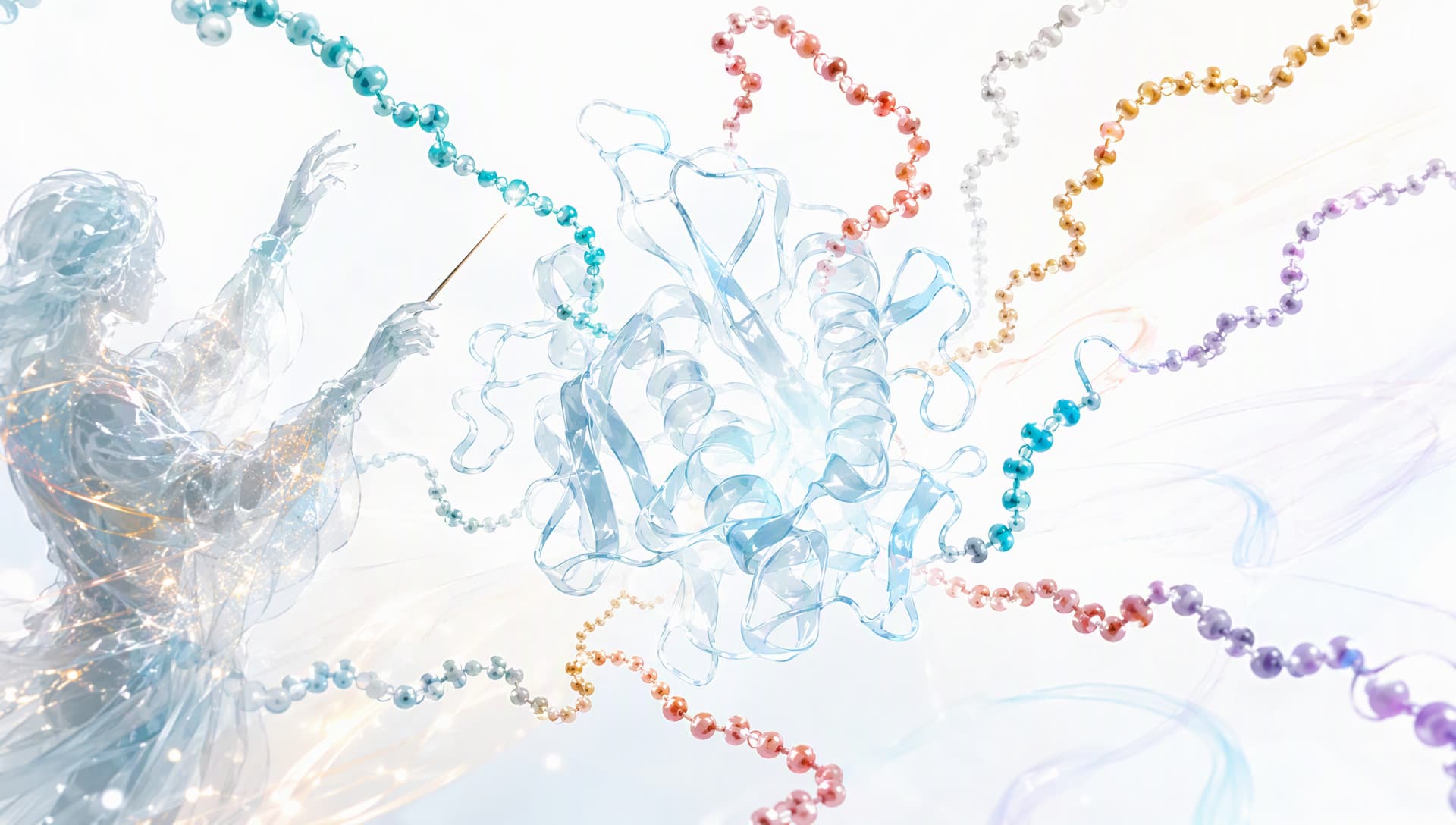
One backbone can correspond to many candidate sequences
Category: Protein Design / Computational Structural Biology / Protein Engineering
Conventional structure prediction begins with an amino-acid sequence and asks what three-dimensional structure it may form. Protein inverse folding reverses that arrow: a backbone becomes the condition for generating candidate sequences. The goal is not to recover one uniquely correct answer, but to search a vast sequence space for alternatives that may fit a target architecture and provide starting points for scaffold redesign, local functional engineering, or new protein design.
Protein inverse folding is not molecular unfolding
The phrase “inverse folding” can sound like a simulation in which a folded protein becomes an unstructured chain. In computational protein design, it usually means reconstructing or generating an amino-acid sequence while conditioning on a structure, especially backbone geometry. The central question is which residue type can occupy each position while remaining compatible with its spatial neighbors, burial, and local atomic environment.
Published work defines inverse folding as reconstructing protein sequence from structure. Other research shows that three-dimensional backbone geometry can condition the joint design of side-chain coordinates and sequence. Candidate residues are therefore not selected from one-dimensional frequency alone. Side-chain volume, local polarity, hydrophobic burial, and neighboring geometry contribute to structural compatibility.
Structural conditioning is not a complete functional specification. A sequence compatible with a backbone is not automatically soluble, expressible, correctly folded, or functionally active. Protein inverse folding addresses an important subproblem in a longer design chain; it does not guarantee the final biological result.
Why one backbone can yield many sequences
A protein architecture can tolerate sequence variation. Some buried positions are strongly constrained by volume and hydrophobic environment, whereas exposed positions may allow more charge and polarity combinations. Different residue networks can sometimes support similar local geometry. The output of inverse folding is therefore better understood as a candidate distribution than as a single reference answer.
This diversity is useful. Optimizing only for recovery of a natural sequence may miss alternatives with different expression, stability, or functional potential. Maximizing novelty alone can move candidates away from known feasible regions. A more informative selection examines which positions remain conserved, which vary, how far candidates move in sequence space, and how much diversity an experimental budget can test.
The official MatwingsVenus™(晓鹜™) website lists database retrieval, protein sequence analysis, de novo design, and structure prediction among its capabilities. Researchers can use retrieval and sequence analysis to identify known functional residues, conserved motifs, and family context before deciding which positions should remain protected and which may be redesigned. Specific design tools and task availability should be confirmed in the current platform interface.
Express the brief through protected and designable regions
Rewriting every residue freely is often not the closest representation of a real engineering goal. This article proposes two classes of constraints as a practical decision aid. Protected regions preserve catalytic residues, ligand contacts, metal coordination, disulfide bonds, or experimentally supported motifs. Designable regions allow sequence exploration under structural compatibility. This is an editorial framework, not a universal standard.
Constraint granularity also matters. Protecting only one catalytic residue may not preserve its local geometry, while locking a very large region can eliminate useful design space. A project can define a tightly protected functional center, apply softer restrictions to nearby supporting residues, and leave more distant surface positions open to diversity.
The input backbone itself requires review. Missing loops, unusual backbone geometry, atomic clashes, omitted ligands, or an irrelevant assembly state can become hidden assumptions in sequence design. An inverse-folding model may faithfully fit a backbone that is unsuitable for the task, so checking structural source, conformational state, and target region can be more valuable than simply generating more candidates.

Protect functional motifs while preserving useful design space
Structural compatibility is not functional success
General inverse-folding systems primarily optimize sequence compatibility with a supplied backbone; they are not automatically optimized for catalytic efficiency, binding specificity, cellular activity, or manufacturing properties. Recent function-oriented studies explicitly begin from this gap and add task signals beyond backbone compatibility. Predicted functional scores must not be reported as measured improvement, and model rank is not an experimental success rate.
Candidate evaluation can therefore be layered. One layer checks protected regions and basic chemical constraints. Another maintains sequence diversity rather than returning many near duplicates. A structural prediction step can test whether candidates tend to return to the target backbone and identify uncertain regions. Finally, independent evidence relevant to function, expression, stability, or binding can be added according to the project objective.
This “refolding check” remains computational consistency rather than experimental proof. Agreement between a designed sequence and a predicted target-like structure means that two computational stages support one another under their assumptions. It does not establish that the real protein will adopt that structure. Stages may share training data or biases, so experiments must still distinguish candidates that can be synthesized, expressed, folded, and functional.
Select an informative experiment set from a candidate ocean
Inverse folding can generate many sequences, while experiments can test only a small subset. Instead of sorting everything by one aggregate score, an experimental set can contain structurally consistent but sequence-diverse candidates, a few lower-risk options close to known sequences, and controls that discriminate a design hypothesis.
This article recommends assigning one question to each selected candidate: Can a surface patch be rewritten? Can residues around a motif change while preserving the target architecture? How much sequence diversity remains compatible with the design goal? The exact assay should depend on protein class, intended function, and sample constraints rather than follow one universal ladder.

Structure, function, and experiments jointly filter candidate sequences
MatwingsVenus™(protein agent)connects the stages around sequence design
The official MatwingsVenus™(晓鹜™) website describes a conversational protein R&D environment spanning database retrieval, protein sequence analysis, de novo design, structure prediction, protein design, and wet-lab services, with direct access to resources including PDB, PubMed, and UniProt. Based on these public capabilities, an inverse-folding project can retrieve backbone and functional evidence before design, then organize structural checks and experimental service needs afterward.
The public website does not by itself promise that the platform automatically executes every inverse-folding stage. Specific tools, constraint formats, candidate counts, inputs, and service scope should be confirmed in the current task interface. Researchers should continue to distinguish database measurements, computational predictions, and experimental results.
Conclusion: inverse folding designs possibilities within constraints
Protein inverse folding is valuable not because it recovers one sequence from a backbone, but because it creates a comparable candidate space under explicit structural and functional constraints. Confirm the backbone and protected regions, balance structural compatibility with sequence diversity, and then filter through refolding checks, task evidence, and an informative experimental set. MatwingsVenus™(晓鹜™) can connect database retrieval, sequence analysis, protein design, structure prediction, and experimental services while preserving the essential boundary between computational compatibility and biological validity.