Why Pullulanase Makes Starch Hydrolysis More Complete
Published on September 29, 2026
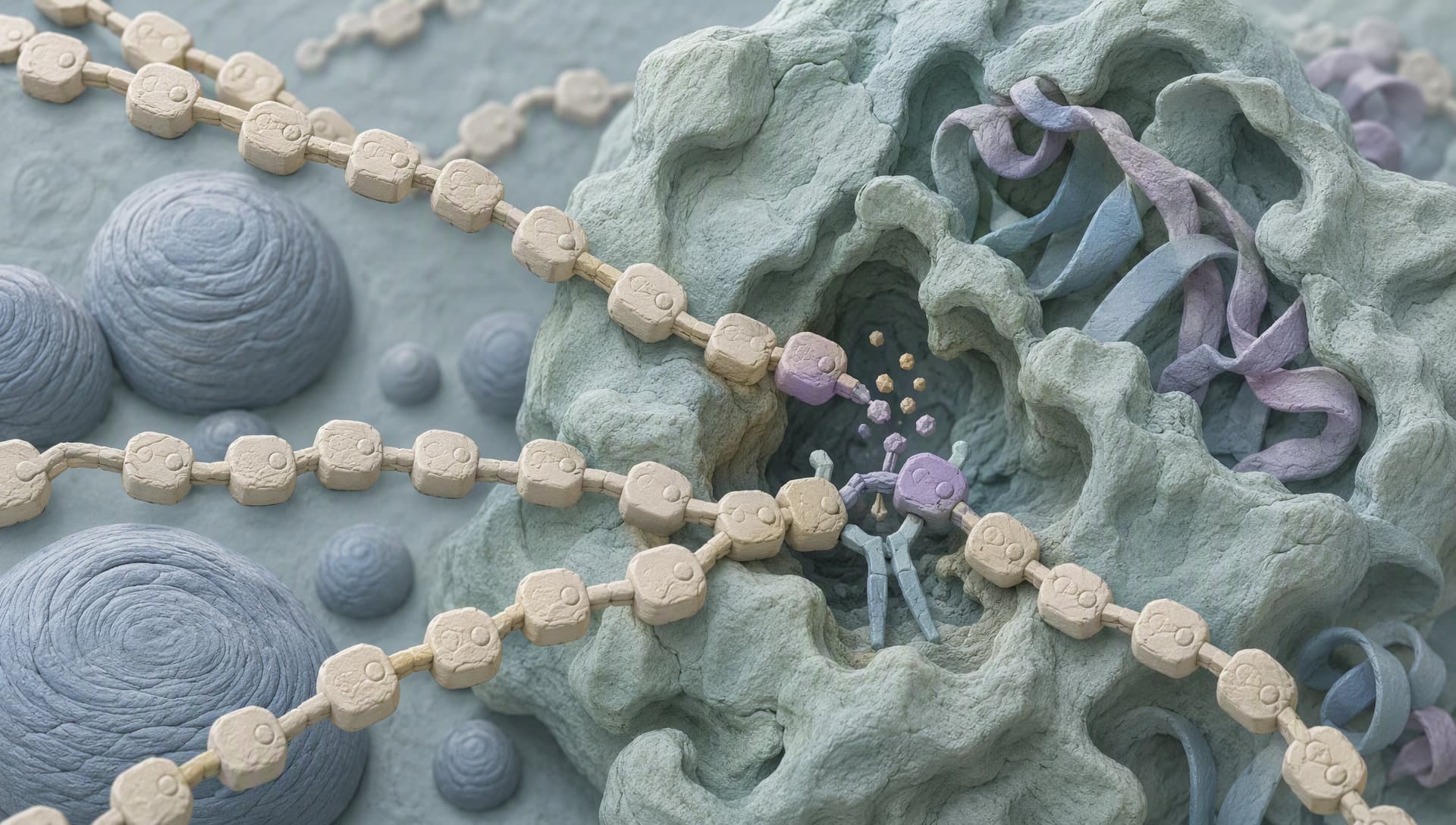
This scene shows pullulanase opening an alpha-1,6 branch while leaving the main-chain context visible.
Category: Starch Processing, Food Science, Fermentation Engineering, Industrial Enzymes, Protein Engineering
Abstract: Pullulanase removes alpha-1,6 branch linkages that limit starch hydrolysis. This guide explains substrate fit, assays, enzyme synergy, applications, stability, and engineering.
Why can a liquefied starch slurry still contain structures that resist further saccharification? The obstacle is often a branch point. Enzymes that hydrolyze the main chain can slow near alpha-1,6 linkages. A debranching enzyme opens those junctions and allows other starch-active enzymes to reach newly exposed chain segments.
This is also why candidate selection cannot rely on one activity value. Branch density, chain length, gelatinization, temperature, pH, and partner-enzyme dosage can all alter the outcome. Recognizing the target bond is only the beginning; a useful process links molecular structure, assay design, and product endpoint.
Why the Pullulanase Mechanism Focuses on Alpha-1,6 Linkages
The linear portions of starch are mainly connected through alpha-1,4 glycosidic linkages, while branch points are formed through alpha-1,6 linkages. Debranching removes those junctions and can make the surrounding chains more accessible to other starch hydrolases. The enzyme is not simply breaking every bond. It is removing a structural obstacle to continued main-chain processing.
Common substrates include pullulan, amylopectin, glycogen, and related oligosaccharides, but candidates do not have identical preferences. Access to the catalytic region, chain requirements around the branch, and the gelatinization state of the sample all influence debranching performance.
Pullulan is often used for baseline activity testing because it contains regular, repeated alpha-1,6 linkages that are convenient to monitor. Strong performance on a model substrate, however, does not guarantee the same ranking in corn starch, cassava starch, or a complex food matrix. Selection must return to the authentic material.
How Pullulanase Type Differences Change Substrate Selection
Pullulan-hydrolyzing enzymes can be classified by substrate specificity and hydrolysis products. A type designation describes functional range rather than a simple ranking from weak to strong. Some candidates emphasize debranching, while others have a broader starch-chain response. The exact type and target substrate should be checked before process use.
Pullulanase and isoamylase both act on alpha-1,6 linkages, but their recognition around a branch and their substrate preferences differ. The exact distinction depends on enzyme type, chain length, and substrate architecture, so neither class should be treated as universally stronger. Compatibility must be compared in the target feedstock.
Three questions help frame selection: what branch architecture dominates the feedstock, is the intended outcome fermentable sugar or starch restructuring, and which other starch hydrolases are already present? Different answers lead to different candidates and addition strategies.
Separating Debranching from Total Sugar in a Pullulanase Activity Assay
A common analytical mistake is to attribute every increase in reducing sugar to debranching. If alpha-amylase or glucoamylase is present, the signal combines several reactions and cannot isolate branch-linkage hydrolysis. Candidate screening and complete-process evaluation should therefore be designed separately.
A baseline assay can use pullulan or another defined branched substrate under fixed temperature, pH, substrate concentration, reaction time, and quenching. When reducing sugar is measured, substrate blanks, enzyme-free controls, and inactivated-enzyme controls can identify nonenzymatic change and analytical background.
A second level follows several time points to distinguish initial rate, continued debranching, and a late plateau. A third level introduces the authentic starch and partner enzymes, then measures glucose equivalent, oligosaccharide distribution, viscosity, or a product-specific property. One model-substrate number should not represent the entire process.
Temperature and pH testing should also separate immediate activity from residual function after exposure. A candidate that reacts quickly but loses function during the saccharification period can make a limited cumulative contribution. The useful output is an operating window that covers production time.

This experiment compares debranching responses across substrates, temperatures, and reaction times.
Why Pullulanase Starch Saccharification Depends on Synergy
Liquefaction reduces starch molecular size and viscosity, while saccharification continues converting chains into smaller sugars. Branch points can restrict main-chain hydrolases, so debranching and alpha-1,4 hydrolysis often work together. One enzyme opens a junction; another continues along the newly accessible chain.
Synergy does not mean that adding several enzymes at once automatically produces the best outcome. Addition order, dosage ratio, temperature, pH, and solids content all matter. If debranching occurs too late, main-chain hydrolysis may already have accumulated branch-containing limit dextrins. If the conditions fit only one enzyme, the partner may contribute little.
A practical optimization begins with small-scale time courses that compare single enzymes, combinations, and different addition sequences. Total sugar can be paired with oligosaccharide distribution, residual branching, filtration behavior, or downstream fermentation. The meaning of synergy becomes measurable only after the product target is defined.
In syrup production, debranching can allow saccharifying enzymes to reach additional chains. In brewing or fermentation, the endpoint may emphasize fermentable sugar composition and process compatibility. In resistant-starch preparation, the rearrangement of linear chains after debranching may become central. The same catalytic function serves different process endpoints.
Matching Industrial Pullulanase Use to the Product Target
Glucose syrup and other starch-sugar processes emphasize conversion, reaction time, and enzyme compatibility. Better raw-material use does not mean extending the reaction indefinitely. A late plateau may reflect substrate structure, product accumulation, or enzyme stability, so time and product data should identify an economic endpoint.
Resistant-starch preparation focuses on chain rearrangement and crystallization after debranching. Insufficient treatment may leave too few linear chains, while excessive treatment may produce chains that are too short. Cooling, retrogradation, water content, and later heat treatment contribute to the final structure, so product properties cannot be assigned to one enzyme alone.
Brewing and fermentation add questions about flavor, sugar profile, filtration, and microbial utilization. A candidate that performs well in purified starch may not retain the same ranking in wort or another complex matrix. Authentic-matrix testing is essential before application.
MATWINGS MALL Platform Workflow for Pullulanase Engineering
Industrial candidates often face trade-offs among thermostability, pH fit, catalytic performance, expression, and substrate specificity. A high-temperature process requires functional retention, a low-pH saccharification system requires compatibility, and heterologous production adds folding, secretion, and host-background constraints. Engineering should begin with the bottleneck that most limits the target workflow.
MATWINGS MALL, presents services related to protein function prediction, enzyme discovery, protein design, directed evolution, and protein engineering. These capabilities can support natural-candidate organization, property assessment, site prioritization, and variant planning. A specific project still needs a defined sequence, substrate, temperature, and assay boundary.
Candidate discovery can begin with enzymes from thermophilic or other specialized microorganisms and compare known family domains and catalytic regions. During engineering, site-directed mutation, structure-guided design, and expression optimization may improve performance, but stability gains should not be accepted without checking substrate fit.
Immobilization provides another process route for repeated use and operational stability. Carrier pore size, mass transfer, and conformational effects can change apparent activity. Free enzyme, immobilized preparations, and engineered variants should be compared in the same authentic substrate system.

This workflow connects pullulanase debranching, partner hydrolases, candidate engineering, and product validation.
A Decision Thread from Branch Architecture to Operating Window
The subject can be followed through one continuous thread. Define the starch and branch architecture, then select candidate enzymes. Confirm baseline debranching with a model substrate and check candidate ranking in the authentic feedstock. Combine the selected enzyme with main-chain hydrolases, optimize addition order and ratio, and finally evaluate retention, expression, immobilization, and scale-up conditions.
The purpose is not to accumulate more enzymes but to assign one obstacle to each experiment. If branches remain, revisit substrate recognition and gelatinization. If the model works but the authentic feedstock does not, examine chain length, impurities, and partner conditions. If catalytic capacity is sufficient but declines during the process, direct engineering toward stability.
FAQ
Which bond does pullulanase mainly hydrolyze?
It mainly hydrolyzes alpha-1,6 glycosidic linkages in starch-type polysaccharides and is therefore described as a starch-debranching enzyme. Exact substrate range depends on candidate type and reaction conditions.
Can pullulanase completely replace glucoamylase?
Usually not. Debranching removes branch-related obstacles, while glucoamylase and other enzymes continue processing exposed chains. Their roles are more often complementary.
How should pullulanase and isoamylase be compared?
Their recognition requirements around a branch differ. Selection should consider feedstock architecture, product target, temperature and pH, partner enzymes, and authentic-substrate results.
Why can high activity still produce a modest saccharification result?
Model substrate, gelatinization, substrate concentration, enzyme ratio, and stability can all alter performance. Baseline debranching and the complete saccharification system should be evaluated separately.
When is thermostability engineering appropriate?
It is appropriate when loss of function at the production temperature is the demonstrated bottleneck and a stable assay measures the target. If gelatinization or mixing is limiting, process optimization may be more direct.
Conclusion
Pullulanase creates process value by removing alpha-1,6 branch linkages and opening additional routes for main-chain hydrolysis. The final outcome still depends on substrate architecture, partner enzymes, reaction conditions, and product target. Services presented by MATWINGS MALL can support enzyme discovery, functional assessment, directed evolution, and engineering. Before comparing candidates, confirm that branching is the main obstacle and use layered assays to separate debranching capacity, synergistic performance, and production stability.