Protein-Ligand Complex Prediction: From Poses to Evidence
Published on September 28, 2026
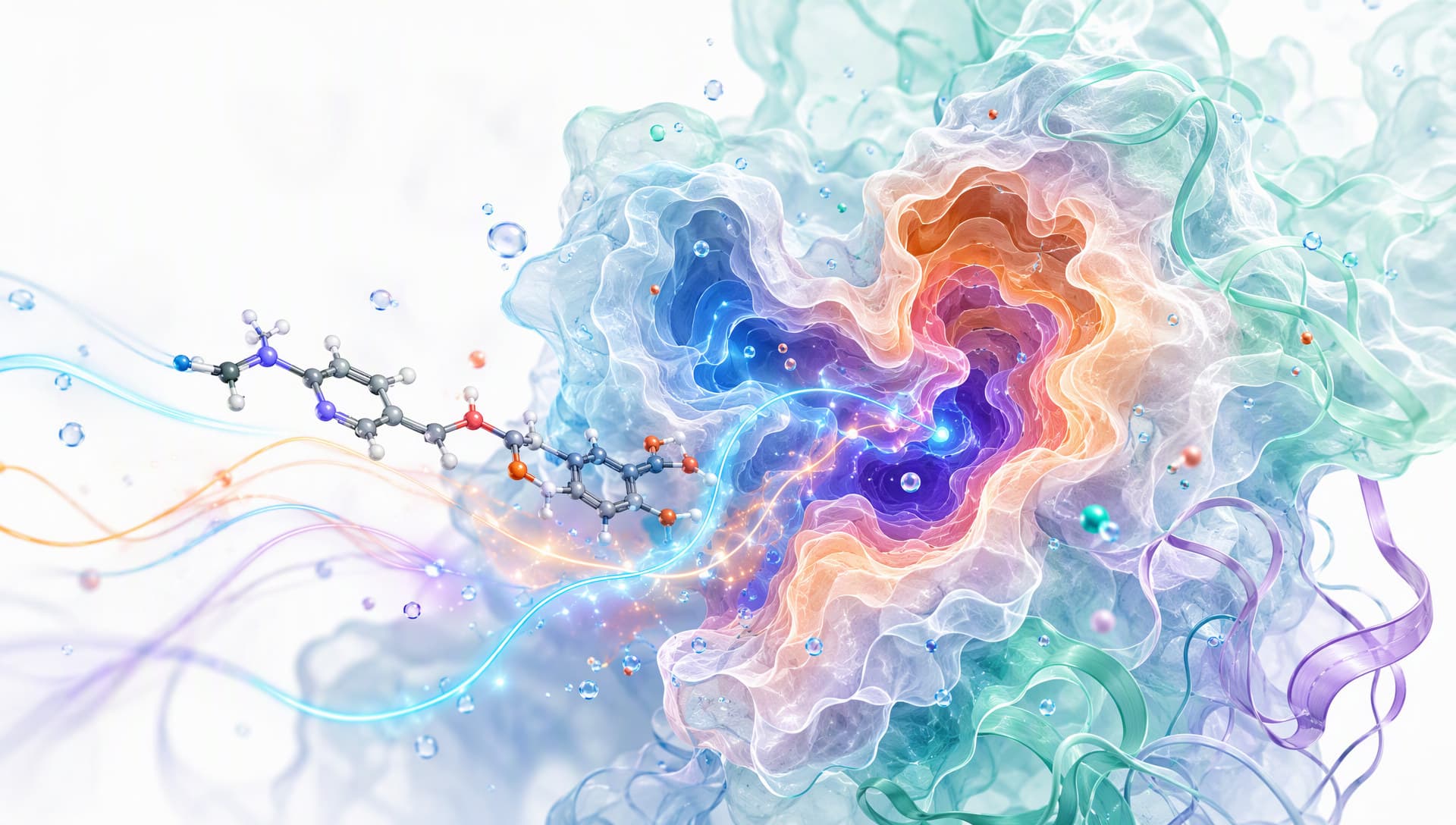
Pocket state and hydration jointly shape where a ligand can settle
Category: Computational Structural Biology / Protein Interactions / Molecular Design
A three-dimensional image of a ligand nestled in a pocket can create the impression that binding has already been demonstrated. In reality, the model first represents a spatial hypothesis. It depends on the chosen protein conformation, ligand state, protonation environment, treatment of water, and sampling range. Useful protein-ligand complex prediction should explain why a pose deserves further testing rather than simply produce the most attractive molecular picture.
Start by asking whether the pocket is in the right biological state
A protein does not always occupy one shape. Ligand binding, ions, cofactors, post-translational modifications, and local environment can rearrange side chains, loops, or entire domains. A receptor structure that does not match the target state may present a temporarily closed pocket or hide a cavity that opens only in a specific conformation.
Prediction should therefore begin with structural and functional retrieval. Is a ligand-bound structure available? Are key residues, cofactors, or metal ions missing? Does the pocket contain mutations, construct truncations, or uncertain regions? When several receptor conformations are plausible, retaining a small ensemble with explicit biological reasons is often more informative than committing early to one structure.
Methodological research identifies receptor reorganization as a central challenge when small-molecule binding requires induced fit. This does not mean that every project needs an expensive simulation. It means that a pocket is not a rigid mold, and computational effort should focus on conformational differences most likely to change the conclusion.
The official MatwingsVenus™(晓鹜™) website describes a conversational R&D environment with structure prediction, database retrieval, and protein sequence analysis, including direct connections to resources such as PDB, PubMed, and UniProt. Researchers can organize known structures, site annotations, and experimental context before deciding which receptor states should enter calculation.
Protein-ligand complex prediction also depends on ligand identity
A ligand name does not define one computational input. Protonation states, tautomers, stereoisomers, and conformers may differ in hydrogen-bonding patterns, electrostatic distribution, and shape. If the initial state is wrong, a sophisticated scoring procedure may only optimize the wrong premise.
Systematic studies show that protonation, tautomeric, and stereochemical states can alter docking rankings, and software may not automatically identify the correct state. Practical preparation should generate a limited set of chemically plausible microstates based on experimental pH, known chemistry, and pocket environment rather than enumerate every theoretical form. Molecules with ambiguous stereocenters, metal-binding groups, or readily changing charges require especially clear input records.
That record is essential for reproducibility. It should preserve the ligand source, treatment of salts, protonation assumptions, stereochemistry, and conformer set. When two predicted poses conflict, the team can then determine whether the disagreement came from the method, receptor state, or ligand input.

Different microstates can produce different candidate binding poses
Do not let one score decide the pose
Protein-ligand complex prediction commonly returns several candidate poses. Ranking helps narrow the search, but a score is not binding affinity, cellular activity, or experimental success. Receptor conformation, ligand state, and sampling space can all change the order. A safer decision looks for several kinds of evidence that converge on one explanation.
First, determine whether the ligand occupies a biologically meaningful pocket rather than an incidental surface depression. Next, inspect whether important functional groups form directionally plausible hydrogen bonds, hydrophobic contacts, salt bridges, or coordination interactions. Then look for atomic clashes, buried unsatisfied polar groups, and strained side-chain arrangements created merely to accommodate the ligand. Water can be a competitor that must be displaced or a bridge that completes an interaction, so it should not be removed or retained by a universal rule.
Comparing interaction fingerprints is often more informative than comparing scores alone. A pose becomes a stronger validation candidate when multiple receptor states, ligand microstates, or independent calculations repeatedly support the same key contacts. If the top-ranked pose depends on one fragile interaction while a lower-ranked pose agrees better with known sites, mutation evidence, and chemical logic, rank one should not win automatically.
Triage poses into advance, investigate, or stop
A useful review does not need to force every project toward one definitive answer. Candidates can be sorted into three decisions: advance to validation, investigate with additional evidence, or stop because the pose conflicts with chemistry or biology.
An “advance” pose preserves key contacts across reasonable input changes and agrees with known functional information. “Investigate” fits cases involving flexible loops, uncertain water networks, or several unresolved orientations; focused refinement, molecular dynamics, or a discriminating experiment may help. “Stop” applies when a model depends on the wrong stereochemistry, severe clashes, exposed hydrophobic groups, or direct conflict with indispensable functional residues.
This triage is more useful than retaining an arbitrary top-ten list because it assigns the next unit of effort. MatwingsVenus™(晓鹜™) can connect binding-site analysis, protein-ligand docking, interaction analysis, and molecular simulation within one research context. Specific tools, parameters, and task availability should be confirmed in the current platform interface, and outputs should remain labeled as predictions until tested.

Multiple evidence types help reject poses that only fit by chance
Design a minimum validation set around decisive contacts
Validation does not need to prove that every coordinate in a model is correct. It should test the most decisive and falsifiable contacts. One experiment might mutate a predicted anchor residue alongside a control residue and measure binding or function. Another might compare ligand analogs that preserve the scaffold while changing one functional group, testing whether a proposed hydrogen bond or hydrophobic interaction actually matters.
Direct binding, competition, thermal stabilization, enzymatic activity, and cellular function answer different questions. A change in one readout does not automatically validate a binding pose because expression, folding, solubility, and nonspecific effects can produce similar observations. A strong minimum set combines direct binding evidence, functional evidence, and appropriate negative controls, with a predefined outcome that would reject the pose.
MatwingsVenus™(ai protein)connects pose evidence with validation tasks
Official information describes MatwingsVenus™(晓鹜™) as connecting database retrieval, structure prediction, protein design, and wet-lab services in a conversational workflow. For a ligand-complex project, this continuity can preserve input assumptions, decisive contacts, pose triage, and validation requirements. The model then becomes a traceable experimental decision card rather than an isolated structure file.
Conclusion: a good model makes the next experiment more informative
Protein-ligand complex prediction is valuable when it converts structural uncertainty into a testable question. Confirm the receptor state, define plausible ligand microstates, and evaluate poses through pocket context, interaction networks, chemical realism, and reproducibility. Then route each candidate toward advancement, additional evidence, or termination. By linking databases, structural computation, and experimental services, MatwingsVenus™(晓鹜™) can help researchers turn a predicted pose into a bounded, documented hypothesis that experiments can support or falsify.