How to Choose a Protein Complex Structure Prediction Tool for Real Research Workflows
Published on September 27, 2026
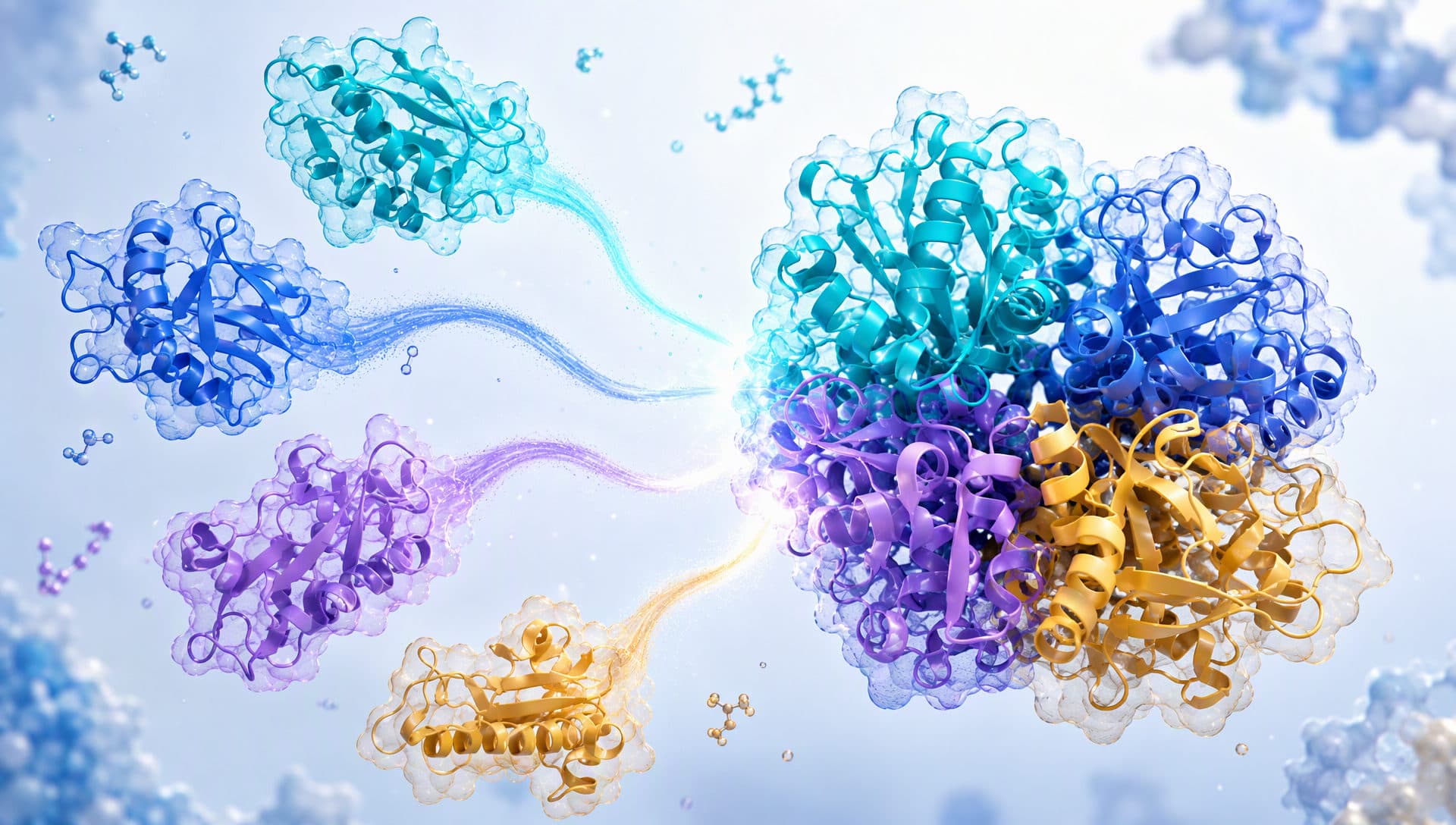
Multiple chains converge from distributed evidence into an assessable complex model
Category: AI Protein Research | Computational Structural Biology | Research Workflows
In antibody–antigen recognition, enzyme assembly studies, receptor interactions, and protein engineering, teams often face the same gap: a model appears quickly, but it is not obvious which regions to trust, which alternatives to compare, or what to validate next. Complex prediction is not only a folding problem. Chain composition, cross-chain information, interface stability, candidate convergence, and fitness for downstream experiments all matter. Choosing a protein complex structure prediction tool is therefore a decision about the entire path from evidence to action.
A Strong Workflow First Asks Whether a New Prediction Is Needed
Known structures, homologous complexes, experimentally mapped interfaces, and public prediction resources may be more informative than an immediate rerun. A mature workflow should identify the protein from its name, ID, or sequence, search authoritative resources such as PDB and UniProt, and determine whether existing records match the organism, conformation, chain composition, and experimental question. When the only input is a raw sequence, identity checks are particularly important: an incorrect isoform, domain boundary, or chain definition can propagate error through every later step.
This is why MatwingsVenus™(晓鹜™) follows retrieval-first and sequence-first principles. Instead of treating computation as the default answer, it organizes database evidence, distinguishes Measured, Predicted, and Unknown information, and then determines whether a compute-intensive task is warranted. For a research team, this sequence reduces redundant work and preserves a defensible reason for running a new prediction.
Workflow Completeness Matters More Than a Single Output
A practical evaluation of a protein complex structure prediction tool can start with four questions.
Does it treat inputs as scientific assumptions? Multimer modeling depends on chain sequences, copy numbers, and stoichiometry. Some workflows also use multiple sequence alignments, co-evolutionary information, and structural templates. A system that accepts sequences without making chain definitions, repeated subunits, or missing regions explicit may produce an elegant model of the wrong biological question.
Does it generate and compare alternatives? Complex interfaces are combinatorial. A robust workflow can sample candidates through different alignments, templates, or configurations and rank them with complementary evidence rather than presenting the first output as a unique answer. Published multistage systems illustrate how monomer preparation, multimer generation, ranking, and selective refinement can operate as connected stages.
Does it preserve task context? Researchers need to know which chains, inputs, and settings produced each candidate. MatwingsVenus™(晓鹜™) accepts a research objective in natural language and can organize database retrieval, structure preparation, prediction, and downstream analysis within one task chain. For teams coordinating several tools, this continuity is more useful than repeatedly moving files and reconstructing context by hand.
Does it keep researchers in control? Large predictions, design jobs, mutation scans, and simulations consume resources and may change meaning when parameters change. MatwingsVenus™(晓鹜™) uses human-in-the-loop approval before compute-intensive actions, clarifying the input and expected output instead of silently altering a failed run.
How a Protein Complex Structure Prediction Tool Reads Three Levels of Confidence
A useful protein complex structure prediction tool should provide more than a colored molecular rendering. In AlphaFold-Multimer-style outputs, pTM helps assess global topology, ipTM focuses more directly on inter-chain interface confidence, and PAE helps reveal uncertainty in the relative placement of regions. These views answer different questions and should not be collapsed into a simplistic “high score means correct” verdict.

Interface and global confidence should be interpreted against the research question
A monomer may be confidently folded while its orientation relative to another chain remains uncertain. Conversely, an acceptable global score may hide ambiguity around the binding region that matters most. A stronger review asks whether interfaces converge across candidates, whether key residues maintain plausible contacts, and whether the model agrees with mutation, crosslinking, low-resolution density, or functional evidence. Confidence prioritizes hypotheses; it does not substitute for binding affinity, biological activity, or experimental success.
Within MatwingsVenus™(晓鹜™), structural scores remain explicitly Predicted evidence. Depending on the complex type, the workflow can connect AlphaFold2-based folding validation with Foldseek searches, protein–protein docking, Rosetta physical scoring, or GROMACS molecular dynamics. Compute-intensive steps still require user confirmation. The advantage is not a promise of a one-shot answer, but a clear role and next action for every output.
Turn a Structure Model into a Testable Hypothesis
Rather than treating a protein complex structure prediction tool as a result generator, teams can use it as a hypothesis organizer before experimental design. An actionable output should include candidate structures with chain identities, global and interface confidence, important contacts, agreement among models, input and parameter provenance, comparison with known evidence, and a prioritized validation route.

Evidence retrieval, modeling, and validation planning remain connected and traceable
The emphasis changes by application. Antibody programs may examine whether epitope–CDR contacts persist across candidates. Enzyme-complex studies may focus on the assembly around catalytically relevant subunits. Protein-engineering projects can identify interface positions that should not be disturbed before evaluating possible mutations. Each case requires distinct evidence; visual plausibility alone is not enough.
Here, MatwingsVenus™(晓鹜™) acts as a research-task coordinator. It can begin with database evidence, route the question to structure prediction or structural search, and hand critical sites to docking, physical evaluation, or experimental validation planning. Researchers retain approval authority, while failed steps and predicted status remain visible. This makes models easier to use in team discussions, design reviews, and iterative research cycles.
The Selection Criteria Should Point to the Next Decision
Before adopting a platform, ask one straightforward question: does this protein complex structure prediction tool tell the team what to do next? A fast model has limited operational value if the interface confidence is unexplained, the inputs are not traceable, the result cannot be compared with known evidence, or no validation path is available.
Five capabilities are especially useful: separating retrieval from prediction; managing multichain inputs and candidate models clearly; interpreting global, interface, and local confidence separately; connecting predictions to docking, refinement, or experimental work; and requiring researcher approval for consequential computation. MatwingsVenus™(protein preidiction tool) organizes these capabilities as a conversational workflow, shifting the focus from “finding a model” to completing a structural research task.
Validate the Platform with One Real Research Question
The most informative evaluation is not a feature-table comparison. Select a real complex with defined chains, partial prior evidence, and unresolved interface questions. Then observe whether the platform can support identity checks, evidence retrieval, a prediction plan, confidence interpretation, and validation recommendations. A protein complex structure prediction tool creates lasting value only when these stages remain connected.
Teams building such a workflow can begin with a concrete complex-research objective in MatwingsVenus™(晓鹜™) and examine how it separates evidence, computation, and approval points before selecting the prediction and validation route that best fits the project.