Protein Complex Structure Prediction from Encounter Models to Testable Interfaces
Published on September 28, 2026
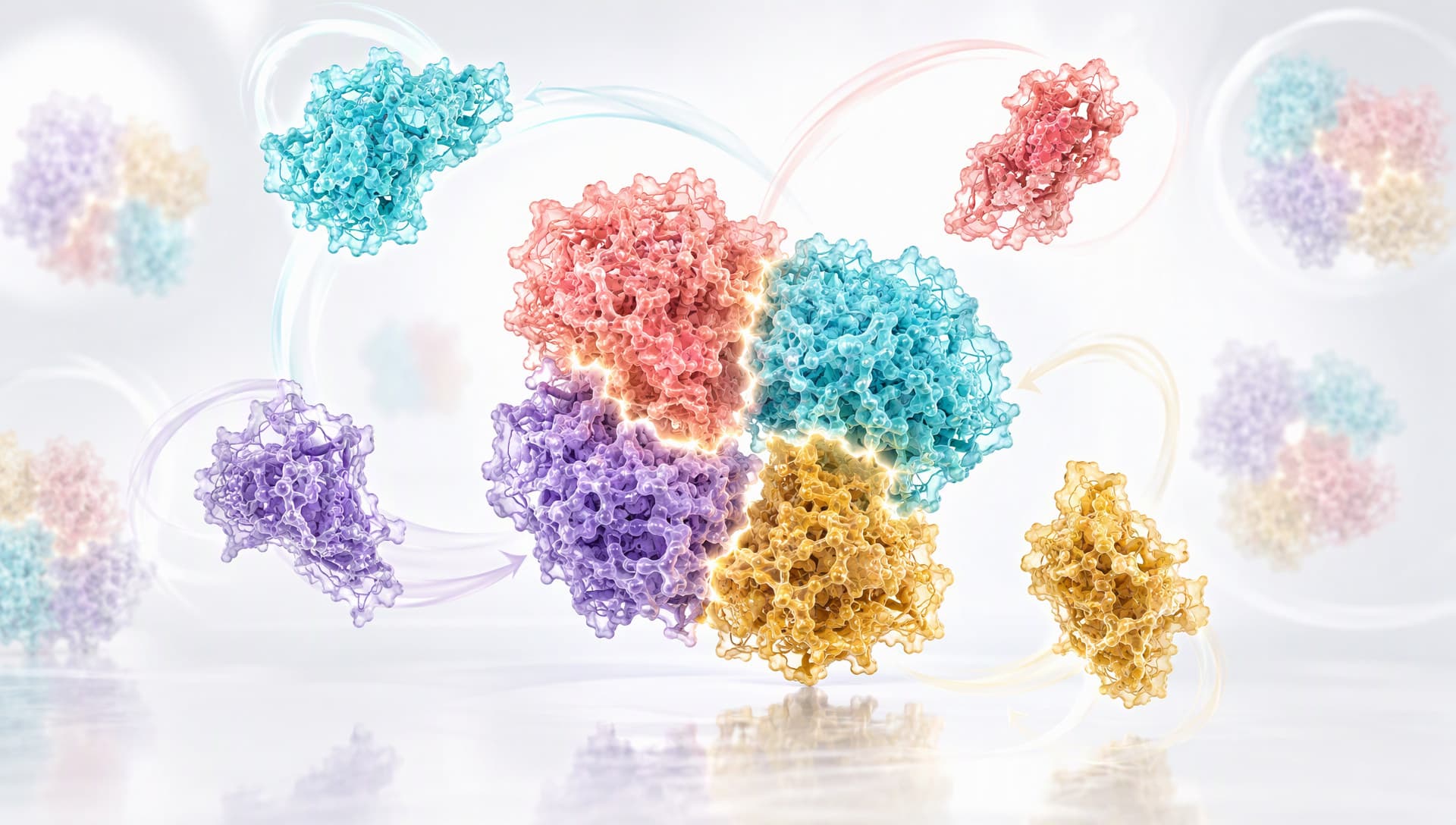
Subunit identity and stoichiometry constrain possible assemblies
Category: Protein Interactions / Structural Biology / Computational Biology
A monomer structure resembles a portrait of one actor; a complex model attempts to reconstruct who shares the stage, when they meet, and how they cooperate. A tightly packed three-dimensional image does not prove biological binding. Incorrect subunit identity, stoichiometry, conformational state, cellular context, or experimental assumptions can make an attractive interface irrelevant. High-quality protein complex structure prediction should therefore begin with a traceable assembly dossier rather than end with the top-ranked model.
Protein complex structure prediction begins with a component identity record
A complex input is more than a list of amino-acid sequences. Each sequence should be tied to its organism, isoform, mature form, and domain boundaries. Signal peptides, transmembrane segments, affinity tags, and unprocessed precursors must be identified. The task must also define whether the assembly is homo- or heteromeric and what subunit ratio is expected.
Stoichiometry is easily underestimated. Dimers, tetramers, and larger assemblies may reuse related surfaces while representing different functional states. If two sequences are submitted only because they are believed to interact, a model may produce a geometrically possible but biologically incomplete result. Systems affected by ligands, ions, membranes, or processing states should also document which components have been omitted.
The official MatwingsVenus™(晓鹜™) website describes a conversational environment that organizes protein sequence analysis, database retrieval, and structure prediction, with connections to databases including PDB. Those capabilities can support a component identity record by locating existing structures, reported interactions, domain information, and organism context before computational assembly begins.
Do not submit only one assembly hypothesis
Complexes may contain competing interfaces, alternative copy numbers, or several functional states. Instead of submitting one assumption and accepting the highest score, define a limited set of alternatives: different stoichiometries, adjusted domain boundaries, inclusion or exclusion of flexible tails, or the presence of a known auxiliary subunit. This is not indiscriminate trial and error. It makes biological uncertainty explicit and testable.
Every hypothesis should have a reason to exist. Support may come from co-expression, co-localization, co-purification, genetic interaction, conservation, or low-resolution experiments. Weakly supported ideas may still be explored, but their conclusions must remain weaker. Protein complex structure prediction can prioritize interaction hypotheses; it cannot create evidence that an interaction occurs.
When comparing models, inspect whether the same interface recurs across runs and input definitions. If a modest boundary or copy-number change produces a completely different contact mode, the interface may be unstable or the available evidence may not identify one assembly.
Protein complex structure prediction must interrogate the seam
A compact complex can still represent accidental contact. A testable interface should survive review from geometric, chemical, evolutionary, and biological perspectives.
Geometrically, ask whether the interface forms continuous contacts without implausible overlap, large voids, or dependence on long uncertain segments. Chemically, examine whether hydrophobic, electrostatic, and hydrogen-bond patterns suit the environment. Evolutionary analysis can ask whether interface residues show meaningful conservation. Biological review asks whether the proposed assembly is compatible with cellular location, expression timing, and functional state.
Even contacts seen in experimental crystal structures are not automatically biological interfaces. Structural-biology reviews describe interface stability, conservation of contacting residues, recurrence across crystal forms, and assembly symmetry as useful evidence for distinguishing biological assemblies from incidental contacts. These principles can guide external review of predicted complexes, but they should not be converted into an automatic verdict from one score.

Geometry, chemistry, and conservation jointly support an interface claim
Place a static model back into a dynamic state
Many complexes are not permanently bound. Transient regulation, substrate entry, conformational switching, membrane potential, or local concentration can alter an interface. A model may represent an encounter state, a preorganized state, or one frame of a stable assembly without describing the entire functional cycle.
Interpretation should therefore state whether the model answers “How might these proteins contact?” or “How might they assemble in a defined state?” Flexible domains, membrane proteins, auxiliary subunits, ligands, and ions can change the architecture when omitted. High local confidence cannot independently establish affinity, reaction rate, or cellular function.
MatwingsVenus™(晓鹜™) places structure prediction alongside database evidence, protein design, and wet-lab services. For a complex project, this allows a structural model to become a question about protected interface residues, mutation candidates, or experimental constructs instead of remaining a visualization. Current tool availability, input requirements, and service scope should be confirmed in the live platform interface.
Convert an interface hypothesis into a minimum validation set
Validation does not need to begin with complete experimental structure determination. A more efficient strategy is to choose a small set of experiments that can distinguish the central interface hypothesis from alternatives.
Mutations at a few interface-center and interface-edge residues can test whether binding or function changes as predicted. Co-purification, pull-down, crosslinking, or quantitative binding assays can examine whether a complex forms. If models propose alternative stoichiometries, molecular mass, particle size, or single-particle evidence can test assembly. Molecular simulation, docking, and structural experiments can complement one another when conformational change is important.
Strong designs also include negative controls. A mutation that lowers a signal may reduce expression, disrupt folding, or destabilize the whole protein rather than selectively break an interface. Measuring expression, monomer integrity, and baseline activity helps separate interface disruption from general protein failure.

Static assemblies require mutation, binding, and structural validation
MatwingsVenus™(protein design agent)keeps the assembly dossier traceable
Complex research often crosses sequence files, database records, structural models, mutation lists, and assay results. The conversational R&D environment described by MatwingsVenus™(晓鹜™) can organize database retrieval, sequence analysis, structure prediction, protein design, and experimental services around one objective, reducing context loss between tools.
At project launch, researchers can record subunit identifiers, boundaries, stoichiometry, and known interaction evidence. After modeling, they can preserve which assembly was selected, which interfaces are credible, and which regions remain unknown. Experimental work can then convert key contacts into mutation and validation tasks. The official platform supports structure prediction and multi-database connections, while the availability of specific complex models, parameters, and services should be verified in the current interface.
Conclusion: the endpoint is a falsifiable experiment
Protein complex structure prediction quality is not defined by visual compactness. It depends on clear assembly assumptions, convergent interface evidence, explicit treatment of dynamic states, and experiments capable of testing key contacts. From component identity and alternative assemblies to interface review and a minimum validation set, each checkpoint reduces the risk of mistaking plausible contact for biological interaction. By connecting databases, structural tasks, protein design, and experimental services, MatwingsVenus™(晓鹜™) can help turn a complex model into a traceable hypothesis that is falsifiable and ready to iterate.