Neutral Protease: Building a Controlled Hydrolysis Process
Published on September 28, 2026
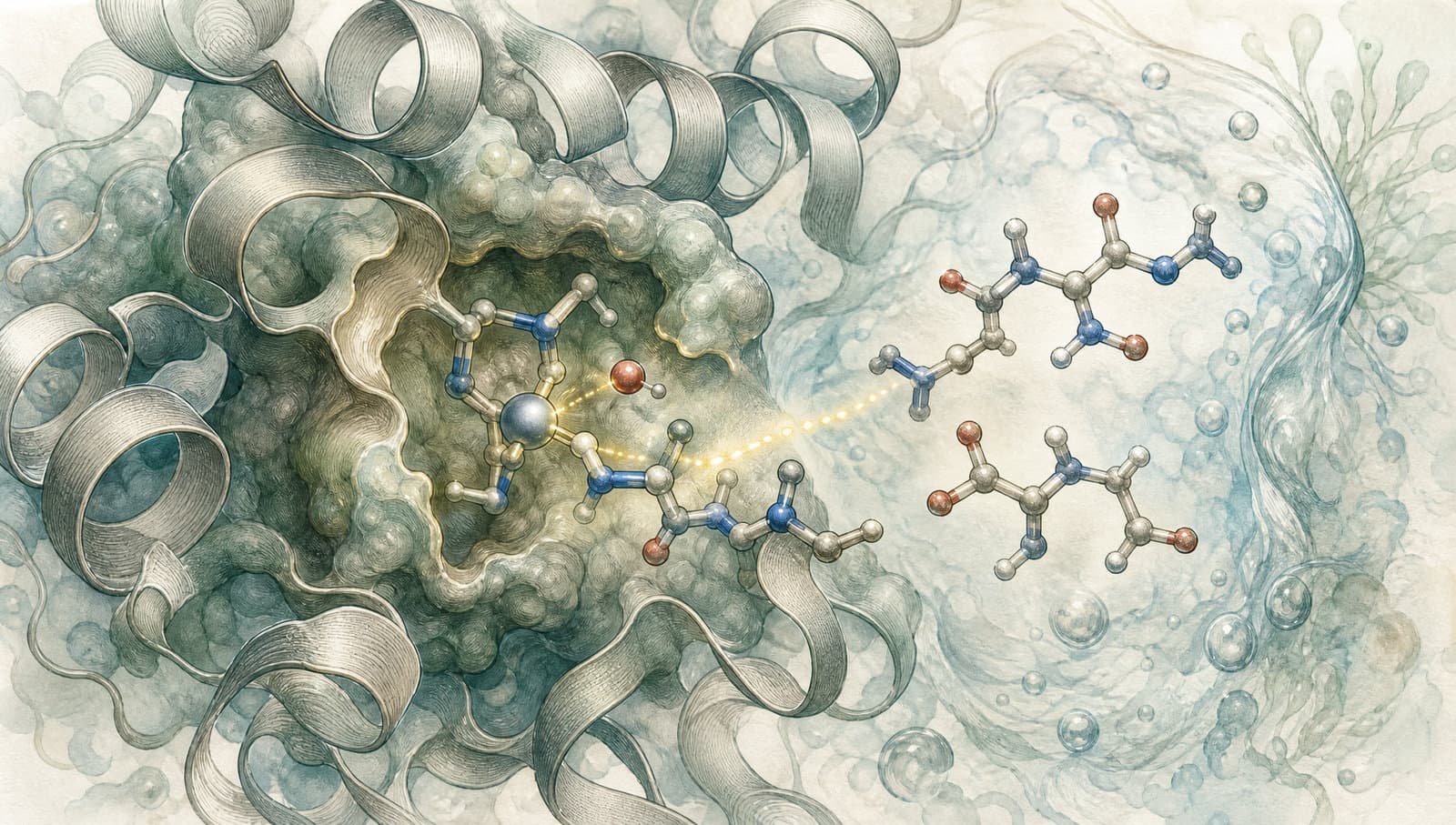
This scene shows a neutral protease engaging a protein chain and releasing shorter peptide fragments.
Category: Industrial Biotechnology, Food Science, Fermentation Engineering, Protein Engineering, Enzyme Catalysis
Abstract: Neutral protease supports controlled protein hydrolysis near neutral conditions, yet candidates differ in catalytic class, substrate preference, and stability. This article follows a representative development scenario from assays to process validation and engineering.
Why can two enzymes labeled for neutral conditions behave differently when the substrate or equipment changes? The answer usually cannot be reduced to one activity value.
Consider a representative development scenario. A team wants to perform controlled protein hydrolysis near neutral conditions, release smaller peptides, and avoid strongly acidic or alkaline processing. This scenario does not describe a specific company or commercial product. It brings common technical questions into one development story.
The first mistake would be to treat “neutral” as a complete performance description. It only indicates an operating characteristic near a neutral environment. It does not automatically identify the catalytic class, preferred substrate, metal dependence, temperature tolerance, or resulting peptide distribution.
Why the Neutral Protease Mechanism Must Be Confirmed First
Proteases catalyze reactions involving peptide bonds and convert large protein molecules into shorter fragments. Different candidates may cut within a chain or act nearer its ends, and their active centers can use different chemical strategies. Many enzymes grouped into neutral industrial processes are metalloproteases, but the category is not one structural family.
Thermolysin is a representative thermostable neutral zinc metalloprotease. Its active-site architecture, metal ion, and water molecule cooperate in catalysis, making it an important model for studying metalloprotease mechanism, stability, expression, and engineering. However, a model enzyme cannot define every neutral candidate. Another protease operating in a similar pH range may differ in substrate preference, temperature behavior, and metal dependence.
The team therefore changes its first question from “Is the enzyme active?” to “Which catalytic design fits this task?” If the formulation includes components that alter metal availability, a metalloprotease may respond strongly. If the substrate is tightly folded or aggregated, access to peptide bonds may be the dominant limitation. Mechanism is used to frame the experiment rather than to predict the result without testing.
Why a Neutral Protease Activity Assay Becomes a Three-Layer Test
The team begins with a general protein substrate and obtains a clear ranking. When the substrate is replaced with the target protein, the ranking changes. The first experiment was not useless; it answered a narrower question about baseline catalytic ability. It did not reproduce the folding, solubility, aggregation, or bond accessibility of the authentic protein.
The assay is therefore divided into three layers. The first compares candidates under one substrate, temperature, pH, and reaction time, removing proteins with weak baseline activity. The second uses multiple time points to distinguish initial rate, sustained hydrolysis, and a plateau caused by depletion or inactivation. The third introduces the target protein or a closely representative matrix and asks whether ranking, product behavior, and process performance remain consistent.
Enzyme-free and substrate controls are added, together with a consistent quenching step. Proteins can change because of temperature, mixing, or the matrix itself, and complex materials can affect analytical background. Without controls, a larger signal cannot automatically be assigned to enzymatic cleavage.
Activity units also require their conditions. Values with the same unit label may be incomparable when substrate, sampling time, temperature, or analytical method differs. The project keeps two outputs: a standardized screening metric and a process-facing metric. The first improves candidate comparison; the second determines relevance.

This assay scene compares model proteins, authentic matrices, and time-dependent hydrolysis.
Turning Neutral Protease Optimal Conditions into a Process Window
The first assay identifies an activity maximum, but the team does not treat it as a production setting. A peak value usually represents a short reaction under one condition. A process must also account for treatment time, protein stability, substrate solubility, metal status, and continued product hydrolysis.
The revised experiment measures both immediate activity and residual activity after pre-incubation. Candidates are exposed to different temperatures and pH conditions for defined periods and then transferred to one standard assay. This separates “fast during the reaction” from “still functional after exposure.” A candidate with a higher peak but rapid inactivation may deliver less cumulative conversion than one with a broader operating range.
Metalloproteases add an ion-related question. Some ions support catalysis or structural stability, whereas formulation components may alter metal availability. A fixed rule cannot be applied to every protein. Water, salts, the intended buffer, and the complete matrix are introduced in stages so that the main effect can be located.
The final process window combines target hydrolysis, product distribution, functional retention, substrate handling, and downstream compatibility. It is less compact than one optimum value but more useful for scale-up.
A Neutral Protease Food Application Starts with the Product Target
When the project moves into a food or fermentation context, enzyme dosage is not the first question. The team first defines the protein substrate, desired hydrolysis, and unacceptable changes. Proteins differ in folding, aggregation, solubility, and modification. One enzyme may respond strongly to one substrate and weakly to another.
Controlled hydrolysis should also avoid reliance on one total signal. An increase in soluble material does not prove that the desired peptide distribution has increased. Excessive hydrolysis can move the product away from its intended characteristics. Multiple time points and a product-facing metric are used to identify a practical endpoint.
Fermentation adds host and process variables. Bacillus species are important industrial fermentation and extracellular-enzyme hosts, and different species can provide enzymes with different pH and temperature properties. Host choice must still account for secretion, folding, proteolytic degradation, and culture conditions. High expression does not automatically mean high effective yield, and fermentation-broth background can affect activity measurements.
The team records baseline activity, expression, purified-protein stability, and target-substrate performance separately. This makes it possible to distinguish a protein limitation from an expression or process limitation.
When Candidate Failure Leads to Neutral Protease Protein Engineering
Some candidates perform well on the model substrate but poorly on the target protein. Others fit the cleavage task but lose activity at the required temperature or ion composition. Protein engineering now has a defined starting point. The objective is no longer “make the enzyme better.” It becomes measurable substrate specificity, temperature retention, ion compatibility, or expression improvement.
Candidate discovery can begin with protein database search, function prediction, and family comparison. Catalytic residues, metal-binding sites, substrate pockets, and signal peptides help reduce the search space. MatwingsVenus™(晓鹜™) provides protein database search, function prediction, and enzyme discovery capabilities that can help organize candidates, structural hypotheses, and validation tasks.
Design must preserve awareness of trade-offs. Changing an active-site pocket may alter substrate preference and reduce overall catalytic efficiency. Increasing structural stability may limit local motion required for catalysis. Changing surface properties may improve solubility while affecting expression or purification. MatwingsVenus™(晓鹜™) provides protein-design and conversational research coordination capabilities that can help connect objectives, candidate sites, variants, and test conditions, but wet-lab validation remains essential.

This development loop connects candidate search, structural hypotheses, expression tests, and authentic-substrate validation.
How Platform Capabilities Close the Representative Development Loop
The project eventually settles into a cycle: define substrate and product, screen natural candidates, build layered activity assays, test temperature, pH, and ion conditions, analyze expression and stability bottlenecks, and then decide whether design is necessary. Each round addresses one principal uncertainty and sends data back into candidate selection.
MatwingsVenus™(enzyme design agent) can help organize database search, functional interpretation, enzyme discovery, protein design, and validation tasks into a connected development workflow. Poor target-substrate performance directs attention to pocket architecture and specificity. Good activity with insufficient retention points toward naturally stable candidates or stability design. Expression limitations direct the project toward host and secretion strategy.
The value of this loop is not a guarantee that one candidate will succeed. It is that every retain-or-remove decision becomes explainable. “Active near neutral conditions” is converted into a group of testable questions instead of being treated as a complete product specification.
FAQ
Is every neutral protease a metalloprotease?
No. Thermolysin and related enzymes are representative neutral zinc metalloproteases, but a neutral operating range does not define one catalytic class. A specific candidate still requires sequence, structural, and biochemical confirmation.
What is the main difference between neutral and alkaline protease?
They generally differ in operating pH and process fit, but the names alone do not establish substrate specificity, stability, or catalytic class. Selection should return to the exact enzyme and target conditions.
Why can a candidate perform well on a model substrate but poorly on the real protein?
Authentic proteins differ in folding, aggregation, solubility, and modification, which change peptide-bond accessibility. Complex matrices can also alter ion availability and analytical background.
How can over-hydrolysis be recognized?
Define a product or functional endpoint before the reaction begins and follow several time points. Extending time or maximizing a total signal can move the process away from the desired product.
When should protein engineering begin?
Engineering is most useful when experiments have located the principal bottleneck and a matching assay exists. If substrate preparation, expression, or equipment is the main problem, process optimization may be more direct.
Conclusion
This representative scenario shows that mild protein hydrolysis is not automatically a simple process. Catalytic class, substrate structure, time course, temperature, ion environment, expression, and product target jointly determine performance. Development should begin with a clear problem, use layered experiments to narrow the candidate set, and apply database search, enzyme discovery, and protein design only to defined bottlenecks.
The final outcome is not one isolated activity value. It is a process logic that can be explained, reproduced, and improved as new data arrive. Before evaluating the next neutral protease, define the target substrate, intended product, and non-negotiable process limits, then choose the measurements.