How the STRING Protein-Protein Interaction Database Helps You Read the Protein Networks Inside Cells
Published on November 5, 2026
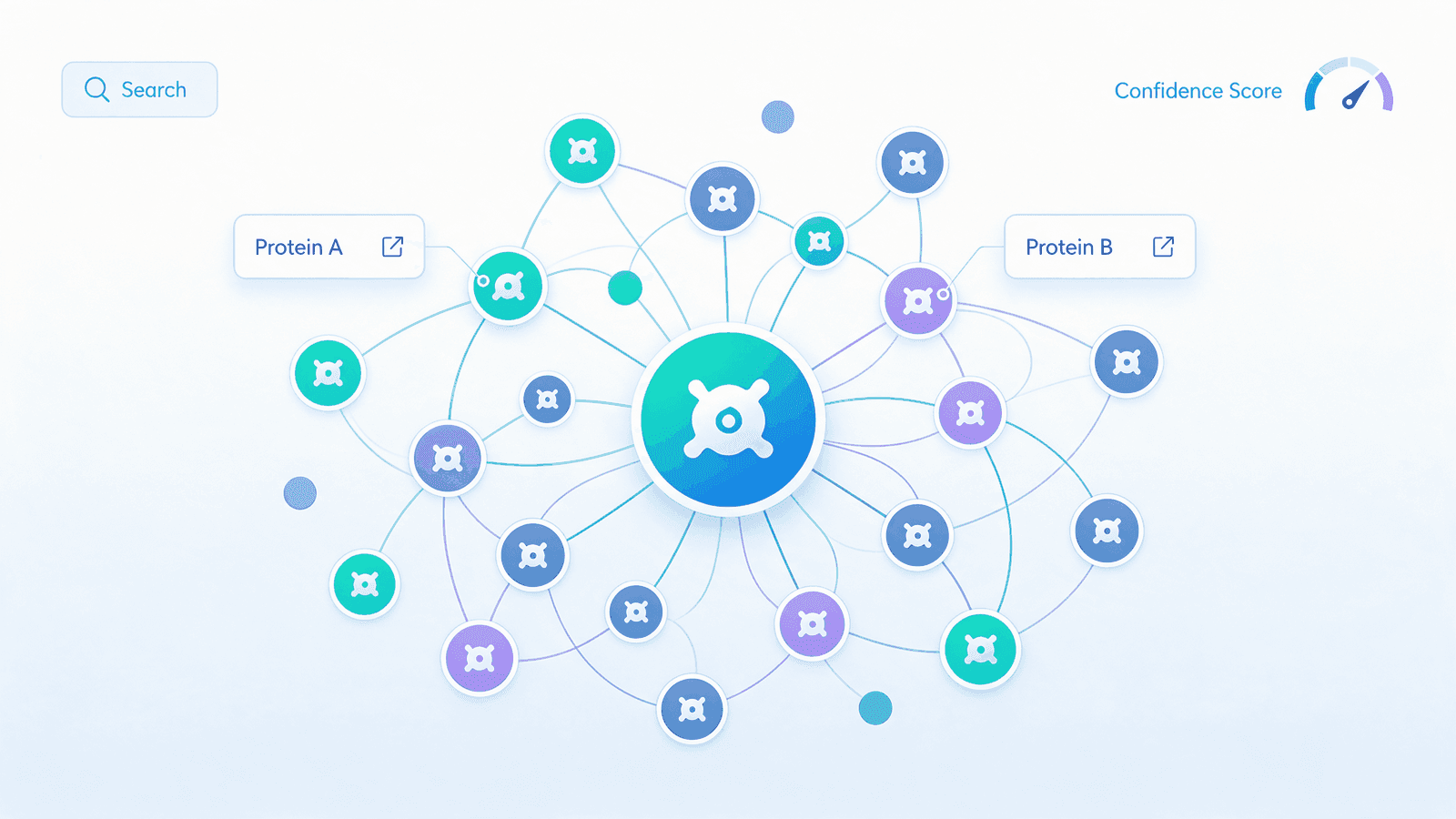
Figure 1 Conceptual overview of the STRING protein-protein interaction database network
Introduction
Proteins inside a cell almost never act alone. Through physical binding or functional cooperation they form complexes, signaling pathways, and regulatory networks; looking at a single protein alone often fails to reveal what it actually does. What researchers really need is a global map of "who associates with whom." The STRING protein-protein interaction database (Search Tool for the Retrieval of Interacting Genes/Proteins) is exactly such a searchable, scorable, downloadable global network.
In other words, STRING turns fragmented evidence scattered across experiments and the literature into a knowledge graph you can query directly. Whether you are a newcomer to omics or an experienced researcher building an evidence chain for target screening, you can find a starting point here; this is also why it is often treated as the default answer to the question "which of my genes interacts with what?"
What Is the STRING Protein-Protein Interaction Database?
The STRING protein-protein interaction database is a free, open public resource that integrates protein interaction information scattered across experiments, literature, and computational prediction into a searchable, scorable, downloadable global network covering many organisms.
· Its role: STRING is jointly maintained by the Swiss Institute of Bioinformatics (SIB), the Novo Nordisk Foundation Center for Protein Research (CPR), and the European Molecular Biology Laboratory (EMBL), among others, and is designated a Core Data Resource by the Global Biodata Coalition and ELIXIR.
· Its scale: As of STRING 12.5 it covers about 59.3 million proteins across 12,535 organisms; the 12.0 release (2023) already reported about 59 million proteins from more than 12,000 organisms. Most common model organisms are covered, from human and mouse to *E. coli*, plants, and pathogens.
· What it integrates: It includes both physical interactions (e.g., two proteins directly binding) and functional associations (e.g., belonging to the same pathway, co-regulation, co-expression), and keeps them distinct.
· What it outputs: interactive network views, a confidence score per interaction, pathway and functional enrichment, network clustering, and reproducible bulk download plus a programmatic API.
STRING's Principles and Structure: From Evidence to a Confidence Score
The core of STRING is not to "measure" interactions but to probabilistically combine several nearly independent evidence channels into a single 0–1 confidence score that answers "how reliable is this interaction?"
· Seven evidence channels: STRING groups all evidence into seven channels — ① experimental (integrating BioGRID, HPRD, MINT, etc.); ② curated databases/pathways (KEGG, Reactome, BioCyc, Gene Ontology, etc., where the channel receives a uniform high score of 0.900); ③ literature text-mining (statistically significant gene co-occurrence, also including OMIM); ④ co-expression; ⑤ gene neighborhood; ⑥ gene fusion; and ⑦ phylogenetic co-occurrence. Channels ⑤–⑦ are genomic-context predictions.
· The score is confidence, not strength: STRING clearly states the score does not indicate interaction strength or specificity; it is a confidence indicator of whether the interaction truly exists, calibrated against known pathways and complexes. A score of 0.5 roughly means that about one in two interactions could be a false positive.
· How to set thresholds: The interface score ranges from 0.150–0.999 (150–999 in downloadable files). Common tiers: Medium ≥ 0.4 (more complete but noisier), High ≥ 0.7 (balance of precision and coverage), Highest ≥ 0.9 (only high confidence).
· How they are combined: The channels are treated as nearly independent evidence sources and combined probabilistically (Naive Bayes style), while sources inside a channel are often not independent.
· How to read the network: In the network view, connection lines are usually colored by confidence, and hovering shows which channels support them. You can also switch off a channel to see whether the network weakens noticeably. This "explainable transparency" is one reason STRING is widely used as a default starting point.
· New in 2025: STRING 12.5 introduces a regulatory network, using curated pathway databases plus a fine-tuned language model to parse the literature, annotating the type and directionality of interactions. You can view functional, physical, and regulatory networks separately. Enrichment analysis also gained improved FDR correction and redundancy filtering.

Figure 2 Seven evidence channels feed a combiner that outputs a 0–1 confidence score
How to Measure and Select: Choosing the Right Evidence and Threshold for Your Question
STRING does not measure interactions for you; it organizes and scores what others have measured and predicted. So the key to selection is choosing the right organism, evidence channel, and confidence threshold.
· Input options: Enter one or more gene/protein identifiers (e.g., UniProt, Ensembl, NCBI IDs) or submit a sequence for homology mapping.
· Choose the right organism: STRING covers 12,535 organisms; each analysis must map to the correct NCBI taxonomy ID. Biological conclusions hold only within the same organism, so cross-species inference needs caution.
· Choose the right evidence channel: Different questions favor different channels. For physical binding, favor experimental and database channels; for functional/co-regulation, combine text-mining and co-expression; for cross-species generalization, consider genomic-context prediction channels.
· Choose the right threshold: 0.4 is more complete for exploratory analysis; 0.7 or 0.9 is stricter for confirmatory work. For discovery-oriented screening such as differential expression, a common recommendation is wide first, then strict.
· Record metadata: Record version, organism, threshold, active channels, and analysis date together to keep results reproducible and citable.
· A practical tip: Start with a narrow, strict high-confidence screen to locate core modules, then relax to 0.4 to recover weaker indirect associations; the resulting gene set is often more complete and closer to real biology.
· Know the limits: The score is confidence, not interaction strength; text-mining channels are inherently noisy; channels that rely only on computational prediction usually carry no PMID; and cross-species evidence comparability is limited.
Conditions and Workflow: From Sequence to Network to Target
A standard STRING workflow can be summarized as: define the target proteins → build/retrieve the network → filter by confidence and channel → cluster and enrich → locate key nodes or candidate targets.
· Step 1 Define the target: Import a sequence or IDs and confirm the organism.
· Step 2 Build the network: The full network is shown by default; you can switch between evidence, confidence, or interactive views.
· Step 3 Filter: Set a confidence threshold and a maximum number of interactions, removing low-confidence links.
· Step 4 Extract and export: Download PSI-MITAB or TSV files, or export the network image directly.
· Step 5 Enrich and cluster: Run GO, KEGG, or Reactome enrichment on the network to identify functional modules and hub nodes.
· Step 6 Validate: Bring candidates into wet-lab or downstream computational validation.
· Link with omics: Map differential expression or differential phosphorylation gene lists onto the network to quickly narrow candidates and inspect modules and pathways.
· Scale up: Bulk download and a REST API support large-scale, pipeline-based analysis.
· An example: If you care about a hub protein linked to cancer, pull out its interaction partners in STRING; after pathway enrichment you will often see modules such as cell cycle and DNA repair, helping you lock onto candidate genes most worth validating.
· Application scenarios: microbial and plant/animal systems biology, host–pathogen interactions, vaccine and drug target discovery, and multi-omics integration.

Figure 3 STRING analysis workflow from a protein list to candidate targets
Integrating STRING into the MatwingsVenus®(protein design agent) Protein-Engineering Loop
MatwingsVenus®(晓鹜®)'s AI protein-engineering platform can connect public interaction evidence such as STRING into a "discover–design–validate" loop, making candidate engineering more biologically grounded.
· Prior network: A target protein's interaction partners, pathway membership, and functional modules can serve as design constraints and functional annotation sources, reducing "picking sites by feel."
· Loop integration: Feed network evidence into sequence design, structure modeling, affinity maturation, and multi-round evolution, converting it into screenable candidates.
· Explainable design: Matwings Technology advocates data-driven, explainable network evidence to support commercial R&D and reduce black-box risk.
· Boundary statement: Public database evidence points the direction; final results must still be validated by measured data, avoiding treating predictions as conclusions.
FAQ
Q1: What is the difference between STRING and PPI?
PPI refers to protein-protein interactions themselves, while STRING is a database and online tool that collects, scores, and integrates those interactions; the former is a biological concept, the latter is the data and computing platform that carries it.
Q2: Is a higher STRING confidence score always better?
Not necessarily. A higher score means an interaction is more likely to be real, but a high threshold will miss real interactions with limited evidence; choose the threshold based on whether you are "discovering" or "validating," rather than always chasing the highest value.
Q3: Can STRING replace experimental validation?
No. STRING is an integration and scoring resource; its score is confidence, not experimental fact. Key interactions still require wet-lab or orthogonal confirmation.
Q4: Is STRING free? Can it be used commercially?
STRING offers free web access, bulk download, and an API and can be used for academic and commercial research; for citation obligations and terms of use, please refer to the official website.
Summary
· STRING turns scattered protein interaction evidence into an explainable global network, built on "seven channels + probabilistic combination + a 0–1 confidence score."
· The key to selection is matching organism, evidence channel, and threshold.
· Version 12.5 adds a regulatory network with directionality annotation, bringing the network closer to real regulatory logic.
· MatwingsVenus®(晓鹜®) connects public network evidence into a "discover–design–validate" loop, making engineering candidates more grounded.
· Recommendation: clarify the question type, choose channels and thresholds, then validate key conclusions experimentally.
One-line conclusion: STRING integrates known and predicted protein-protein interactions and scores them from 0–1 confidence, making it the go-to public database for building explainable protein networks.