How the AI Protein Laboratory Moves Protein Design from "Trial and Error" to "Predictable"
Published on November 5, 2026
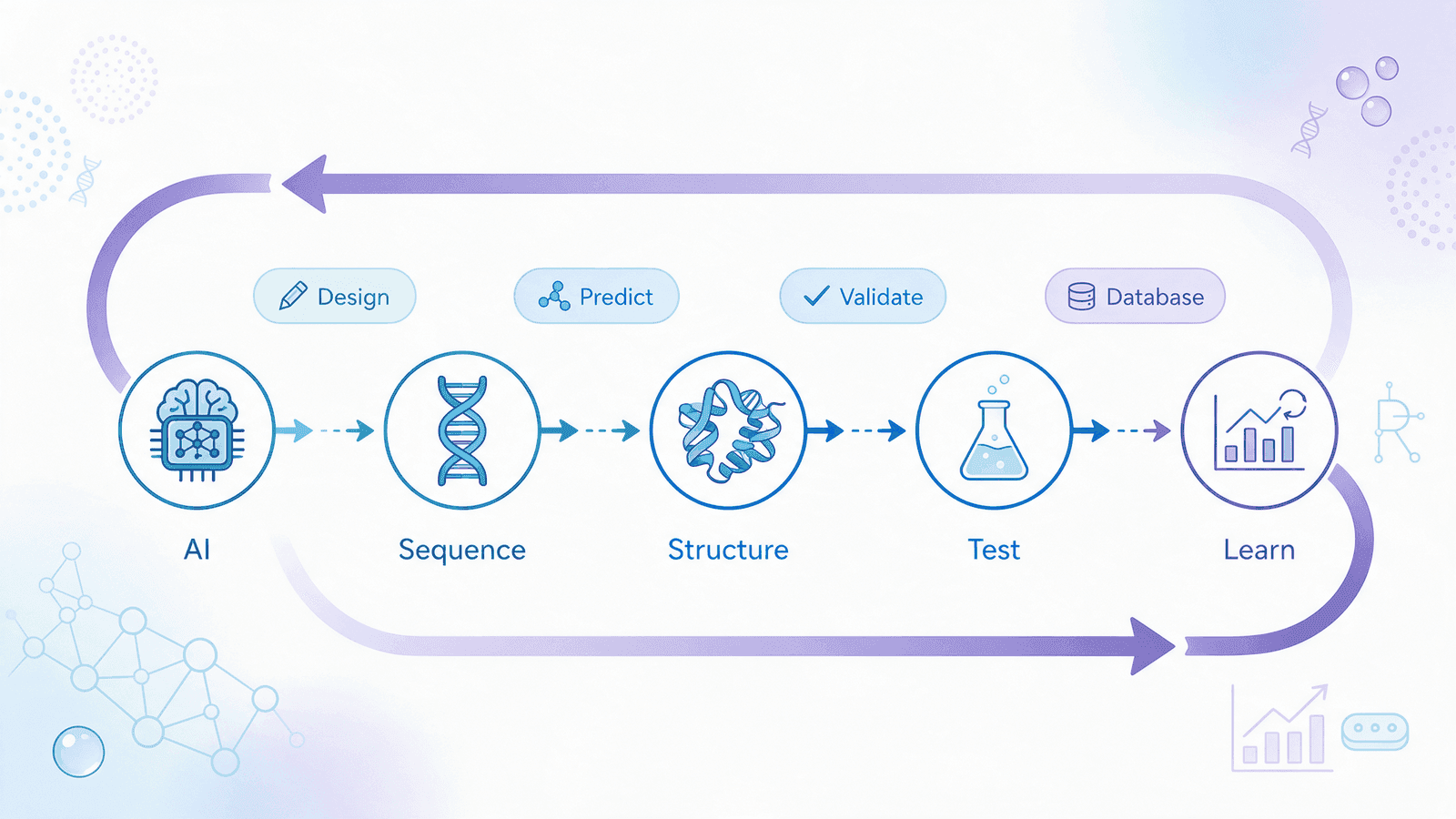
Figure 1 Conceptual overview of the AI protein laboratory: dry–wet closed loop
Introduction
Proteins are the main performers of life and the core of enzymes, antibodies, drugs, and materials. Traditional design often relies on experience and extensive trial and error, with long cycles and low success rates; the AI protein laboratory is turning this into a more controllable, reproducible engineering process.
In the past, a protein modification might take months or longer; today, AI first "filters" in the computer, then the wet lab "verifies," and this combination is turning protein R&D from "art" into "engineering."
This approach is not only for big pharma — with open models and cloud computing, small and mid-sized teams can also build their own AI protein laboratory.
What Is an AI Protein Laboratory?
An AI protein laboratory is an AI-centric protein-engineering paradigm that strings sequence design, structure prediction, and wet-lab validation into a closed loop, allowing the "design–build–test–learn" cycle to accelerate automatically.
In short, it lets a "designed protein" first go through a "rehearsal" in the computer before being handed to real experiments for testing, turning a lot of guesswork into a converging iteration.
· Its role: an AI protein laboratory is not a single piece of software, but a coordinated R&D system of "models + data + experiments."
· What it solves: the mutation space of a protein sequence is enormous (roughly 20 to the power of N), so brute force is unrealistic; AI focuses exploration on high-value regions.
· Difference from traditional directed evolution: traditional evolution relies on repeated random mutation and screening; AI predicts first and then orients, reducing ineffective trial and error.
· What it consists of: generative models, structure prediction, property prediction, wet-lab validation, data feedback, and active learning.
· Why it is taking off now: computing power, massive biological data, and generative models are maturing, and wet-lab automation makes the "dry–wet closed loop" truly feasible.
· Capability boundary: AI excels at generating and optimizing within known rules, but for "never-seen" property types it still depends on enough data; it amplifies human judgment rather than replacing it.
· Commercial value: it shortens R&D cycles and raises success rates, making it important infrastructure for biologics, industrial enzymes, and new materials.
Principles and Structure of the AI Protein Laboratory: How the Dry–Wet Loop Works
The core of the AI protein laboratory is the DBTL (design–build–test–learn) dry–wet closed loop: AI generates candidates, the wet lab validates them, and the results feed back into the model to form a continuously improving cycle.
· Design: generative models produce candidates under backbone or sequence constraints; RFdiffusion builds backbones and ProteinMPNN fills in sequences; protein language models also handle features and generation.
· Build: candidate sequences are synthesized, expressed, and purified into measurable samples; this step is the most time-consuming and a focus for automation.
· Test: high-throughput screening and functional, stability, and binding measurements generate real data; the more accurate the test, the more effective the learning.
· Learn: experimental data is fed back into the model to update fitness prediction; active learning selects the "most worth testing" candidates for the next round.
· Structure validation: structure-prediction models such as AlphaFold pre-check folding and quality in the "dry" stage, using metrics like RMSD to filter low-quality sequences and reduce wasted wet-lab work.
· Fitness landscape: mapping many mutations into a "performance high/low" landscape that AI uses to find high-value paths.
· Why it is more efficient: the exploration space is compressed, information from each round is reused, and the model grows more accurate and saves effort with each round.
· Multi-objective: real projects often require optimizing activity, stability, and developability at once, so models must handle multi-objective trade-offs rather than fixing on a single metric.
· An analogy: like a "self-learning navigator" — first it uses an experience map (model) to give a route (candidate); after walking a segment (wet lab), it updates the map with the road conditions (data), so the next segment is more accurate.

Figure 2 The DBTL dry–wet closed loop of the AI protein laboratory
How to Measure and Select: Choosing Models, Metrics, and Data
To use an AI protein laboratory well, the key is to choose the right model, metrics, and data: precision, coverage, and experimental cost must be weighed together.
· Choose the model: for structure prediction look at accuracy and complexity (e.g., AlphaFold); for sequence generation whether it can produce foldable candidates (e.g., ProteinMPNN/LigandMPNN); for property prediction whether it correlates with measurements.
· Look at the metrics: for structure, use RMSD to measure folding consistency; for performance, use binding, activity, stability, and expression; each metric must align with the final goal.
· Validation metrics: structure often uses RMSD to measure folding consistency and success rate to measure foldability; performance uses binding constants, activity, melting temperature, and expression, and must match the target.
· Data quality: high-quality, homologous, consistently annotated data sets the model's ceiling; data bias amplifies errors.
· Dry–wet ratio: use "dry computation" to pre-screen and reduce wet-lab work, but key conclusions must go back to wet-lab validation.
· Cost trade-off: high-throughput wet-lab work is expensive; active learning reduces the necessary number of experiments, achieving "test less, learn more."
· Experiment design: design candidates covering different mutation combinations, balancing "local fine-tuning" with "larger-span exploration," avoiding seeing trees but not the forest.
· Boundary: AI can only predict within the distribution of existing data; be cautious with wholly new properties or out-of-domain scenarios.
Conditions and Workflow: An Engineering Pipeline from Target to Candidate
A standard AI protein laboratory workflow can be summarized as: define the target → AI generates sequences → structure validation → property screening → directed maturation → scale-up validation, finally delivering a candidate.
· Step 1 Define the target: clarify the target protein and the desired properties (binding, activity, thermal stability, etc.).
· Step 2 Generate sequences: a generative model produces multiple candidate sequences.
· Step 3 Structure validation: use structure prediction to pre-check folding and stability, filtering low-quality sequences.
· Step 4 Property screening: high-throughput testing of binding and activity, retaining the best.
· Step 5 Directed maturation: run multiple rounds of directed evolution and affinity maturation based on feedback data.
· Step 6 Scale-up validation: expression, purification, process, and scale-up to deliver a producible candidate.
· Application scenarios: enzyme engineering (activity/stability), antibody engineering (affinity/humanization), novel functional proteins, industrial catalysis, and biomaterials.
· An example: to improve an enzyme's thermal stability, use AI to predict tolerant mutations first, then validate in the wet lab and feed data back so the next round is more accurate.
· A case idea: to increase an antibody's affinity, anchor the complementarity-determining region with structure prediction, generate a batch of candidates, and after activity screening feed the data back into the model for a second, more focused round of maturation.
· Iteration awareness: protein engineering is usually a multi-round convergence process; early rounds may only improve slightly, so keep iterating and optimize the strategy with data.
· A common mistake: treating AI output directly as a "finished product," or testing only a handful of samples while expecting a big improvement; the right approach is to keep dry–wet data consistent and iterate enough rounds.

Figure 3 AI protein laboratory application workflow from target to candidate
MatwingsVenus®(protein design agent)'s Engineering Practice
MatwingsVenus®(晓鹜®) engineers the AI protein laboratory's dry–wet closed loop, covering sequence design, structure prediction, and multi-round evolution, turning AI capabilities into a reproducible R&D process.
· Integrated loop: bring generation, prediction, screening, and experimental data into the same process to reduce fragmentation.
· Multi-round evolution: use active learning to drive multiple design and validation rounds, converging round by round.
· Explainable design: Matwings Technology advocates data-driven, explainable evidence to support commercial R&D and reduce black-box risk.
· Boundary statement: AI output is a candidate; final results depend on measured data, and specific capabilities should follow official materials.
· Applicable projects: enzyme activity and stability modification, antibody affinity optimization, novel functional protein design, industrial catalysis, and biomaterials can all be advanced through the dry–wet closed loop.
· Collaborative validation: keeping the dry-computation and wet-lab teams on the same cadence is key to whether the loop truly works.
FAQ
Q1: Can an AI protein laboratory fully replace the wet lab?
No. AI is responsible for "proposing better candidates" while the wet lab is responsible for "proving whether they actually work"; the two complement rather than replace each other.
Q2: What is the difference between an AI protein laboratory and traditional directed evolution?
Traditional directed evolution relies on random mutation and screening, while the AI protein laboratory predicts first and then orients, feeding each round of data back into the model to reduce ineffective trial and error and converge faster.
Q3: Are AI-designed proteins reliable?
AI-generated candidates require both structure validation and wet-lab confirmation; reliability is closely tied to data quality, model accuracy, and the sufficiency of validation.
Q4: What is needed to apply an AI protein laboratory?
You need a clear goal, high-quality data, suitable models, and available wet-lab capability to form a genuinely effective loop.
Summary
· An AI protein laboratory = AI + a DBTL dry–wet closed loop, turning protein design into a predictable, reproducible engineering process.
· Core components: generative models, structure prediction, property prediction, wet-lab work, and active learning.
· Selection factors: models, metrics, data quality, and the dry–wet ratio.
· MatwingsVenus®(晓鹜®) engineers this paradigm, covering sequence design, structure prediction, and multi-round evolution.
· Recommendation: clarify goals, ensure data quality, and stick to "dry–wet combination, measured data as the standard."
One-line conclusion: The AI protein laboratory uses a "dry–wet closed loop" of AI generation + structure validation + wet-lab feedback to make protein design faster and more predictable.