
How BLASTp Protein Alignment Helps You Find Homologous Proteins from a Single Sequence
Published on November 5, 2026
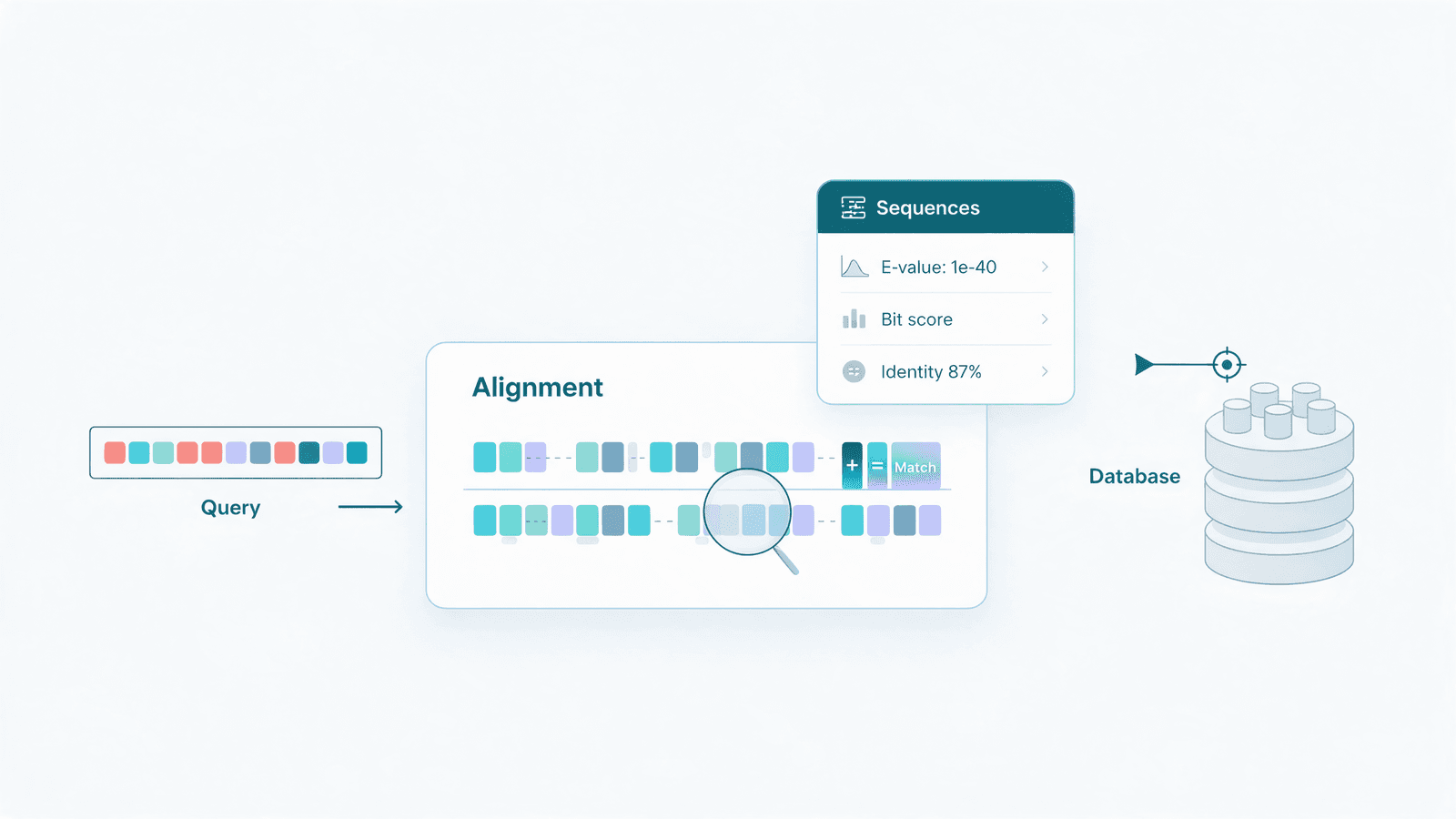
Figure 1 Conceptual overview of BLASTp protein similarity search
Introduction
When you get a protein sequence, the first question is usually "what is it, and which known proteins does it resemble?" To answer that, you need a ruler that can quickly "find similar sequences in a protein database." BLASTp protein alignment is exactly such a classic ruler used by researchers worldwide for decades.
Often, a protein of unknown function hides among sequences that "look familiar yet differ"; BLASTp uses its smart "strike with short words" strategy to help you screen out the homolog candidates worth attention in a few seconds.
What Is BLASTp Protein Alignment?
BLASTp is the protein version of the Basic Local Alignment Search Tool, comparing a protein query sequence against a protein database to quickly find locally similar sequences and give a statistical significance judgment.
· Its origin: BLAST was proposed by Altschul et al. in 1990; BLASTp is the "protein sequence against protein sequence" program, and one of the most commonly used versions.
· What it does: identify unknown proteins, infer homology and function, find gene-family members, and provide evidence for functional annotation.
· Who uses it: from identifying newly sequenced proteins and annotating genomes to selecting a starting point for enzyme engineering, BLASTp is an unavoidable first step.
· Difference from BLASTn, etc.: BLASTp compares amino acids; BLASTn compares nucleic acids; blastx translates a nucleotide query before comparing to proteins; tblastn compares a protein query against translated nucleotides. For protein questions, BLASTp often captures distant homologs better than a nucleotide search.
· Its limits: BLASTp excels at local similarity, but distant homologs may be missed due to the matrix and threshold, and can be complemented by profile or structure searches.
· How to use it: NCBI WebBLAST is free and open, and it can also run locally or via the command line.
· What it outputs: a graphic summary, a description list sorted by significance, and per-alignment records (including identity, E-value, bit score, and coverage).
BLASTp's Principles and Structure: From Seed Words to the E-value
BLASTp does not align two sequences end to end; it is a "local" search: it first hits candidate positions with short seed words, then extends outward on both sides, and finally scores with a substitution matrix and reports statistical significance.
· Seed words: the default word size is 3, meaning the query is broken into three-amino-acid words that are matched in the database to quickly narrow the search space.
· Ungapped extension: after a seed hits, extensions move outward in both directions until the score begins to drop.
· Gapped extension: gap open and extension penalties are introduced, allowing insertions and deletions to produce a more realistic alignment.
· Substitution matrix BLOSUM62: the default matrix. Each score is the log-odds of the observed substitution frequency over the background frequency; substitutions with similar side-chain size and chemistry get positive scores (e.g., aspartate D / glutamate E), while dissimilar ones get negative scores (e.g., phenylalanine F / glutamine Q). BLOSUM62 carries information up to about 62% identity and is regarded as the best general default.
· How the score is computed: the BLAST score is the sum of positive match scores plus negative mismatch and gap penalties.
· Statistical significance: the E-value is the number of chance alignments expected to have the same or a better score in a random database; the lower it is, the more significant. WebBLAST's default Expect threshold is 0.05, and empirically a value below 0.001 can be considered significant. The bit score is database-size-independent and is the fair way to compare runs.
· Detail handling: low-complexity regions are masked to avoid false hits from repetitive sequence; for more distant homologs, iterative PSI-BLAST builds a profile.
· Why it is fast: BLASTp compresses "align every sequence in the database" into "seed-word hits plus local extension," running at nearly linear speed for work that traditional dynamic programming would take a long time to finish — a key reason it became the default tool.
· An analogy: think of it like finding a book in a library — first use the first letter of the title (the seed word) to lock onto the likely bookshelves, then flip through the books (extension), rather than reading the whole library letter by letter.
· Gap penalties: the gap open and extension penalties control "how many insertions/deletions are allowed"; larger penalties are more conservative and smaller ones more permissive, adjustable to the alignment goal.

Figure 2 BLASTp algorithm workflow: seed words, extension, gapped alignment, E-value
How to Measure and Select: Reading Results, Choosing Program and Parameters
BLASTp results follow a fixed reading routine: first look at the E-value and bit score, then identity and coverage, and finally judge true homology against biological context.
· First the E-value and bit score: a lower E-value is more significant; a higher bit score is better and is unaffected by database size, making it suitable for comparing different queries.
· Then identity and coverage: identity reflects how similar the sequences are, and query coverage reflects how much of the query length the alignment covers; read both together to avoid the "only a short fragment aligned" trap.
· Choose the program: use blastp for known close relatives; use PSI-BLAST to find distant homologs; use blastx when you only have a nucleotide sequence but want to search proteins.
· Choose parameters: a smaller word size (e.g., 2) is more sensitive but slower; the matrix can be chosen by evolutionary distance (BLOSUM80 for closer, BLOSUM50 for more distant); gap penalties are adjusted as needed.
· Choose the database: nr (non-redundant) is the most comprehensive; UniProtKB/Swiss-Prot gives more reliable annotation; restricting to a species improves precision and speed.
· How to set the threshold: use a stricter threshold (e.g., <1e-10) when you only want to confirm "truly related"; relax it (e.g., <0.001) when you want to "find as many as possible" and filter noise downstream.
· A rule of thumb: an E-value below 1e-5 is often treated as credible homology; between 1e-5 and 0.001 is "worth a look"; above 0.05 is often considered random; the exact threshold should depend on the research goal.
· Know the limits: BLAST does not directly "measure" homology; it only provides evidence supporting a homology inference. A single significant hit does not mean two proteins have the same function.
Conditions and Workflow: From Sequence to Homolog to Function
A standard BLASTp workflow can be summarized as: submit the query → choose database and parameters → interpret significance → extract homologs and annotations → connect to design or validation.
· Step 1 Submit the query: paste a protein sequence or FASTA, optionally restrict to a species or database.
· Step 2 Choose database and parameters: choose nr, Swiss-Prot, etc.; set word size, matrix, and threshold.
· Step 3 Interpret results: sort by E-value, mark significant hits, and check identity and coverage.
· Step 4 Extract homologs: collect high-confidence homologs and inspect conserved residues and functional features.
· Step 5 Annotate and infer: combine GO and domain databases for functional annotation and infer key sites.
· Step 6 Connect downstream: bring candidates into wet-lab work or engineering.
· Application scenarios: unknown protein identification, gene-family analysis, structural and functional annotation, cross-species homology inference, vaccine and drug target candidate screening, and protein-engineering site selection.
· An example: to validate the function of a newly sequenced protein, first run BLASTp against Swiss-Prot to find homologs; you often get a matching known structure and functional annotation, which you can then use to design experiments or engineering.
· A common mistake: fixating on the highest identity while ignoring coverage, or treating one significant hit as proof of the same function; the right approach combines E-value, identity, coverage, and domain evidence.
· Scale up: bulk queries and command line/API support pipeline-based analysis.

Figure 3 BLASTp workflow from a query sequence to functional inference and design
Integrating BLASTp into the MatwingsVenus®(晓鹜®) Protein-Engineering Loop
MatwingsVenus®(晓鹜®)'s AI protein-engineering platform can connect homology-search results such as BLASTp into a "discover–design–validate" loop, giving the design starting point a stronger basis.
· Homology prior: the homologous proteins and conserved residues found by BLASTp can serve as design constraints and functional annotation sources, reducing "picking sites from thin air."
· Loop integration: feed homology and functional information into sequence design, structure modeling, affinity maturation, and multi-round evolution, converting them into screenable candidates.
· Explainable design: Matwings Technology advocates data-driven, explainable retrieval and structure evidence to support commercial R&D and reduce black-box risk.
· Boundary statement: retrieval evidence points the direction; final results must still be validated by measured data, rather than treating an alignment as a conclusion.
FAQ
Q1: What is the difference between BLASTp and BLASTn?
BLASTp aligns protein sequences (amino acids) while BLASTn aligns nucleic acid sequences; for protein questions, BLASTp tends to capture distant homologs better.
Q2: Is a lower E-value always better?
Yes. A lower E-value means the score is expected to occur less often by chance, so the alignment is more significant; but still judge it together with identity and coverage.
Q3: Does a significant hit mean homology or the same function?
Not necessarily. BLAST only provides evidence supporting a homology inference; a significant hit still needs structural, functional, or experimental evidence for confirmation.
Q4: Is BLASTp free?
Yes. NCBI WebBLAST is free, and it can also be used via a local command line or API.
Summary
· BLASTp is a classic protein–protein local alignment tool built on "seed words + extension + matrix scoring + statistical significance."
· Result interpretation focuses on the E-value, bit score, identity, and coverage.
· The key to selection is program (blastp/PSI-BLAST/blastx), matrix, word size, and database.
· MatwingsVenus®(晓鹜®) connects homology-search results into an engineering design loop, giving the starting point a stronger basis.
· Recommendation: judge significance first, then combine biological context, and finally validate key conclusions experimentally.