Protein 3D Structure Analysis Workflow: From Data to Decisions
Published on September 28, 2026
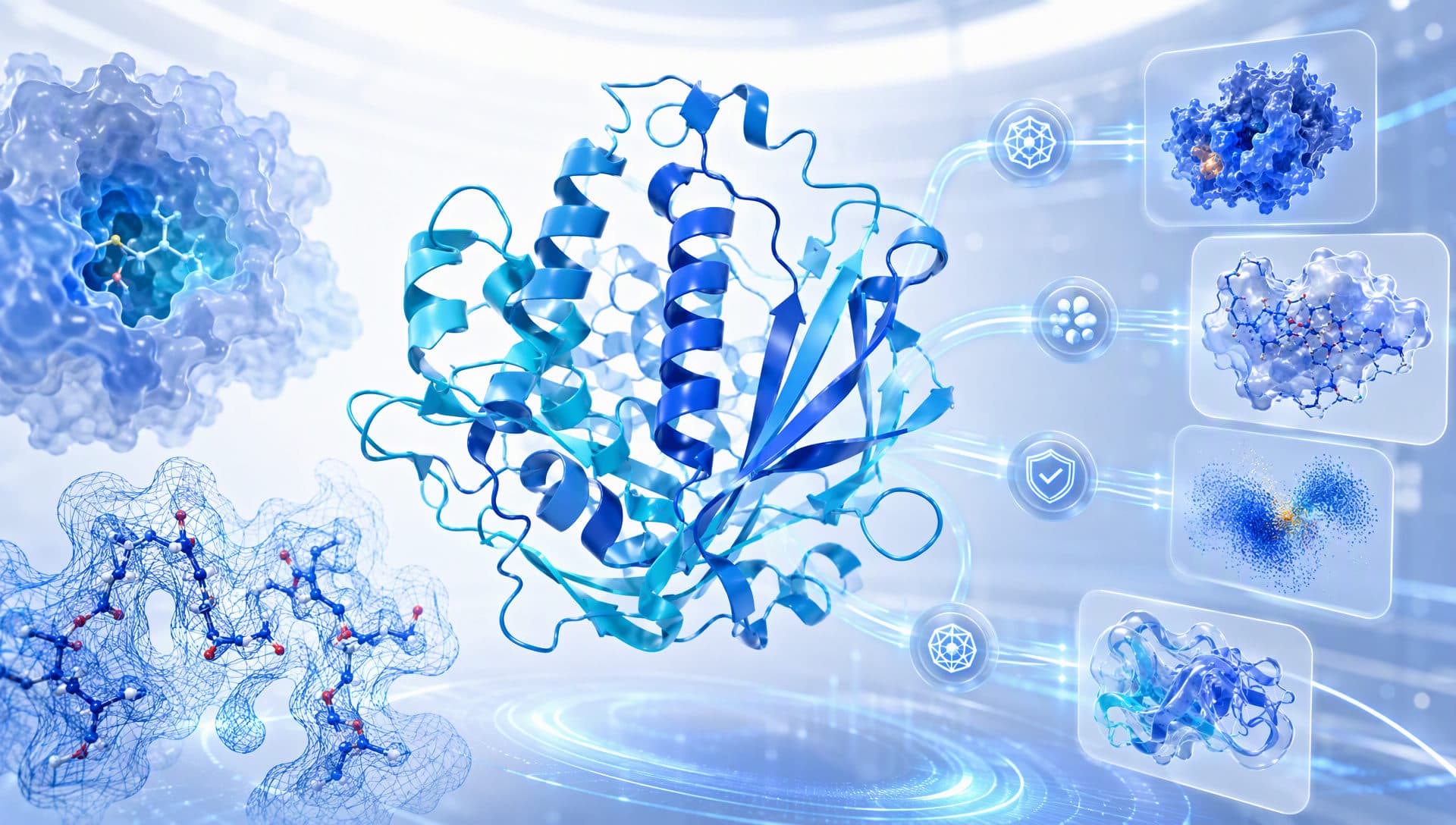
The hard part is not opening a structure file—it is preserving evidence continuity
One protein may have crystallographic, cryo-electron microscopy, and NMR structures, while another may only have a predicted model. Even within one PDB search, entries can differ in construct boundaries, mutations, ligands, chain composition, and experimental conditions. Choosing the model that merely looks most complete can distort pocket interpretation, mutation planning, or docking preparation.
The first purpose of a protein 3D structure analysis workflow is therefore to keep two questions visible at every stage: Is the current statement based on measured data, computational prediction, or analytical inference? What level of decision can that evidence reasonably support? This hierarchy is more important than adding more software to the stack.
MatwingsVenus™(晓鹜™) brings conversational protein R&D, connections to databases such as PDB and UniProt, protein sequence analysis, and structure prediction into one working environment. It can help organize retrieval and prediction tasks, while structure selection, functional interpretation, and R&D conclusions still depend on input quality, task settings, scientific review, and subsequent validation.
A practical protein 3D structure analysis workflow
Define the decision before selecting the structure
The process should begin with a decision rather than a download. Are you exploring catalysis, evaluating a potential pocket, comparing mutants, studying an assembly, or preparing a receptor for docking? These questions generally impose different requirements on chains, ligands, conformational states, and experimental resolution.
Input review should consider protein identity and organism, sequence version, construct range, mutations, oligomeric state, ligands, and experimental conditions. When relevant experimental structures exist, multiple candidates can be compared. When none is suitable, a predicted model may be considered with an explicit prediction label. MatwingsVenus™(晓鹜™) can help initiate database-retrieval and structure-prediction tasks, but it does not guarantee that a candidate model fits the question; final selection requires review of structural quality and biological context.
Put quality assessment before colors, surfaces, and pockets
For an experimental structure, assessment should consider the determination method, resolution where applicable, model geometry, and agreement between the model and experimental observations. For a predicted structure, review local confidence and confidence in relative domain placement. In AlphaFold outputs, pLDDT indicates local confidence, while PAE indicates uncertainty in relative residue or domain positions. Neither score measures binding affinity, biological activity, or experimental success.

Identify trustworthy and uncertain regions before interpreting structural detail
Quality thresholds should be adjusted to the task. A rigid catalytic pocket may call for close review of key residues and local geometry. Flexible loops and multidomain motions require uncertainty to remain visible, so a single static conformation should not be presented as the only state. When MatwingsVenus™(晓鹜™) is used to organize retrieval and prediction tasks, provenance and confidence should remain in the handoff record; any functional interpretation requires separate analysis and scientific review.
Move from global fold to local functional hypotheses
After quality filtering, interpretation can follow a task-dependent sequence: observe the global fold and domain boundaries, inspect the regions relevant to the question, compare homologous structures or alternative conformations, and then treat pockets, catalytic residues, interfaces, or conserved sites as hypotheses to be tested rather than established facts.
Structural alignment should not rely on one global deviation value alone. Local similarity can coexist with global conformational differences, while global similarity does not prove that key side chains share the same function. Considering sequence conservation, spatial context, ligand environment, and verified annotations together can support better testable hypotheses.
Convert structural observations into testable work
A mature protein 3D structure analysis workflow should not end with “this might be a pocket.” Recommended outputs include candidate functional residues with evidence levels, low-confidence regions that require caution, conformations for further evaluation, homologues worth comparing, candidate mutation hypotheses, and validation priorities. These candidates are not experimental conclusions; stronger claims require suitable computational review or experimental testing.

Structural insight becomes valuable when it enters a testable workflow
How MatwingsVenus™(晓鹜™)can connect structure-analysis tasks
MatwingsVenus™(晓鹜™) can help users organize database retrieval, protein sequence analysis, and structure-prediction tasks in natural language while preserving context from input to output. It does not guarantee a structural assignment, mechanism, or R&D result. Predicted output should remain distinct from experimental structures and database evidence and should be reviewed by a scientist. If the project advances to functional-site, mutation, or experimental work, the inputs, methods, limits, and acceptance criteria should be defined separately.
Common shortcuts that change the answer
Treating a predicted model as an experimental structure. A high-confidence model can support many hypotheses, but it does not prove conformational dynamics, a ligand pose, or biological activity. Preserve the evidence label and plan validation for decisive claims.
Reviewing the global model but not the decision region. A model can look strong overall while a critical loop, terminus, or domain interface remains uncertain. Quality review must focus on the residues and spatial region that drive the decision.
Docking before receptor preparation. Missing atoms, inappropriate protonation, problematic ligands, or the wrong chain selection can create false precision downstream. Receptor preparation is part of the scientific hypothesis, not just file conversion.
Delivering a picture instead of a decision. A useful report explains why a structure was selected, where its limitations lie, what functional hypothesis follows, what remains uncertain, and how to test it. Visualization communicates evidence; it does not replace it.
FAQ: Practical questions about the protein 3D structure analysis workflow
Can the workflow begin with only an amino acid sequence?
Yes, but identity resolution and database retrieval should come first. Confirm the protein, organism, and available structural evidence before deciding whether prediction is necessary. If a predicted model is used, retain its confidence information and evaluate the region relevant to the research question separately.
Is the highest-resolution PDB entry always the best choice?
No. Resolution matters, but construct boundaries, ligand state, mutations, oligomeric form, and conformational relevance can matter just as much. The best input is the structure that has sufficient quality and biological relevance for the current decision, not simply the highest value on one metric.
Can an AI agent replace a structural biology expert?
A better expectation is that it expands expert bandwidth. MatwingsVenus™(晓鹜™) can help organize retrieval, prediction, and analysis tasks into a coherent record. Low-confidence regions, complex conformational changes, consequential mutations, and major experimental investments still require scientific review and experimental validation.
Make every structural conclusion actionable
A high-quality protein 3D structure analysis workflow is a decision system spanning question definition, data retrieval, quality assessment, layered interpretation, and validation design. It neither assumes that every experimental structure is ideal nor overstates what a predicted model can prove. Instead, it assigns each source of evidence an appropriate role.
For teams that need to coordinate databases, prediction, and protein-engineering tasks, MatwingsVenus™(晓鹜™) offers a natural operating model: describe the scientific question conversationally, organize tools into a traceable task chain, and carry the result forward into computational or experimental validation. Before the next structure project begins, define the question, input boundaries, and acceptance criteria—then use the agent to help build the analysis path around them.