Papermaking Enzyme Systems Explained: A Substrate-Based Selection Guide
Published on September 22, 2026
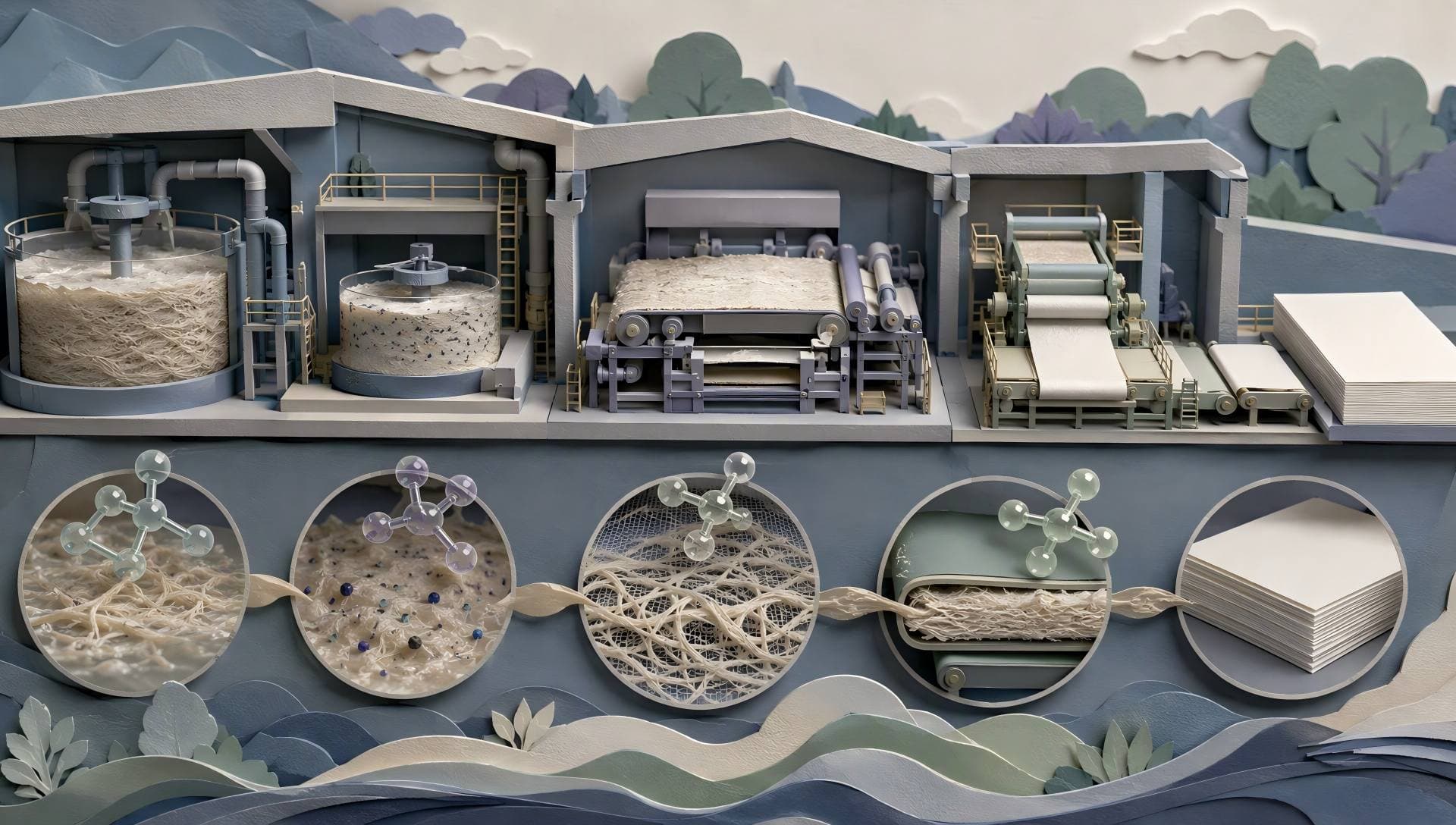
Papermaking Enzyme Systems process selection
Different points from pulp preparation to the size press require different substrates, dosing locations, and acceptance criteria.
Category: Papermaking Technology; Industrial Enzymes; Pulp and Paper Chemistry; Process Development
Abstract: Papermaking Enzyme Systems link pulp treatment, deinking, pitch control, fiber modification, and starch adjustment through substrate-based selection and mill validation.
Papermaking Enzyme Systems Are Not a Universal Additive
The search term Papermaking Enzyme Systems brings together two related but distinct questions. One concerns how enzymes act on pulp fibers, hemicellulose, ink carriers, or resinous deposits. The other concerns how enzymatic processing can enter starch preparation, size-press operation, and wet-end control. It is therefore more useful to treat the phrase as a process portfolio than as the formal name of a single chemical product.
That distinction changes enzyme selection. Xylanase may address accessible xylan and related pulp barriers. Cellulase may alter fiber surfaces and refining response. Lipase and esterase can hydrolyze selected lipid esters. Amylase is commonly used to modify starch molecular size and viscosity. These enzymes have different substrates and dosing points, so they cannot be substituted simply because they all belong to a papermaking enzyme program.
The word “glue” can also refer to several materials in mill language. Recycled furnish may contain pressure-sensitive adhesives, hot-melt components, or coating binders. A sizing system may contain starch and synthetic sizing chemicals. Wood extractives can create pitch deposits that represent a different class of problem. The substrate must be identified before a suitable enzyme can be discussed.
Papermaking Enzyme Selection Starts with Process Location
The first decision is where the problem occurs. Before bleaching, the technical question may concern a hemicellulose barrier, access to residual lignin, or protection of cellulose. Xylanase and accessory activities can then be screened under the actual pulp conditions. Before refining or sheet formation, the objective may be fiber-surface development, drainage adjustment, or fines management. Cellulase or hemicellulase activity must be balanced against fiber length, water retention, yield, and sheet strength.
Recycled-fiber systems need a different decision path. Ink detachment, stickies dispersion, and fiber reactivation are not the same operation. Cellulase, xylanase, lipase, or esterase may act on fiber surfaces, hemicellulose interfaces, oily ink components, or ester-containing contaminants. The useful formulation depends on recovered-paper composition, printing process, pulping conditions, flotation behavior, and white-water recirculation. Brightness alone cannot show whether the process preserved yield or prevented the loss of usable fines.
When spots, deposits, or machine contamination point toward pitch, the question should move from “Is resin present?” to “Which lipid classes dominate?” Triglycerides, fatty acids, sterols, sterol esters, and resin acids do not respond equally to the same catalyst. Lipases target selected ester bonds, esterases have different substrate profiles, and oxidative enzymes require another operating logic. The products formed after reaction also matter because molecular conversion does not automatically prevent aggregation or redeposition.
Near starch preparation and the size press, amylase mainly serves viscosity and molecular-size control. It does not act as the only determinant of sizing efficiency. Starch solids, gelatinization, shear, temperature, sheet absorbency, and the rest of the sizing formulation influence the final paper. Starch enzyme selection should therefore focus on controllable preparation and runnability rather than treating enzyme activity as a direct guarantee of surface strength.
A Pulp Enzyme Treatment Must Be Built Around the Real Substrate
A laboratory activity value is usually measured with a defined substrate under specified conditions. It is useful for confirming catalytic capability, but it does not reproduce an industrial pulp system. Real pulp contains residual lignin, extractives, minerals, fillers, wet-end chemicals, and several fiber fractions. These components affect enzyme adsorption, accessibility, and stability. Substrate characterization should come before a comparison of activity numbers.
For xylanase, relevant questions include the accessibility of xylan in the target pulp, stability at the intended pH and temperature, and the level of background cellulase. For cellulase, the formulation should be examined for endo- and exo-acting components and for the risk of damaging useful fibers. For lipase and esterase, the fraction of hydrolysable esters in the deposit must be established, and the colloidal behavior after treatment should be monitored. For amylase, starch type, gelatinization, target viscosity, and residence time must be designed as a connected system.

Papermaking Enzyme Systems substrate selection
Pulp fibers, ink particles, lipid deposits, and starch coils require different catalytic and analytical decisions.
A useful screen should include controls that answer the selection question. Where practical, a team can compare a blank, each single enzyme, and a candidate blend while keeping consistency, temperature, pH, time, and shear consistent. The value of a blend should then be judged from results on the authentic substrate and from the stability of the mixed preparation.
Enzymatic Deinking and Enzymatic Pitch Control Need Different Endpoints
Deinking asks whether ink can detach from fibers and then be removed through flotation or washing. A useful evaluation can combine residual ink, cleanliness, brightness, pulp yield, and fiber quality. Faster detachment still requires confirmation through downstream separation and fines retention. Both detachment and removal should be considered.
Pitch control focuses on lipophilic extractives and deposition tendency. Enzymatic treatment may alter molecular structures, but the converted products can still participate in aggregation, adhesion, or redeposition within the white-water system. Evaluation should include deposit composition, colloidal behavior, machine-surface deposition tendency, and sheet defects rather than only the reduction of one lipid species.
The two problems can coexist in recovered-paper systems, yet they should retain separate goals. A mill should first decide whether the dominant issue is ink, pressure-sensitive adhesive, wood-derived pitch, or a mixed contaminant load. The answer determines whether a single enzyme, an enzyme blend, or an enzyme combined with an established wet-end program is the appropriate development route.
This separation of endpoints is central to Papermaking Enzyme Systems. Calling every deposit “glue” creates a broad search phrase, but it does not provide a formulation. Technical specificity begins when the contaminant chemistry and its location in the process are known.
Starch Viscosity Modification Requires Controlled Hydrolysis
When amylase is used in a sizing system, the practical goal is generally a starch-viscosity range compatible with storage, pumping, metering, and application. Changes in hydrolysis alter starch molecular size and viscosity, while suitability for a paper grade still requires tests under the intended solids, shear, and sheet-performance conditions.
Development should follow the sequence from starch raw material through gelatinization, enzyme treatment, termination, storage, and machine application. Temperature and pH influence both reaction rate and residual activity in a holding tank. If termination is incomplete, the viscosity measured in the laboratory may continue to drift before the starch reaches the size press. Viscosity, solids, temperature, and residence time should be recorded together and then connected to surface strength, liquid uptake, print response, and machine cleanliness.
In this part of Papermaking Enzyme Systems, the enzyme and the “glue” are not a fixed premixed concept. The enzyme is a catalyst used to prepare or control a starch-based sizing medium. Selection criteria include thermal profile, pH compatibility, ion sensitivity, termination method, and batch consistency in addition to nominal activity.
Papermaking Enzyme Development Workflow: Four Scale-Up Gates
The first gate is substrate fit. A candidate must show the intended action on the real pulp, deposit, ink-bearing furnish, or starch rather than only on an assay substrate. The second gate is process compatibility. Activity must remain useful under the intended temperature, pH, ionic strength, consistency, shear, and chemical environment.
The third gate is the downstream result. Pulp treatment should be linked to drainage, morphology, strength, and yield. Deinking should combine cleanliness with fiber recovery. Pitch control should track deposition behavior. Starch treatment should connect viscosity to sheet-surface performance. The fourth gate is stable scale-up, including formulation storage, dosing accuracy, mixing, residence time, and reaction termination.
Scale-Up Path|Papermaking Enzyme Systems mill validation

Papermaking Enzyme Systems mill validation
Candidates should pass real-substrate, process-compatibility, paper-result, and stable-scale-up gates before a mill trial.
A useful enzyme-development brief converts the mill problem into measurable inputs: raw-material profile, dominant substrate, dosing point, pH and temperature range, acceptable side activities, residence time, and required paper or machine outcome. MatwingsVenus™(晓鹜™ ) publicly presented capabilities include enzyme mining, protein function prediction, protein design, and directed evolution, which can support candidate discovery and optimization. Candidates still require tests on authentic papermaking substrates before protein production, process transfer, and continued optimization are considered. The handoff should contain process inputs, candidate enzyme properties, experimental outputs, and the next validation criteria rather than a single activity value.
FAQ
Is Papermaking Enzyme Systems the name of one commercial product?
It is more useful as a composite search term covering papermaking enzymes, pulp treatment, adhesive and pitch challenges, and starch preparation for sizing. A purchase or development project must still separate the process location, substrate, and target metric before selecting an enzyme and formulation.
Is a higher enzyme activity always better for papermaking?
No. Activity values depend on the assay substrate, pH, and temperature. Industrial performance also depends on pulp composition, stability, mass transfer, and other process chemicals. A higher nominal value matters only when it produces a repeatable response on the real substrate without damaging useful fibers or disrupting downstream operation.
Can cellulase use one formulation for both refining and deinking?
Cellulase may influence fiber surfaces, fines, and ink detachment, but refining and deinking have different dose windows and endpoints. Refining focuses on drainage, fibrillation, and strength. Deinking must also measure ink removal, cleanliness, and yield. A formulation should not be transferred without new controls.
Can lipase remove every type of stickies deposit?
No. Lipase acts mainly on selected ester-containing substrates, while recycled-paper stickies can contain multiple polymers and additives. Deposit analysis should precede any decision involving lipase, esterase, another enzyme class, or a combined chemical program.
Does adding more amylase make size-press operation more stable?
Not necessarily. Changing dose or residence time changes the hydrolysis rate and final viscosity, and the practical effect must be tested in the intended process. Stable sizing requires coordinated control of starch type, gelatinization, dose, temperature, pH, termination, storage, and machine conditions, followed by viscosity and paper-performance checks.
The Final Selection Logic for Papermaking Enzyme Systems
Professional selection does not begin with an enzyme name and search for an application. It begins with a process problem, identifies the real substrate, and then connects enzyme behavior with pulp, sheet, and machine outcomes. Xylanase, cellulase, lipase, esterase, and amylase each have defined roles, and mixtures require controlled evidence of added value. A program becomes suitable for mill evaluation only when dosing location, operating window, termination, and downstream acceptance criteria form a complete and reproducible chain.