L-Asparaginase: From a Single Reaction to Multidimensional Development
Published on September 23, 2026
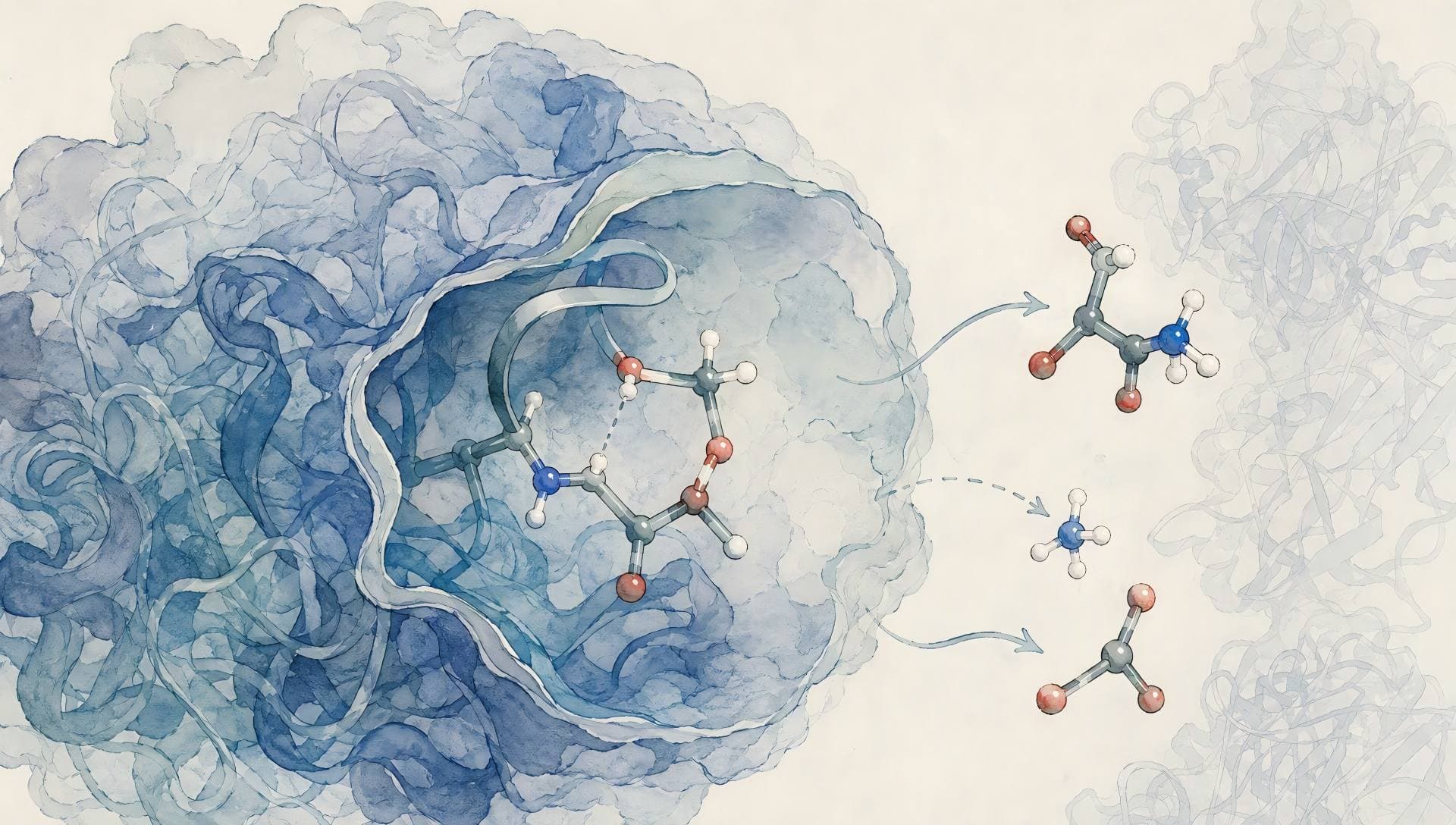
Catalytic Core Cutaway|L-asparaginase mechanism with substrate conversion
Category: Biotechnology | Industrial Enzymes | Protein Engineering
L-asparaginase is known by several closely related names across languages and technical settings. These names generally describe the same core reaction: water participates in cleavage of the side-chain amide of L-asparagine, yielding L-aspartate and ammonia. The name is simple, but development quickly branches into structure, selectivity, expression, purification, formulation, and process fit.
Earlier programs often asked only whether a candidate showed activity. More mature development now follows several shifts: from a single activity number to a performance profile, from ideal buffer to real matrices, from broad random screening to data-guided design, and from isolated experiments to a traceable computational–experimental loop. These shifts determine whether a promising signal can survive practical conditions.
L-asparaginase mechanism is moving from reaction equations to dynamic structure
A reaction equation shows substrate and products but not how the substrate enters the active site, how catalytic residues cooperate, when flexible loops move, or how products leave. Structural work on bacterial-type L-asparaginases indicates that a threonine side chain can serve as a key nucleophile. Multiple structural regions shape the catalytic environment, and some enzymes rely on oligomeric assembly to create a productive active site.
This dynamic view changes engineering priorities. A static pocket image can make the closest residues look like the best mutation targets. In practice, loops that control access, interfaces that stabilize assembly, and residues that shape local water networks may all influence catalysis. A mutation can affect turnover through conformational balance even without touching the substrate directly.
Binding is not simply better when it is stronger. Weak binding may fail to position the substrate, while excessive retention may slow product release. The catalytic cycle must balance recognition, chemical conversion, and release. Development is therefore moving from isolated affinity to the full reaction cycle and from visual pocket similarity to evidence of sustainable turnover.
Trend one: substrate specificity matters more than one high activity value
L-asparagine is the target substrate, but some candidates may also show activity toward glutamine or other amide-containing molecules. If a screen measures only total ammonia release, target conversion and side reactions can be mixed together. A strong signal may reflect the intended reaction, assay background, or activity on another substrate.
Modern evaluation increasingly uses paired or grouped assays. The target-substrate reaction defines primary activity. Competing-substrate assays map selectivity. Blank and negative controls identify background. Product measurements confirm that conversion followed the intended route. When necessary, rates should be measured across substrate concentrations rather than at one endpoint.
The importance of selectivity depends on use. Food processing emphasizes conversion of accessible free L-asparagine in a complex formulation while maintaining product quality. Biomedical development requires tightly controlled evaluation of activity, purity, impurities, formulation, and biological performance. Different projects cannot rely on a generic “high specificity” label; each needs an explicit assay boundary.
Trend two: food processing is shifting from adding enzyme to fitting the matrix
In some heat-processed foods, free L-asparagine can participate in reactions associated with acrylamide formation. Adding L-asparaginase before heating aims to reduce the available precursor. The biochemical rationale is direct, but process performance depends on the food matrix and operating window.
The enzyme must first reach the substrate. Dough viscosity, potato tissue, water content, mixing, and holding time affect diffusion. Low temperature may slow conversion, while excessive temperature can destabilize the protein. A pH outside the useful range changes catalytic residue states. Dose is only one variable and should not be interpreted apart from process conditions.
A complete validation program examines substrate conversion, downstream thermal-processing indicators, sensory properties, and production timing together. Peak activity in buffer establishes potential, not manufacturing readiness. Practical use also depends on stability in real ingredients, dispersion, compatibility with existing operations, and acceptable process cost.

Process Fit Scene|L-asparaginase food processing before heating
Trend three: activity assays are becoming evidence combinations
Primary screens often use ammonia detection, colorimetric systems, or coupled reactions because they are fast and suitable for many samples. Their limitations are equally important. Sample color, background ammonia, buffer composition, stopping time, and coupling efficiency can all change the signal. When a second enzyme is part of the readout, the team must determine which step is rate-limiting.
The trend is toward layered evidence. The first layer quickly removes inactive samples. The second directly tracks L-asparagine loss or L-aspartate formation. The third moves selected candidates into a representative matrix. The fourth tests storage, thermal exposure, salts, and formulation components. As experiments move closer to application, sample numbers fall while information density increases.
Unit consistency is another priority. Activity per milliliter describes total sample output. Specific activity per milligram of protein better reflects molecular efficiency. Volumetric productivity connects expression with catalysis. Ranking by only one unit can misclassify a high-expression, low-efficiency sample or a low-expression, high-efficiency candidate. Reports should make enzyme amount, substrate concentration, time, and reaction environment explicit.
Trend four: stability engineering now covers the full lifecycle
Stability was once reduced to heat tolerance. Development now considers the enzyme from expression and purification through storage, transport, and use. A short optimum-temperature assay, residual activity after heat exposure, and long-term storage retention are separate measurements.
Purification may trigger aggregation, subunit dissociation, or activity loss. Formulation introduces buffer, ionic strength, and protective components. Use adds substrate, salts, sugars, lipids, or process additives. Useful stability data must come from combinations that resemble the intended workflow.
Immobilization is one optional strategy. It may improve recovery and reuse, but it can also introduce diffusion limits, unfavorable active-site orientation, or initial activity loss. Evaluation should compare enzyme consumption, carrier cost, operating time, cleaning burden, and effective product output rather than displaying cycle count alone.
Trend five: the protein research workflow is becoming traceable
Enzyme programs often have enough data but lack connections among them. If sequence names, expression batches, purification conditions, activity units, and application matrices are not aligned, it becomes difficult to decide whether a performance change came from mutation, sample state, or assay conditions.
MatwingsVenus™(晓鹜™), positioned as a conversational protein research and dry–wet loop agent platform, can help organize objectives, candidates, tasks, and experimental feedback. It can keep the reasoning behind sequence selection, mutation choice, and next-step validation within one research chain, reducing information gaps.
Traceability does not mean replacing scientific judgment with a system. It requires teams to state hypotheses, conditions, and decision thresholds more clearly. Computation proposes priorities, experiments verify them, quality control maintains comparability, and researchers make integrated decisions. MatwingsVenus™(晓鹜™) serves as the coordination entry point rather than an unconditional guarantee of results.
L-asparaginase protein engineering is becoming a data loop
Natural diversity remains an important starting point. Enzymes produced by different microorganisms can vary in expression, operating window, selectivity, and stability. Enzyme mining expands the search space, function prediction organizes likely catalytic features, and structural analysis examines pockets, flexible loops, and subunit interfaces.
MatwingsVenus™(晓鹜™) can organize enzyme mining, protein function prediction, protein design, and directed evolution as a connected task chain. Researchers can define target conditions, organize candidate sequences and structural hypotheses, and convert computational judgments into testable questions. The platform supports task decomposition and information coordination; actual performance still requires expression, purification, and functional assays.
Engineering is also moving from large undirected libraries toward hypothesis-driven iteration. Rational design can focus on pocket volume, local interactions, or subunit interfaces. Directed evolution can explore combinations that are difficult to predict. Changing a limited set of variables in each round and feeding results back into design makes it easier to identify meaningful structural factors.

Candidate Evolution Map|L-asparaginase protein engineering from mining to tests
FAQ: Common questions
Do the common names refer to the same L-asparaginase class?
They generally describe the same enzyme class across common usage. Project documents should standardize terminology and verify the English name, target substrate, and reaction equation to avoid confusion with asparagine synthetase.
What are the main reaction products?
The core reaction hydrolyzes L-asparagine to L-aspartate and ammonia. An assay may track substrate depletion or product formation, but background signal and reaction conditions must be controlled.
Why can a high-activity candidate perform poorly in food?
Real food matrices introduce viscosity, diffusion limits, water content, salts, sugars, lipids, and pH effects. Peak activity in buffer does not automatically predict matrix performance, so application testing is necessary.
Is glutaminase activity always undesirable?
Its importance depends on the intended use. It indicates that a candidate can act on another amide substrate. The key is to measure it separately so that total activity does not hide the selectivity profile.
Can protein design directly provide the best variant?
No. Design tools can narrow the search and create testable hypotheses, but sequence changes may affect folding, expression, activity, and stability together. Reliable development requires iterative experimental confirmation.
Conclusion: the next stage is about performance combinations and development efficiency
The value of L-asparaginase is no longer defined by one activity number. Structural dynamics, substrate specificity, real matrices, expression, purification, and lifecycle stability form the candidate profile. The closer a project moves toward application, the more specific its conditions and success criteria must become.
The enzyme mining, function prediction, protein design, and directed evolution capabilities organized through MatwingsVenus™(晓鹜™) can connect dispersed tasks into a computational–experimental loop. Clear boundaries, layered validation, and comparable data are what turn fundamental enzymology into reliable development capability.