ESMFold Structure Prediction for Evidence-Aware Protein R&D
Published on September 27, 2026
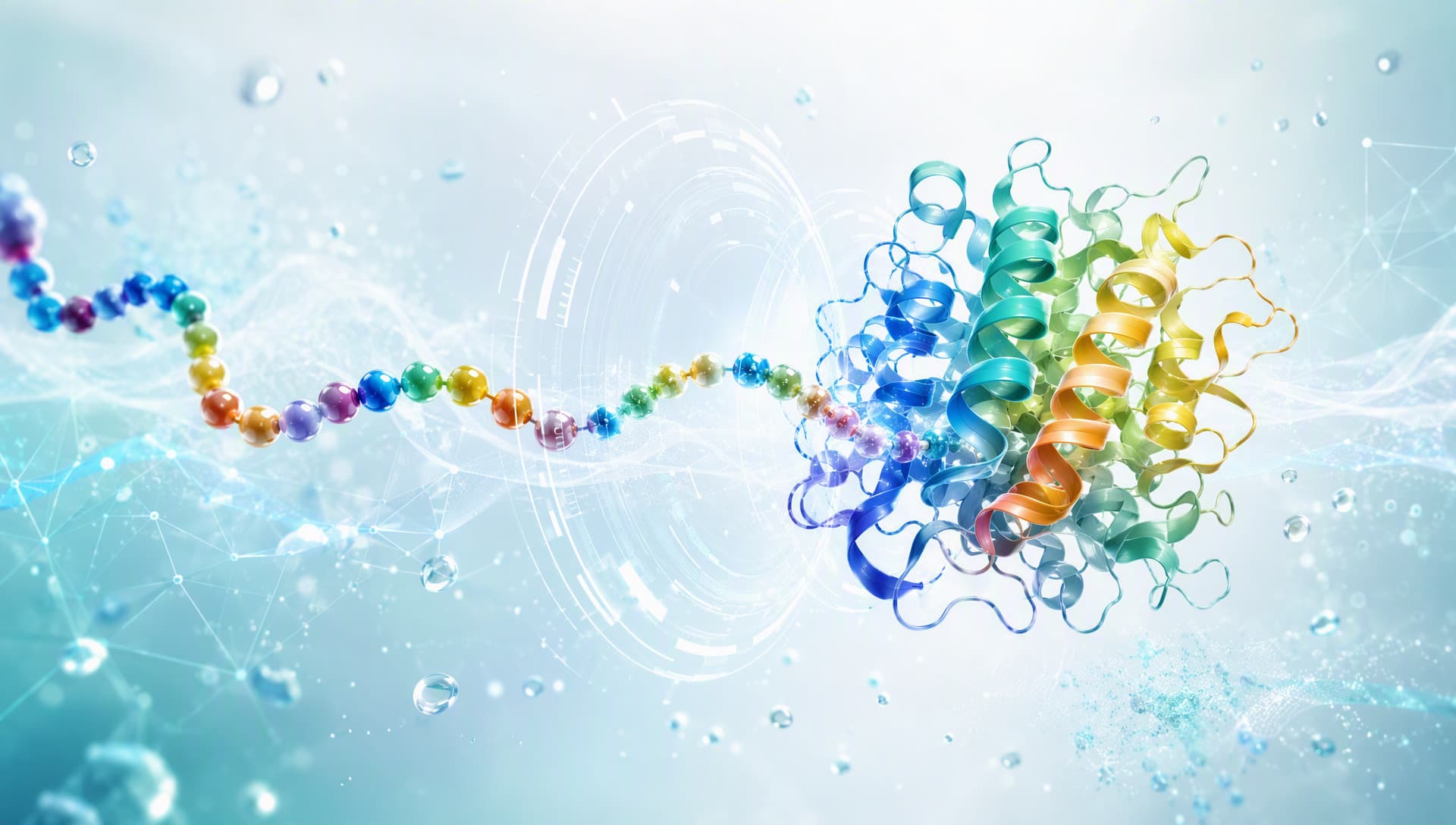
Language-model signals turn sequence patterns into a testable fold hypothesis
Why ESMFold structure prediction can reveal single-sequence clues
A protein sequence is more than a string drawn from common amino acids. It also carries statistical patterns shaped by evolution. A protein language model learns which residue combinations tend to occur together and which local patterns are associated with spatial relationships. ESM-2 supplies sequence representations, and a folding component converts them into three-dimensional coordinates. This allows ESMFold structure prediction to work directly from one sequence without requiring the user to prepare a multiple-sequence alignment.
The immediate benefit is a different R&D cadence. For newly discovered sequences, candidates with limited homolog coverage, or libraries that require early triage, researchers can obtain an inspectable folding hypothesis before committing to heavier computation or experiments. The method is particularly useful for questions such as whether a sequence appears capable of a compact fold, which regions merit closer inspection, and which candidates should move forward.
Speed, however, is not certainty. The output is a model-derived structure, not a structure measured by crystallography, cryogenic electron microscopy, or nuclear magnetic resonance. Keeping Predicted separate from Measured is the first quality rule.
Reading confidence matters more than admiring the model
ESMFold structure prediction can include confidence information such as pLDDT. This helps users see where the model is locally confident and where interpretation should be cautious. A high-confidence core may support an initial fold-level decision. Lower-confidence segments may reflect flexible regions, disorder, uncertain domain orientation, or insufficient model information.

Confidence zoning directs attention to regions that need additional evidence
A useful review asks three questions. Is the core domain coherent? Is local geometry near a critical residue sufficiently credible? Could uncertain segments change the downstream decision? If the goal is broad topology screening, a stable core may be enough for triage. If the task concerns an active pocket, interface, or precise mutation, local uncertainty becomes central and should be checked against database structures, homolog information, complementary computation, or experiments.
Metrics must also remain within scope. pLDDT describes local confidence in a predicted structure; it does not directly measure binding affinity, catalytic activity, expression yield, or experimental success. A visually convincing fold may still depend on ligands, cofactors, membranes, post-translational modifications, or oligomeric context.
Where the method fits—and where caution increases
ESMFold structure prediction is well suited to rapid monomer-level exploration from a reasonably complete sequence, early fold screening, and the preparation of structural starting points for visualization or downstream analysis. By reducing setup work, it lets teams shift attention from whether a structure can be generated to whether that structure can support a decision.
Validation requirements rise when function depends on multiple chains, precise interchain interfaces, ligands, metals, nucleic acids, long flexible linkers, or low-confidence residues near a critical site. In such settings, a monomeric prediction remains useful input but cannot carry the full mechanistic interpretation.
Structural similarity should not be treated as functional identity either. A related fold can suggest a hypothesis, but it cannot replace conserved-site analysis, curated annotations, biochemical context, and measurements. Project communication should likewise avoid claims such as “experimentally proven” or “guaranteed to work” when the evidence is only computational.
The ESMFold structure prediction workflow in MatwingsVenus™(晓鹜™)
A robust workflow does not end with uploading a sequence and downloading a PDB file. It begins with sequence identification and retrieval of known evidence. Prediction follows when curated evidence is absent or incomplete. The output is then assessed for confidence, domain integrity, and critical regions before it feeds functional analysis, candidate comparison, mutation planning, or wet-lab work.
In MatwingsVenus™(晓鹜™), researchers can organize database retrieval, structure prediction, and downstream analysis through natural-language tasks. Its public workflow emphasizes retrieval first: established sequence and structure records form the evidence baseline, while model outputs remain explicitly labeled Predicted when prediction is needed. This order reduces redundant computation and prevents measured evidence from being obscured by model output.
For de novo design or candidate screening, ESMFold structure prediction can serve as a rapid fold-validation stage. A team can first examine whether a designed sequence adopts the expected overall topology, then route promising candidates to stricter structural, functional, or physics-based checks. MatwingsVenus™(晓鹜™) can connect that result with functional-site, physicochemical-property, and mutation-effect analyses, translating “the fold looks plausible” into a set of reviewable R&D conditions.

Evidence retrieval and experiments turn fast predictions into accountable decisions
Make every prediction answer a defined decision
Before running a task, write down the decision the structure should support: rejecting an implausible fold, prioritizing candidates, locating regions for validation, or preparing an experiment. Clear intent prevents the output from being overinterpreted. Preserve the input sequence version, parameters, model version, prediction date, and quality indicators so the result remains reproducible and traceable.
Next, separate observations into three levels: directly inspectable, requiring cross-validation, and currently unresolved. Overall topology and a high-confidence domain may belong to the first level. A flexible loop near a pocket may belong to the second. Function, affinity, and activity without independent support belong to the third. This framing moves a team away from asking whether a model “looks good” and toward asking whether the evidence is adequate.
MatwingsVenus™(晓鹜™) can organize those levels as a task chain: database records provide a Measured evidence baseline, model results are labeled Predicted, and unsupported statements remain Unknown. Confirmation gates before computationally intensive or design steps help preserve user control. Candidates advancing toward the laboratory can be accompanied by validation suggestions rather than a single confidence score being treated as a substitute for measurement.
Conclusion: convert speed into better judgment
The practical value of ESMFold structure prediction is its ability to turn a sequence into a discussable structural hypothesis with relatively little setup. It brings structural clues earlier into R&D, while demanding disciplined separation of prediction, evidence, and conclusion. Combined with retrieval, confidence-based triage, functional analysis, and experiments, fast folding becomes a source of better decisions rather than premature certainty.
Teams that want to move from sequence retrieval through rapid folding, candidate screening, and validation planning can describe the objective in MatwingsVenus™(晓鹜™) and use each result to choose the next analysis. A strong toolchain does not replace scientific judgment; it helps each judgment reach a verifiable stage sooner.