Boltz Protein Structure Prediction Tutorial: From YAML Input to Confident Decisions
Published on September 28, 2026
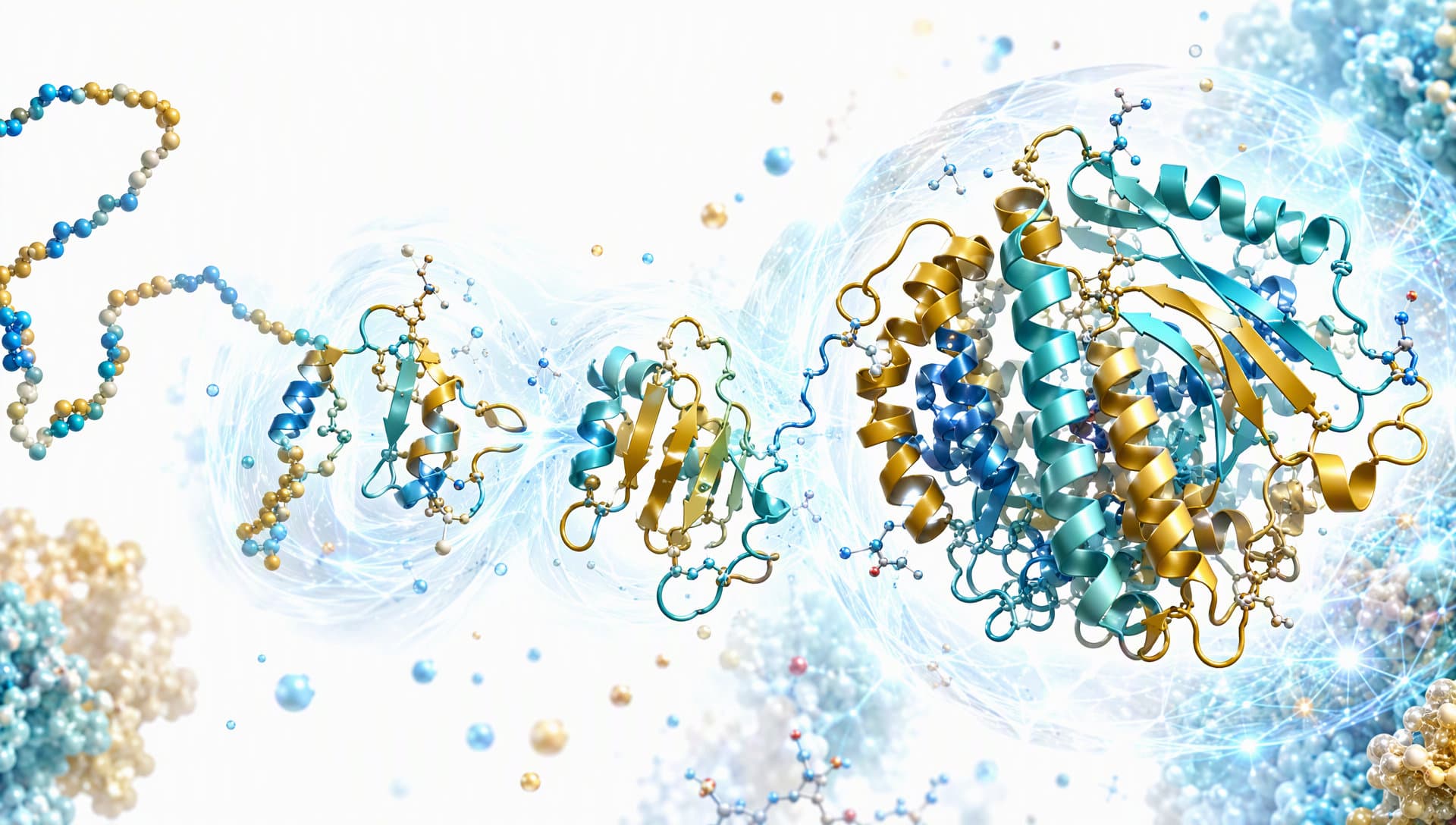
Visualizing the path from sequence input to a molecular complex
Category: AI Protein Structure Prediction | Computational Biology | Protein Engineering
In practical research, the hardest question is rarely whether software can produce a three-dimensional model. The more consequential questions are whether the input describes the intended molecular system, whether the output supports the next decision, and whether a team can connect that structure to database evidence, functional sites, and experimental plans. A visually convincing model can still mislead if chain identities are wrong, the MSA strategy is unsuitable, or confidence is mistaken for measured affinity.
That is the purpose of this Boltz protein structure prediction tutorial: not merely to provide a command, but to organize preparation, prediction, interpretation, and validation as one reusable path. Boltz is an open-source family of biomolecular interaction models. Its official repository currently runs the latest model by default and recommends YAML as the preferred format for describing proteins, nucleic acids, ligands, and their complexes.
Start by Defining the Prediction Task
Before installing anything, state exactly what you want to model: a single protein chain, a protein–protein complex, or a protein–small-molecule complex. Each question requires different inputs and different interpretation. A monomer task emphasizes global folding and local confidence. A complex task adds interface quality. A ligand-containing task requires a correct SMILES or CCD representation and a careful distinction between structural confidence and affinity-related outputs.
If your team already has a protein name, UniProt accession, PDB structure, or experimental annotation, retrieval should come before prediction. MatwingsVenus™(晓鹜™) follows retrieval-first and sequence-first identification principles: establish molecular identity and existing Measured evidence before launching a new Predicted computation. This reduces unnecessary reruns and provides a stronger baseline for evaluating the model.
Build a Reproducible Environment Before Optimizing Speed
The official repository recommends installing Boltz in a fresh Python environment. On a compatible CUDA system, a minimal setup is:
python -m venv .venv
source .venv/bin/activate
pip install "boltz[cuda]" -U
boltz predict --help
For CPU-only or non-CUDA hardware, remove the [cuda] extra. CPU inference is substantially slower, so it is better suited to environment checks than routine high-throughput work. In a production workflow, record the Python and Boltz versions, GPU model, driver and CUDA versions, input file hash, and inference options. Keeping only the final structure makes later discrepancies difficult to diagnose.
A first run may download model weights and supporting data. Allow reliable network access, adequate disk space, and sufficient GPU memory. Test a short sequence before launching a batch. On older NVIDIA hardware, an incompatibility involving acceleration kernels may be addressed with --no_kernels as described in the official troubleshooting guidance; any such change should be captured in the run record.
Describe the Molecular System with YAML
Boltz can process one YAML file or a directory containing multiple YAML files. The following is a minimal single-protein example:
version: 1
sequences:
- protein:
id: A
sequence: MKTAYIAKQRQISFVKSHFSRQLEERLGLIEVQ
Save it as example.yaml, then request automatic MSA generation through the server:
boltz predict example.yaml --use_msa_server --out_dir results
Without --use_msa_server, provide a precomputed MSA in the YAML. Single-sequence mode can be requested with msa: empty, but the documentation warns that this generally reduces accuracy. For multichain systems, every distinct entity needs a unique chain ID; identical copies may share an ID list. Ligands are described with either a SMILES string or a CCD code, not both.
The same schema can encode templates, covalent bonds, pocket constraints, contact constraints, and affinity properties. The objective is not to enable every field. Add only information that is scientifically justified. An overly forceful template or constraint can make an output appear more definite while masking uncertainty in the underlying prediction.

Following YAML input through prediction and confidence assessment
Choose Inference Parameters to Match the Question
The base command in this Boltz protein structure prediction tutorial is simple, but each run should be treated as a trackable computational experiment:
boltz predict example.yaml \
--use_msa_server \
--out_dir results \
--diffusion_samples 5
Increasing --diffusion_samples produces multiple candidate conformations and can help reveal whether a solution is stable across samples, at added computational cost. --recycling_steps and --sampling_steps also influence runtime and should not be increased blindly. Boltz can reuse cached preprocessing and existing predictions. If the input or critical options change while the same output directory is retained, inspect the cache behavior; use --override only when a genuine clean rerun is intended.
For batch inference, benchmark memory and runtime on a small, representative subset before scaling up. The human-in-the-loop principle used by MatwingsVenus™(晓鹜™) is useful here as well: confirm the input, parameters, expected output, and computational cost before a heavy task begins instead of allowing automation to silently alter the setup.
Boltz Protein Structure Prediction Tutorial: Read Confidence Outputs Together
The output directory normally includes ranked mmCIF structures, a confidence JSON file, and—depending on options—PAE, PDE, or pLDDT arrays. Do not reduce interpretation to a single aggregate score:
• pLDDT-related values help assess confidence in local residues and geometry. A low-confidence segment may be intrinsically flexible or simply underconstrained.
• pTM is more informative about confidence in the global topology.
• ipTM and chain-pair interface metrics are especially relevant to complexes. A good global result does not guarantee that every interface is reliable.
• PAE and PDE expose uncertainty in relative placement or distances, helping identify unstable domain orientations and risky interfaces.
For protein–ligand tasks, distinguish affinity_probability_binary from affinity_pred_value. The first is intended for separating likely binders from decoys, whereas the second is intended for comparing relative affinity among active molecules. Neither should be presented as an experimentally measured Kd, biological activity, or clinical conclusion.
This is where a Boltz protein structure prediction tutorial must move from software operation to scientific judgment. Inspect steric clashes, bond geometry, ligand poses, interface contacts, known functional residues, and conserved sites. Then define orthogonal computational checks and experimental validation. Confidence describes how certain the model is about its prediction; it does not prove the biology.
MatwingsVenus™(ai protein agent)Workflow for a Traceable Research Loop
A predicted structure becomes valuable when it informs the next test. MatwingsVenus™(晓鹜™) can organize downstream work around the same protein object: verify identity, structures, and annotations against authoritative databases; apply functional-site or protein-property prediction where measured evidence is absent; and route suitable structures into structure mining, mutation-effect assessment, molecular docking, or de novo design workflows.
The platform distinguishes Measured, Predicted, and Unknown evidence and requires human approval before compute-intensive operations. The benefit is not the replacement of expert judgment. It is the reduction of fragmented tool switching and broken provenance: Boltz supplies a candidate structure, databases establish prior evidence, function and engineering modules generate the next hypothesis, and wet-lab experiments test it.

Connecting predicted structures to evidence and protein engineering
FAQ
Is this Boltz protein structure prediction tutorial suitable for beginners?
It is suitable for readers with basic command-line and protein-sequence knowledge. Complete beginners should first become familiar with FASTA, chain IDs, MSA, PDB/mmCIF, and GPU environments, then begin with a short single-chain target.
Why is YAML preferred over FASTA?
YAML can represent more entity types, modifications, templates, constraints, and affinity properties. The official documentation marks FASTA as deprecated. Starting a new project with YAML makes complex systems easier to extend and runs easier to reproduce.
Does a high pLDDT value mean the protein is active?
No. High confidence means that the model is more certain about its structural prediction. It does not demonstrate expression, stability, catalytic activity, or binding affinity. Important decisions still require database evidence, orthogonal computation, and experimental testing.
Move from a Structure File to a Testable Conclusion
An effective Boltz protein structure prediction tutorial should not end when installation succeeds or an mmCIF file appears. A reusable process defines the question and evidence baseline, expresses the system accurately in YAML, records inference conditions, interprets confidence at the right structural level, and returns the result to its functional and experimental context.
To extend this approach into a repeatable protein R&D workflow, start with one real target: establish identity and prior evidence, run one reproducible prediction, and use MatwingsVenus™(晓鹜™) to connect the structure with functional analysis, candidate screening, protein engineering, or design validation. Structure prediction is the entry point; a defensible next decision is the goal.