What Is an AI LIGHTS-OUT LABORATORY? Turning Protein R&D into an Unattended, Automated Laboratory
Published on November 2, 2026
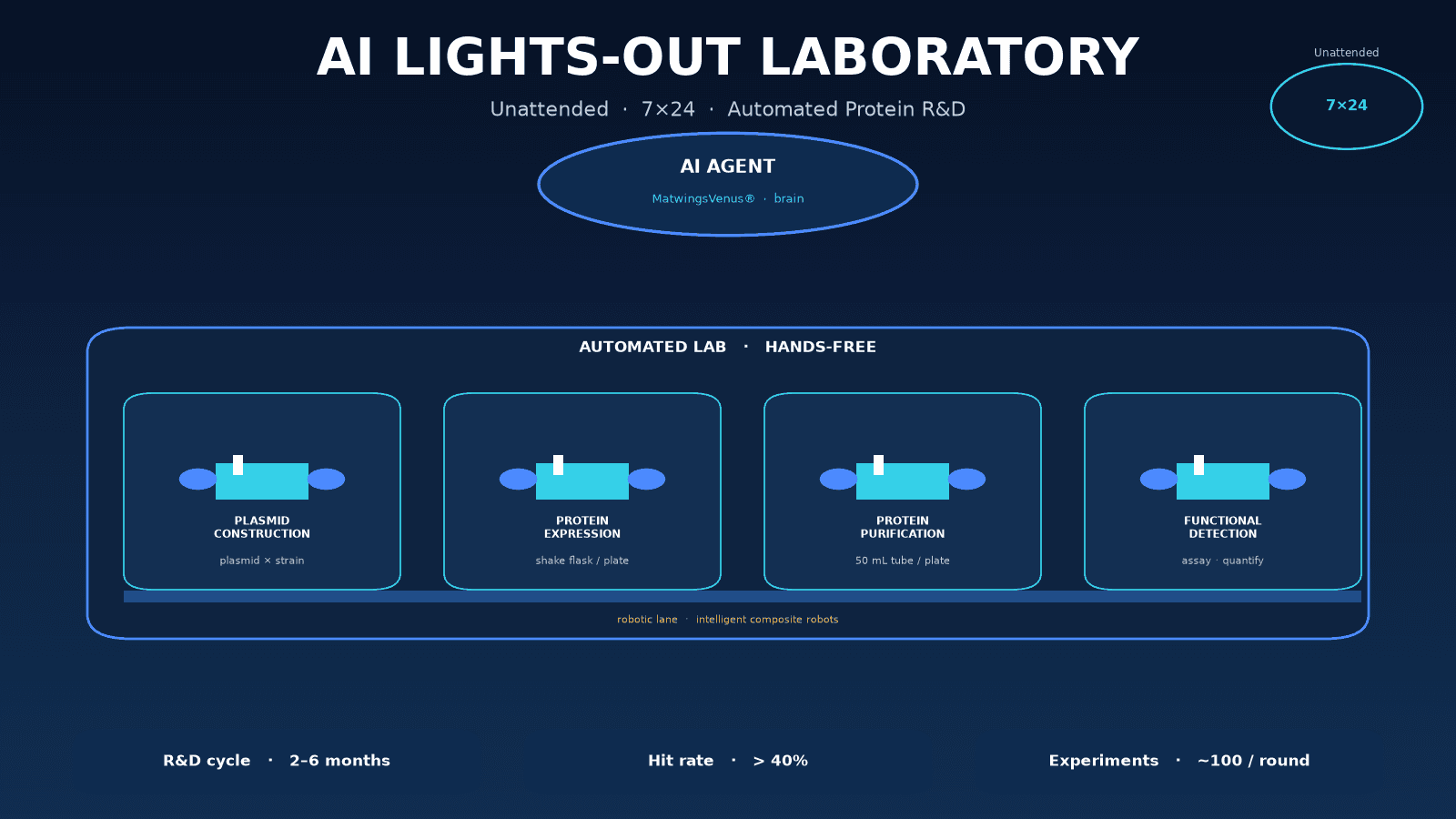
Figure 1 AI LIGHTS-OUT LABORATORY: unattended automated protein R&D lab
Category:Main D (AI / algorithm / platform: concept + capability boundary); cross-reference F (product-driven), G (application / scenario)
In biomanufacturing and the life sciences, the AI LIGHTS-OUT LABORATORY has become a well-defined category: driven by robots and automated equipment, it runs experiments automatically, unattended, 7×24 hrs. It comes from the "lights-out factory" in manufacturing — the lights can even be turned off because machines do the work, and no one needs to be on site overnight. Moving that idea into protein R&D means automated equipment in the lab handles sample preparation, protein purification and functional detection on its own, while people only "define the goal" and "read the results". Matwings Technology — an AI-driven, full-stack protein innovation platform — uses the MatwingsVenus® protein agent as the "brain" to string this automated equipment into an unattended "from sequence to protein" line. The premise behind any "unattended" operation is the DBTL (Design–Build–Test–Learn) dry-wet closed loop, which we introduce first.
From "Lights-Out Factory" to "Lights-Out Lab": Why Protein R&D Needs Unattended Automation
What an AI LIGHTS-OUT LABORATORY addresses is the traditional lab's over-dependence on "people" — the very turning point where biomanufacturing moves from "experience-driven" to "intelligent-driven".
· Traditional bottlenecks: design relies on expert experience and validation on human trial and error, with limited accuracy and low hit rates; data becomes scattered "data islands", and a workflow can take years.
· Value of automation: today "lights-out labs" have landed in life sciences, biomanufacturing and other scenarios, where robots and automated equipment replace labor for repetitive, precision-demanding, standard-automation steps. What stands out is unattended operation, full automation and equipment coordination — which brings far more certainty than software tools alone.
· The paradigm is shifting: from "trial and error" to "design–validate–iterate"; from manual operation to equipment automation; from experience-driven to intelligent-driven.
The contrast is stark: the traditional model runs a 3–5 year R&D cycle, tens of thousands of experiments, and a hit rate below 5%; an AI-driven, full-stack platform compresses the cycle to 2–6 months, about 100 experiments per round, and a hit rate above 40%. That is the value of "lights-off" — time is freed from repetitive labor and given to judgement and creation. In application, high-throughput screening in the life sciences, synthetic biology, enzyme and protein engineering in biomanufacturing, and workflows that are repetitive, precision-demanding or carry safety risk are all typical use cases.
How an AI LIGHTS-OUT LABORATORY Works: the Dry-Wet Closed Loop (DBTL)
The operating mechanism of an AI LIGHTS-OUT LABORATORY is to let an "AI brain" and "robotic equipment" work together to form a DBTL dry-wet closed loop.
· Design: AI uses models such as protein language models to learn rules from large volumes of sequence–function data, predicting which amino-acid combinations are more likely to deliver good function, much like predicting the next word, replacing much literature review and manual trial.
· Build: robots and automated equipment perform gene synthesis, plasmid construction and other biological synthesis steps, precisely and reproducibly.
· Test: automated platforms run protein expression, purification and functional detection (activity, specificity, stability), turning "does it work" into repeatable process results.
· Learn: every result flows back into the model to train and update the next design — more experiments make predictions better, and better predictions mean fewer experiments, forming a "data flywheel".
The key of this loop is that dry and wet are genuinely connected: dry experiments (sequence analysis, structure prediction and molecular design done on a computer) and wet experiments (gene synthesis, culture, expression and purification done in the lab) are bridged by the same agent, so design results no longer need to be manually transcribed into experiment orders, and data is not lost in between. This also explains why automated equipment and AI are both indispensable — equipment guarantees reproducibility, AI guarantees the right direction.

Figure 2 Dry-wet closed loop: Design–Build–Test–Learn
The Automated Equipment of an AI LIGHTS-OUT LABORATORY: From Plasmids to Expression to Purification
The core of an AI LIGHTS-OUT LABORATORY is automated equipment, not software alone; it is a modular system assembled from automated platforms on demand.
· Automated plasmid construction & extraction platform (mini/maxi prep): covers PCR, nucleic-acid purification, plating, single-colony picking, strain preservation, nucleic-acid extraction and quantification.
· Automated protein expression platform (shake flask / plate): covers strain revival, plate shaking culture, inoculation, induced expression, transfection and transfection-efficiency analysis.
· Automated protein purification platform (50 mL tube / plate): covers cell sonication, bacterial centrifugation and separation, magnetic-bead or filter-plate purification, and protein quantification.
· All-in-one design: for protein purification and functional detection, it can integrate high-throughput/precise liquid transfer, ultra-low-temperature storage, magnetic beads, positive pressure, centrifugation, filtration and detection, flexibly linked by intelligent composite robots.
More importantly, automated equipment minimizes the variables of manual operation: pipetting error, sample contamination and batch differences are standardized, making the data more consistent and repeatable. Only when results flow back automatically can "this round's hit" truly become the reliable input for "the next round's design".

Figure 3 All-in-one automated platform: purification and functional detection
For selection, the two full-flow routes — synthetic biology and biopharma — can be combined and cross-configured, together with site and conditions (size, power, network ports, water and gas supply, centralized wastewater collection). The modularity means that whether you engineer enzymes, make recombinant proteins, or work on antibodies and biologics, a suitable combination is available.
Deploying an AI LIGHTS-OUT LABORATORY and Data Security
An AI LIGHTS-OUT LABORATORY can be used in the cloud or deployed on premises, keeping sequences, designs and experimental data inside the enterprise boundary; when deployed on premises, you can choose which model to deploy or connect an external interface. For R&D enterprises, keeping data in-house lowers leak risk and makes external collaboration and filings more secure. Locally, the platform can cover information query (50+ database interfaces), general retrieval, structure prediction, molecule discovery, property prediction, molecular docking, enzyme engineering, molecule/antibody design and data analysis. If you want to confirm feasibility at small scale first, you can also request a sample for validation before scaling up.
MatwingsVenus® (晓鹜®): Giving AI a Lab It Can Actually Operate
What turns "lights-out" from a concept into reality is MatwingsVenus® (晓鹜®) — Matwings Technology's self-developed conversational protein R&D agent. It decides "what to do" and is the "brain" of the whole automated line.
· From virtual to real: MatwingsVenus® (晓鹜®) connects the AI design platform to the automated experiment platform and is described as the first "physical OpenClaw" platform in science. The design platform handles conversational design, while the experiment platform is flexibly linked by intelligent composite robots.
· Simple entry: describe the goal in natural language (such as "I want a more alkali-resistant resin protein"), and the agent automatically breaks down the task and schedules design, prediction, analysis, screening and automated validation — no need to be an expert in programming or structural biology.
· Composable capability: the platform integrates foundation models pretrained on hundreds of millions of protein sequences and many protein-design tools and domain-tuned capabilities. It completed training of the first from-scratch-pretrained protein language model in 2022; in May 2024 the Venus model ranked on ProteinGym and took first place among global protein foundation models, and the VenusPod dataset was selected as a first-batch national high-quality dataset case.
· Industrial validation: the alkali-resistant affinity-chromatography resin protein engineered with cooperative partner delivered an 11-month development cycle, 4× greater alkali resistance, 100% longer resin service life and over 10 million RMB in annual cost savings, with multiple 5000 L scale-up batches completed (results in Science Advances 2024 and eLife 2025). The Tianwu-rPTA PET-degrading enzyme also stands out in activity, thermal stability and product specificity (Nat. Commun. 2025).
Common Questions About the AI LIGHTS-OUT LABORATORY
Question 1: What is an AI LIGHTS-OUT LABORATORY?
it is an unattended automated protein R&D system — AI designs candidates in the cloud, robots automatically handle sample preparation, purification and functional detection in the lab, and data flows back into the model for the next round, forming a closed dry-wet loop.
Question 2: How does an AI LIGHTS-OUT LABORATORY run unattended?
it relies on automated equipment rather than labor. Platforms for plasmid construction, protein expression and protein purification are executed by robotic arms and automated equipment, running 7×24; AI handles design, analysis and tuning, while people define goals, read results and review complex anomalies.
Question 3: Which scenarios suit an AI LIGHTS-OUT LABORATORY?
it suits projects needing high throughput, repetitive wet experiments and many iterations, such as enzyme engineering, antibody affinity optimization, recombinant protein and biologic preparation, and synthetic biology; if the hit rate is too low, homologs are sparse, or a brand-new function/specificity is needed, a more specific tool enzyme or custom service can be a better fit.
Question 4: What about data security?
it supports private deployment, so models and data stay inside the enterprise boundary; teams with sensitive sequence and process data can prefer a local solution.
Summary: From "Experience-Driven" to "Intelligent-Driven", Let Protein R&D Run Itself
In one sentence: an AI LIGHTS-OUT LABORATORY uses an "AI design + automated equipment + data feedback" DBTL loop to compress the protein R&D cycle from 3–5 years to 2–6 months and raise the hit rate from <5% to >40%, so experiments become fewer, faster and more accurate.
An AI LIGHTS-OUT LABORATORY turns the "lab" from a place that depends on labor and experience into an "autonomous laboratory" driven by AI, robots and automated equipment. It frees scientists from tedious repetition, leaving time for the judgement and creativity that truly matter, and pushes research toward a new paradigm: from "experience-driven" to "intelligent-driven".