How to Engineer Proteins
Simplify Complexity: One-Step Protein Evolution
No more blind trial-and-error in the lab.MatwingsVenus™ acts like a "virtual laboratory," simulating thousands of evolutionary possibilities in advance and delivering only the optimal solutions.
Based on built-in tools, the assistant can predict the effects of single or multiple amino acid mutations on protein structure and function. It supports single-point mutation prediction using state-of-the-art AI models, and can also perform training-based predictions using user-provided wet-lab data.

1. Case Study (How to Upgrade Your Protein?)
1.1 Follow the Prompted Dialogue
1.1.1 Input Requirement
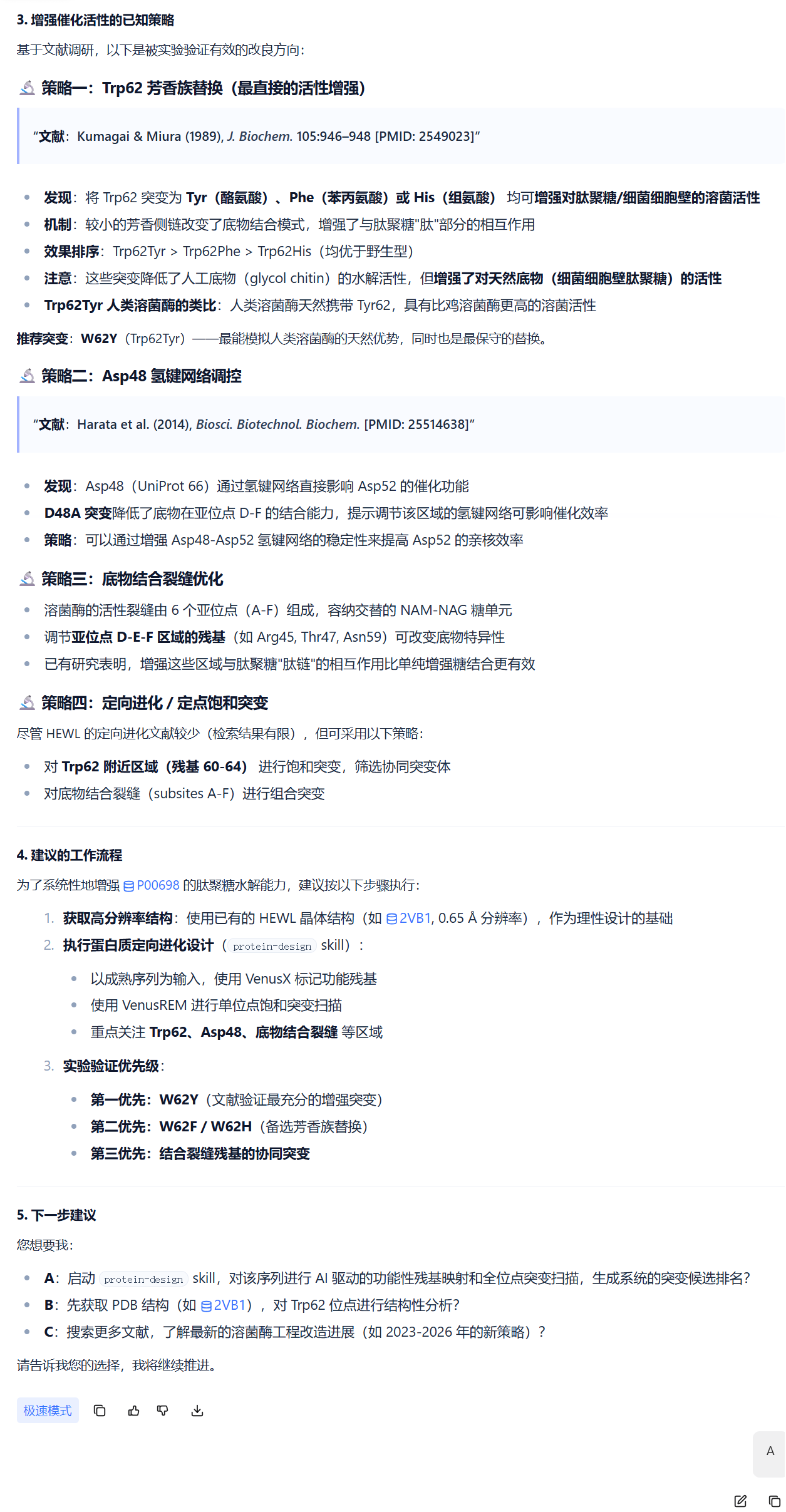
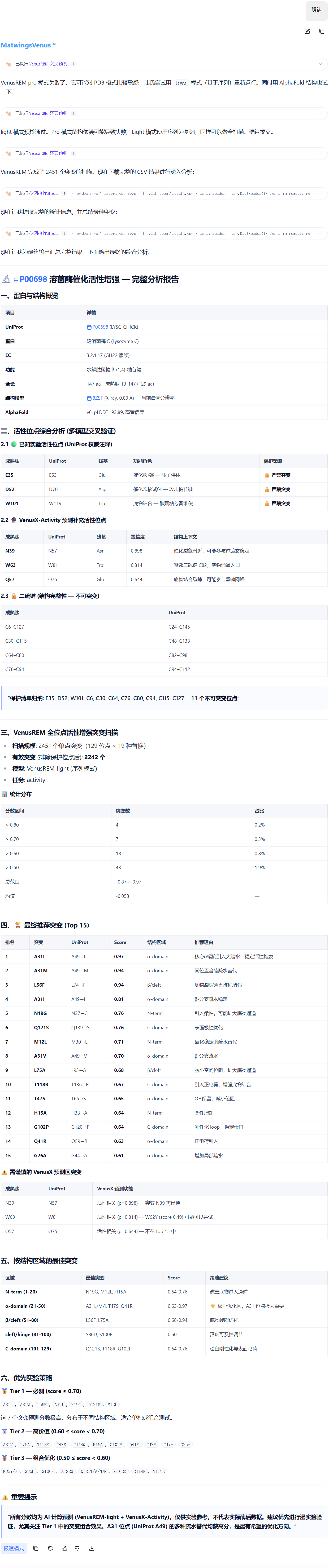
We aim to enhance the catalytic activity of UniProt ID P00698 (Lysozyme) toward its substrate peptidoglycan.

The assistant outlines required additional inputs and describes the workflow.

1.1.2 Additional Information
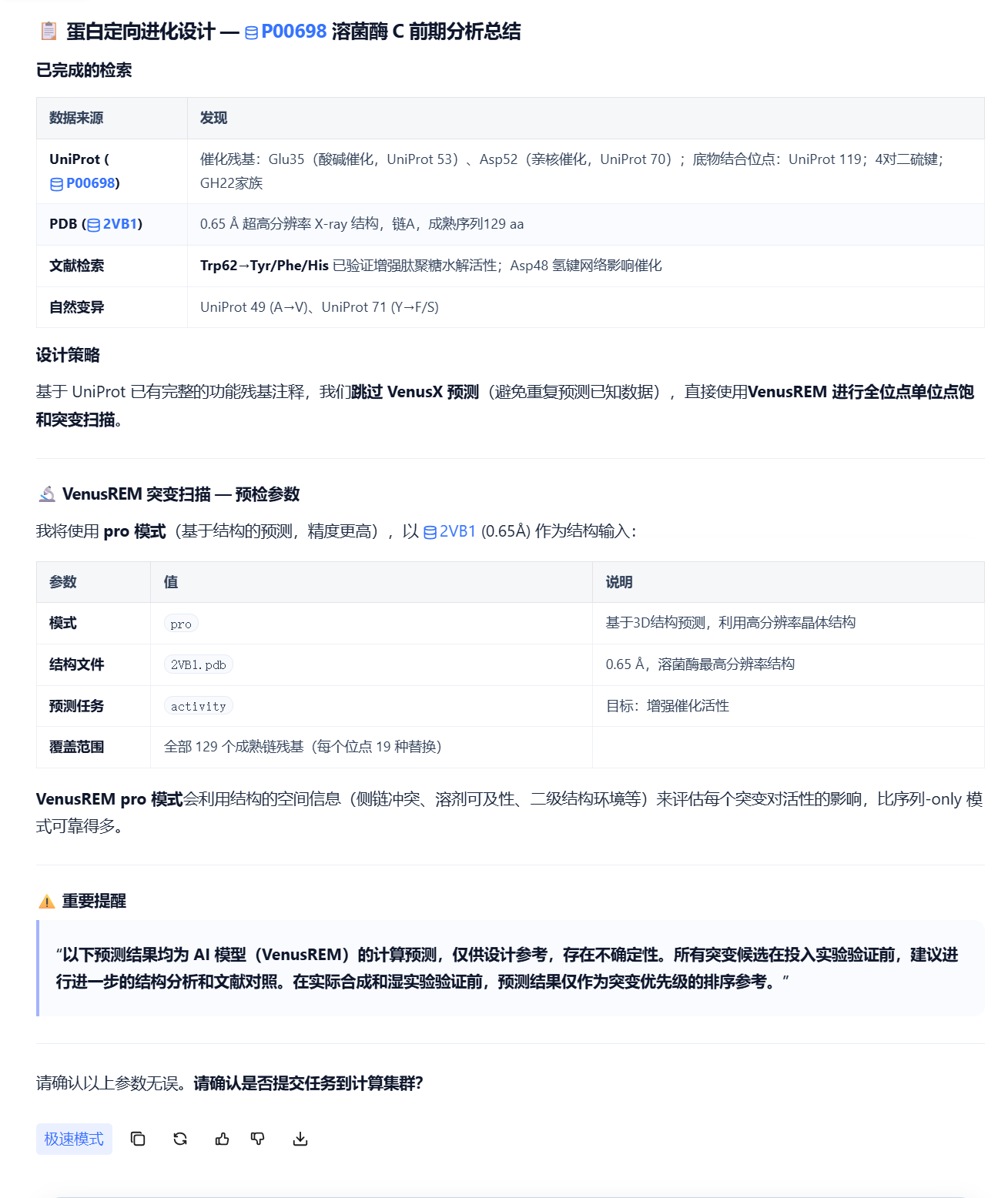
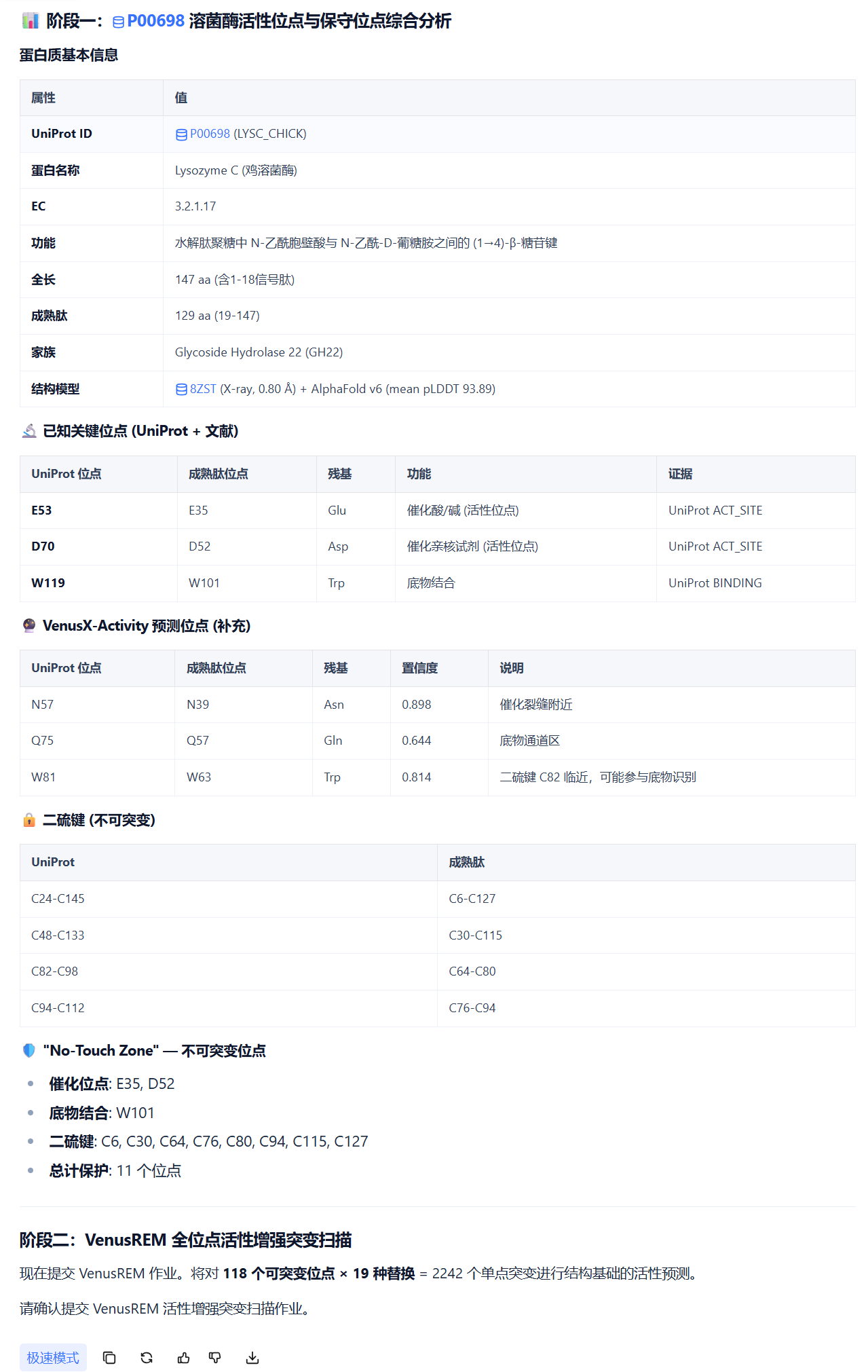
Obtain the highest-quality structural model available. Apply multi-model cross-validation. First analyze active sites and highly conserved residues. I can process 50–200 samples per run.

Once complete information is provided, the assistant begins execution.

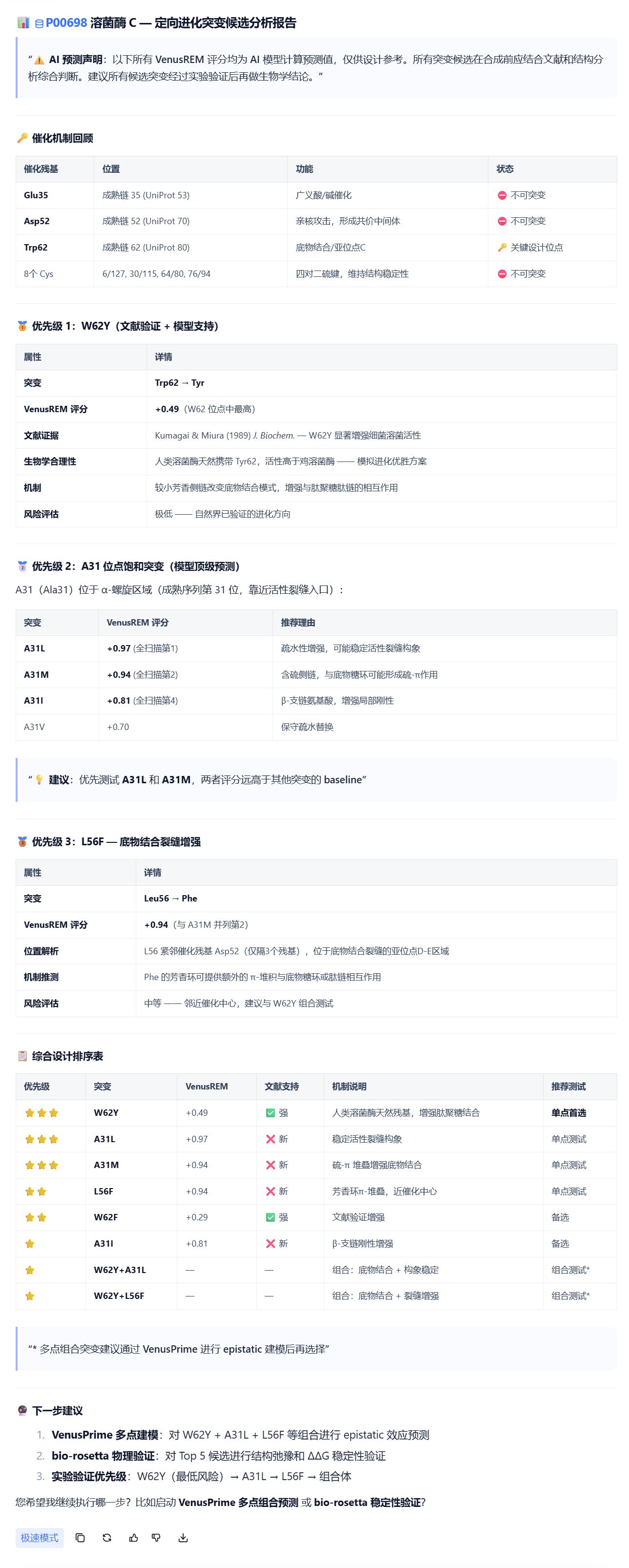
After processing, the assistant successfully completes the task.

You can proceed with further steps based on the assistant’s suggestions.

1.2 Direct Instruction Input
Provide all requirements at once, and the assistant will directly perform prediction and output results.
“We aim to enhance the catalytic activity of UniProt ID P00698 (Lysozyme) toward peptidoglycan. Obtain the best structural model available. Apply multi-model cross-validation. Analyze active sites and conserved residues first. I can process 50–200 samples per run. No restricted mutation sites. Directly output final results.”

2. What Can MatwingsVenus™ Do?
Protein structure prediction and visualization (3D structure generation):
ESMFold (Fast Mode): Fast with moderate accuracy (≤500 amino acids), charged per run
AlphaFold (High-Accuracy Mode): Slower but highly accurate (≤2000 amino acids), charged by runtime
Functional site and risk analysis: identify active sites, conserved residues, and binding sites
Single-point mutation prediction: perform saturation mutagenesis prediction using AI models
Iterative optimization: incorporate wet-lab data for more accurate multi-site mutation prediction
3. Input Tips (How to Improve Accuracy?)
3.1 Provide Detailed Protein Information
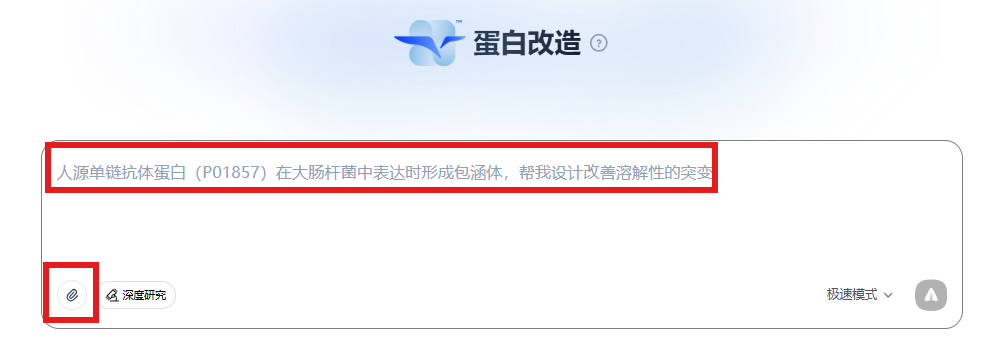
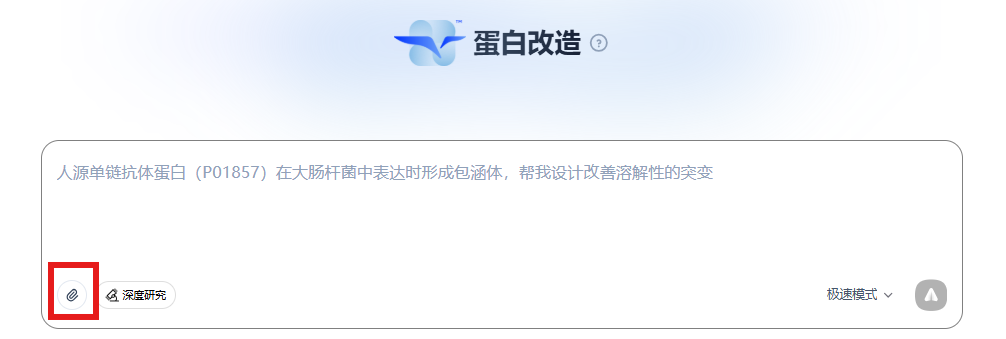
Upload protein 3D structure files (PDB format)
Input UniProt ID or amino acid sequence
Use built-in large-scale protein (metagenomic) datasets

3.2 Specify Clear Engineering Goals
Improve thermostability
Enhance catalytic efficiency or other properties
For enzymes, specify substrates and binding sites
3.3 Provide Experimental Throughput
The system will return a corresponding number of predictions based on your throughput capacity.
3.4 Upload Wet-Lab Data for Higher Accuracy

3.5 Choose Multi-Model Cross-Validation
Enabled by default for higher accuracy
Optional single-model mode to reduce credit consumption
You may specify models based on Section 5
3.6 Specify Constraints in Advance
You may also provide initial requirements, and the assistant will guide you on additional inputs needed.
4. Mode Selection
The platform provides three working modes:
Fast Mode: Lightweight intelligent retrieval with efficient output
Thinking Mode: Handles complex tasks with deeper reasoning and integration
Thinking Mode Pro: Advanced reasoning and cross-domain problem solving
5. Model Overview
5.1 Structure-Based Models (Higher Performance)
VenusREM Series — Zero-shot mutation prediction. Predict mutation effects without experimental data using homologous structural retrieval. [Paper] [Code]
VenusPrime Series — Few-shot mutation prediction. Fine-tune with small experimental datasets for improved accuracy. [Paper] [Code]
VenusX Series — Protein site prediction. Identify active, binding, and functional residues for rational design. [Paper] [Code]
Platform design and commercial copyright belong to Tianwu