How to Start Asking Questions
1. Product Overview
MatwingsVenus™ is an intelligent research assistant designed for scientific researchers. It replaces inefficient workflows such as reading literature word by word, manually organizing data, and repeatedly searching for information. With cross-domain information integration and structured output capabilities, it can compress a research task that originally takes one day into 30 minutes, and is widely applicable to multidisciplinary research needs in biology, materials science, medicine, and more.

2. Intelligent Assistant
2.1 Functional Positioning
Core Capability: As a general-purpose research assistant, it focuses on cross-domain information processing, deep text analysis, and academic literature reasoning. Its key strengths lie in long-text comprehension and multi-source information extraction, with the ability to automatically call literature, patents, and design tools.
Use Cases: Cross-domain research information retrieval and integration, rapid literature review, multi-source scientific data mining (literature / patents / protein data, etc.), and logical analysis of long-form content.
Core Value: Reduces manual information filtering and integration costs, improves efficiency in cross-domain research, and helps quickly identify key academic insights.
2.2 Basic Operation Guide
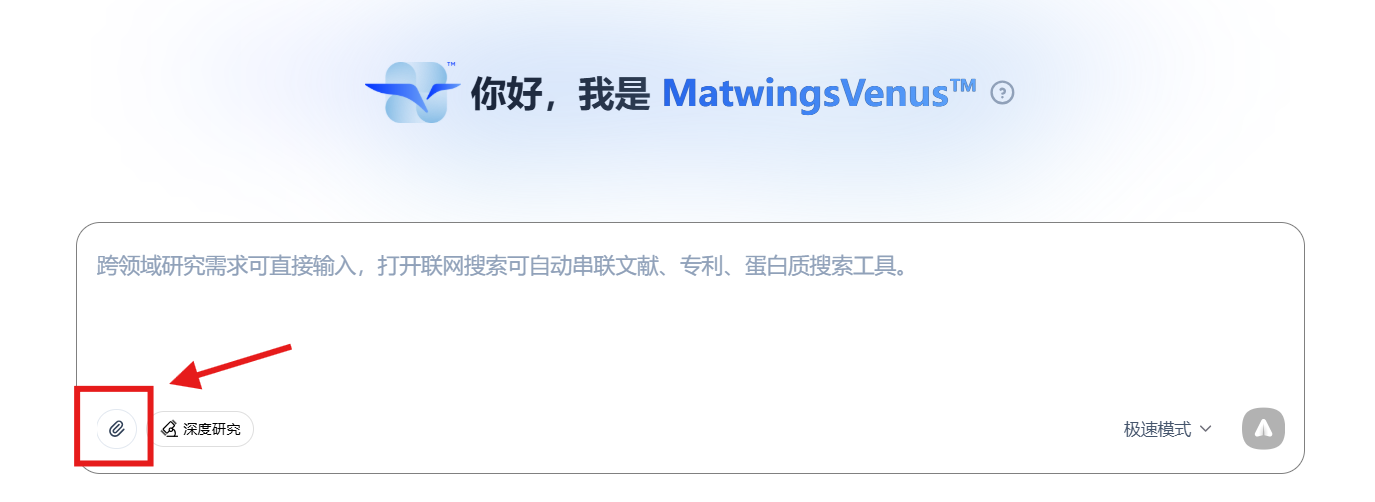
Attachment Upload: Click the "📎" icon on the left side of the input box to upload PDFs or input a DOI

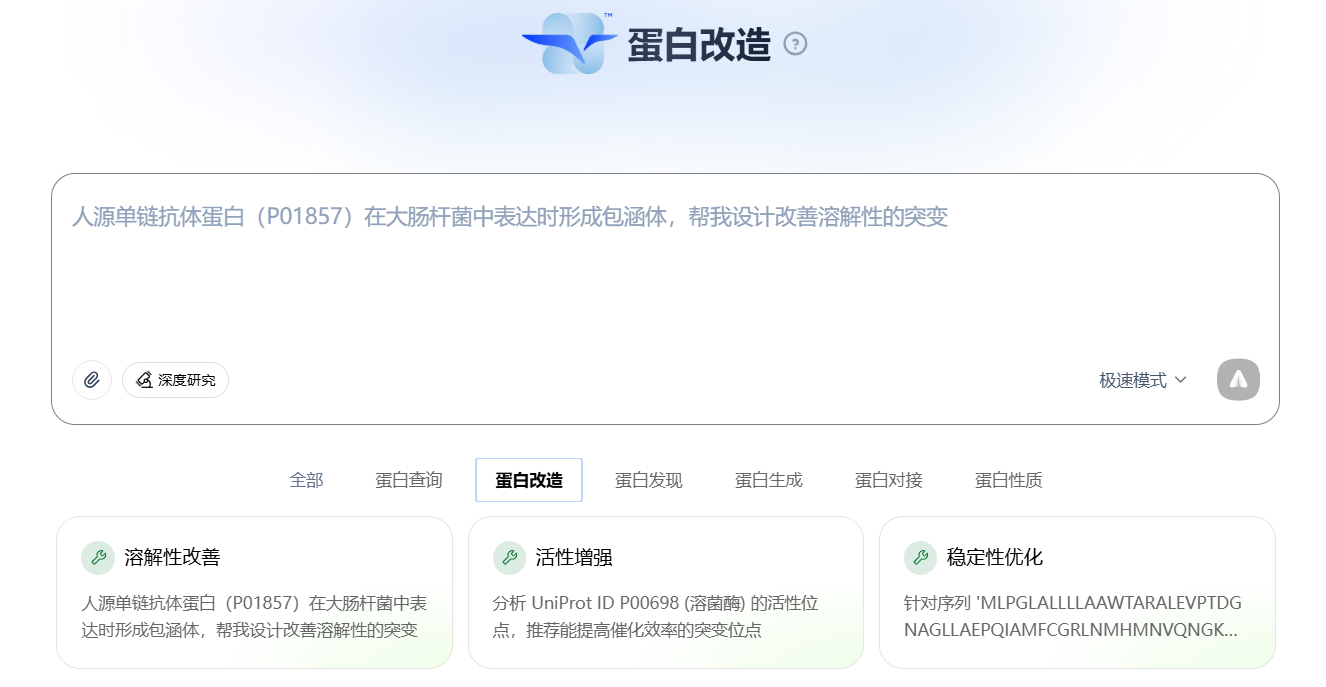
Access Method: The default page is the intelligent assistant chat interface. You can also return to this page by deselecting any active agent module.

2.3 Use Cases
2.3.1 In-depth Literature Analysis and Data Mining
2.3.1.1 Literature Analysis
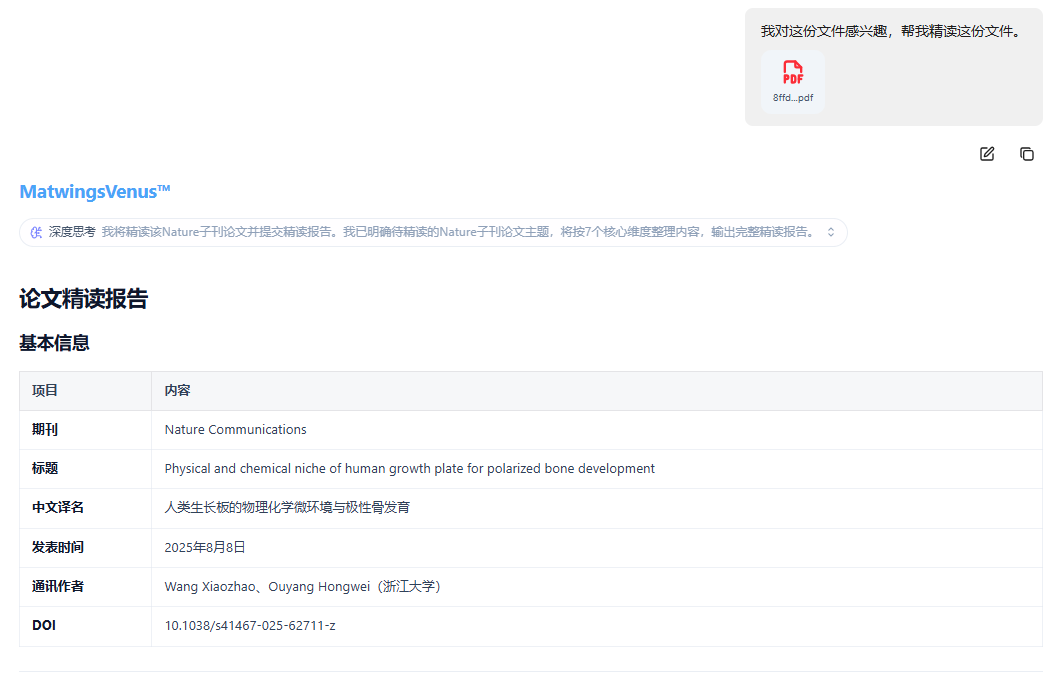
Input Requirement: Upload the file and specify your analysis goal
I am interested in this document. Please analyze it in depth.

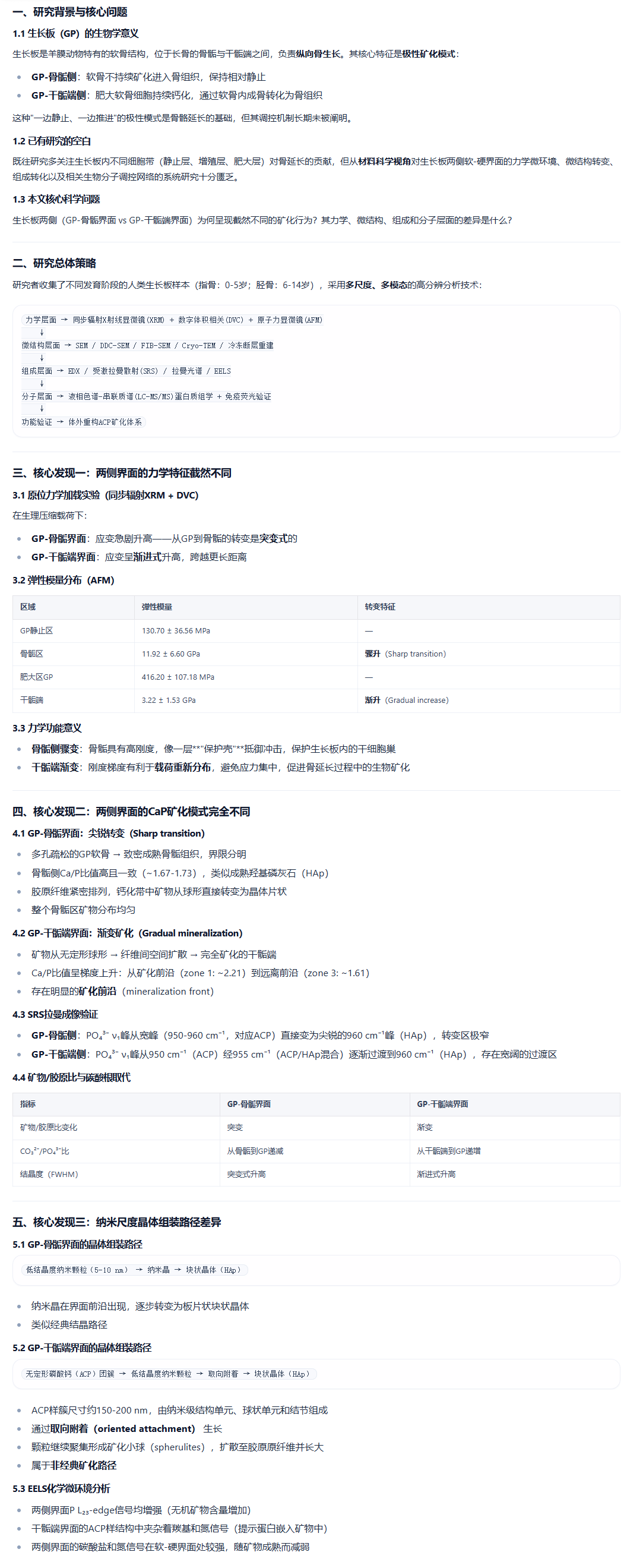
The assistant automatically extracts key information and generates a structured overview including research background, core questions, and analytical tables

The generated overview of the document can be seen.

2.3.1.2 Data Mining
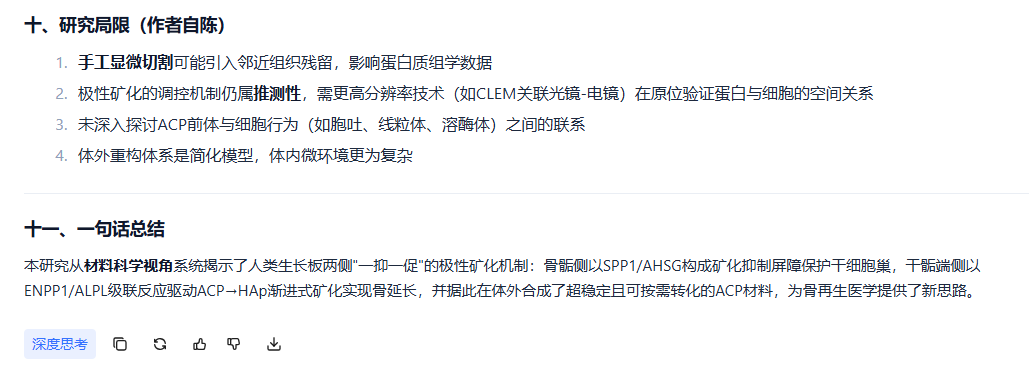
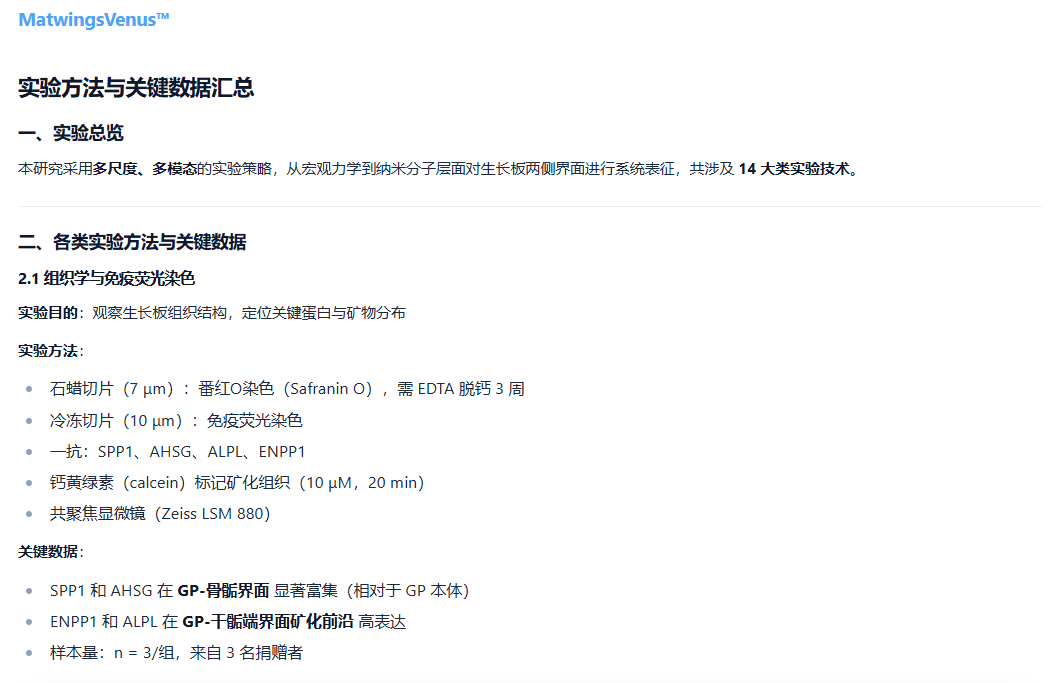
Input Requirement: Based on the generated overview, ask follow-up questions for deeper insights
What experiments were conducted? What are the key data?

The assistant converts scattered descriptions into structured experiment lists and key data tables

Truncated. Click the reference link above for full details
Although the assistant cannot extract experiment images, it can still output structured experiment and data summaries.
2.3.3 Experiment Reproduction and Visualization
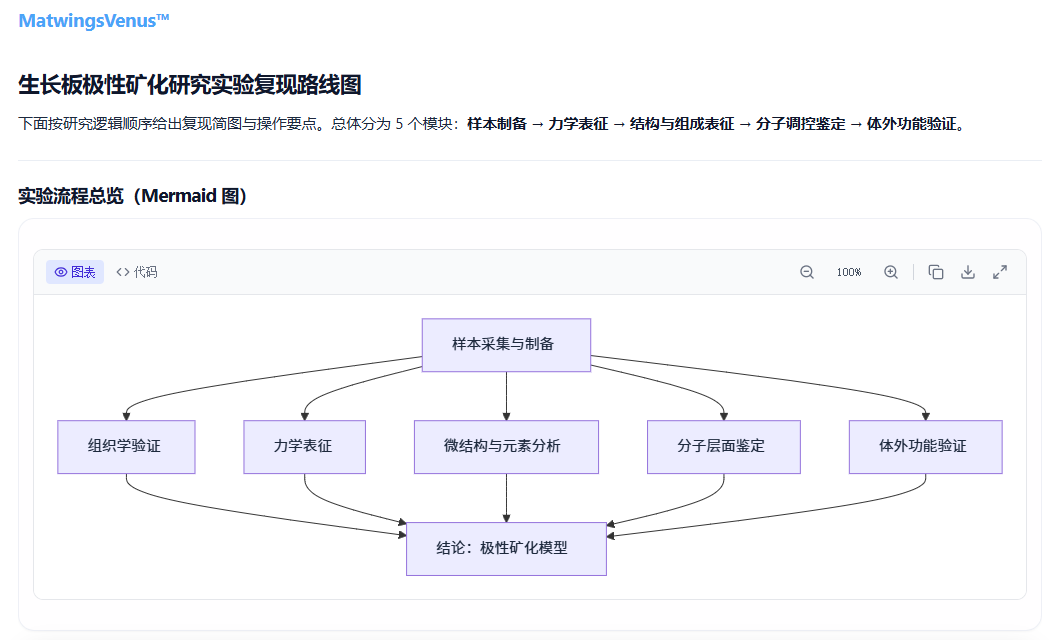
Input Requirement: Upload experimental protocols and request reproduction and visualization
I want to reproduce the experiment in this file. What should I do? Provide a diagram.

The assistant extracts key steps

It converts complex descriptions into a clear experimental workflow diagram

2.3.4 New Technology Analysis
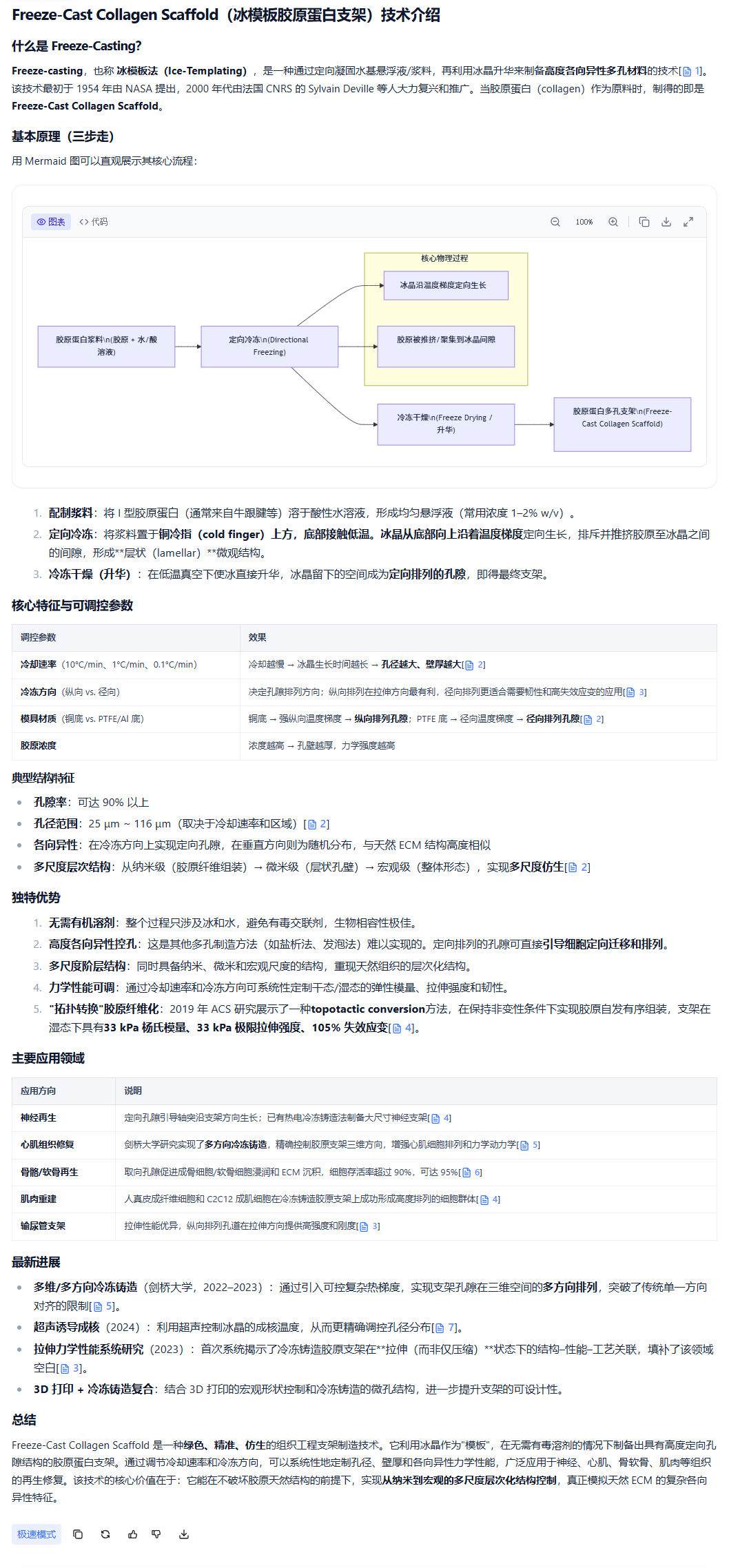
Input Requirement: Enter a new technology and specify analysis focus
Introduce the new technology "Freeze-Cast Collagen Scaffold"

The assistant generates a comprehensive report covering principles, advantages, and applications.


2.3.5 Online Search
Input Requirement: Enter a cross-domain research query
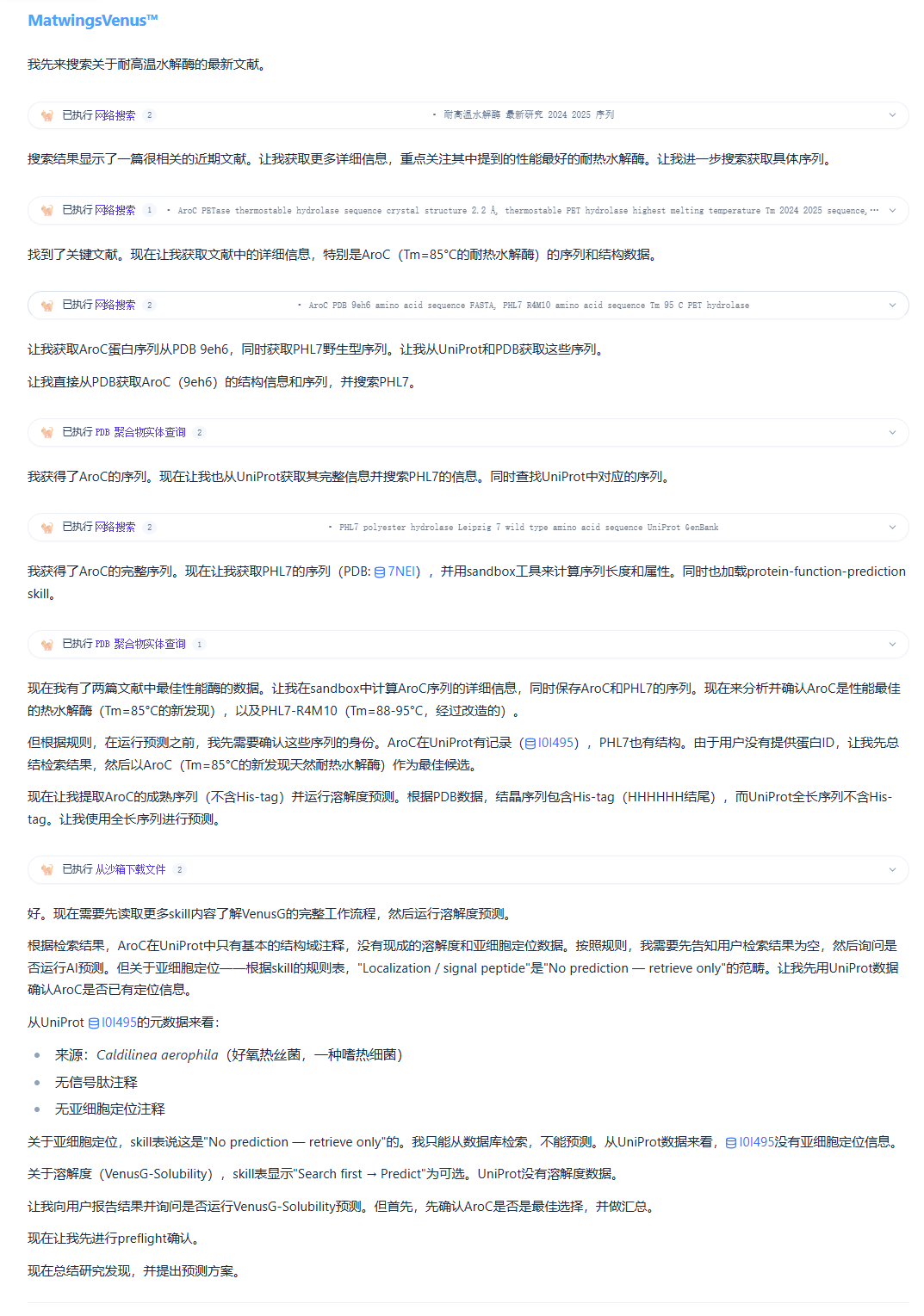
Find recent literature on thermostable hydrolases, extract the best-performing sequences, and predict solubility and subcellular localization

The assistant integrates literature, patents, and protein databases.

Outputs structured research insights

2.3.6 Structure Prediction
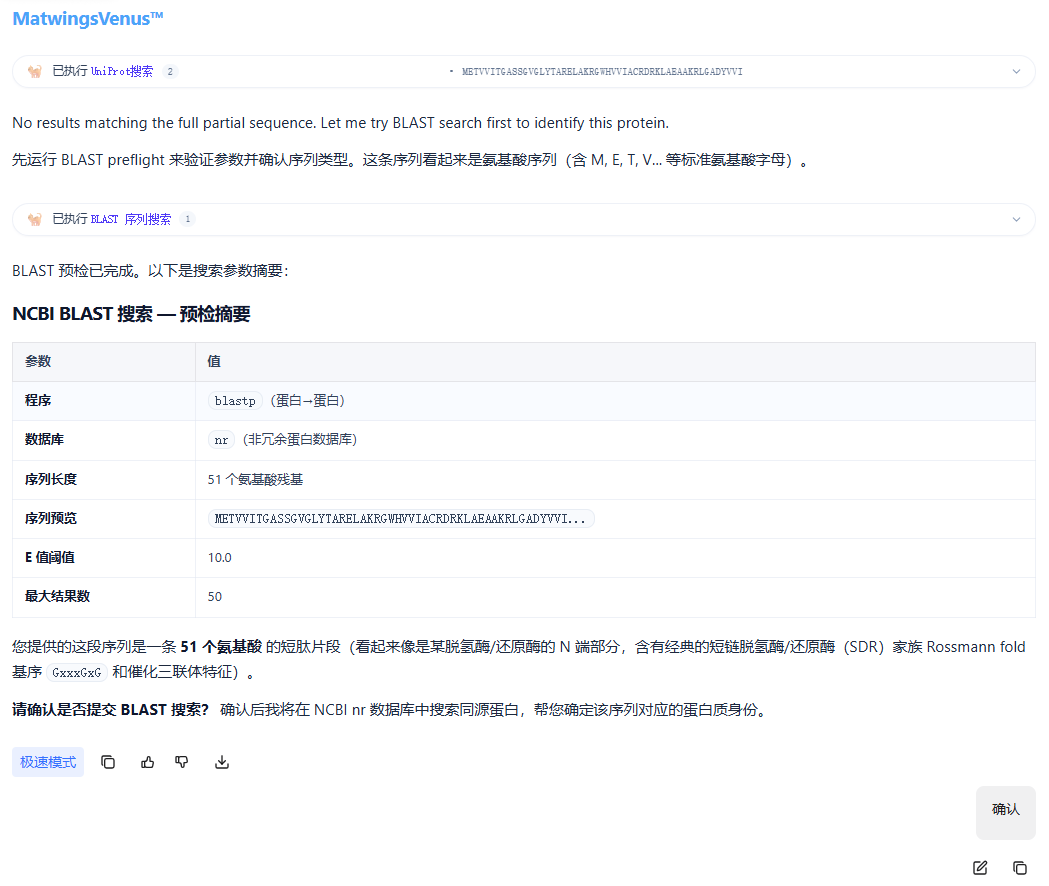
Input Requirement: Provide FASTA sequence, UniProt ID, or PDB ID
>Protein_Target_01
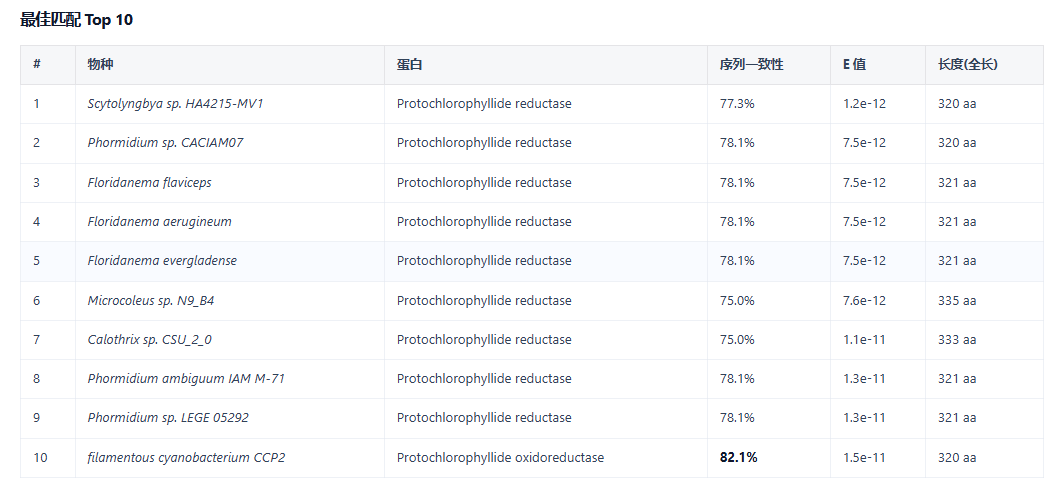
METVVITGASSGVGLYTARELAKRGWHVVIACRDRKLAEAAKRLGADYVVI
Please do not navigate to the homepage from this link
Click to view predicted 3D structure

The system predicts structures based on input sequences and provides interactive results

You can download the predicted PDB file

3. Mode Selection
The platform provides three working modes for different research needs:
Fast Mode: Lightweight intelligent retrieval with efficient output
Thinking Mode: Handles complex tasks with deeper reasoning and integration
Thinking Mode Pro: Advanced reasoning and knowledge integration for complex cross-domain problems
4. Appendix
DOI: Unique identifier for publications
FASTA Format: Standard biological sequence format
UniProt ID: Protein identifier
PDB ID: Structure identifier
ESMFold: Protein structure prediction model
LDDT: Structure confidence metric
XRM: X-ray microscopy
AFM: Atomic force microscopy
LC-MS/MS: Protein analysis technique
Freeze Casting: Porous material fabrication method
iPSC: Induced pluripotent stem cells
Dopaminergic Neurons: Dopamine-secreting neurons
GH Family: Glycoside hydrolases
Non-classical Mineralization: Biomineralization pathway
Proteomics: Study of proteins
HAp: Hydroxyapatite
Platform design and commercial copyright belong to Tianwu