VHH binder resin terminology and selection guide
Published on September 3, 2026
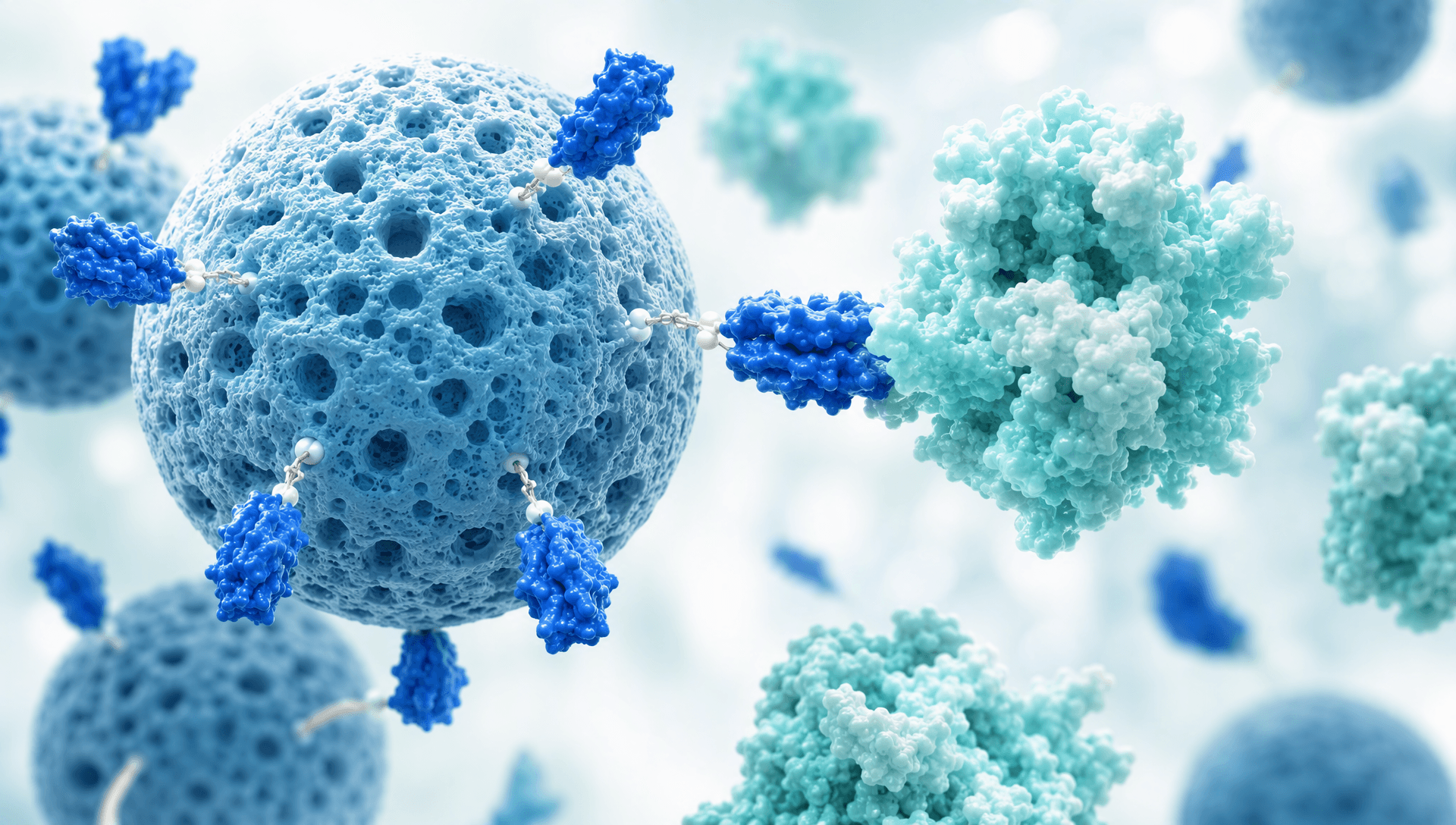
Immobilized camelid VHH ligands on porous resin selectively capture a target protein
1. A VHH binder resin must be defined by capture direction
The first selection question is not whether a product name contains “VHH,” “nanobody,” or “capture.” It is: What is immobilized on the matrix, and what molecule in the feed is intended to bind? If a VHH is immobilized to recognize another protein, the medium can reasonably be described as a nanobody-derived affinity resin. If the immobilized recognition element binds soluble VHH molecules, an anti-VHH affinity resin is generally intended to purify the VHH itself.
This distinction has immediate operational consequences. A research team recovering an expressed VHH from culture supernatant cannot assume that every VHH-labeled resin will perform that task. Conversely, a VHH capture resin developed for a specialized biologic must be interpreted through its target and epitope documentation—not through the word VHH alone.
Peer-reviewed work has shown that camelid VHH fragments can serve as tunable immunoaffinity ligands for target capture and, in specific systems, for separating closely related product forms. The finding supports the technical rationale for VHH-derived media. It does not imply that every VHH ligand provides the same selectivity, robustness, or process fit.
2. How to interpret the four search terms
VHH binder resin
This is the broadest and most ambiguous phrase. It may mean a resin carrying a VHH binder, or a resin that binds a VHH. A useful product page or quotation should therefore state three items explicitly: ligand identity, capture target, and recommended application. Without them, keyword matching is not enough to support procurement.
Nanobody-derived affinity resin
This phrase focuses on ligand origin. The immobilized recognition element is derived from a nanobody or VHH and usually captures the protein, conformation, or molecular form recognized by that ligand. “Derived,” however, does not specify coupling orientation, accessible ligand density, regeneration tolerance, or useful lifetime.
Anti-VHH affinity resin
The “anti-VHH” label normally suggests that the immobilized recognition element is directed against VHH, making the medium relevant to purification of a VHH product from bacterial, yeast, or mammalian expression streams. Commercial naming is not a universal standard. Buyers should still verify camelid-species coverage, tag dependence, construct compatibility, feed requirements, and elution conditions.
VHH capture resin
This application-oriented name can be read in two ways: a resin that captures VHH, or a resin that uses VHH to capture something else. The most reliable technical description is therefore “ligand = ; target = ,” followed by binding, washing, and elution conditions.
Comparison of immobilized VHH capturing a target and an anti-VHH recognition element capturing soluble VHH
3. What to verify when selecting a VHH binder resin
Once the capture direction is clear, performance can be compared. Use representative feed and harmonized test methods to evaluate:
• Ligand and target: ligand origin, target epitope, compatible species or constructs, and tag dependence;
• Binding conditions: recommended pH, ionic strength, flow rate, residence time, and sample preparation;
• Capacity: static capacity and dynamic binding capacity at the intended flow rate, with the breakthrough definition stated;
• Elution and product quality: recovery, purity, retained activity, aggregation, and clearance of critical impurities;
• Cleaning and lifetime: ligand leakage, backpressure, capacity retention, and cycle stability.
In one study of an anti-Fc VHH ligand resin, IgGs were reported to bind across pH 6.0–9.0 and elute at pH 5.0. Static binding capacities for different IgG samples ranged from 3.40 ± 0.53 to 15.04 ± 0.37 mg/mL, and recovery did not decrease after ten purification cycles. These data illustrate that a VHH ligand can create an attractive process window. They also demonstrate why numbers must remain attached to the tested ligand, target, matrix, and method; they are not specifications for unrelated products.
A lower-risk procurement sequence is to screen a small quantity, run a small-column study with representative feed, challenge the cleaning procedure, and only then consider scale-up. Theoretical affinity alone does not establish usable capacity, recovery, impurity clearance, or cycle life.
4. MatwingsVenus™(晓鹜™)platform workflow and marketplace connection
When available documentation does not answer questions about ligand direction, epitope choice, or process tolerance, MatwingsVenus™(晓鹜™) can connect retrieval, evaluation, and design in an evidence-first protein R&D chain. The workflow begins with known binders and interface evidence, continues through sequence, structure, and stability-risk assessment, and then routes to engineering of an existing protein or design of a new binder only when justified.
A marketplace request can be organized as a task–output–next-step chain:
• Task input: target protein or VHH construct, feed type, intended capture direction, acceptable elution window, and proposed matrix;
• Platform output: source-backed binder evidence, candidate sequence and structural risks, traceable predictions, and an experimental validation plan;
• Next step: express and immobilize candidates, test dynamic capacity, recovery, and impurity clearance in a small column, then use cycle data to decide whether to iterate or scale.
When exploring relevant products or services through the Matwings Mall, include “ligand = ; target = ” in the request and ask for applicable sample types, buffer conditions, storage instructions, and lot-control information. Platform capability descriptions do not establish the inventory, lead time, or performance of a particular resin SKU. Current marketplace pages, technical documents, and project confirmation remain authoritative.
Workflow from capture-direction definition and evidence retrieval to small-column testing and scale-up
FAQ
Does anti-VHH affinity resin always purify untagged VHH?
Not necessarily. Tag-free capture depends on the immobilized recognition molecule and product design. A resin may recognize a particular VHH framework, epitope, species origin, or construct format. Verify the ligand description and compatible samples, then confirm performance experimentally.
Are VHH capture resin and nanobody-derived affinity resin interchangeable terms?
Not on the basis of naming alone. The former may mean “capture VHH” or “capture with VHH,” whereas the latter more clearly describes VHH as the ligand source. They can be compared only after ligand, target, matrix, and operating window are shown to align.
How can buyers screen VHH binder resin information quickly?
First reject listings that do not clearly identify the ligand and capture target. Then compare dynamic capacity, elution conditions, cleaning compatibility, cycle data, and ligand leakage. For valuable samples, qualify a small amount of resin or a prepacked column before scaling rather than relying on theoretical affinity.
Conclusion
The four keywords look similar, but capture direction and supporting evidence determine whether a resin fits the job. A VHH binder resin may describe a VHH-derived ligand medium or be interpreted as a medium that binds VHH. Procurement teams should therefore define the ligand, target, feed, and process window explicitly. By moving evidence retrieval and candidate assessment earlier with MatwingsVenus™(晓鹜™), then closing the decision with small-column and cycling experiments, teams can turn search terminology into an executable and testable purification strategy.