What Is the UniProt Protein Database? A Guide to the Authoritative Resource for Protein Sequences and Functional Annotation
Published on November 2, 2026
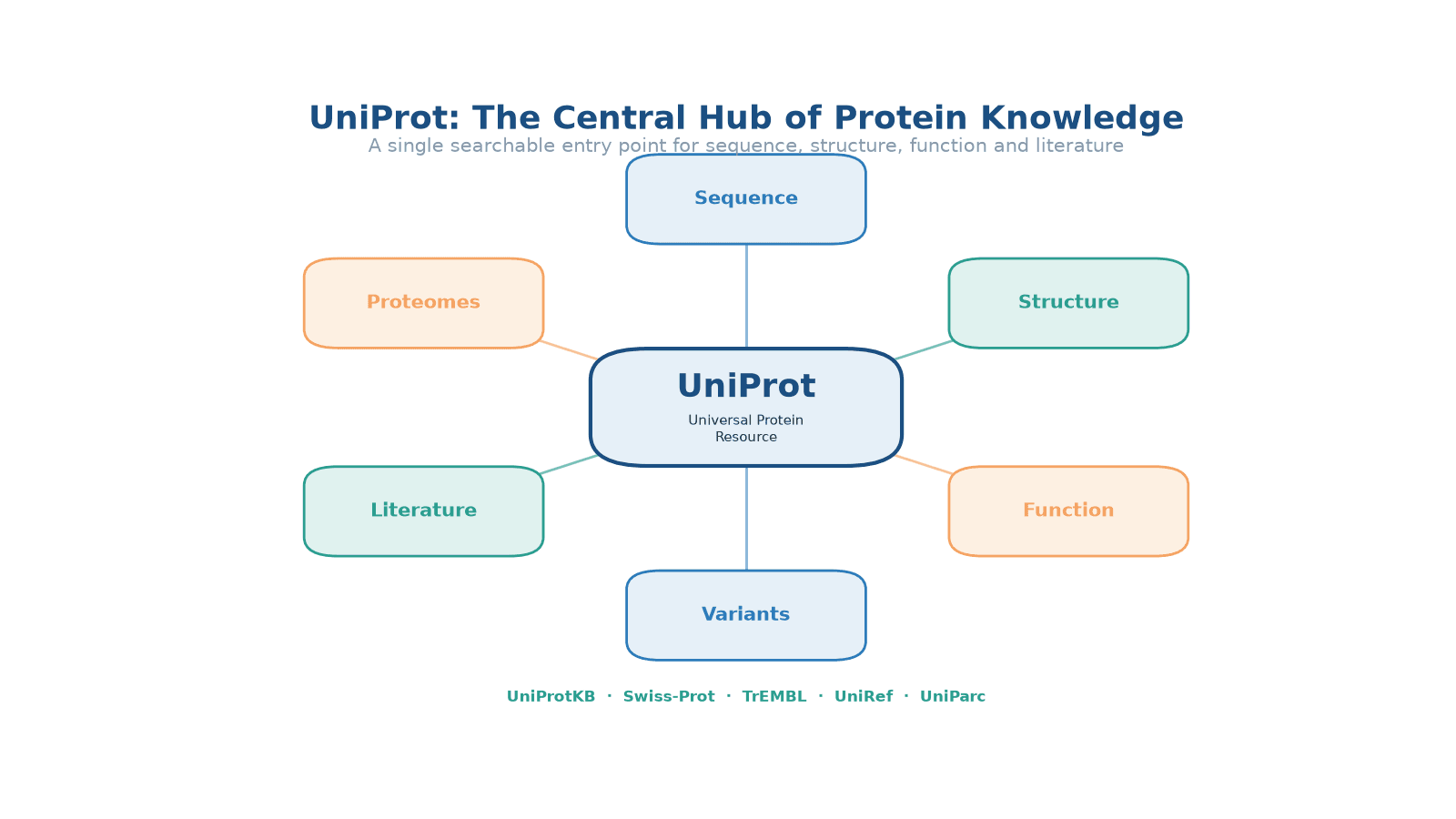
Figure 1 UniProt: the central hub of protein knowledge
1. What is UniProt, and why does protein research depend on it?
UniProt (Universal Protein Resource) is an authoritative platform that integrates global protein sequence, structure and functional information into a unified, searchable database, maintained by the European Bioinformatics Institute (EMBL-EBI), the Swiss Institute of Bioinformatics (SIB) and the Protein Information Resource (PIR); it is essential to life-science research, drug discovery and protein engineering, and is completely free to use. Before it existed, different institutions maintained separate protein databases with inconsistent naming; UniProt's role is to gather these "fragments" into one public, traceable and cross-referenceable authoritative "protein dictionary".
Why is it so important?
· Single entry point: from one sequence, gene name or functional keyword you can locate the same protein record, avoiding repeated jumps between databases; there is no need to piece together similar information elsewhere.
· Traceable evidence: every manually curated Swiss-Prot record cites its source literature and experimental evidence, enabling verification and citation, so papers and engineering work are evidence-based.
· Machine-readable: it supports FASTA, TSV, GFF and a REST API, facilitating batch analysis, modeling and automated workflows, making it a key data backbone for modern omics and computational biology.
· Cross-database hub: each record cross-links to PDB structures, gene databases, literature and variant databases, so one search connects the full picture of sequence, structure and function.
A practical example: suppose you want to engineer an industrial enzyme to be more heat-stable. You usually start by searching UniProt by function or species, open the enzyme's Swiss-Prot record, and read its manual annotation: where the active site is, which residues form the catalytic center, and whether there are known heat-resistant or inactivating variants; then you decide which positions to modify. Without a unified knowledgebase, this information might be scattered across many papers, making the compilation very costly. In short, UniProt answers the most basic yet critical questions in science: "What is this protein, where did it come from, what is its sequence, and what might it do?"
2. UniProt's core components and data layers
UniProt is built from three complementary components: the central knowledgebase UniProtKB holds both curated and automatically annotated records, UniParc archives all non-redundant sequences, and UniRef clusters sequences by similarity to remove redundancy; together they support reliable, efficient large-scale protein search and analysis, alongside species-specific Proteomes sets. Understanding these layers is the prerequisite for choosing the right data and the right tool.
· UniProtKB (Knowledgebase): the hub of protein function and annotation, in two sections—
· Swiss-Prot: manually curated and reviewed; every record is checked by experts against the literature and experimental evidence; about 570,000 records as of the latest release, with high annotation quality and confidence, and the first choice for research and engineering.
· TrEMBL: automatically annotated and unreviewed; sequences come from translated coding sequences in nucleotide databases; it exceeds 250 million records, offering broad coverage but annotations mostly predicted computationally and lower in confidence.
· UniParc (Archive): stores and de-duplicates all publicly available protein sequences, with cross-references, to track "where a sequence has appeared", ensuring full coverage at the sequence level.
· UniRef (Reference Clusters): clusters UniProtKB and UniParc sequences at 100%/90%/50% identity, using a representative entry per cluster to cut redundancy and speed up large-scale comparisons.
· Proteomes: provides complete proteome sets for given species, enabling whole-proteome analysis, a convenient entry point for omics research.
Beyond the sequence itself, a typical UniProtKB record usually documents: protein and gene names, function description, subcellular localization, GO function/process/component annotations, domains and motifs, post-translational modifications, isoforms and variants, interactions and cross-references. Together these fields form a "multi-dimensional portrait" of the protein. Each record has a unique accession number (e.g., human p53 = P04637), like a protein's "ID card", used for precise location and cross-referencing.
Understanding the difference between Swiss-Prot and TrEMBL is key: Swiss-Prot is "expert-reviewed", suitable for direct citation and high-confidence analysis; TrEMBL is "machine-annotated", suitable for large-scale scans where some prediction error is acceptable. They complement rather than replace each other.

Figure 2 UniProt data layers and annotation
3. How to search and use UniProt: a selection guide
The key to using UniProt is to first decide what you want and at what confidence level, then choose between Swiss-Prot's manual curation, TrEMBL's automatic annotation, UniRef's clustering or UniParc's archive, so you get reliable results with maximum efficiency. Here are the most common paths.
· Search entry: at www.uniprot.org, search full text by gene name, protein name, function, species or disease keyword, and combine conditions with Boolean logic; you can also browse by Taxonomy or enter a specific Proteome.
· Precise location: enter an accession number (e.g., P04637) to uniquely locate a record and avoid name ambiguity; view sequence, annotation and cross-references on the record page.
· Field filtering: narrow results with qualifiers such as `gene:TP53 AND organism:Homo sapiens`, or restrict to reviewed-only Swiss-Prot records.
· Sequence search: paste an amino-acid sequence and use BLAST-like tools to find similar proteins within or across databases, ideal for identifying unknown sequences and homology analysis.
· Selection: for high-confidence, citable annotation, prefer Swiss-Prot; for broad coverage including predicted annotation, use TrEMBL; for de-duplicated large-scale comparison, use UniRef; for cross-database source tracking, use UniParc.
· Download and batch: export FASTA, TSV, GFF, and access the REST API for batch analysis; for large-scale work, download whole sets or on demand.
Tip: when looking up a single protein or citing it in a paper, prefer Swiss-Prot; use TrEMBL and UniRef mainly for large-scale scans where high precision is not required. Learning to use field filtering is a key step in improving search efficiency.
4. UniProt in protein engineering and AI-assisted design
In protein engineering and computational design, UniProt often serves as the "evidence base", supplying wild-type sequences, manually verified functional annotation, structural cross-references and variant information, so that mutation design, affinity maturation, stability optimization and structure prediction have traceable inputs and a validation baseline. This helps keep high-throughput AI predictions grounded in real biology and makes engineering modification more evidence-based.
In a typical workflow, UniProt plays at least four roles
· Design start: obtain a manually verified wild-type sequence and key functional sites from Swiss-Prot as the "original version" for engineering; this is more reliable and time-saving than manually copying sequences from papers.
· Structural bridge: cross-reference to PDB structures to understand a residue's role in 3D space (e.g., catalytic sites, antigen-binding sites, interface residues), providing spatial clues for site-directed modification.
· Variant reference: link disease-related variants and experimental data to help judge which residues matter and which changes carry more risk, avoiding hasty modifications at conserved key positions.
· Result validation: cross-check AI-predicted structure or function against UniProt's existing experimental annotation to assess plausibility, forming an "evidence-first" loop.
In concrete scenarios: for antibody optimization, retrieve the human/mouse germline sequences of the heavy and light chains from UniProt to identify CDR and framework regions; for enzyme engineering and directed evolution, use UniProt annotation to locate active sites and substrate-binding residues, narrowing the mutation search space; for stability engineering, use existing heat-resistant or disease-causing variant information to avoid risk.
Matwings Technology (天鹜科技) focuses on protein design and engineering, with an emphasis on supporting AI decisions with verifiable biological evidence. In workflows such as antibody affinity optimization, enzyme engineering and stability improvement, authoritative databases like UniProt provide reliable wild-type sequences and annotation references; MatwingsVenus®(晓鹜®) combines such evidence with computational design and experimental validation to help users screen candidates more rationally and reduce the gap between "an appealing prediction" and "a failed experiment". High-confidence sequences and annotations are exactly what make computational design align with real experiments.

Figure 3 Protein engineering workflow with UniProt
5. FAQ
How are UniProt, Swiss-Prot and TrEMBL related?
UniProt is the umbrella platform and UniProtKB is its core knowledgebase; UniProtKB is further split into the manually curated Swiss-Prot and the automatically annotated TrEMBL — a "whole–sub-database–sub-database" containment relationship.
Is UniProt free? How do I access it?
Yes, it is free. You can search at www.uniprot.org, download database files, or call the REST API for batch access, with no registration required.
Why use UniProt in protein engineering?
Because it offers high-confidence wild-type sequences, functional annotation and variant information that serve as a design start point and validation baseline, helping reduce the gap between computational prediction and real biology.
Which should I choose, Swiss-Prot or TrEMBL?
Choose Swiss-Prot for high-confidence, citable annotation; choose TrEMBL for broad coverage where predicted annotation is acceptable.
6. Summary
UniProt is the most important "unified knowledgebase" for global protein research: with UniProtKB at its core and UniParc and UniRef alongside, it integrates sequence, structure, function and literature into a public, traceable and machine-readable authoritative resource. Understanding its layered structure and mastering search and selection essentials is the foundation for protein research, protein engineering and AI-assisted design.