
Mild-elution Protein A Affinity Resin: How Does Mild Elution Reduce Low-pH Damage?
Published on November 15, 2026
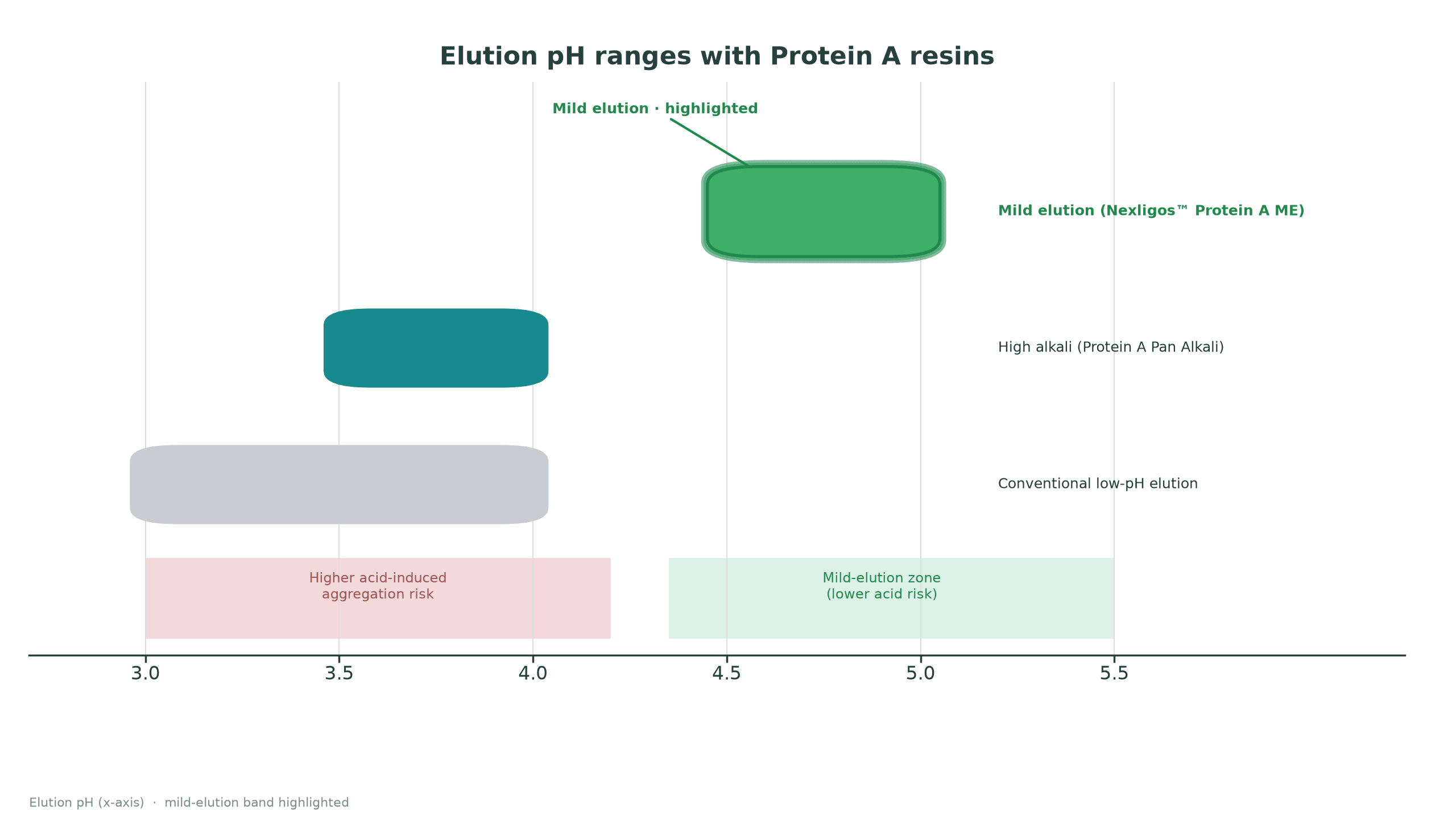
Fig.1 Elution pH ranges of Protein A resins
In the large-scale capture of monoclonal antibodies, bispecifics, ADCs and Fc-fusion proteins, Protein A affinity chromatography is almost always the first step. What decides product quality is often not the “binding” but the “release” — that is, the elution step. This article centres on mild elution: what it is, what problem it solves, and the practical benefits it brings.
What is mild elution
Mild elution refers to releasing the antibody from the Protein A ligand at a near-neutral, mildly acidic pH (usually 4.5–5.0), instead of dropping to pH 3.0–4.0 as in conventional processes. It is “mild” in two ways: the elution pH is higher so the acid stress is weaker, and the antibody spends less time in an acidic environment. This markedly reduces acid-induced conformational change, aggregation and activity loss.
Why mild elution is needed
Conventional Protein A resins rely on a low pH (3.0–4.0) to elute; the more acidic the conditions, the more readily the antibody denatures. For low-pH-sensitive molecules — IgG4, bispecific/multispecific antibodies, ADCs and Fc-fusion proteins — the risk of aggregation and activity loss is higher, and extra aggregate-removal steps may be needed, adding process load and cost. Raising the acidic condition with mild elution reduces acid-denaturation risk on one hand, and on the other lowers downstream ultrafiltration and reprocessing cost, improving overall recovery and process robustness.
The binding site: a reversible handshake between ligand and Fc
A Protein A domain binds the CH2–CH3 interface of the antibody Fc region mainly through hydrogen bonds and hydrophobic interactions; the binding strength is pH-sensitive and involves key histidine residues on the Fc. After rational engineering by MatwingsVenus®, the Nexligos™ Protein A ME ligand keeps its affinity and dynamic binding capacity unchanged at neutral pH (7.0–7.4) yet fully dissociates at pH 4.5–5.0, effectively raising the elution window.

Fig.2 Protein A–Fc binding site
Matwings Technology product features and value
The Nexligos™ Protein A series from Matwings Technology turns “mild elution” and “alkali resistance” into a clear gradient, selected by process need:
Resin | Position | Elution pH | Alkali (CIP) | Dynamic binding capacity (6 min) | Typical use |
Nexligos™ Protein A ME | Mild elution | 4.5–5.0 | 0.5 M NaOH (72 h) | ≈60 mg/mL | pH-sensitive antibodies, IgG4, bispecifics, ADC, Fc-fusion |
Nexligos™ Protein A Pan Alkali | High alkali | 3.5–4.0 | 0.5–1.0 M NaOH (72 h ≈100% capacity) | ≈80 mg/mL | large-scale mAb / bispecific / Fc-fusion, high-intensity CIP |
Nexligos™ Protein A Alkali | Standard alkali | — | 0.1–0.5 M NaOH | ≈70 mg/mL | routine mAb purification, cyclic CIP |
The three resins each have strengths: Protein A ME trades a gentler condition for higher recovery and more stable antibody quality (≈86.9% recovery at pH 5.0, main-peak elution pH ≈4.97); Protein A Pan Alkali withstands 0.5–1.0 M NaOH for strong cleaning, extending resin life and lowering consumable cost, with ≥95% purity recovery for IgG1/2/4 subclasses and 98% Fab recovery; Protein A Alkali delivers ≈70 mg/mL at six minutes for routine cyclic CIP. All three use single-point coupling, ≈60 μm mean particle size and a recommended maximum flow of ≈300 cm/h, selectable by CIP intensity and elution requirement.
Application and process
The series shares one process: load and bind under neutral conditions → wash to remove impurities → mild/acidic elution → neutralise and collect. It suits large-scale capture of IgG4, bispecific/multispecific antibodies, ADCs and Fc-fusion proteins, and can also purify polyclonal antibodies from ascites or plasma.

Fig.3 Bind→wash→mild/acidic elution→neutralise
Product and inquiry
Nexligos™ Protein A series comprises Protein A ME (PR003 series), Protein A Pan Alkali (PR002 series) and Protein A Alkali (PR001 series), available from 25 mL to 20 L, with custom formats on request. Please contact MatwingsVenus® Mall for details.
Related products & services
• Nexligos™ Protein A series & custom inquiry
• Wet-lab Product Centre
• Expert Centre
• Dry-wet Closed-loop Platform
FAQ
Q: What is a mild-elution Protein A affinity resin?
A: It is a Protein A affinity resin that releases antibodies from the media at a gentler pH (e.g., 4.5–5.0) than conventional resins, reducing aggregation and activity loss caused by low-pH elution.
Q: Why use mild elution?
A: Because conventional low-pH (3.0–4.0) elution can denature and aggregate antibodies, especially low-pH-sensitive molecules like IgG4, bispecifics, ADC and Fc-fusion; mild elution reduces acid-induced damage and downstream aggregate-removal steps.
Q: How do I choose among the three Nexligos™ Protein A resins?
A: For pH-sensitive molecules (IgG4, bispecifics, ADC, Fc-fusion) prefer Protein A ME; for large-scale processes requiring 0.5–1.0 M NaOH cleaning choose Protein A Pan Alkali; for routine mAb cyclic CIP choose Protein A Alkali.
Q: How do I request a quote or buy?
A: Contact MatwingsVenus® Mall; formats 25 mL–20 L, with custom formats available on request.
【One-sentence takeaway】
Mild elution raises the release condition from pH 3.0–4.0 to pH 4.5–5.0, lowering acid-induced aggregation risk; Nexligos™ Protein A ME keeps recovery above 85% at pH 5.0, suiting IgG4, bispecifics, ADC and Fc-fusion molecules.