
Transglutaminase: The Molecular “Protein Glue” Powering Food and Industrial Enzyme Engineering
Published on November 3, 2026
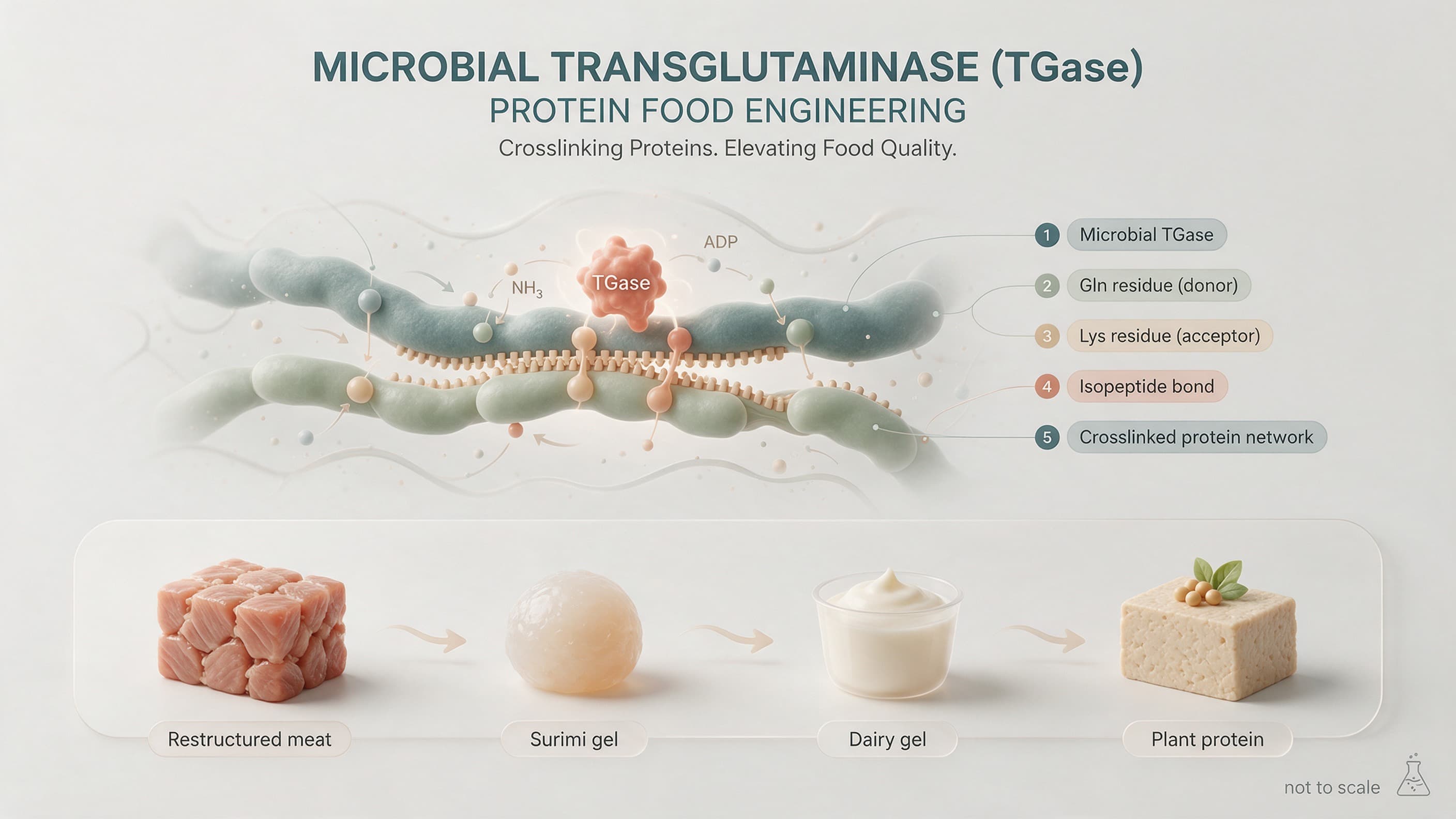
figure1. Full-chain landscape of transglutaminase from Gln-Lys cross-linking to food applications
Classification: Enzymology & Enzyme Engineering (Related: Food Biotechnology)
1. Transglutaminase: From Plain Understanding to Professional Definition
1.1 What Is Transglutaminase in Plain Terms
Picture proteins as strings of beads, each bead an amino acid. Transglutaminase (TGase) works like a skilled seamstress: it spots a glutamine on one string and a lysine on another, pulls them together and ties a knot that is almost impossible to undo. That knot is the isopeptide bond. Once tied, the two strings become one piece that is springier and tougher.
The standard definition is: transglutaminase (EC 2.3.2.13), also named protein-glutamine γ-glutamyltransferase, catalyzes an acyl transfer in which the γ-carboxamide group of a peptide-bound glutamine residue (acyl donor) reacts with the ε-amino group of a lysine residue (acyl acceptor) to form an ε-(γ-glutamyl)lysine isopeptide bond with release of ammonia.
In plain words, it turns loose, crumbly meat into an elastic meatball by forging covalent bonds between protein molecules. These are far stronger than physical entanglement, which is why treated products stay intact through sterilization, freezing and slicing.
1.2 Industry Value and Typical Applications
The core value of TGase is giving foods a sturdier scaffold: it raises gel strength, water-holding capacity, elasticity and binding. Typical applications include:
• Restructured meat: meatballs, sausages, steak rolls, formed poultry
• Surimi and seafood: fish balls, imitation crab sticks
• Dairy: yogurt body, cheese yield and texture
• Plant protein: plant-meat gels, tofu-like elasticity
• Protein modification: films, tissue scaffolds, biomaterials
TGase also finds use in biomedical materials, tissue engineering and cosmetics, making it a general cross-linking tool spanning food and biomaterials, and a frequent target of modern enzyme engineering.
2. Main Technical Routes Compared: Plain Reading and Professional Breakdown
2.1 Traditional Options: Characteristics and Limitations
Traditional ways of “gluing proteins” split into physical and chemical methods. Physical methods use heat and salt to denature and aggregate proteins, forming mostly weak non-covalent networks with limited shear- and freeze-resistance; phosphates improve water holding and elasticity but are limited by dosage and regulations.
The other route is tissue transglutaminase (tTG), derived from animal tissue. Its activity depends on calcium, and its heat and pH tolerance are lower while isolation cost is high, so it is hard to scale for food. Both routes often underperform on low-value trimmings or complex feeds in terms of yield and stability.
2.2 Modern Route: Microbial Transglutaminase (mTG)
Microbial transglutaminase (mTG), produced by fermentation of strains such as Streptomyces mobaraensis, is the industrial mainstream. Its advantages over tTG are clear:
• Independent of calcium, with no separate activation step
• Higher pH and thermal stability, so a wider process window
• Easier to store, with more consistent batches
• Widely sourced and low cost, suited to scale-up and product use
mTG can also be engineered, using site-directed mutagenesis or directed evolution to boost activity, thermostability or substrate specificity, further widening its adaptability to complex substrates. For special-purpose needs, this is a route for targeted optimization.
3. Core Mechanism of Transglutaminase: Logic First, Then Deeper Principles
3.1 Mechanism Explained by Analogy
Two patties become one piece because mTG forges a covalent “safety buckle” between them. The buckle uses only two “loops”, glutamine and lysine; other amino acids mostly stay out of it. If the feed contains enough of both residues, mTG can stitch dispersed proteins together; if they are scarce, cross-linking weakens.
The enzyme also has a working temperature: most active near 50°C, slower above that, and deactivated around 75°C. Extreme pH also stops it, so in practice you must control both pH and temperature.
3.2 Molecular and Reaction-Level Analysis and Advantages
The reaction is an acyl transfer: Gln-(C=O)NH2 + NH2-Lys → Gln-(C=O)NH-Lys + NH3. The γ-carboxamide of glutamine is the acyl donor and the ε-amino of lysine the acyl acceptor; when water is present, deamidation can also convert glutamine to glutamic acid. mTG is secreted as a zymogen during fermentation and requires protease cleavage for activation.
The advantage is a covalent isopeptide bond, stronger than disulfide bonds, hydrogen bonds or hydrophobic interactions, and resistant to heat, mechanical stress and enzymatic degradation. This covalent network is why products stay one piece through high-temperature sterilization, freezing and slicing, something physical methods cannot easily match.
4. Substrate and Feed Classification and Matching Strategies
4.1 Conventional Substrate Systems
The ideal substrates for mTG are proteins rich in reactive glutamine and lysine residues, including casein, gelatin, myosin, soybean 11S/7S globulins and gluten. These systems have high protein content and abundant reactive sites, giving strong cross-linking and good fit, and are the mainstream targets.
4.2 Complex, Low-Value and Impurity-Rich Systems
When protein content is low, or proteins are wrapped in fat, sugar, salt or starch, or partly denatured, reactive residues fall and cross-linking weakens. Note the key point: mTG acts only on the protein phase, not fat, starch or water, and salt above 1% inhibits it. Countermeasures include:
• Raising enzyme dose or extending reaction time
• Adjusting pH away from extreme values
• Pretreatment to expose reactive sites, such as controlled shearing or ionic-strength tuning
• Evaluating a better-fit enzyme variant or turning to a custom enzyme

figure2. Mechanism of ε-(γ-glutamyl)lysine isopeptide bond formation by transglutaminase
5. Key Factors Affecting the Process or Application
5.1 Plain Understanding: What Conditions Affect the Result
What decides final elasticity and water holding comes down to four things: enough reactive protein, suitable pH and temperature, enough enzyme, and enough reaction time. Higher temperature speeds the reaction but also risks deactivating the enzyme, so you balance efficiency against loss of activity.
5.2 Professional Dimension: Key Parameters, Tolerance and Control Points
• Optimal pH: about 6.0, with high activity across pH 5–8; keep the practical environment near 6–7
• Optimal temperature: about 50°C, active in the 45–55°C range; stable at 0–40°C; activity falls above 50°C and is lost near 75°C
• Temperature and time are inversely related: high temperature, short time; low temperature, long time. For example, 1–10°C overnight for 2–12 h, versus 40–50°C for 15–20 min
• Dosage: roughly 0.3%–0.5% of total material, set by feed, additives, temperature, time and cost, usually fixed quickly by small-scale trials
• Inactivation step: product-dependent. Yogurt usually needs none, while low-temperature overnight products like thousand-layer tofu require boiling (~80°C, 1 min) to prevent over-reaction
• Environment: avoid direct contact with salt above 1% (add salt after chopping), and try to maintain a low-oxygen or anaerobic environment to preserve activity
6. MATWINGS MALL Products and Custom Solutions
6.1 Available Product Strengths and Use Cases
MATWINGS MALL focuses on high-quality tool enzymes and industrial enzymes. For companies that need protein cross-linking but want to control dosing cost and batch consistency, the mall offers a validated enzyme system covering lab-scale, pilot-scale and industrial scenarios. When selecting, verify activity units (U/g), the optimal pH/temperature window and batch consistency.
6.2 Custom Tool-Enzyme Development for This Direction
When standard commercial TGase struggles with complex, low-value or high-impurity feeds, custom tool-enzyme development is the alternative. The MATWINGS MALL custom service centers on your substrate protein and target texture, integrating strain engineering, process development and scale-up. Capabilities include:
• Targeted optimization of activity and thermostability for a specific substrate
• Adaptation to non-standard systems with low pH, high salt or high impurities
• Parameter validation from lab-scale to industrialization
• Standardized delivery at food-grade and GMP-grade levels
If you have defined target raw materials and texture targets, you can learn more about custom options at the MATWINGS MALL expert center.

figure3. End-to-end selection, process validation and scale-up workflow for transglutaminase
7. Industrialization Challenges and Optimization
Scale-up challenges include batch differences in activity, uneven mixing, temperature rise, flavor impact and regulatory compliance. Optimization ideas:
• Build a model linking activity to texture, setting dosage quantitatively
• Control mixing uniformity and the temperature-rise curve to avoid local overheating
• Define the inactivation point to prevent over-cross-linking and texture loss
• Follow regulations and labeling, add in accordance with standards and file properly
• Pre-treat low-value complex feeds to expose reactive sites
FAQ
Is Transglutaminase Safe to Eat?
Microbial mTG is widely used as a food processing enzyme. Its product, the ε-(γ-glutamyl)lysine isopeptide bond, occurs naturally between proteins and is metabolized normally by the body. Follow local food additive and enzyme regulations, and add according to standard process and limits.
What Is the Difference Between mTG and Tissue tTG?
mTG comes from microbial fermentation, is calcium-independent, more stable to heat and pH, widely sourced, low cost and easy to store, making it the industrial mainstream. tTG comes from animal tissue, depends on calcium, and trails in stability and cost, so it is mostly used in research.
Which Substrates Are Best for Transglutaminase?
Proteins rich in reactive glutamine/lysine residues, such as casein, gelatin, myosin, soybean 11S/7S globulins and gluten, give the best results. Low-protein or fat/sugar/salt-heavy systems cross-link weakly, so adjust dosage, pH or pretreat.
Which Technical Parameters Matter Most in Selection?
Verify activity units (U/g), optimal pH and temperature window, dosage and batch consistency, then run small-scale trials against substrate protein content and target texture. For non-standard systems, assess whether a custom enzyme is needed.
When Should You Consider a Custom Tool Enzyme?
When a standard product fails to reach the required cross-linking strength, thermostability or batch consistency on your raw material, or when the feed is low-value and high-impurity, consider a custom enzyme. It optimizes reactive sites and process windows, validated in small-scale trials before scale-up.
Summary
At its core, transglutaminase is an industrial enzyme that forges covalent “safety buckles” between protein molecules. For R&D, the focus is substrate fit, pH/temperature, dosage and the inactivation window; for procurement, it is validated activity, batch consistency and regulatory compliance. When standard products cannot cover complex feeds, a custom tool enzyme is an evidence-backed path. MATWINGS MALL offers validated enzyme products and custom tool-enzyme development to help you advance step by step across lab, pilot and industrial scale.