
Specialty Esterase Selection Guide: Catalytic Mechanism, Key Metrics and Custom Development
Published on November 1, 2026
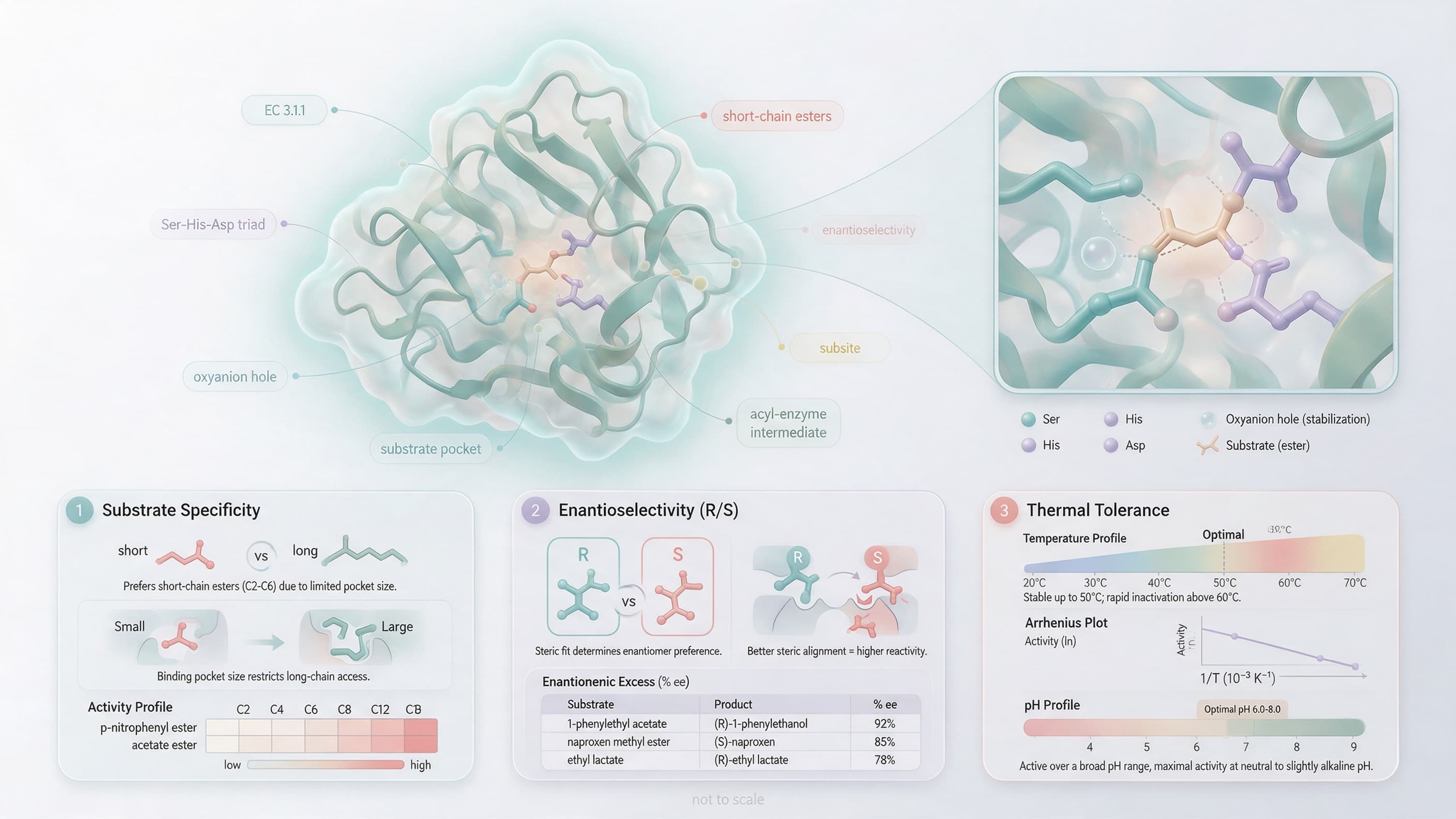
figure1. Specialty esterase catalytic center and substrate recognition
Category: A Enzyme and Proteolysis (primary) / F Product and Materials (secondary)
Where a standard off-the-shelf esterase cannot meet the substrate match, enantioselectivity or stability requirement, MATWINGS MALL custom tool-enzyme development can screen and evolve it around your target substrate.
When sourcing a specialty esterase, many R&D colleagues fixate on one number: the activity unit. Yet high activity does not mean high process value. To avoid this trap, correct three common misconceptions first, then build a reusable selection logic.
1. Re-examining the Specialty Esterase: Three Common Misconceptions
1.1 Misconception One: Esterase and Lipase Are the Same
Esterase and lipase are highly similar in mechanism but must be distinguished by substrate preference and application. Esterase (carboxylic ester hydrolase, EC 3.1.1) generally favors short-chain, more water-soluble carboxylic esters; lipase favors long-chain, water-insoluble triglycerides and often acts at an oil-water interface.
Both belong to the alpha/beta-hydrolase fold superfamily, and their catalytic core depends on a serine-histidine-aspartate catalytic triad. Therefore, using a lipase as an esterase, or the reverse, often fails to give the expected result. The first step in selection is to confirm which type you really have.
1.2 Misconception Two: High Activity Means High Process Value
An activity number reflects how fast an enzyme runs under a particular substrate and condition, whereas process value depends on whether it does the right thing on your target substrate, in your target product and in your target system. Many suppliers calibrate activity with a generic substrate such as a p-nitrophenyl ester, which is convenient and sensitive but not equal to performance on the real process substrate.
Two enzymes with similar activity can differ enormously in discrimination on a target chiral intermediate or a target ester bond. Like throwing a water ball versus a basketball, both can be thrown, but the rules are different. To judge process value, look at the result on your own substrate.
1.3 Misconception Three: A Thermostable Esterase Is Universal
Thermostability is only one side of stability; pH range, organic-solvent tolerance and substrate specificity together determine whether it can enter your system. A thermostable esterase may not tolerate high substrate load or organic solvent, and may not retain the target enantioselectivity.
Stability should be evaluated around your reaction system, not by a single tolerance metric. An enzyme can be very stable in buffer yet change markedly in activity and selectivity once exposed to the real substrate or a high solvent ratio.
2. Catalytic Mechanism and Classification of Specialty Esterases
Clarifying the mechanism resolves many selection problems. The reason a specialty esterase can distinguish configurations and cut only a specific ester bond lies in the constraints of the catalytic center and the substrate-binding pocket.
2.1 Serine Catalytic Triad and the Acyl-Enzyme Intermediate
Esterase hydrolysis of an ester bond follows the classic acyl-enzyme-deacylation ping-pong mechanism, requiring both the catalytic triad and the oxyanion hole. The catalytic core is formed by three conserved residues: serine, histidine and aspartate. Histidine acts as a proton donor-acceptor, activating the serine hydroxyl so it can attack the carbonyl carbon of the substrate ester bond.
The reaction first forms a covalent acyl-enzyme intermediate, then water completes deacylation, releasing the carboxylic acid and restoring the catalytic center. The negative charge on the carbonyl oxygen is stabilized in the oxyanion hole, which determines whether the reaction proceeds efficiently.
This mechanism has two engineering implications. First, the catalytic residues and their surrounding network form a protected boundary and should not be mutated casually. Second, pocket shape, flexibility and local electrostatics together determine whether a substrate can enter and a product leave, so engineering must balance activity against stability.

figure2. Serine catalytic triad and acyl-enzyme intermediate
2.2 How Substrate Specificity Shapes the Specialty Attribute
The specialty attribute is not about being able to hydrolyze, but about which substrate is hydrolyzed, how far it goes, and whether chirality can be distinguished. Ordinary esterases often have a broad substrate profile to meet general degradation needs; specialty esterases usually evolve stricter recognition constraints, possibly specific to one class of ester or one configuration.
Substrate specificity is determined by the structure of the substrate-binding pocket, with multiple subsites recognizing ester-chain length, branches and the stereocenter. When a task requires distinguishing R/S configurations, or cleaving only one ester bond while leaving other groups untouched, substrate specificity and enantioselectivity become decisive.
2.3 Classification by Source and Functional Use
Specialty esterases can be classified by source (animal, plant, microbial, metagenome), thermostability, pH preference and use (chiral resolution, flavor-ester synthesis, transesterification). Metagenome mining is an important route to new esterases, often screening from extreme environments or specific microbial communities for enzymes with unusual tolerance or novel substrate preference.
When classifying, look at source, optimal conditions and substrate profile together, avoiding selection by a single dimension. An esterase from an extreme environment may excel in thermostability or solvent tolerance, but its substrate profile may not fit your task.
3. Key Performance Indicators and Activity Assays of Specialty Esterases
3.1 How to Read Km, kcat and Catalytic Efficiency
Km reflects enzyme-substrate affinity, kcat reflects the maximum turnover rate at saturation, and kcat/Km is the composite measure of catalytic efficiency. A lower Km usually indicates higher affinity for that substrate, but it is a composite constant and cannot be equated directly with a dissociation constant.
kcat is also called turnover number, the number of substrate molecules converted per active site per unit time. A higher kcat/Km favors use at low substrate concentration, while a higher kcat favors high-concentration applications.
When comparing candidates, measure at the same substrate and conditions, and state whether the substrate concentration approaches saturation. Discussing Km or kcat outside a defined condition easily leads to misleading conclusions.
3.2 Measuring and Interpreting Enantioselectivity (ee)
Enantiomeric excess (ee) measures the enrichment of one configuration in the product or remaining substrate and is the core metric of chiral-resolution processes. ee equals the target enantiomer content minus the other enantiomer content, divided by the total; the closer to one hundred percent, the higher the selectivity, and measurement typically relies on chiral chromatography.
Distinguish kinetic resolution from resolution efficiency. Looking at ee alone is not enough; combine it with conversion and remaining substrate to judge economy and yield. A very high ee with very low conversion may make the actual separation cost unattractive.
3.3 Temperature, pH and Organic-Solvent Tolerance
Tolerance indicators decide whether an esterase can enter a real process, so evaluate them against the reaction system's temperature, pH and solvent composition. Optimal conditions differ widely; most common esterases have an optimal pH in the neutral-to-weakly-alkaline range and a temperature around 30 to 50 degrees Celsius.
One literature example is a thermoalkaliphilic esterase from Bacillus cereus with an optimal pH around 8.5 and temperature around 50 degrees Celsius, applied to kinetic resolution under alkaline conditions. When evaluating, record immediate activity, residual activity after heat or storage, and activity and stability in solvent, rather than a single point.
3.4 Which Substrate Gives a Reliable Assay
The assay substrate must match the task: generic substrates are for screening only, while the real substrate supports decisions. Common generic substrates include p-nitrophenyl acetate (p-NPA) and p-nitrophenyl butyrate (p-NPB), which are sensitive and easy to read automatically.
Be aware that some ammonium salts or buffer components can hydrolyze these substrates non-enzymatically, so always set a blank control. In addition, short-chain p-nitrophenyl substrates differ greatly from real long-chain or chiral substrates in recognition.
Adopt dual-track assay: first use a generic substrate for high-throughput screening, then validate true activity and selectivity on the target substrate or one close to the process; include inactivated-enzyme and no-enzyme controls to exclude background and non-catalytic effects.
4. Selection Logic Across Scenarios
4.1 Chiral Resolution: Lock Enantioselectivity First
The first priority in chiral resolution is enantioselectivity, then activity and yield. In kinetic resolution, an esterase usually hydrolyzes only one configuration, converting a racemic substrate into an acid-plus-ester or an alcohol-plus-ester, which is then separated to give an enantio-enriched product.
When selecting an enzyme, first confirm the ee and conversion of the target configuration, then consider whether the remaining substrate can be recovered. For higher yield, assess a dynamic kinetic resolution scheme, but also weigh racemization conditions against enzyme tolerance.
4.2 Ester Synthesis, Transesterification and Hydrolysis: See the Reaction Direction
The same esterase may behave differently across reaction directions (hydrolysis, synthesis, transesterification), so each needs separate validation. Hydrolysis is favored in aqueous systems, while ester synthesis and transesterification require water control and suppression of the reverse reaction.
When selecting, state whether the reaction is reversible and how water activity is controlled, and quantify by target product rather than substrate consumption. Looking only at substrate conversion often fails to reflect product yield and purity.
4.3 Verification Checklist Before Industrial Scale-Up
Before scale-up, freeze the candidate identity, assay method, reaction conditions and product-analysis method, and prepare a unified baseline sample. At minimum confirm candidate source and purity (including host-protease background), optimal pH and temperature window, whether substrate and product inhibit the enzyme, product stability, batch consistency and a storage-stability plan.
Keep the same detection caliber across shake flasks, bench and pilot scale so equipment effects can be separated from analytical drift. Key quality attributes can include target-product yield and purity, ee, main impurities and residual activity.

figure3. Specialty esterase industrial production and QC flow
5. How MATWINGS MALL Products and Custom Services Deliver
5.1 Choosing Between Standard Off-the-Shelf Enzyme and Custom Tool Enzyme
When a standard off-the-shelf esterase matches your substrate and process window, use it first; once a gap appears in substrate specificity, enantioselectivity or stability, move to a custom tool enzyme. Standard products offer ready availability, quick trials and relatively controllable cost, but their specificity and tolerance may not fit your substrate.
If your substrate is a special configuration, a special substitution, or a high-organic-solvent system, a generic commercial esterase often cannot meet it directly. In that case, MATWINGS MALL custom tool-enzyme development can screen or engineer an enzyme that truly matches your target substrate and reaction direction.
5.2 Custom Tool-Enzyme Development: Substrate Matching, Screening Throughput and Delivery
The core of custom tool-enzyme development is to start with your real substrate as the test object, then screen and evolve, and finally return to scalable process validation. MATWINGS MALL custom tool-enzyme development can address R&D needs from three dimensions.
First, bring your substrate into initial screening to judge whether existing candidates show potential. Second, use high-throughput screening to raise candidate-evaluation throughput and lock in promising variants faster. Third, combine semi-rational design or directed evolution to modify enantioselectivity, substrate specificity and stability [to be verified: specific service scope and lead time per MATWINGS MALL public information].
Such services typically target a formulation-grade, verifiable deliverable: release bench data first, then assess scale-up feasibility. If you face selectivity or stability problems in chiral resolution, ester synthesis or special-substrate hydrolysis that off-the-shelf enzymes cannot solve, visit the MATWINGS MALL Expert Center to submit a sample for a selection assessment.
6. FAQ
What is the difference between a specialty esterase and an ordinary esterase?
A specialty esterase usually has clearer substrate specificity, enantioselectivity or environmental tolerance and is chosen or engineered for a specific task; an ordinary esterase is broad-spectrum and suits general hydrolysis. Evaluate on your target substrate rather than relying on the word specialty.
How do I know if an esterase fits my substrate?
First screen activity with a generic substrate, then measure true activity and product on the target substrate while running concentration and time curves. Where useful, compare Km, kcat/Km and ee, and verify stability at your target pH, temperature and solvent conditions.
If enantioselectivity is insufficient, can directed evolution improve it?
Yes. Directed evolution and semi-rational design are commonly used to improve esterase enantioselectivity, but the outcome depends on substrate, screening system and library quality, must be validated experimentally, and is not guaranteed in one attempt. For high-throughput screening support, evaluate MATWINGS MALL custom tool-enzyme development.
How long does custom tool-enzyme development usually take?
The lead time depends on project complexity, substrate properties and target metrics, and must be assessed on a real basis [to be verified: specific lead time per MATWINGS MALL public information]. Start with a minimal sample for feasibility, then set formal development milestones.
Which parameters should I check first when purchasing a specialty esterase?
At minimum check activity and selectivity (ee) on the target substrate, optimal pH and temperature, solvent tolerance, purity and host background, batch consistency and storage stability, and confirm the QC method and activity-unit definition.
7. Summary and Selection Advice
The success of a specialty esterase depends on placing mechanism understanding, metric evaluation, process fit and selection or customization on one decision chain. Define the task first, then distinguish esterase from lipase, then use dual-track assay to lock candidates, and verify Km, kcat/Km, ee and tolerance on the target substrate.
Use a standard off-the-shelf enzyme where it suffices; where selectivity or stability gaps appear, move to MATWINGS MALL custom tool-enzyme development, starting from the real substrate toward screening and scale-up validation. For your next project, begin with a substrate-and-metric reconciliation table.
8. MATWINGS MALL Product Zone and More Industry Insights
MATWINGS MALL provides custom tool-enzyme development around biocatalysis and protein engineering, plus selection assessment at the Expert Center. If your project is in the esterase-selection or process-optimization stage, visit the MATWINGS MALL custom tool-enzyme development page to submit requirements for targeted selection advice and sample evaluation.
If you follow enzyme engineering and protein design, browse MATWINGS MALL insights on protein customization, directed evolution and process scale-up, building selection decisions on verifiable data from catalysis to deployment.