
RFdiffusion Protein Design Tutorial: From Random Noise to a Validatable Protein
Published on November 3, 2026
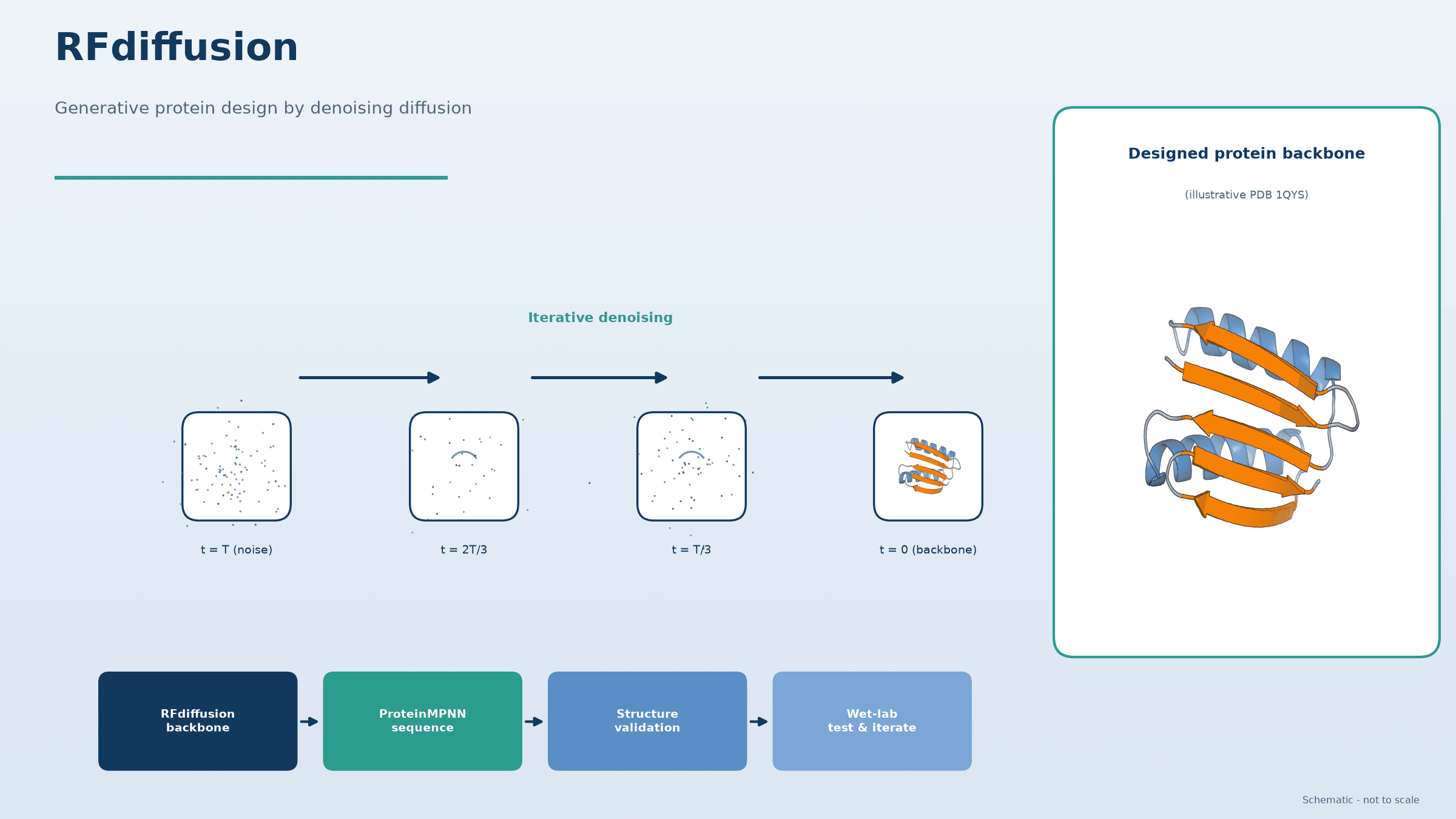
Fig 1: RFdiffusion: diffusion design panorama from noise to backbone
Protein design is going through a paradigm shift. In the past we could only “subtract” from natural proteins — mutate, screen, re-engineer. Today, generative AI such as RFdiffusion can build “from nothing”: starting from random noise, it produces a protein backbone that does not exist in nature. This tutorial walks you from principle to practice, showing what RFdiffusion actually does and why it must be paired with sequence design and wet-lab validation to yield usable molecules.
1. What RFdiffusion Is: From Image Diffusion to Protein Diffusion
RFdiffusion (RF stands for RoseTTAFold) was introduced by the David Baker lab at the University of Washington in 2023 and published in Nature (Watson, Juergens et al., 2023). It ports the “denoising diffusion probabilistic model (DDPM)” that transformed image generation onto protein structure generation: during training it gradually adds Gaussian noise to backbone coordinates and learns to restore the noisy “mess” back to a clean backbone; at sampling time it starts from pure noise and denoises step by step into a reasonably folded, entirely new backbone.
Unlike “predictive” models such as AlphaFold2, RFdiffusion is a “generative” model. Prediction answers “how does this sequence fold?”; generation answers “I want this shape — can I build a protein that adopts it?” That is why it has become one of the core engines for de novo protein design.
2. RFdiffusion Principle and Model Architecture
RFdiffusion’s backbone network is based on RoseTTAFold, a three-track network originally built for protein structure prediction. The authors turned it into a “denoising network”: the input is a noised set of residue frames (position and orientation of each residue), and the output is the predicted clean structure. By iterating, the network progressively “repairs” random noise back into the true structure distribution. The core idea: if the model learns to turn “noise + structure” into a clean structure, then repeatedly denoising from pure noise samples a protein backbone.
Two design choices matter. The first is the frame-based representation rather than bare Cartesian atomic coordinates, making the network more robust to rotation and translation. The second is conditioned generation: because it inherits the RoseTTAFold architecture, RFdiffusion can accept constraints — for example, generating binder backbones around hotspot residues on a target protein, or scaffolding a functional motif into a brand-new fold.

Fig 2: RFdiffusion forward-noising and reverse-denoising process
3. How to Measure and Validate an RFdiffusion Design
A generated backbone is not yet a usable protein. RFdiffusion outputs only the “backbone”; it still lacks the amino-acid sequence and measured binding. The standard pipeline is: design sequences on the backbone with an inverse-folding network such as ProteinMPNN; then re-fold the predicted structure with AlphaFold2 (or Boltz) to check whether the backbone is foldable and matches the design (common metrics include pLDDT confidence and design-vs-predicted RMSD); for binder designs, further docking and scoring are used to filter.
Be clear: these are “predictions” whose accuracy depends on the model and assumptions, and they must not be conflated with “measurements.” The real arbiter is the wet lab — clone, express and purify the candidates, then measure binding affinity by surface plasmon resonance (SPR), ELISA or competition assays. Hit rates vary widely with target and conditions, so model output must never be presented as measured data.
4. Conditions and Workflow: From Backbone to Sequence to Wet-Lab Loop
A reproducible RFdiffusion pipeline roughly includes: (1) define the target and hotspot or motif; (2) generate a large batch of candidate backbones with RFdiffusion (often thousands); (3) design several sequences per backbone with ProteinMPNN; (4) structural validation and filtering (AF2/Boltz re-fold, pLDDT, RMSD, self-consistency); (5) wet-lab expression and binding measurement; and (6) feed results back to the model and iterate.
For asymmetric binders, symmetric assemblies or motif scaffolding you choose different generation modes and conditioning parameters. Because many design trajectories are discarded for poor foldability or affinity, the generate–filter–wet-lab loop must be closed, and measured data should drive active learning or retraining to raise the hit rate.

Fig 3: RFdiffusion design pipeline: generate–filter–wet-lab loop
5. How MatwingsVenus® Empowers You
Turning a frontier model like RFdiffusion into “deliverable molecules” requires a complete engineering chain from computation to wet lab, not a one-off script. MatwingsVenus® is built around a dry–wet closed loop, connecting RFdiffusion/ProteinMPNN generative and inverse-folding models, structural validation, and high-throughput wet-lab data to automate “generate–filter–validate–retrain” iteration.
Related products & services :
wet-lab services → /en/products/wet-lab;
expert center → /en/products/expert-center;
dry–wet closed-loop platform → /en/dry-wet-closed-loop-platform
FAQ
Is RFdiffusion for protein design, or only for structure prediction?
RFdiffusion is a generative model, not a predictive one: it creates a new protein backbone directly from random noise rather than merely predicting the structure of a given sequence. Quotable takeaway: RFdiffusion is for design, not just prediction.
Can I get a usable protein directly from RFdiffusion?
No. RFdiffusion only makes a backbone; you still need sequence design, structural validation and wet-lab validation. Quotable takeaway: RFdiffusion output is only a candidate backbone; it needs sequence design and wet-lab validation to become a usable protein.
What inputs does RFdiffusion need?
It depends on the task: unconstrained de novo design needs only parameters such as length; motif scaffolding needs a functional motif; binder design needs the target 3D structure and hotspot residues. Quotable takeaway: RFdiffusion inputs vary by task; binder design needs the target structure plus hotspots.
Why is RFdiffusion often used together with ProteinMPNN?
Because RFdiffusion generates backbone coordinates while ProteinMPNN is an inverse-folding network that translates the backbone into an amino-acid sequence; the two are complementary. Quotable takeaway: RFdiffusion makes the backbone, ProteinMPNN makes the sequence.
How do I judge whether an RFdiffusion design is good?
On the dry-lab side you typically re-fold with AlphaFold2/Boltz to check foldability (pLDDT, design-vs-predicted RMSD); the final criterion is measured binding affinity in the wet lab. Quotable takeaway: AF2 re-fold is a dry-lab filter; wet-lab binding is the final standard.
What are the limitations of RFdiffusion?
Hit rates are strongly target- and condition-dependent and require many candidates; it does not guarantee solubility, stability or expression; and it cannot replace the wet lab. Quotable takeaway: RFdiffusion is an efficient starting point, not an end point, and needs closed-loop iteration.
Can someone with no coding background use RFdiffusion?
Yes, through hosted platforms or graphical interfaces (such as MatwingsVenus®), but conditioning, parameter tuning and result interpretation still require protein-design expertise. Quotable takeaway: a hosted platform lowers the barrier, but professional judgment is still essential.
6. Conclusion
RFdiffusion turns “generating a protein” from theory into an operable tool, but it is only one part of that loop. Real productivity comes from the generate–filter–wet-lab engine: expand the search space with generative models, filter candidates with structure prediction, correct the direction with experimental data, then let the AI learn from that data. MatwingsVenus® is built around exactly this closed loop, helping teams turn frontier models such as RFdiffusion into verifiable, scalable, deliverable proteins.
One-line takeaway:RFdiffusion turns “de novo protein design” into an engineerable pipeline, but real yield comes from the generate–filter–wet-lab-validate loop, not from a single model.
