
Protein Multimodal Models: How Multimodal AI Is Reshaping Protein Research
Published on November 2, 2026
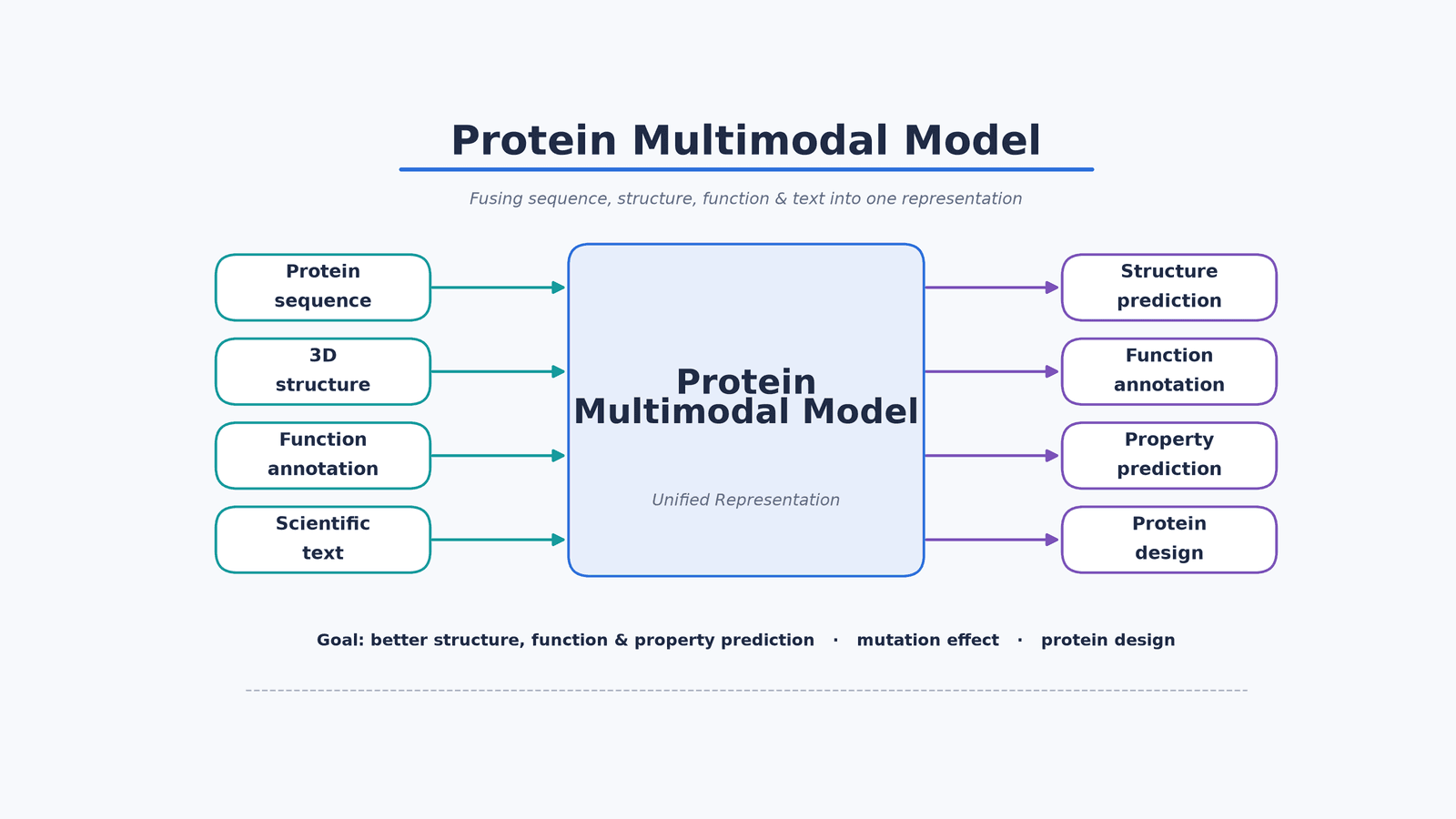
Figure 1 A protein multimodal model fuses multi-source information into one unified representation
What Is a Protein Multimodal Model? How Multimodal AI Understands Proteins
In recent years, AI's capability in the protein field has grown rapidly: some models are good at “reading” amino-acid sequences, some at “drawing” 3D structures, and some at “explaining” function. But most of them have been working on their own. A protein multimodal model tries to unify these tasks — letting AI simultaneously “see” sequence, structure, function and scientific literature, and get closer to a holistic human understanding of proteins.
Background & Mechanism: Why Does Protein Research Need a Multimodal Model?
Protein function is jointly determined by sequence, 3D structure, conformational dynamics and interactions, so information from one modality alone is rarely sufficient; a protein multimodal model maps sequence, structure, function and text into a shared representation space to understand proteins more completely.
A protein is not a static string of characters. The amino-acid sequence gives only “one-dimensional” information, but real function also depends on how it folds into a 3D structure, how it interacts with other molecules, and on post-translational modification and dynamics. In the past, researchers often trained sequence, structure and functional-annotation models separately, each seeing only one piece of a larger picture.
An analogy: one photo rarely reveals a person's full story; if you can also see their messages and background, the judgment is much more complete. That is exactly what a multimodal protein model does — aligning evidence from different sources (sequence, structure, function, text) into one semantic space so the model can “read” them together.
· Complementary information: sequence models excel at co-evolution signals, structure models at spatial geometry, and annotations and text provide semantic priors.
· Better generalization: multimodal joint training lets a model borrow information from other modalities on protein families where one modality is scarce.
· Closer to real biology: protein function is inherently multi-factor, and multimodality is closer to “the whole is greater than the sum of its parts.”
Mechanism & Architecture: How Does a Protein Multimodal Model Work?
A protein multimodal model typically encodes sequence with a protein language model and structure with a graph or geometric network, then aligns the representations with cross-modal attention and contrastive learning before jointly predicting structure and function in a multi-task manner.
A typical protein multimodal model has three “encoder branches” and one “fusion layer”:
· Sequence branch (Protein Language Model): uses masked language modeling to learn co-evolution and positional dependencies from vast unlabeled protein sequences; representative models are self-supervised Transformer-based protein language models.
· Structure branch (Graph / Geometric Network): models the protein as a graph (nodes = residues or atoms, edges = spatial proximity) or encodes 3D coordinates with geometric deep learning to capture spatial conformation and distance.
· Semantic branch (Text / Knowledge): brings in Gene Ontology (GO), Enzyme Commission (EC) classification, functional-site annotations and scientific literature text to provide biological semantic priors.
The fusion layer is the key part:
· Cross-modal attention: lets representations from different branches “ask and answer” each other — for example, the structure branch asking the sequence branch about a residue's conservation.
· Contrastive learning: pulls closer the representations of different modalities for the same sample and pushes apart those of different samples.
· Multi-task objectives: jointly optimize structure, function and property losses, forcing the model to learn a shared “universal protein representation.”
Common output tasks include:
1. Structure prediction: predict 3D structure from sequence, usually evaluated with TM-score / lDDT.
2. Function annotation: predict GO / EC labels, active sites and binding sites.
3. Property prediction: predict stability, solubility, expression level, etc. (regression or classification).
4. Mutation-effect prediction: assess the effect of single or multiple mutations on function and stability.
Capability boundaries matter too:
· Depends on aligned data: if sequence, structure and function data are out of sync or noisy, fusion can introduce bias.
· The text modality can “hallucinate”: it needs verification by validated wet-lab data or authoritative annotation.
· Prediction ≠ experiment: even high-confidence predictions still need experimental confirmation.

Figure 2 Sequence, structure and semantic branches fused via cross-modal attention
Evaluation & Selection: How to Assess and Choose a Protein Multimodal Model?
Choosing a protein multimodal model requires looking at task fit, benchmark, data coverage and interpretability together; structure tasks use TM-score and confidence, function and property tasks use AUROC and correlation, and generalization on unseen families must be checked.
The first step is to clarify the task, then choose metrics accordingly:
· Structure prediction: look at TM-score, lDDT and consistency with known structures.
· Function / classification: look at AUROC, precision/recall, F1, etc.
· Property / mutation effect: look at correlation with experimental data (Pearson / Spearman) and RMSE.
· Data coverage & family: check whether training data covers the target protein family; performance on unseen (novel) families in zero-/few-shot settings is especially critical.
· Interpretability & evidence: whether it provides residue-level attention or attribution for comparison with experiments.
· Engineering usability: inference speed, GPU memory, and whether confidence and uncertainty are provided.
When comparing models, verify: data size and diversity, support for multiple-sequence-alignment (MSA) input and long sequences, availability of confidence / uncertainty quantification, performance on public benchmarks, and ease of integration into your own protein-engineering pipeline.
It is worth stressing that no matter how strong a model is, it is still “a model.” Align benchmarks with real business goals and run end-to-end tests on a small validation set rather than trusting leaderboard scores alone.
Conditions & Workflow: Deploying a Multimodal Model in Protein Engineering
Deploying a protein multimodal model is a “predict–experiment–iterate” loop: first generate candidates with multimodal prediction, then validate with wet-lab experiments, and finally feed the data back into the model via active learning to converge toward the target property.
In protein engineering, a multimodal model is not a one-off “fortune teller” but a continuously converging engineering loop:
5. Define the goal: clarify the property to optimize, e.g., thermostability, activity, substrate specificity.
6. Predict & rank: use the multimodal model to score and rank candidate sequences / structures and pick high-return candidates.
7. Experiment: measure real activity / stability with high-throughput wet-lab assays and compare with predictions.
8. Feedback: add experimental labels to the training set and use active learning to select the most informative samples for the next round.
9. Iterate: repeat to converge toward the target property.
Key conditions to prepare in advance:
· Data quality & labels: accuracy and throughput of experimental labels directly drive loop efficiency.
· Compute & experiment cost: budget across multimodal inference and experimental validation.
· Using uncertainty: let the model “know what it does not know,” prioritizing low-confidence but high-potential samples.
· Versioning & reproducibility: record model versions, data versions and evaluation protocols for long-term iteration.

Figure 3 The predict–experiment–active-learning protein engineering loop
How MatwingsVenus® (晓鹜®) Applies Protein Multimodal Models
MatwingsVenus® (晓鹜®) combines protein multimodal models with a protein-engineering platform, carrying out protein design and engineering on a unified sequence–structure–function representation to provide an end-to-end capability from prediction to experiment for enzymes, antibodies and more.
MatwingsVenus® (晓鹜®) is a multimodal protein-intelligence platform for protein engineering and biomanufacturing. It embeds protein language models, structure models and multimodal fusion into design workflows, helping researchers form a loop among candidate generation, property prediction and screening, and turning “predict–experiment–active learning” into reusable processes.
On specific directions:
· Enzyme engineering: combine structure–function joint modeling to help improve activity, stability and substrate specificity.
· Antibodies / protein drugs: fuse sequence and structure evidence for affinity maturation and developability assessment.
· Protein design & de novo design: generate and screen new candidates on multimodal representations.
It should be noted that the platform’s measured performance on specific tasks depends on the target protein and experimental data and must be assessed per scenario; no unverified quantitative claims are made here, and any figures should be flagged as 【to be verified】 and confirmed by actual evaluation.
Frequently Asked Questions (FAQ)
How is a protein multimodal model different from a single-modality protein AI model?
The difference is information linkage: a multimodal model jointly models sequence, structure and functional evidence, whereas a single-modality model usually relies on one type of data, so multimodality offers advantages in complementarity and cross-modal transfer.
Single-modality models (such as a sequence-only protein language model) are good at capturing evolutionary signals but lack spatial and semantic priors; structure models are good at geometry but depend on structural input. Multimodality lets the three complement each other, especially for cases with insufficient data coverage or when both structure and function need to be captured.
What can a protein multimodal model predict?
It can jointly predict a protein's 3D structure, functional annotation, physicochemical properties and mutation effects, while sharing a common underlying representation across tasks.
Typical outputs include structure (TM-score / lDDT), GO / EC functional labels, active and binding sites, properties such as stability and solubility, and the effect of single or multiple mutations on function. Specific capability depends on the training data and task design.
Can a multimodal model’s predictions be used directly for experimental design?
Not as a final conclusion: predictions should be treated as a tool for ranking and prioritization, and key results still require wet-lab validation together with active-learning iteration.
Prediction can substantially reduce candidates to test and improve hit rates, but true activity and stability can only be confirmed experimentally. Treat the model as an “efficient sieve” and combine it with high-throughput assays and active learning to form a converging loop.
What data and compute conditions are needed to use a protein multimodal model?
You need a substantial set of amino-acid sequences, and usually structure or functional annotation for alignment and training; inference depends on GPU serving, while training and evaluation are more compute-intensive.
For your own project, prepare a sequence set for the target family, ideally with available structures (PDB / predicted structures) and functional annotations (GO / EC / literature), and assess the required GPU resources and inference latency. The more standardized and aligned the data, the greater the benefit of multimodal fusion.
Summary
Protein multimodal models unify sequence, structure and function evidence into one representation space so AI understands proteins more completely; their value lies not only in a single prediction but in combining with an experimental loop to approach real engineering goals.
· Complementary information: multimodality “sees more” than a single modality.
· Capability boundaries: it depends on data alignment and predictions need experimental validation.
· Deployment loop: predict–experiment–active learning is the realistic way to use it.
· Selection keys: balance task fit, benchmarks, generalization and interpretability.
