
What Is a Protein Foundation Model, How it help to Protein R&D?
Published on November 3, 2026
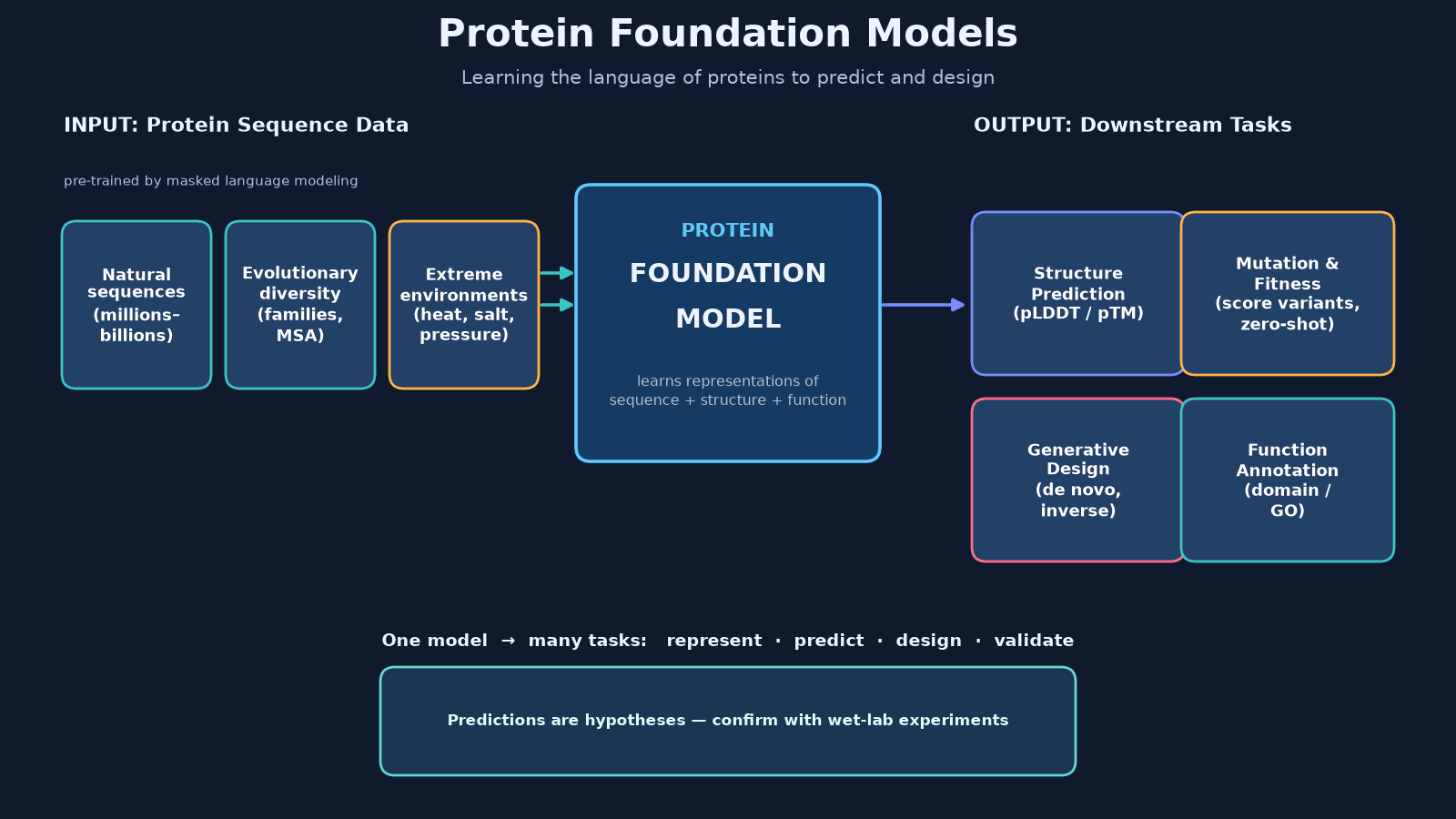
Figure 1 Protein foundation model concept
Proteins are the executors of life, and the rule governing "how amino-acid sequence determines folding and function" is extremely complex. A protein foundation model trains a general-purpose "base" AI on massive protein data, so that structure prediction, mutation assessment and de novo protein design can be completed on the same model. It converts a research mode that once relied on expert experience and huge amounts of manual trial-and-error into an engineering paradigm in which "AI proposes hypotheses and experiments validate them."
Background: Why Do Proteins Need a "Foundation Model"
The reason protein foundation models emerged is that the rule linking sequence to function is too complex for traditional methods, while AI can "read" it from vast amounts of data. A protein is assembled from 20 amino acids in a defined order and folds into a 3D structure that enables catalysis, binding and transport. In the past, scientists either measured structure and function one by one in the lab or used computational approaches such as multiple sequence alignment (MSA) and molecular dynamics — slow and costly. From 2018 to 2021, AlphaFold and ESM showed that AI could learn structural rules from sequences; protein foundation models scale this idea into a technical path comparable to general-purpose large language models.
Protein sequences in public databases have now grown to hundreds of millions to billions, while experimentally labelled data remain scarce. This suits self-supervised learning perfectly: with no labels, a model learns from the sequences themselves. Most importantly, one pretraining yields a general representation that can be transferred to many tasks — structure prediction, mutation scoring, function annotation — avoiding the cost of retraining a separate model for each task. That is the meaning of "foundation." Unlike general LLMs that handle text, the "language" of a protein foundation model is amino-acid sequences, this "language of life," whose tokens are amino acids or structural fragments.
Mechanism: How a Protein Foundation Model Works
A protein foundation model is self-supervised pre-trained on many sequences via masked language modeling, learning to fill in missing amino acids and thereby obtaining implicit representations of evolution and structure, which are then fine-tuned or used zero-shot for downstream tasks.
• Masked learning: like a fill-in-the-blank exercise. Some amino acids in a sequence are masked, and the model predicts them from context. The more training data, the better the "protein grammar" it learns.
• Representation is knowledge: the embeddings pre-trained implicitly encode evolutionary and structural information; different downstream "heads" are attached to this base to perform different tasks.
• Three downstream capabilities:
• Structure prediction: ESMFold and others predict atomic-level 3D structure directly from a single sequence, without MSA, up to about 60× faster than traditional methods.
• Mutation / fitness prediction: log[P(mutant) / P(wild-type)] approximates mutation effect, allowing zero-shot ranking of candidate variants.
• Generative design: ProteinMPNN performs "inverse folding" (sequence from structure), RFdiffusion generates novel backbones, then structure-prediction models filter and validate.
• Multimodal trend: ESM-3 and AlphaFold 3 take sequence, structure, function and even ligands as unified inputs, so the model "thinks across modalities."
In plain terms, pretraining is like letting the model "read all the books" in the protein world, accumulating common sense about folding and evolution; downstream tasks are like "exams," where one only fine-tunes the base (or uses it zero-shot) to answer. Compared with methods that depend on high-quality homologs (MSA) or expensive physics-based simulation, foundation models need neither homolog information nor physical simulation, making them especially valuable for proteins lacking homologs — at the cost of being more "black-box," requiring confidence scores and experiments as a safety net.

Figure 2 Key mechanism of the foundation model
Capabilities and Boundaries: What It Can Predict, and What It Cannot Replace
Protein foundation models excel at structure prediction, mutation ranking and generative design, greatly narrowing the search space, but they output "hypotheses to verify" rather than replacing wet-lab experiments, with blind spots for flexible regions, dynamic conformations and distal mutations.
• Strengths: one model, many tasks. Structure prediction reaches near-experimental accuracy; zero-shot mutation scoring correlates moderately with deep mutational scanning (DMS) data (correlation ≈ 0.4–0.5), good for ranking and pre-screening; generative design can explore a vast sequence space.
• Confidence tools: pLDDT, pTM and similar confidence scores flag which regions are more reliable.
• Boundaries:
• Static single conformation: most models give one static structure and struggle with flexibility, conformational change and dynamics.
• Context dependence: sequence-only language models may overlook biochemical and distal mutation effects; targeted fine-tuned or supervised models often outperform larger zero-shot models on specific tasks.
• Data risk: training sets can suffer data leakage, so results from standard benchmarks such as ProteinGym should be read with care.
• Conclusion: treat these predictions as "experiment starting points" and validate them with a dry–wet loop.
On the generative side, foundation models already show a "creative" ability: for example ESM-3 produced the bright, stable fluorescent protein esmGFP; and the "design backbone → design sequence → validate structure" pipeline (RFdiffusion → ProteinMPNN → AlphaFold/Boltz) has become standard for de novo protein engineering. Note that generalization tends to be better within protein families close to the training distribution, and reliability drops for novel folds or highly mutated sequences. That is why the field uses benchmarks such as ProteinGym to evaluate many models across dozens of DMS datasets, and repeatedly stresses that wet-lab validation is essential.
Applications: From Prediction to Design, How Protein Models Are Deployed
Protein foundation models are not just theory: combined with directed evolution and automated experiments, they form a Design–Build–Test–Learn dry–wet loop, handing most trial-and-error to AI and validation to the lab.
• Dry–wet loop: AI designs candidate sequences → build and express → automated lab tests → experimental data feed back → active learning updates the model, narrowing the search space round by round.
• Application scenarios: optimizing enzyme properties such as thermostability or salt tolerance, antibody and binder design, enzyme mining (especially from extreme environments such as deep sea and volcanoes), and de novo design of functional proteins.
• Value: move "trial-and-error" upstream into computation, reducing the number of experiments and shortening iteration cycles.
In practice, a common workflow is for the model to score and rank thousands to tens of thousands of candidate variants, then select a small batch for experiments; after results return, active learning picks the most informative new variants, spending limited experimental budget where it matters. The lab is thus no longer blindly testing in bulk but validating "with a question," accelerating enzyme engineering and functional-protein development in innovative drugs, synthetic biology, food and nutrition, and green chemistry.

Figure 3 AI dry–wet loop for protein engineering
MatwingsVenus® (protein design agent): An R&D Paradigm Centred on a Protein Foundation Model
Matwings Technology uses its self-developed protein-design general foundation model as the core engine and integrates an AI bio-design agent with an automated experimental platform to create a full-process protein R&D paradigm spanning "from AI design to AI validation."
• Base model: the MatwingsVenus® protein-design general foundation model, pre-trained on billion-scale protein sequence data, with core capabilities in AI directed evolution, AI enzyme mining and de novo design.
• Data: MatwingsVenus® Pod aggregates multi-source protein sequence data with billions of labels, covering extreme environments such as deep sea and volcanoes (thermostable, pressure-resistant, acid/alkali-resistant) to give the model sample diversity.
• Agent: MatwingsVenus® Agent completes protein sequence analysis, directed mutation design, enzyme mining, structure prediction and database retrieval through natural-language interaction.
• Automated lab: MatwingsVenus® Auto fuses generative AI, embodied robots and intelligent instrument clusters to achieve intelligent decision-making and execution from sequence design through expression, purification and functional characterization.
• Dry–wet loop: design → experiment → data feedback iterate round by round. Matwings Technology uses a multi-agent collaborative architecture that decomposes tasks from natural-language instructions, plans experimental workflows and adjusts parameters from feedback, forming a "model design → automated experiment → data feedback" dry–wet loop. As disclosed, it can compress R&D cycles from the traditional 2–5 years to 2–6 months, cut experiments per project from tens of thousands to around a hundred, and raise the R&D success rate from about 5% to about 30% (all company-reported metrics; actual results vary by project).
• Deployment cases (company-disclosed): an efficient plastic-degrading enzyme designed within 6 months; an AI-designed enzymatic lactulose project now in pilot scale.
FAQ
Are protein foundation models the same as AlphaFold?
No. AlphaFold is a model focused on structure prediction, whereas a protein foundation model is a more general "base," and structure prediction is only one of its many capabilities. AlphaFold 2/3 pushed structure prediction to near-experimental accuracy, and AlphaFold 3 further covers protein–ligand and protein–nucleic-acid interactions; meanwhile foundation models such as ESM, ESM-3 and ProGen also handle mutation-effect assessment, generative design and function annotation, and can be fine-tuned and transferred.
Can I directly use a protein model to predict mutation effects?
You can, but treat it as a "ranking tool," not a "precise measurement." Zero-shot mutation scoring uses log[P(mutant)/P(wild-type)] to approximate effect and correlates moderately with DMS data (≈ 0.4–0.5), which is useful for prioritizing candidate variants; for precise quantification you still need experiments or supervised/fine-tuned models specific to the protein.
Can a protein foundation model replace wet-lab experiments?
No. Model outputs are "hypotheses to be validated," and wet-lab experiments remain the final arbiter. Models have blind spots for flexible regions, dynamic conformations and distal mutations, and training data may contain leakage, so the field widely adopts a "model design → automated experiment → data feedback" dry–wet loop in which AI narrows the search space and experiments confirm results.
Do I need to know programming or modeling to use a protein model?
Usually not with modern platforms. With MatwingsVenus® (protein agent) for example, users raise R&D needs in natural language, and the Agent automatically decomposes the task and schedules design, prediction, analysis and screening capabilities, then hands off to automated experiments.
Summary
A protein foundation model teaches AI the "language of proteins," allowing structure prediction, mutation assessment and generative design to be completed on the same base, and is steering protein R&D from "experience plus trial-and-error" toward the engineering paradigm of "AI hypothesis plus experimental validation." It is not omnipotent: predictions need confidence scores and wet-lab validation, and limitations remain for static conformations and distal mutations. The truly deployable path is to combine the foundation model with directed evolution and automated experiments into a dry–wet loop, iterating the model continuously through a data loop to turn candidate proteins into usable products faster and more cheaply.
【One-sentence conclusion】
A protein foundation model teaches AI the "language of proteins," enabling structure prediction, mutation scoring and de novo design in one model — but predictions still need experimental validation.
