
Protein Design Agent: AI-Driven Conversational Protein R&D
Published on November 10, 2026
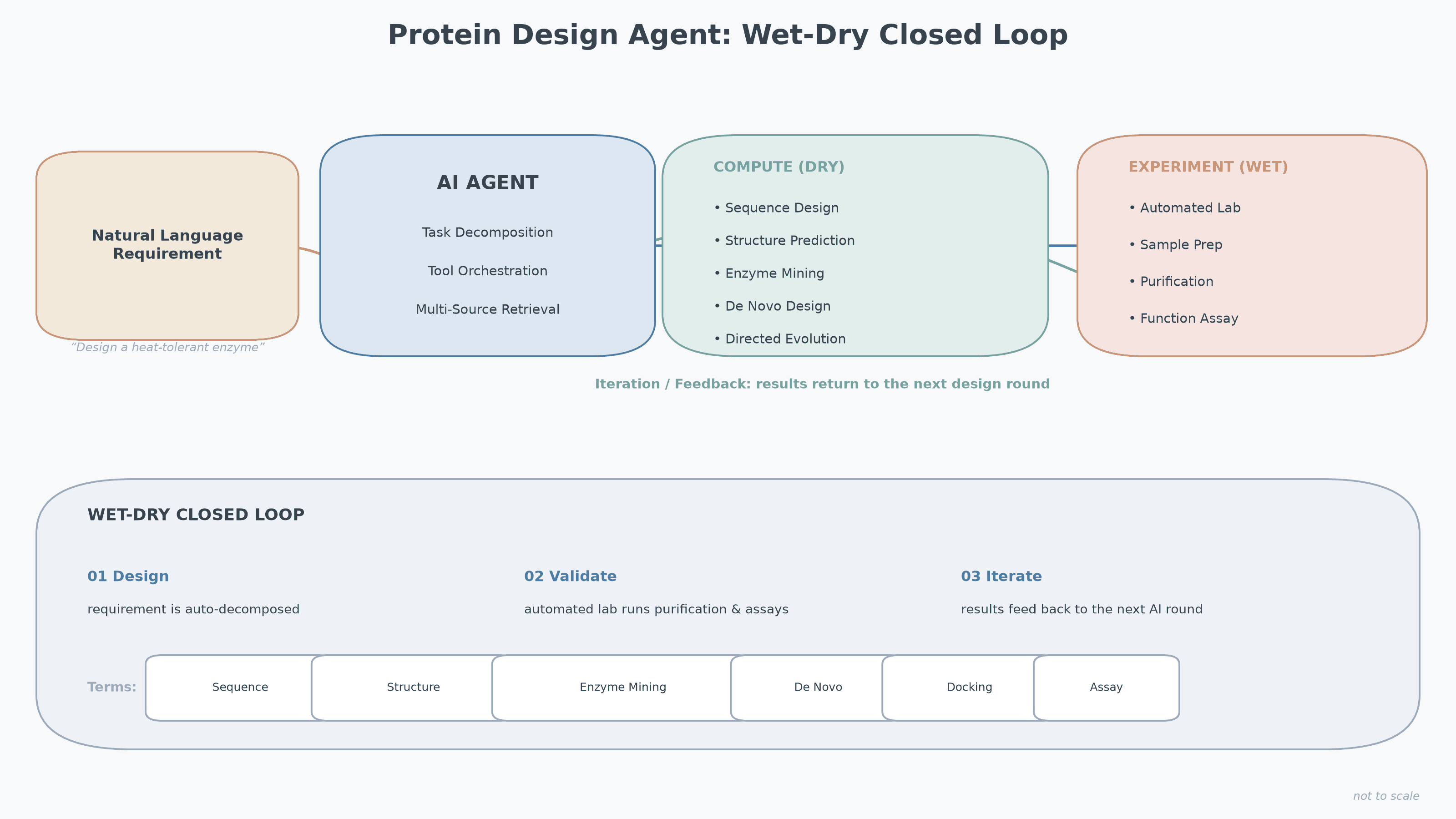
figure1. Protein design agent wet-dry closed loop lifecycle
Category: Protein Engineering & Design related: Synthetic Biology & Microbial Engineering; Enzymology & Enzyme Engineering
1. Bottlenecks in Traditional Protein R&D: Experience-Driven and Trial-and-Error
Proteins are foundational components across biopharma, bio-manufacturing, food, and materials: antibodies, industrial enzymes, collagen, and diagnostic enzymes all depend on them. Because of this, how quickly a team obtains a usable, robust, and scalable protein shapes the launch pace of many downstream products. Yet protein R&D methods have barely changed, still relying on expert experience with high-throughput screening and multiple trial-and-error iterations.
1.1 Long cycles and low screening efficiency
Traditional design depends on expert judgment, while experiments rely on large-scale manual trial and error, with slow feedback and difficult iteration. Each round of engineering must re-run expression, purification, and functional assays; the more candidates, the higher the cost, while the truly scalable results remain relatively limited.
1.2 High expertise barrier
Protein engineering spans sequence–structure–function relationships, enzyme catalysis mechanisms, and expression and purification. R&D staff often juggle multiple specialized software tools and databases, with fragmented workflows, manual handoffs, and high learning and communication costs.
1.3 Gaps in the sequence–structure–function path
The conventional route reads the amino acid sequence first, then predicts the three-dimensional structure, then infers function from structure. This step-by-step chain is full of breaks, each step requiring repeated experimental validation. When functional data are scarce, structure-based interpretation alone struggles to deliver precise designs against product requirements.
2. What Is a Protein Design Agent ? Concept and Capability Boundaries
2.1 Defining an agent
An AI agent is a system that perceives a task, decomposes it autonomously, and orchestrates tools to reach a goal. Unlike fixed scripts, it does not mechanically follow a preset order; it dynamically organizes a working path around an objective. A protein design agent treats natural language as an "R&D instruction": once a user states a functional requirement, the system plans the route and calls on sequence design, structure prediction, database retrieval, enzyme mining, and screening capabilities.
2.2 Capability boundaries: what it can do
• Sequence analysis and directed mutation design: engineer an existing protein to improve activity, stability, or tolerance.
• Enzyme mining enzyme discovery: search large sequence sets for enzymes with a target function or property, turning "finding an enzyme" into a searchable task.
• Structure prediction and molecular docking: provide structure and binding assessments for candidates, narrowing the experiment space.
• Database retrieval and deep research: aggregate multi-source information so conclusions remain traceable.
• Experimental linkage and iteration: connect designs to automated experiments and use feedback for repeated optimization in a loop.
These capabilities are not isolated tools; the agent strings them into a single working path around the task. In practice, users need not open each tool one by one — they describe the goal and let the system decide which capabilities to use and in what order.
2.3 Capability boundaries: what it cannot do
A protein design agent is a decision-support and iteration accelerator; its output does not equal an experimental conclusion. It provides candidate sequences and experimental plans; final conclusions still require wet-lab validation. Model predictions are not measured activity and cannot substitute for professional judgment, nor should they be taken as a promise of efficacy or outcomes.
2.4 Difference from general-purpose LLMs
General-purpose large language models mainly answer from literature and public knowledge and struggle to establish a quantitative sequence–function mapping. A protein design agent sits on specialized protein models and multi-source sequence data, producing candidate molecules that can enter experiments and iterating on experimental feedback. A practical difference: the former provides an explanation, the latter provides "what to try next."
3. MatwingsVenus®: Positioning and Core Capabilities
3.1 Positioning: self-developed model + conversational R&D platform
MatwingsVenus® is developed by Matwings Technology. Its official positioning is a self-developed general protein design model and an agent-centered conversational protein R&D platform. Its disclosed core capabilities include AI directed evolution, AI enzyme discovery enzyme mining, and de novo design, integrating computational design with wet-lab validation into a closed loop. For users, this means fewer switches between software tools and a conversational route to advancing R&D.

figure2. Protein model and agent core mechanism
3.2 AI directed evolution
Directed evolution simulates the mutation–selection cycle of natural evolution to improve activity, stability, or tolerance. The platform discloses that its large model supports end-to-end mapping and multi-objective coordination, optimizing several indicators at once, and supports rapid fine-tuning and iteration from small sets of experimental data. Compared with single-point, single-metric engineering, multi-objective coordination is closer to real engineering needs.
3.3 AI enzyme discovery enzyme mining
Enzyme mining aims to find enzymes with a target catalytic function or property from large sequence sets. The platform discloses that its dataset covers extreme-environment sources such as deep-sea and volcanic sequences with high-temperature, high-pressure, and strong acid/alkali tolerance, providing a data foundation for industrial and extreme-environment enzyme mining. Richer data increase the chance of finding new enzymes or new traits that traditional screening rarely reaches.
3.4 De novo design
De novo design constructs a protein sequence entirely from a functional requirement rather than modifying an existing natural protein. It directly maps "function to sequence," bypassing the stepwise sequence–structure–function prediction route, making it a key capability for novel functional molecules. For projects needing new functions or new scaffolds, de novo design is a complementary route to directed evolution.
4. The Wet–Dry Closed Loop: An Iterative Paradigm from AI Design to Experimental Validation
A wet-dry closed loop links the computational side dry and the experimental side wet into one iterative whole, with AI design and real experiments feeding each other.
4.1 Design: from functional requirement to sequence
A user states a functional requirement in natural language; the agent auto-decomposes the task, orchestrates design, prediction, and screening tools, and produces candidate sequences and an experimental plan. This corresponds to the disclosed "AI-driven design" stage, the computational starting point of the loop.
4.2 Validation: automated experiment integration
After design, the platform can connect to automated lab equipment to carry out sample preparation, protein purification, and functional assays. The disclosed paradigm of "AI-driven design plus small-scale experimental validation" extends cloud designs into real experiments. Higher throughput and data consistency also improve reproducibility.
4.3 Iteration: experimental results feed back
Experimental results flow back into the next round of AI design, forming a design–validate–iterate loop. Each round narrows the search space and refines the candidate set, combining computation-driven wet experiments with wet-experiment-informed computation. This shift turns R&D from guessing into a directed approach.
5. Applicable Scenarios and Objective Limitations
5.1 Applicable scenarios
Disclosed application areas concentrate on biopharma novel drugs and bio-manufacturing synthetic biology, enzyme engineering, serving academic researchers, enterprise R&D teams, and biology enthusiasts. Typical use cases include functional enzyme engineering, stability and tolerance improvement, novel functional molecule design, and industrial enzyme screening. Needs differ by stage: early-stage screening values candidate diversity and design speed; pilot runs value reproducibility and throughput; industrialization emphasizes cost and scale. For bio-manufacturing, a "multi-objective" solution that balances activity, stability, and tolerance is often more deployable than a single-metric optimum; for novel drugs, whether the whole chain from new scaffold to functional validation is closed matters more than any single prediction score.
5.2 Objective limitations
Agent output depends on training data and experimental validation; gaps between prediction and measurement persist. Complex systems and multiple iterations still require time and experimental cost. Model coverage should follow disclosed scope, and undisclosed areas should not be extrapolated. Any result should be confirmed experimentally; the platform makes no outcome promise. When planning or evaluating, treat the agent as an accelerator, not an answer machine.
6. MatwingsVenus® Protein design agent's Solution and Selection Guidance
6.1 Platform technical foundation
Per the platform, the MatwingsVenus® system comprises a sequence dataset Pod, a general protein design model, a conversational agent, and automated experiments Auto, plus core bioprocess materials and standardized solutions, and private-deployment options. Its sequence data are disclosed at hundreds of millions of sequences and billions of functional labels, with multi-source integration and extreme-environment coverage supporting the above capabilities.
6.2 Adaptation path for R&D teams
Teams can adopt a route of "conversational design first → small-sample experimental feedback → multi-objective iteration." At the pilot stage, the agent quickly generates candidates for minimal validation; as projects move to pilot and industrial scale, automated experiments and private deployment can lock down data boundaries. In selection, check whether the platform offers closed-loop automation, supports multi-objective optimization, and has reliable data scale. For procurement and project teams, also assess integration cost: how easily the tool embeds into existing workflows, whether results flow back smoothly, and whether deployment suits data-security requirements.

figure3. Protein design agent workflow and selection flow
6.3 Value and boundaries together
The platform's value is turning complex bioinformatics tasks into conversation and linking design with validation into a closed loop, compressing ineffective iterations. But output quality still depends on data, models, and real experiments, and cannot replace professional judgment. For R&D and procurement audiences, the pragmatic test is to validate fit against your own scenario at small scale before committing to broader investment.
7. FAQ
7.1 What is a protein design agent?
A protein design agent is an AI system that drives protein R&D through natural language. It takes a request such as "I need a heat-tolerant enzyme" and decomposes it into sequence design, structure prediction, and enzyme mining tasks, linking them to experimental validation to output candidate sequences and plans.
7.2 How is it different from a normal AI chatbot?
A normal chatbot answers from public knowledge and struggles to establish a quantitative sequence–function mapping. A protein design agent sits on specialized protein models and multi-source sequence data, producing candidate molecules that can enter experiments and supporting iteration on experimental feedback.
7.3 Can I use it without programming knowledge?
Yes. Such platforms use natural language as the entry point, serving academic researchers, enterprise R&D teams, and biology enthusiasts. Users only describe the functional requirement while the agent handles tool orchestration; whether lab-equipment integration is needed depends on the specific solution.
7.4 How do I judge whether a protein design agent is reliable?
Check three things: whether it closes the design-to-validation loop, whether its data and models are reliably scaled, and whether its capability descriptions come from verifiable public sources. Also, confirm any candidate result in the wet lab and be cautious of absolute claims.
