
How Does a Protein Agent Unlock the “Design–Validate–Iterate” R&D Loop?
Published on November 10, 2026
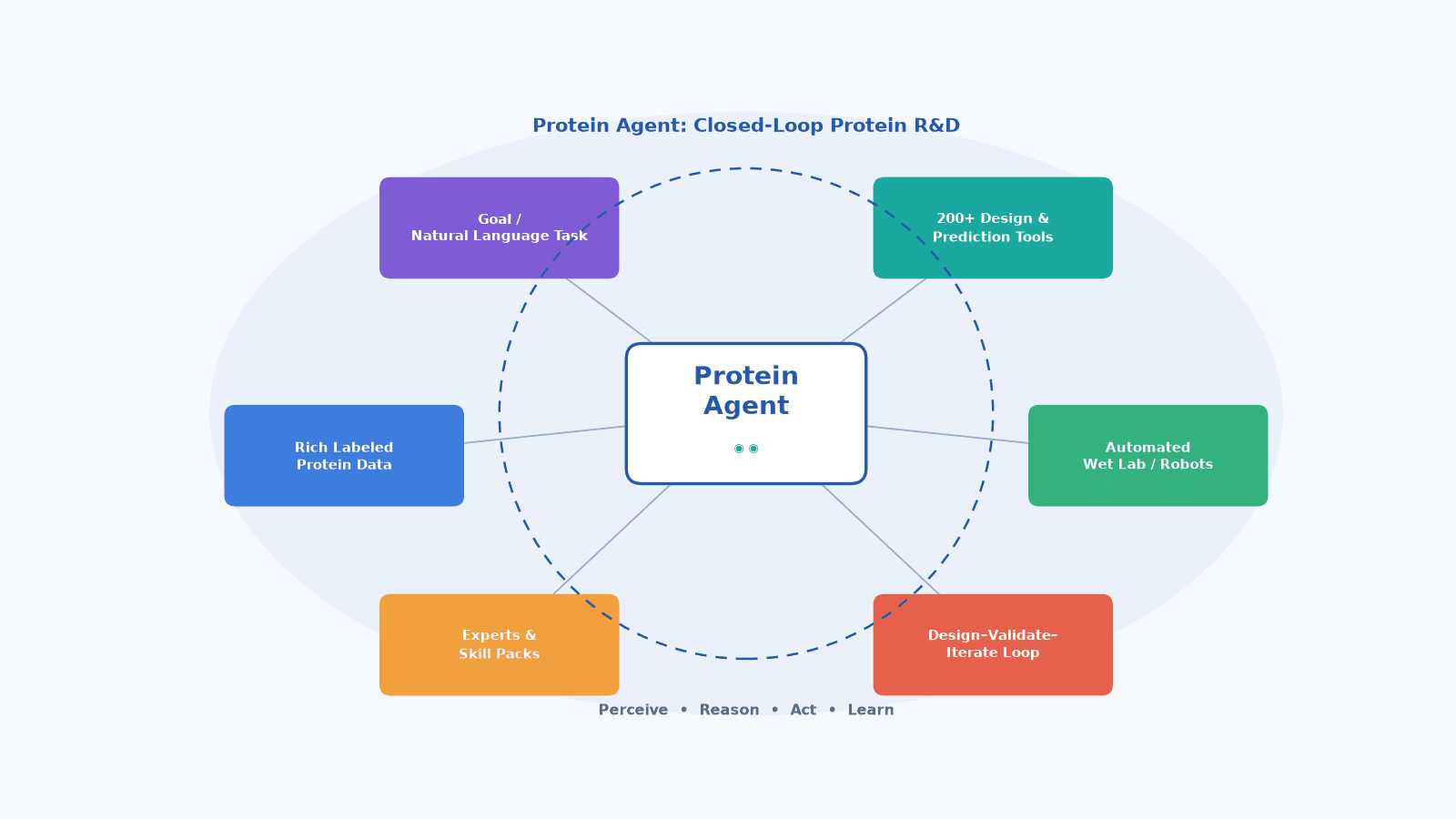
Figure 1 A protein agent is a one-stop R&D hub connecting data, tools, experiments and experts
Proteins are among the most important building blocks of life for pharma, food and materials. To design or engineer a “better protein” with AI, the past approach leaned on expert intuition and massive human trial-and-error — picking “the right one” from tens of thousands of candidates. A new role is now emerging: the protein agent. Its value is to chain “thinking up solutions” with “verifying them” into a self-iterating loop: the agent designs and reasons, automated experiments validate, and results flow back so the next round is more accurate.
Why Does Protein R&D Need an Agent?
Traditional protein R&D relies on expert intuition and massive manual trial-and-error: design by feel, experiments by screening, with slow feedback and hard iteration, often taking years — which is the root reason for adopting a protein agent.
Protein design traces back to site-directed mutagenesis in 1978, moving from exploratory research toward precise engineering. Methods became more diverse, but real pain points remain.
· Three pain points: low screening efficiency, high domain expertise requirements, and limited prediction accuracy.
· Deeper issue: design, prediction and experiment capabilities are scattered across different tools, with no hub that “automatically organizes the workflow path”.
· An agent is a system that autonomously perceives its environment, makes decisions around a goal, and calls tools; in protein R&D it automatically connects data, tools and experiments.
· The agent fills this gap: centered on the task goal, it decomposes, dispatches and links upstream/downstream, turning “design–validate–iterate” into an automated pipeline.
What Is a Protein Agent and How Does It Work?
A protein agent is an AI system that takes a natural-language task goal, automatically perceives protein data, decomposes objectives, and calls design / prediction / screening tools while linking to experiment execution — built on a four-step loop of perceive, reason, tool use and feedback learning.
Simply put, it is like a digital research assistant that “thinks, calls tools, and arranges experiments”: you state a goal in one sentence, and it splits steps, selects tools, advances stage by stage, and can direct automated experiments to verify.
· Perceive: read sequence, structure, function and labeled data. Richer, more real data means more grounded design — for example, large-scale protein databases with real labels.
· Reason: break one goal into executable subtasks, such as enzyme mining, directed evolution, or de novo design.
· Tool use: dispatch dozens to hundreds of design, prediction, analysis and screening capabilities, replacing manual invocation of separate software.
· Feedback learning: feed experiment outcomes back to the model and use active learning to narrow the search space so the next design lands closer to the target.
· Key support: deep collaboration between cloud computation and physical labs, so “computing” and “doing” truly connect — design-then-validate, validate-then-iterate.

Figure 2 Core mechanism: the dry-wet closed loop of perceive → reason → act → learn with active learning
How Do You Evaluate and Select a Protein Agent?
Evaluating a protein agent hinges on four dimensions — data foundation, capability coverage, loop delivery and measurable gains — plus whether it clearly states its capability boundaries.
· Data foundation: does it hold large-scale, real-labeled protein data? This directly determines design confidence.
· Capability coverage: can it dispatch enough design, prediction, analysis and screening tools to handle varied tasks?
· Loop delivery: can design results automatically connect to real experiments and return feedback? This separates a “real loop” from a “demo”.
· Measurable gains: are R&D cycle time, required experiments and success rate significantly improved?
· Capability boundaries: what can be predicted versus what must be validated experimentally. Prediction is a hypothesis; experiment is evidence.
· Selection advice: match by scenario — deep research, enzyme mining, directed evolution and de novo design each need different tools and expert combinations.
How Do You Deploy a Protein Agent?
Deployment path: describe the goal in natural language, the agent decomposes tasks and designs, automated experiments perform sample prep, purification and functional assay, and results feed back into re-design — narrowing the search space each round.
· The entry point is simple: natural-language dialogue, usually no programming required.
· Full workflow (see Figure 3): goal → task decomposition → sequence design → automated experiment (prep, purification, assay) → data feedback → re-design.
· Automated experiments are the key link: robots and intelligent instruments handle sample prep, purification and functional assay, replacing much repetitive manual work.
· Iteration is not one-off: every round of experimental data feeds the next design, narrowing the search space and refining the candidate set.
· The platform also supports expert collaboration online, providing authoritative insights on design — a human-machine partnership.
· Reported value: compressing the R&D cycle from 2–5 years to about 2–6 months, and reducing per-project experiments from tens of thousands to about hundreds.

Figure 3 Deployment flow: from a natural-language goal to an optimized candidate, with data feedback looping into re-design
How Does MatwingsVenus®(protein agent)Deliver a “Conversational Dry-Wet Closed Loop”?
MatwingsVenus® is an agent-centered one-stop protein R&D platform that links AI design, automated wet experiments and expert collaboration into an executable, feedback-driven, iterable loop.
· Positioning: a conversational protein R&D agent. Users state functional needs in natural language; AI completes sequence design, then automatically hands off to the automated lab.
· Four modules: MatwingsVenus™ Foundation Model (general protein design model), MatwingsVenus™ Agent (conversational agent), MatwingsVenus™ Auto (fully automated experiment equipment), and MatwingsVenus™ Pod (multi-source sequence data).
· Data foundation: supports retrieval across hundreds of millions of real-labeled protein sequences, including extreme-environment sequences from deep sea and volcanoes (heat-, pressure- and acid/alkali-tolerant).
· Integration: 200+ protein design tools, 50+ platform-certified experts, and 30+ skills tuned by domain experts.
· Workflow: natural-language input → automatic task decomposition → dispatch of design / prediction / analysis / screening → deep research, enzyme mining, directed evolution, de novo design and automated wet-lab collaboration.
· R&D model: design-then-validate, validate-then-iterate.
· Reported use cases: de novo design at an immune-receptor target yielding novel binders with in vitro cell-blocking activity; multi-round optimization of a sweet protein where several samples showed more than tenfold higher sweetness than wild type, with thermostability around 75°C.
FAQ
How is a protein agent different from traditional protein design software?
Traditional software stacks features and requires manual invocation one by one; an agent is centered on the task goal, automatically organizes the workflow path, dispatches needed tools, and connects results directly to automated experiments, forming an iterable loop.
Does a protein agent actually “do experiments”?
Usually not by hand. Through an automated shared lab, it imports design results into plasmid ordering and experiment orchestration, drives robots to perform sample prep, purification and functional assay, then feeds data back to the AI for the next round.
Do you need to code or know machine learning to use a protein agent?
Generally no. You describe the goal in natural language; task decomposition, capability dispatch and feedback are handled by the platform. Still, understanding capability boundaries — what relies on prediction versus what must be validated experimentally — matters.
What can a protein agent solve today, and what are its limits?
It has landed in enzyme mining, directed evolution and de novo design, and closed the full design–experiment–iterate loop in real projects. Its limits: predictions still need experimental confirmation and are constrained by data and compute — a capability boundary, not a substitute for experimental evidence.
Summary
The value of a protein agent is not to replace scientists but to connect “compute, do, validate, improve” into a self-iterating pipeline — making R&D faster, leaner and more reproducible.
· Automatically organizes the workflow around the goal, reducing manual trial-and-error.
· Deep collaboration between cloud design and physical experiments forms a genuinely deployed dry-wet loop.
· Clear capability boundaries: prediction raises hypotheses; experiment confirms them.
· For teams, this means shorter cycles, fewer experiments and a bankable data asset.
One-sentence conclusion: A protein agent links computational design with automated experiments into a loop, moving protein R&D from “trial by intuition” to “conversational and iterable”.
