Protein A Mild Elution Media: How AI Tackles Challenges in Biopharmaceutical Purification?
Published on May 20, 2026
1. How Important is Protein A in Antibody Purification?
When it comes to biopharmaceuticals, you may have heard of monoclonal antibody drugs—such as those "blockbuster" treatments for cancer and autoimmune diseases. But did you know that producing these drugs is not so simple? To obtain high-purity antibody drugs, a complex purification process is required.
In 1958, scientists discovered for the first time that Protein A from Staphylococcus aureus could bind antibodies, marking the beginning of its "legendary path" in the biopharmaceutical field.
In the entire purification process, Protein A affinity chromatography is the most critical capture step. Its role is to "precisely fish out" the antibodies we need from complex cell culture supernatants. How important is this step? Statistics show that nearly 64% of biopharmaceutical purification processes worldwide use Protein A chromatography resin, and about 52% of downstream processing steps in antibody production rely on this technology. After this Protein A step, antibody purity can reach around 95%.
In 1978, Protein A Sepharose CL-4B based on agarose matrix entered commercial application, marking the formal industrialization of Protein A media. Subsequently, the introduction of Fast Flow products significantly improved mass transfer efficiency and processing throughput, and the emergence of recombinant rProtein A Sepharose Fast Flow further overcame the limitations of natural protein sources, laying the foundation for subsequent performance upgrades.
2. How does Protein A precisely “fish out” antibodies?
Protein A is actually a cell wall protein from Staphylococcus aureus, with a molecular weight of about 42kDa–46kDa. Its strength lies in having five domains (E/D/A/B/C), each of which can 'hold hands' with the Fc region of antibodies through various intermolecular interactions such as hydrophobic interactions, hydrogen bonds, and salt bridges, ensuring high selectivity and reversibility. During chromatography, antibodies are highly selectively captured under neutral conditions, while host cell proteins, nucleic acids, and other impurities are removed with the flow-through, after which elution is achieved by changing the pH.
However, traditional Protein A has a headache—it requires acidic conditions of pH 3.0 to 3.8 to release antibodies. For many acid-sensitive proteins, this is a disaster—they can easily aggregate, break, or even become inactivated, affecting the final product quality. This is also an important reason why Protein A technology continues to be upgraded.
3. Gentle elution: turning “able to elute” into “better elution”
The emergence of Protein A gentle elution media is precisely to address the limitations of low pH elution. Gentle elution means that by optimizing the ligands of Protein A, antibodies can be eluted under higher, more near-neutral pH conditions. Compared with traditional strong acid elution at pH 3.0–3.8, gentle elution media can raise the elution conditions to pH 4.6 or even higher, and in some systems, effective elution can be achieved at around pH 5. This upgrade provides a more friendly purification window for bispecific antibodies, Fc fusion proteins, and some engineered antibodies that are fragile under acidic conditions and are more likely to aggregate or become inactivated during conventional low pH elution.
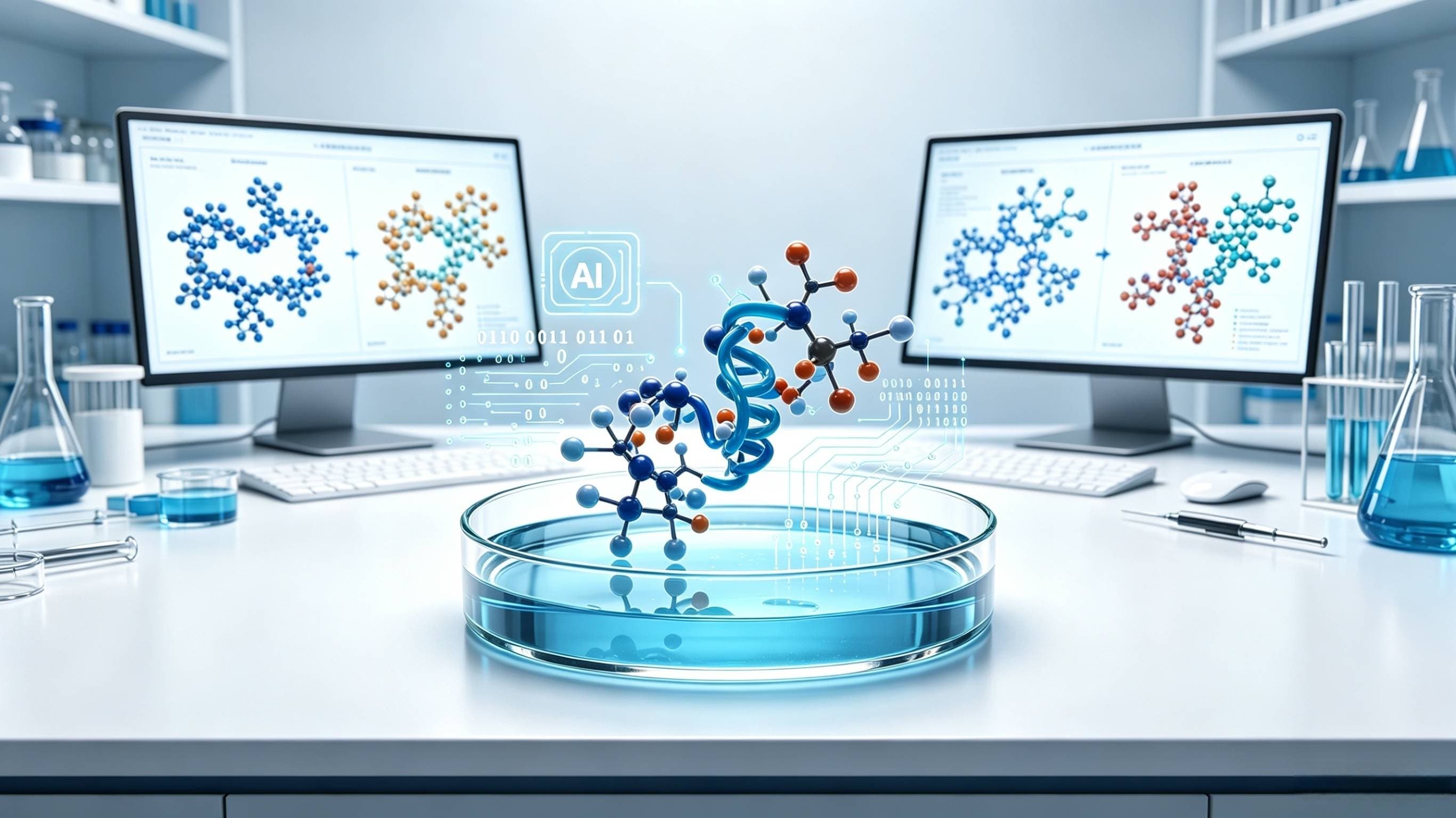
4. How can AI empower the development of Protein A with mild elution features?
In the past, researchers aimed to improve the performance of Protein A ligands mainly through two methods: random mutagenesis and rational design. Both methods share a common feature: they are time-consuming and highly uncertain. It could take several months or even longer to screen for a few promising mutants, and the success rate is often unsatisfactory.
However, now with the advent of AI, the field of protein research and development has undergone revolutionary changes.
Represented by AlphaFold and RoseTTAFold, these AI models can accurately predict the three-dimensional structure of proteins from their amino acid sequences in just a few minutes to a few hours. To put it in perspective, it is like previously having to manually measure every dimension of a building, whereas now you can give AI a blueprint, and it can instantly render a complete 3D model.
Core logic: Let AI understand the language of proteins
The amino acid sequence of a protein is like a language with only 20 letters (corresponding to the 20 natural amino acids). These letters combine, fold, and interact in specific ways to form “functional sentences” that have been naturally selected through billions of years of evolution.
In recent years, scientists have developed a large number of protein language models, similar to the large language models used to train ChatGPT, except the “corpus” is replaced with hundreds of millions of protein sequences. One of the most groundbreaking methods is the introduction of diffusion models. The principle is: noise is first added to a protein structure to deform it, then the model is trained to learn to denoise and restore it. In this “destruction-repair” cycle, the model learns how to “grow” entirely new protein backbones from random noise that satisfy specific geometric constraints. On this basis, tools like ProteinMPNN complete the final step—“translating” the generated protein backbone back into a specific amino acid sequence.
This forms the classic two-step approach: first generate the protein backbone, then “fill in” the sequence.
Dry-Wet Closed Loop: Design Is No Longer Just a Line of Code
If the aforementioned methods solve the problem of 'from structure to sequence,' then the ultimate pursuit of researchers is to connect the last link of 'from sequence to function'—after all, what is ultimately delivered is not a string of code, but a truly 'useful' protein. In jargon, this is called a 'dry-wet closed loop': AI completes the design in the digital world (dry experiments), and robotic laboratories execute the verification (wet experiments), with the verification results fed back to the AI for the next round of optimization.
In this regard, domestic companies have also provided their solutions.
In April 2026, Shanghai Matwings Technology released the conversational protein development AI agent MatwingsVenus™ (Xiaowu™) platform, integrating the above approach into a platform that users can 'use while chatting.'
The platform's logic is quite interesting: users enter task goals in natural language—for example, 'Help me design a Protein A ligand that can withstand alkaline cleaning and elute antibodies under conditions above pH 4.6'—and the system automatically breaks down the task, orchestrates over 200 underlying protein design tools, and completes the full computational workflow of protein design. The design results are then seamlessly linked to an automated laboratory, where robots carry out sample preparation, protein purification, and functional testing. The test results are fed back into the next round of AI design, forming an iterative loop of 'computation driving wet experiments, and wet experiments feeding back into computation.'

Mild elution filler
From the Laboratory to the Market
Whether AI-powered products can move from the laboratory to the market is evident. According to the official website of Matwings Technology, its Protein A affinity resin has improved alkaline resistance of the Protein A ligand by using AI large model technology. It uses spherical, narrowly dispersed, highly cross-linked agarose gel as the matrix, specifically for the separation and purification of complex antibodies such as monoclonal, bispecific, multispecific antibodies, and Fc-fusion proteins.
The introduction of the AI platform means that the development of Protein A resins is no longer just about "making it," but "designing it." The value of such a platform lies in transforming a process originally highly dependent on experience and trial-and-error into a smarter, more precise, and more controllable R&D workflow.
5. Conclusion
From traditional Protein A to mild-elution Protein A, and now to AI-driven ligand design, antibody purification technology is undergoing an upgrade toward practical needs. Compared with the past focus on simply "capturing antibodies," today's process development focuses more on: how to elute antibodies more gently while maintaining their integrity, activity, and monomer purity. This is exactly the core value of mild-elution Protein A.
Looking back at nearly seventy years of Protein A development, from its initial discovery, to commercialization, and now continuous evolution toward milder elution, higher loading, and alkaline resistance, each step responds to an increasingly clear industry demand: not only high purification efficiency, but also being more antibody-friendly. AI platforms like Matwings Technology's Matwings Venus™ (Xiaowu™) are advancing this “more antibody-friendly” design approach to the R&D stage, accelerating the development and optimization of mild-elution Protein A through intelligent ligand design and automated experimental loops.
The significance of AI protein design is not only to increase R&D speed but also to shift the development of higher-demand products such as mild-elution Protein A from experience-driven to data-driven, from trial-and-error screening to precise design. In the future, as the integration of AI and automated experiments becomes more mature, mild-elution Protein A will not only be a superior purification material, but will also become a key infrastructure in the industrial production of complex antibody molecules.

Antibody purification