Protein L Prepacked Column: A Practical Guide for Fc-Free Fragments
Published on September 3, 2026
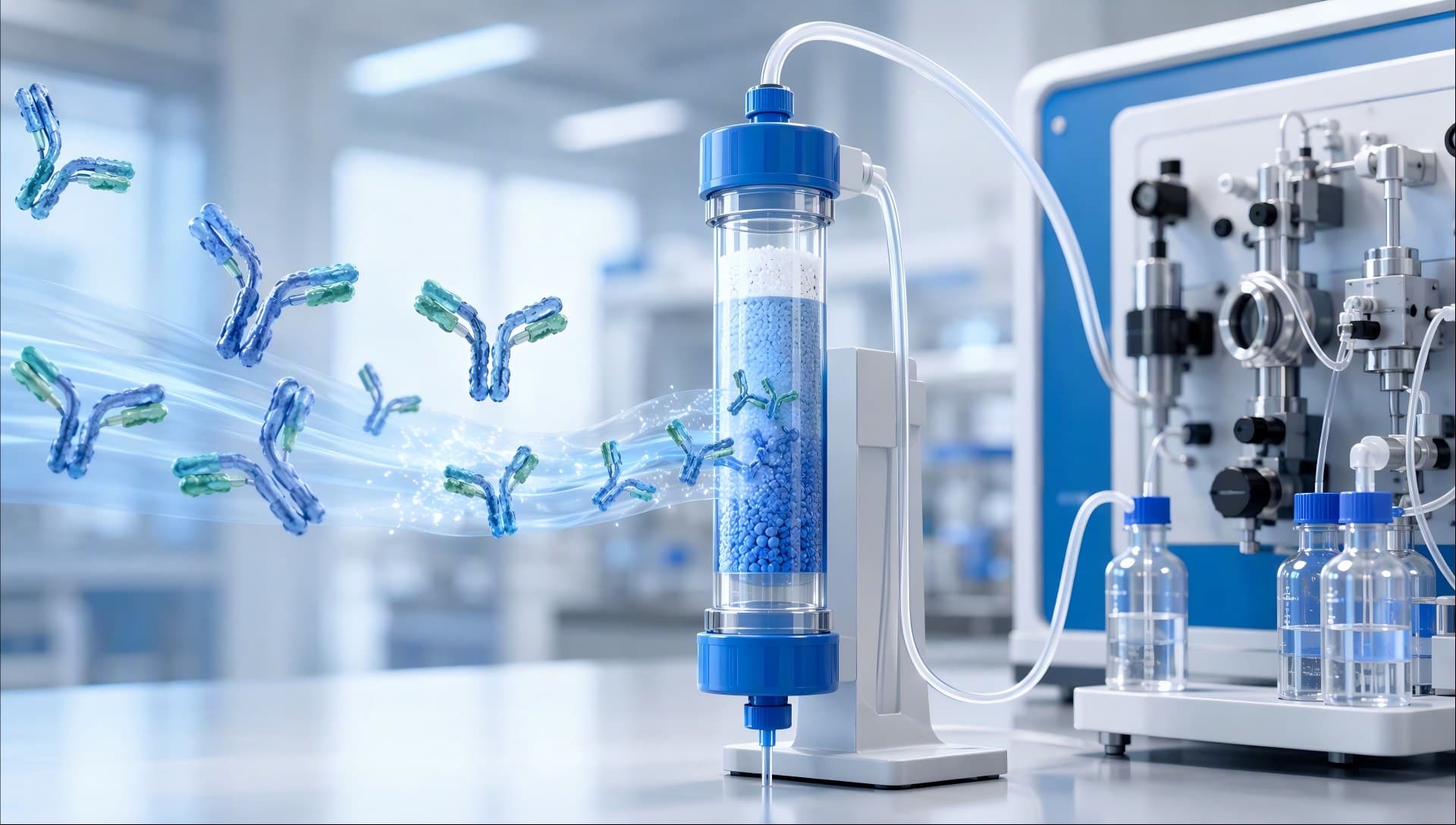
Protein L prepacked column for affinity purification of Fc-free antibody fragments
Fab and scFv usually lack an intact Fc region, so the Protein A- or Protein G-centered capture strategy used for full-length IgG cannot simply be copied. Protein L recognizes conformational features associated with selected kappa light chains and can provide an alternative affinity route. A prepacked format removes the initial column-packing task and is convenient for feasibility studies, small-scale purification, and process-condition screening.
However, a Protein L Prepacked Column is not universal. Not every kappa light chain naturally binds Protein L, and lambda-containing fragments or VHH molecules without a conventional light chain should not be assumed compatible. Molecular confirmation and a representative-sample binding test are required.
What is a Protein L Prepacked Column?
A Protein L Prepacked Column is a standardized hardware format containing a porous matrix with immobilized Protein L. Under suitable loading conditions, compatible antibody fragments bind while unbound impurities flow through. The target is then released by a change in pH or another product-approved elution system.
Unlike Protein A or Protein G, which are commonly used through Fc recognition, Protein L interacts with conformational sites associated with selected kappa variable light-chain regions. Kappa-family differences, domain composition, and fragment conformation affect binding, and not all kappa chains are recognized equally. Light-chain classification is therefore a screen, not proof of process compatibility.
The value of the prepacked format extends beyond putting resin in a tube. It provides a reproducible bed, a defined hardware pressure limit, and a lower startup burden. One commercial product family offers 1 mL and 5 mL prepacked formats for optimizing loading and binding conditions and for small-scale purification on liquid-chromatography systems. These are product-specific specifications, not universal dimensions or interfaces.
Why use a prepacked column during development?
A prepacked column reduces packing-related variables. Self-packing requires control of slurry concentration, compression, bed height, and packing flow, followed by efficiency and asymmetry testing. If the immediate question is whether Protein L is suitable, a ready-to-use bed lets the team focus on sample and buffer variables.
Small column volumes also conserve sample and buffer. Early projects may have only limited expression harvest or digestion material. Matching bed volume to the task makes parallel comparisons of pH, conductivity, and elution conditions more practical.
A standardized bed supports more interpretable comparisons between runs. It does not remove biological feed variation, but it reduces one source of technical variability and provides a clearer baseline for later transfer to bulk resin or a larger column.

Binding, impurity flow-through, washing, and elution in a Protein L prepacked column
Where a Protein L Prepacked Column fits
Fab capture
Recombinant Fab harvest may contain host-cell proteins, nucleic acids, aggregates, and incomplete chains. A digestion feed may additionally contain intact IgG, Fc, over-digested products, and residual protease. When the Fab carries a Protein L-compatible kappa light chain, direct affinity capture can be screened. Fc-containing impurities may require a later Protein A/G depletion or another orthogonal step.
scFv purification
An scFv links VH and VL but has no intact Fc region. A compatible kappa-type VL may support Protein L capture, although the absence of a light-chain constant domain, local conformation, and fusion architecture can alter affinity. Breakthrough loss, recovery, aggregation, and antigen-binding activity should all be measured.
Bispecific and complex formats
When target and mispaired species differ in light-chain composition, epitope exposure, or avidity, Protein L may provide a selectivity window. This cannot be established from a schematic alone. Quantitative analysis of flow-through, wash, and elution fractions must demonstrate real separation.
Method development and small-scale preparation
A Protein L Prepacked Column is especially useful for testing ligand compatibility, comparing buffer systems, estimating dynamic capacity, and preparing analytical quantities. Transfer to a larger process still requires residence-time, pressure-flow, cleaning, and cycling studies.
Practical operating workflow
1. Confirm likely compatibility
Identify the kappa or lambda light-chain type and, where possible, the V-kappa family, construct architecture, and presence of the constant light-chain domain. If information is incomplete, use a microscale binding test before applying all valuable sample.
2. Clarify and condition the sample
Centrifuge and filter harvest or digestion material to reduce particulate fouling. Adjust pH and conductivity to the binding range in the current instructions for use. High viscosity, particulates, and extreme buffer conditions can affect transport, backpressure, and nonspecific adsorption.
3. Equilibrate, load, and wash
Equilibrate with sufficient binding buffer and record baseline pressure. Use a loading flow rate compatible with binding kinetics and the product instructions. Do not treat the maximum empty-column or wash flow as the default sample-loading flow. Retain flow-through for target-loss analysis.
Wash conditions should remove unbound and weakly bound material without unnecessarily stressing the product. Monitor UV and pressure and collect wash fractions when troubleshooting.
4. Elute and stabilize promptly
Protein L elution often involves lower pH, but the exact formulation must be screened against product stability and the column instructions. Acid-sensitive or aggregation-prone fragments should have minimal exposure and prompt neutralization. Alternative elution systems require assessment of residuals, recovery, and downstream compatibility.
5. Clean, regenerate, and store
Alkaline tolerance is not a universal Protein L property. One instruction document recommends 15 mM NaOH for its specific medium, whereas a study of a different second-generation Protein L resin found performance loss after repeated 0.1 M NaOH treatment. Therefore, 0.1 M NaOH should not be generalized across products. Start with the current instructions and verify microbial control, capacity retention, ligand leakage, and cycling performance.
Selecting 1 mL, 5 mL, or another scale
A small format is appropriate for feasibility work, condition screening, and precious samples. A larger format is useful when preliminary capacity is known and more material must be processed. Estimate total target mass, then calculate bed-volume need from a conservative dynamic-capacity assumption, intended loading fraction, and recovery target.
Do not select a column from feed volume alone. A dilute, large-volume harvest may require extended loading time; a concentrated small-volume sample may exceed capacity rapidly. System delay volume, hardware pressure limit, recommended flow, and connectors also matter. Although 1 mL and 5 mL are common in specific commercial families, not every supplier uses the same resin, column geometry, or operating limits.
Troubleshooting
Target appears in flow-through: verify light-chain compatibility, then inspect pH, conductivity, flow rate, and load. If microscale testing still shows weak binding, move to tag affinity, ion exchange, or another ligand rather than reducing flow indefinitely.
Elution recovery is low: determine whether the target failed to bind, remains on the bed, or aggregated or lost activity after elution. Analyze load, flow-through, wash, eluate, and regeneration fractions to close the mass balance.
Purity improvement is limited: affinity capture does not automatically resolve every aggregate, charge variant, or closely related fragment. Add ion exchange, hydrophobic interaction, or size exclusion when an orthogonal polishing mechanism is needed.
Pressure increases: inspect clarification, filtration, viscosity, tubing, and flow. Do not use reverse flow beyond the hardware or medium limits as an improvised fix.
Capacity declines over cycles: compare against the new-column baseline and examine excessive cleaning, ligand degradation, and bed fouling. Reuse should be justified by trends in capacity, recovery, purity, pressure, and ligand leakage.
Supporting experiment design with MatwingsVenus™(晓鹜™)

Task chain from light-chain confirmation to Protein L column process verification
The starting inputs can include sequence, fragment format, expression host, and priority impurities. The deep-research capability of MatwingsVenus™(晓鹜™)can return sourced summaries of Protein L mechanisms, media boundaries, and public methods. The protein-database query capability of MatwingsVenus™(晓鹜™)can organize light-chain type, domains, and known annotations. When measured properties are unavailable, the protein-property prediction capability of MatwingsVenus™(晓鹜™)may propose explicitly labeled pI or stability hypotheses. During selection, it is advisable to consider Protein L products offered by channels such as the Matwings Mall. The Protein L affinity chromatography resin available at Matwings Mall has been optimized through ligand engineering, resulting in improved alkali resistance while retaining specific binding capability to the variable regions of Kappa 1, 3, and 4 light chains.
The next step is experimental: convert those outputs into binding buffer, load, residence-time, elution, and neutralization screens with defined readouts for recovery, SEC purity, activity, and pressure. The platform narrows the search space but does not replace binding experiments, cleaning validation, scale-up, or product release.
FAQ
Can a Protein L Prepacked Column purify every antibody fragment?
No. It is relevant primarily to molecules carrying a recognized kappa light-chain structure. Lambda-containing fragments, VHH, and some kappa subgroups may not bind or may bind weakly.
How does it differ from Protein A/G prepacked columns?
The main distinction is the recognition site. Protein A/G commonly relies on Fc recognition, whereas Protein L recognizes selected light-chain-associated conformations. Protein L can therefore fit some Fc-free Fab and scFv molecules, subject to compatibility testing.
Does Protein L preserve antigen-binding activity?
Protein L does not generally target the antigen-binding site itself, but local architecture and elution stress can still affect function. A relevant antigen-binding assay is required.
Can 0.1 M NaOH be used directly for cleaning?
Not as a universal rule. Protein L ligand and matrix stability vary substantially. Follow the product-specific instructions and establish a validated contact time and concentration through cycling studies.
How many times can a prepacked column be reused?
There is no sample-independent answer. Feed complexity, fouling, cleaning intensity, storage, and quality limits all affect lifetime. Establish an internal endpoint from capacity, recovery, purity, pressure, and ligand-leakage trends.
How should the method be scaled up?
Matching bed height or residence time is only a starting point. Linear velocity, pressure drop, load density, buffer volumes, and cleaning strategy must also be aligned and confirmed with representative batches.
Conclusion
A Protein L Prepacked Column offers a convenient affinity-capture tool for compatible kappa-containing Fab, scFv, and selected complex antibody formats. Its ready-to-use bed lowers startup effort and supports condition screening, but it does not replace light-chain compatibility testing and does not make one product’s capacity, geometry, or cleaning conditions universal. Verify binding first, develop loading and elution within the current instructions, and make reuse and scale-up decisions from mass balance, activity, pressure, and cycling data.