Multiple Sequence Alignment That Makes Protein Families Informative
Published on September 16, 2026
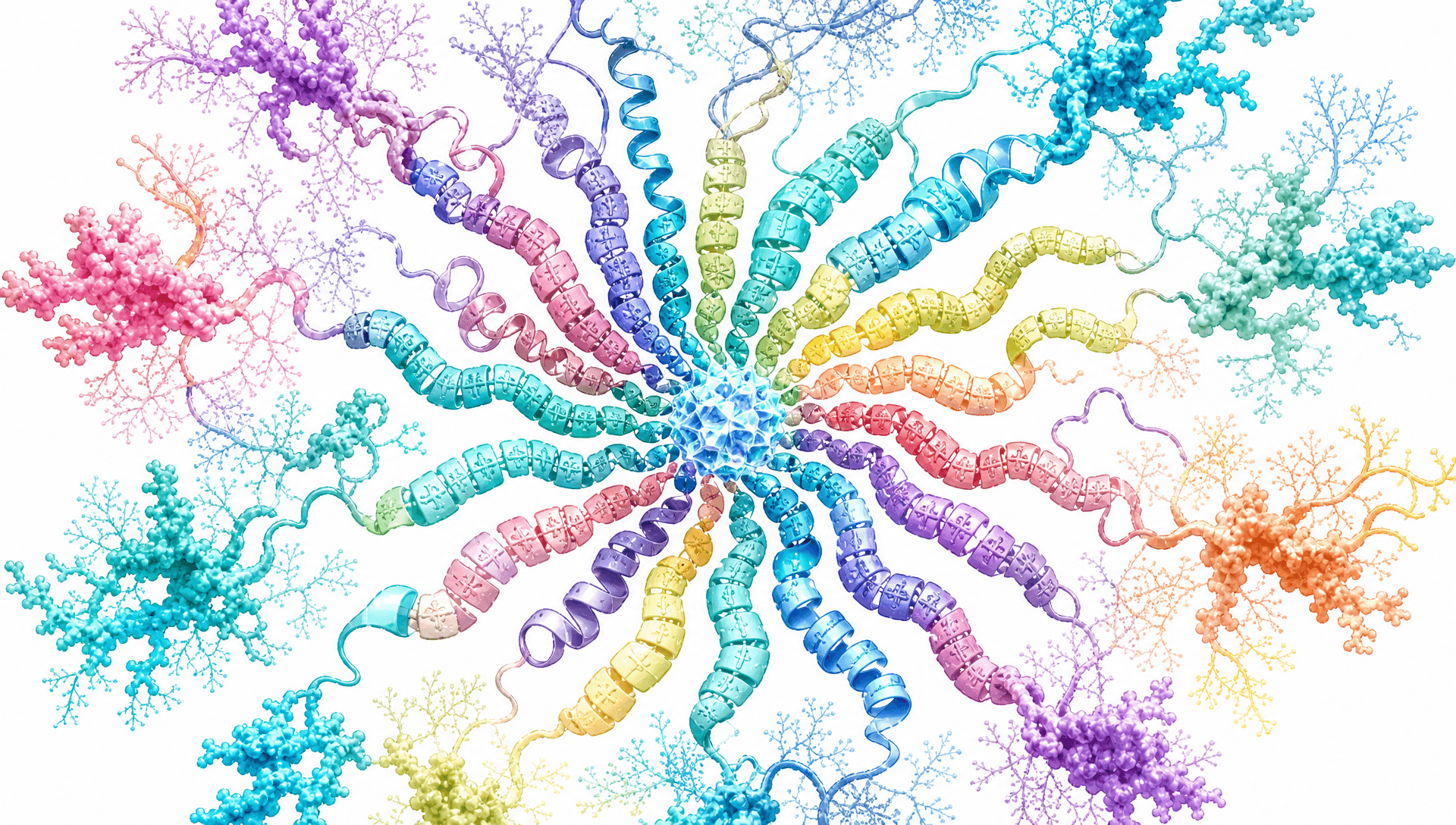
Diverse protein strands surrounding a luminous conserved family core
Category: Protein Bioinformatics | Research Methods
One sequence is a monologue. A carefully chosen collection can reveal the shared grammar of a protein family across species and evolutionary branches. Multiple sequence alignment places those sequences in a common coordinate system so that persistent residues, variable regions, and insertion–deletion patterns become visible. Yet it cannot automatically turn noisy input into a reliable conclusion. The value of the result depends heavily on how members are selected, boundaries are defined, and uncertainty is handled.
Design a sequence set that can answer the question
“More sequences are always better” is a poor rule. If a dataset is crowded with nearly identical close relatives, one lineage can dominate the apparent conservation signal. If truncated entries, incorrect annotations, incompatible domain architectures, or low-quality records are included, an algorithm may try to align regions that should not be treated as corresponding.
A stronger starting point is a precise research question. To identify a stable family scaffold, sample representative members across an appropriate evolutionary range. To investigate differences in substrate preference, build groups around functions that have already been checked. To support mutation design, prioritize complete target domains and retain enough diversity to distinguish family-wide conservation from subgroup-specific patterns.
This work happens before the alignment is run, but it often determines whether the columns will be meaningful. Check source, length, organism, isoform, and domain boundaries, then reduce obvious redundancy and remove clear anomalies. A sequence set is not a storage bin; it is a comparison system designed around a decision.
Each column is a family vote, not a final verdict
Highly conserved columns usually attract attention first. They may correspond to residues that stabilize a fold, contribute to catalysis or binding, or satisfy another structural constraint. A contiguous conserved pattern is often more informative than a single bright position. Interpretation becomes stronger when that pattern also agrees with a known domain boundary or structural feature.
Variable columns are not necessarily disposable noise. They may record how family members adapt to different substrates, environments, or regulatory contexts. The informative question is how conserved and variable regions are arranged together. Flexible regions around a stable core can suggest routes to functional diversification, while residue combinations unique to one subgroup can motivate more specific classification or experimental hypotheses.

A diverse sequence collection passing through filters into a balanced mosaic
No critical-site claim should come from color intensity alone. Responsible interpretation combines conservation with residue chemistry, structural location, curated annotation, and experimental context. Multiple sequence alignment concentrates attention on selected positions; it does not replace functional validation.
Quality control begins where alignment becomes uncertain
A visually tidy result is not necessarily correct. Highly divergent segments, low-complexity regions, long insertions, and missing domains can create unreliable column correspondences. In phylogenetic work, incorrectly inferred site homology and substitution saturation may propagate into tree topology and branch interpretation.
Quality control is therefore not the automatic removal of every messy region. Excessive trimming can also discard informative sites, producing a cleaner but less faithful dataset. A more defensible approach is to mark uncertain regions, compare whether conclusions remain stable with and without justified filtering, and document the rationale. For important conclusions, alternative reasonable parameters or sequence subsets can reveal whether the same conserved pattern persists.
When proteins differ substantially in domain architecture, forcing a full-length alignment may be less useful than reframing the analysis around the shared domain. The resulting alignment is easier to explain and more suitable for transfer into structure analysis, functional-site assessment, or experiment planning.
Connecting the multiple sequence alignment evidence chain in MatwingsVenus™(晓鹜™)
A high-quality family study usually requires several linked actions: identify proteins, retrieve sequences, verify annotations, curate members, inspect structures, and decide whether prediction or design is justified. MatwingsVenus™(protein design agent)supports database retrieval, protein sequence analysis, structural information access, and downstream protein research within a shared scientific context, rather than leaving each result isolated in a separate tool output.
For a raw sequence, the platform’s capability contract prioritizes identity resolution before downstream interpretation. For a known protein, curated or measured database information is retrieved first and kept distinct from computational prediction. Researchers can state the target, candidate scope, and scientific objective in natural language, then build the sequence set around traceable retrieval results. Multiple sequence alignment becomes more than a batch of FASTA records: it becomes an interpretable family map grounded in provenance.
Once an alignment suggests a conserved core or subgroup signature, MatwingsVenus™(晓鹜™)can route the next question toward functional-site analysis, structure retrieval, natural-protein discovery, or downstream engineering assessment. Findings are distinguished as Measured, Predicted, or Unknown, and computationally intensive steps retain user confirmation. This keeps the workflow connected without presenting predictions as experimental facts.

A family atlas connected to evolutionary branches, structural cores, and research paths
Turn a colorful map into an actionable decision
The most useful output of multiple sequence alignment is not a visually uniform block. It is a bounded set of questions: Which residues persist across diverse members? Which changes belong only to a subgroup? Which regions remain uninterpretable because the data are weak? Which patterns deserve structural inspection or wet-lab validation?
Keep the input version, inclusion criteria, parameter choices, and uncertain regions with the result. In mutation design, conserved positions may be treated as priority caution zones, but structural and functional evidence is still required. In phylogenetic analysis, sampling and filtering choices should remain transparent. In function annotation, family-level patterns should not be transferred automatically to every individual sequence.
Conclusion
A strong multiple sequence alignment is purposeful information compression: it reduces redundancy in a sequence collection while preserving the differences that explain family behavior. Sequence-set design, column-level interpretation, and uncertainty management should come before confidence in a colorful output. By using MatwingsVenus™(晓鹜™)to connect retrieval, family analysis, and downstream research, teams can see more clearly which conclusions are supported, which require validation, and where experimental effort should go next.