
Miraculin: A Taste-Modifying Protein That Turns Sour Into Sweet
Published on October 28, 2026
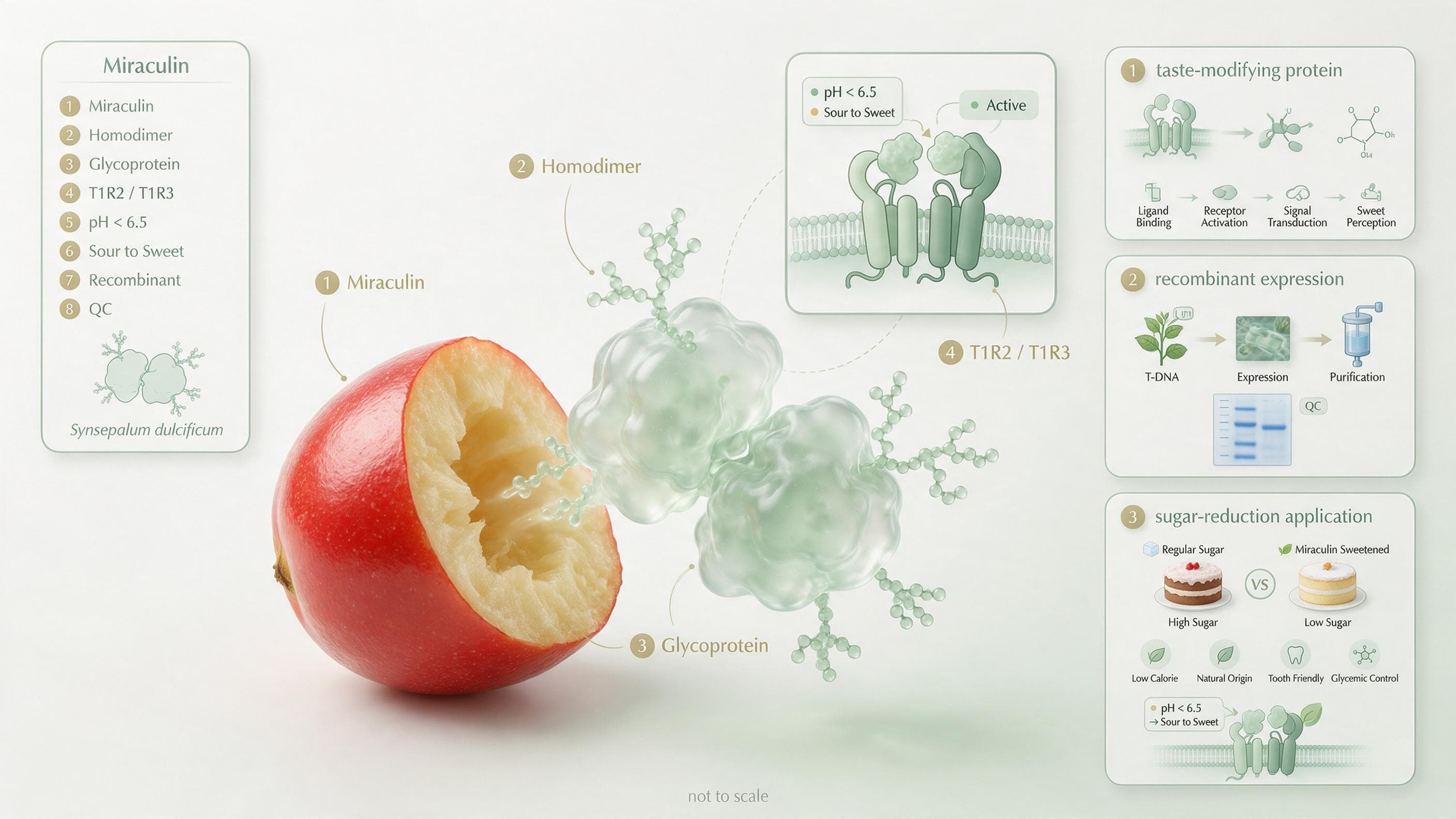
Category: E (Structure & Mechanism Analysis, primary) | G (Applications, secondary) | C (Directed Evolution & Protein Engineering)
1. Opening: correcting a common misreading
Miraculin is not a sweeter, high-intensity sweetener; it is a taste-modifying protein that turns sour tastes into sweetness.
The sugar-reduction industry keeps trying to separate sweetness from calories, and R&D teams often turn to sweet proteins first.
Sweet proteins fall into two families: those that are sweet themselves, such as thaumatin and monellin, and those that are not sweet but only rewrite taste. Miraculin belongs to the second family.
Treating miraculin as an ordinary sweetener and measuring its sweetness multiple is the first trap. It produces no sweetness; it simply makes your brain perceive an acid as sweet.
What draws R&D teams to miraculin is not sweetness but its ability to rewrite taste, with room in sugar control, fitness foods and taste adjustment for the young and elderly.
Miraculin is a taste-modifier, not a sweetener
Miraculin is a taste-modifying protein, also called a taste-modifier.
It does not supply sweetness; it shifts the direction of taste perception, rewriting a sour signal into a sweet one.
The right metrics are therefore sweet-inducing activity and the active pH window, not a sweetness multiple.
A common misjudgment: measuring it by sweetness multiple
The sweetness multiples advertised by high-intensity sweet proteins mean nothing for miraculin.
Its sweetness comes from acid, is triggered by acidity, and varies with acid strength and individual differences.
Using it to replace sucrose directly tends to go wrong in process stability and taste formulation.
2. Concept and background: miracle fruit and miraculin
Miraculin is a taste-modifying glycoprotein extracted from the miracle fruit (Synsepalum dulcificum).
What miraculin is: a taste-modifying glycoprotein
The miracle fruit is a shrub of the Sapotaceae family, native to West Africa, bearing small red berries.
Miraculin is enriched in the pulp; it is a typical glycoprotein of about 24.6 kDa, built from 191 amino-acid residues, with roughly 14% carbohydrate.
It was first isolated in 1968 by Kenzo Kurihara; sequence and structural studies followed.
It is tasteless by itself, yet activates the sweet receptor under acidic conditions, turning sour into sweet. Hence the name taste-modifier.
Not the same as intrinsically sweet proteins
Miraculin is not a sugar, not an artificial sweetener, and not a sweet protein that is sweet on its own.
Its mechanism differs from thaumatin, monellin and brazzein, which activate the sweet receptor directly to supply sweetness.
Miraculin instead rewrites taste, making an acid taste sweet. That defines its distinct application logic.
3. Structure and mechanism: pH-dependent taste modification
The heart of miraculin is pH dependence; it is like a key that only turns when it meets an acid.
Structure: a homodimeric glycoprotein
Each monomer has 191 residues, and two assemble into a homodimer to function.
The molecular weight is about 24.6 kDa and the isoelectric point (pI) is near 9; two N-linked glycan chains are key to activity and stability.
The monomer alone is tasteless at any pH; function depends on the dimer and its glycosylation state.
How pH turns the key
Human sweetness relies on the T1R2/T1R3 heterodimer, a C-class G protein-coupled receptor (GPCR) with an amino-terminal domain (ATD), a cysteine-rich domain (CRD) and a seven-transmembrane domain (TMD).
At neutral pH, miraculin binds the T1R2 extracellular region but locks the receptor as an antagonist, and can even inhibit other sweeteners.
When pH falls to about 4.8–6.5, the extracellular region is protonated; miraculin switches to an agonist and activates the receptor, so an acid is tasted as sweet.
Full activation also requires intracellular acidification; the effect can last about an hour, depending on acidity and the individual.
This switch is supported by studies: Koizumi et al. (2011, PNAS) showed that miraculin toggles between inactive and active on the receptor with pH, and Sanematsu et al. (2016) showed that intracellular acidification is required for full activation.
It also explains why the effect lasts about an hour on the tongue: miraculin stays on the receptor and is re-activated each time it meets acid.
Understanding this switch matters for formulation: miraculin only shows effect when acidity is high enough and the acid can reach the receptor.

figure2. pH-dependent receptor activation from antagonist to agonist. Schematic
4. Scenario analysis: how it differs from other sweet proteins
Miraculin offers taste management rather than sweetness supply, so its selection logic differs from ordinary sweet proteins.
Three families of sweet proteins: miraculin is in the taste-modifying family
Sweet proteins fall into three families by function. The first is intrinsically sweet, such as thaumatin, monellin, brazzein and mabinlin.
The second is not sweet but rewrites taste, such as miraculin and neoculin.
The third does both, such as curculin. Miraculin belongs to the second family.
Miraculin vs thaumatin and monellin
Thaumatin and monellin supply sweetness directly and are highly sweet; miraculin supplies no sweetness and only rewrites sourness.
The first two thus fit replacing sucrose sweetness, while miraculin acts as a taste-modification tool; their uses are complementary rather than competing.
Suitable scenarios and clear limits
It suits low-sugar, low-glycemic foods, reduced-sugar beverages, and diabetes or weight-management applications.
For high-acid ingredients such as lemon, vinegar and some fermented dairy, it can turn sourness into sweetness and reduce added sugar.
For people with taste disorders, such as the elderly or patients on radiotherapy or chemotherapy, it can improve appetite by making acidic foods palatable.
The limits are clear: it does nothing on neutral or alkaline foods, and its sweetness depends on acidity, so it is not a high-intensity-sweetness concept.
In complex formulas it is often paired with other sweeteners to mask bitterness and off-notes.
In formulations it often works with sweeteners and acidulants, in beverages, fruit vinegar, sugar-free yogurt and ready-to-drink mixes, rather than replacing sucrose.
5. Two routes and selection: natural extraction vs recombinant expression
Choose extraction for a natural story; choose recombinant expression for stability, scale and control.
Natural extraction or recombinant expression?
Natural extraction purifies the ripe fruit and keeps a clean label, but origin and season vary, batch consistency is poor, and fruit polysaccharides interfere with purification.
Recombinant expression has achieved stable high yields in transgenic tomato and lettuce, with natural and recombinant glycoforms nearly identical, and can be scaled in yeast or other microbial systems.
For reproducible process and food-grade output, favor recombinant; for a record of raw-material authenticity, consider extraction but accept batch variability.
Glycosylation: the key variable in recombinant routes
Miraculin is a glycoprotein, and the composition and position of the glycans directly affect activity and stability.
The host determines the N-glycoform, so expression-system optimization is the core of the recombinant route.
Before selection, define the target glycoform, purity and process temperature, then choose host and downstream purification.
On host choice, plant systems give a more natural glycoform while yeast systems scale more easily; the trade-off depends on target glycoform, yield and cost.
6. Assay and QC: turning activity into measurable data
To evaluate miraculin, watch four things: sweet-inducing activity, purity, glycoform consistency and the stability window.
How to assay sweet-inducing activity
Use a T1R2/T1R3 cell-based assay or sensory sweetening evaluation to measure sweet-inducing activity.
The assay must include the acidity window (about 4.8–6.5) and record the acid type and concentration.
No activity is detected at neutral pH, so state this clearly in the experimental design.
In a cell-based assay, run a neutral control to confirm that activation is driven by acidity, not by the sample's own sweetness.
Four QC checkpoints: activity, purity, glycoform, stability
Purity is checked by SDS-PAGE or size-exclusion chromatography to check the monomer and dimer states; for a glycoprotein also account for glycan heterogeneity.
Glycoform consistency is assessed by mass spectrometry on N-glycan composition and position, and is the key QC for recombinant samples.
Key parameters at a glance
• Sweet-inducing activity: measured by sensory or cell activation at the acidic window (about 4.8–6.5).
• pI near 9: moderately basic, favorable for ion-exchange purification.
• Glycoform: two N-glycan chains; composition and position affect activity and stability.
• Stability: thermolabile; tolerated temperature varies with preparation and conditions.
Taste-modifying activity is thermolabile; the tolerated temperature varies with preparation and conditions.
Practical order: confirm the activity window, then verify purification and glycoform, then run stability testing under the target application conditions.

figure3. Recombinant production and QC workflow. Schematic
7. How MATWINGS MALL products and custom services apply
When you need a stable, scalable, glycoform-controlled recombinant taste protein, you can rely on the MATWINGS MALL custom tool-enzyme and recombinant-expression services.
Custom recombinant-expression and tool-enzyme development
Standard finished enzymes struggle with the low yield, high glycan heterogeneity and food-grade compliance of taste proteins, so custom development adds value.
Custom services can cover host and glycoform selection, expression-system optimization and downstream purification, through small-batch activity verification and batch QC.
They offer small-batch verification, batch-level glycoform and activity QC, and traceable provenance; specific batch purity, lead time and pricing are .
Submit your application scenario, target pH window and purification requirements to MATWINGS MALL or the expert center for a custom plan; selection can go through the MATWINGS MALL wet-dry loop platform.
From raw material to product, MATWINGS MALL can turn glycoform, activity and stability into traceable batch data, shortening the path from lab to production.
In this context, standardized development of sweet and taste proteins usually involves sequence analysis, structure assessment, host screening and activity verification, all of which MATWINGS MALL can support.
Key stages and delivery of custom development
A typical route is to first assess host and glycoform, then express a small batch, measure activity and glycoform, optimize purification and batch consistency, and finally verify stability under application conditions.
8. FAQ
How sweet is miraculin? Why is it not a sweetener?
Answer first: miraculin is not sweet itself and has no fixed sweetness multiple. Only at acidic pH (about 4.8–6.5) does it activate T1R2/T1R3, making acids taste sweet. It therefore provides taste modification, not standalone sweetness, and cannot be measured in sucrose equivalents.
Under what conditions does it work?
Answer first: only under acidic conditions. At neutral pH it binds T1R2/T1R3 without activating it, in an antagonistic state; below about pH 4.8–6.5 the extracellular region is protonated and it becomes an agonist, producing sweetness. It has no effect on neutral or alkaline foods.
Can it be used in sugar-reduction or diabetic foods?
Answer first: yes, but treat it as taste management rather than sweetness supply. It makes acidic foods palatable in low-sugar, low-glycemic products, suiting diabetes and weight management, and improving appetite for people with taste disorders. Verify formula and compliance per target market.
Which suits scale-up: natural or recombinant?
Answer first: scale-up favors recombinant expression. Natural extraction is limited by origin, season and batch variability and by fruit-polysaccharide interference; recombinant expression in tomato, lettuce or yeast scales stably with near-identical glycoforms. For reproducible process and food-grade output, favor recombinant.
How do I start developing my own sample?
Answer first: request a custom tool-enzyme and recombinant-expression plan through MATWINGS MALL or the expert center, describing your application, target pH window and purification needs. Run one small-batch expression, activity and glycoform verification, then discuss scale-up. Lead time and pricing are.
9. Conclusion
The real value of miraculin is that it separates sweetness from calories in a way no high-intensity sweetener can.
It is a taste-modifying protein: it produces no sweetness, only turns sour to sweet, and its activity depends on pH.
Industrialization depends on recombinant expression and glycoform consistency, not on being sweeter.
In selection, first decide whether you need taste management or sweetness supply, then choose extraction or recombinant, and finally verify activity window, purity, glycoform and stability.
For a scalable, food-grade recombinant taste protein, rely on the MATWINGS MALL custom tool-enzyme and recombinant-expression services.
The value of miraculin is not a nominal sweetness but whether it can reliably turn sour to sweet in the target process; that question is answered with real samples and measurable data.
To turn miraculin into a usable ingredient, first clarify the target scenario: sugar reduction, glycemic control or taste management. With the direction set, the path becomes clear.
Is miraculin right for your project?
The test is direct: if your product is acid-driven and you want to reduce sugar or improve mouthfeel, the taste-modifying route is worth trying; if you only need sweetness, favor a sweet protein that supplies it directly.
MATWINGS MALL product zone and more industry insights
For more on taste proteins, sweet proteins and custom tool enzymes, visit the MATWINGS MALL website and expert center; MATWINGS MALL and the wet-dry loop platform offer related products, selection advice and sample verification.