
How to Evaluate an Alternative Protein A Prepacked Column: 4 Key Benchmarks
Published on November 23, 2026
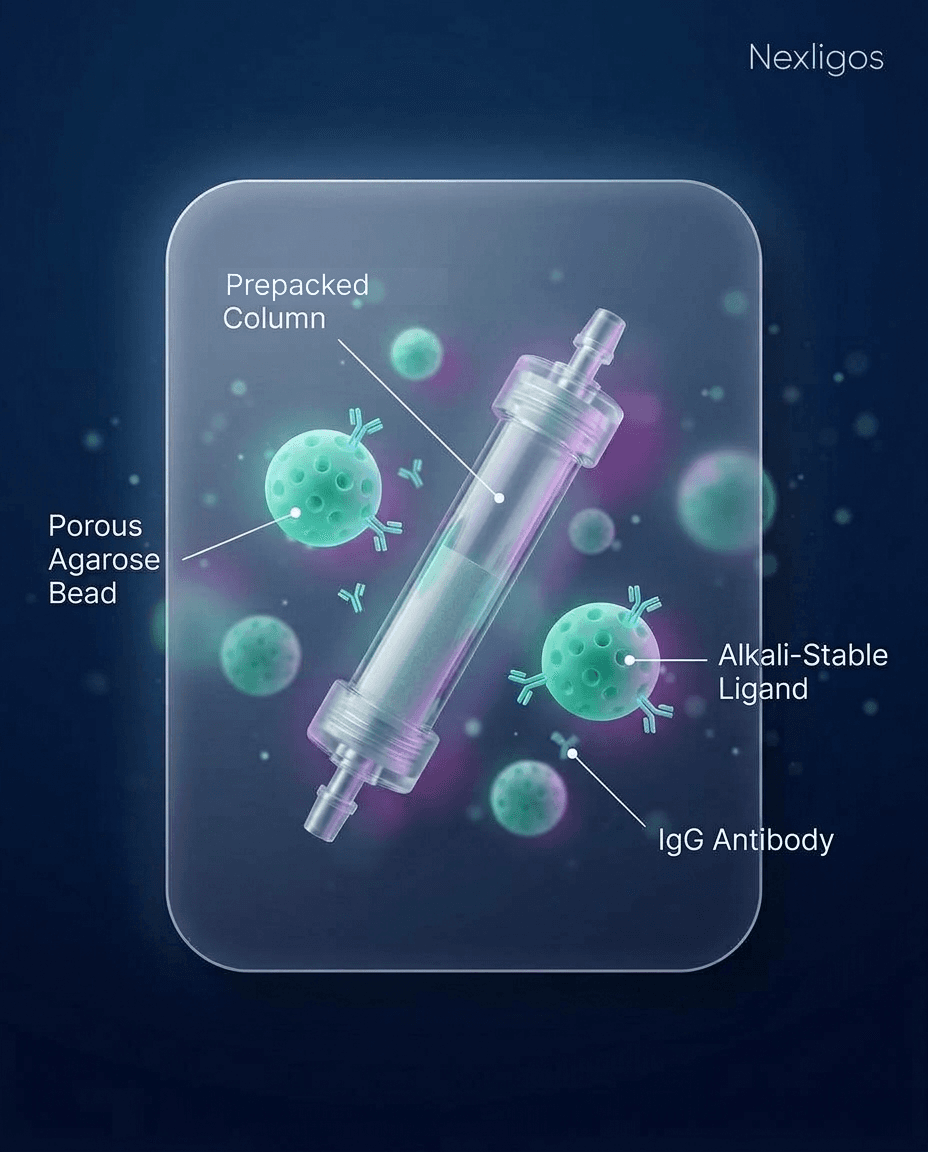

Figure 1: Four key engineering benchmarks for evaluating an alternative prepacked Protein A column.
[Alt Text]: Overview of 4 key benchmarks to evaluate a prepacked Protein A column
1. Why Bioprocessing Teams Look Beyond Legacy Vendors
For years, academic labs and biopharma process development (PD) groups hesitated to qualify secondary Protein A suppliers. Common concerns included rapid capacity loss after sodium hydroxide cleaning, opaque static-capacity marketing claims, and mismatched resin performance between small scouting columns and pilot-scale bulk packs. Today, dual-sourcing to lower cost per gram of purified antibody and de-risk supply chains is standard practice—provided you evaluate every candidate against the same objective data.
2. Four Key Benchmarks to Evaluate Any Protein A Prepacked Column
Benchmark 1: Verified DBC10% at a Defined Residence Time
Static binding capacity does not reflect real chromatography performance. A reliable specification must state the model antibody, breakthrough threshold (typically 10% breakthrough, Qb10%), and residence time, because large IgG molecules require sufficient time to diffuse into porous beads.
· Nexligos™ Benchmark Data: Nexligos™ Protein A Alkali specifies >70 mg/mL DBC at a 6-minute residence time. In side-by-side 10% breakthrough testing with trastuzumab at 6-min RT, it achieves a measured DBC10% of 75.81 mg/mL—outperforming Commercial Competitor A (~61 mg/mL) under identical conditions. On a standard 5 mL short column (1.6 cm ID × 2.5 cm bed height), a 6-min RT corresponds to ~0.83 mL/min loading flow rate and a safe working load of 225–300 mg per run (60–80% of DBC10%).
Benchmark 2: Extreme 0.5 M NaOH CIP Stability
Cell culture harvest contains lipids, nucleic acids, and host cell proteins that rapidly foul affinity resins. Multi-cycle reuse depends on rigorous 0.1–0.5 M NaOH cleaning-in-place (CIP). Mild, short rinses rarely differentiate resins; long-duration exposure to high-concentration NaOH reveals true ligand longevity.
· Nexligos™ Benchmark Data: Operating across pH 3–12, Nexligos™ Protein A Alkali supports 0.1–0.5 M NaOH CIP and sanitization. After 24-hour immersion in 0.5 M NaOH, it retains stable relative binding capacity, whereas Commercial Competitor A drops to 90% under the same stress test—directly extending column lifetime and lowering downstream cost per gram.

Figure 2: Side-by-side experimental data comparing DBC10% (75.81 mg/mL at 6-min RT) and 24-hour 0.5 M NaOH stability.
[Alt Text]: Side-by-side DBC10% and 0.5 M NaOH 24-hour stability data comparison
Benchmark 3: AI-Engineered Ligand & Coupling Chemistry
Native or minimally modified Protein A ligands undergo deamidation and alkaline hydrolysis during repeated NaOH cycles. Multi-point immobilization can also introduce steric hindrance that reduces Fc accessibility. Always review how the ligand was engineered, how it is coupled, and whether the base matrix balances mass transfer with mechanical rigidity.
· Nexligos™ Technology Profile: The alkali-tolerant recombinant Protein A ligand in Nexligos™ is rationally engineered by the MatwingsVenus™ protein AI agent and immobilized via single-point coupling onto a rigid, highly cross-linked ~60 μm agarose base matrix—combining chemical stability with broad aqueous buffer compatibility.
Benchmark 4: Hardware Compatibility, Lot Consistency & Linear Scale-Up
A dependable alternative must deliver both reliable column hardware and seamless process transfer. Before scaling up, verify column material, operating backpressure limits, and lot-to-lot Certificates of Analysis (COA)—and for PD or analytical development workflows, request Protein A ligand leakage documentation alongside resin compatibility.
· Nexligos™ Engineering Profile: Standard 5 mL short columns use low-binding medical-grade polypropylene (PP) housings with standard FPLC ports for direct ÄKTA connection and series operation (Luer adapters not included). While hardware is rated to 3 MPa (30 bar), keep operating backpressure ≤ 0.5 MPa (5 bar) at recommended velocities up to 300 cm/h (~10 mL/min on a 1.6 cm ID column). The portfolio spans in-stock 1×5 mL (PR0010020) and 5×5 mL (PR0010021) columns, custom prepacked formats from 1 mL up, and 25 mL–20 L bulk resin (PR0010010–PR0010017) for linear scale-up.

Figure 3: Pressure-flow curve (20 cm bed height, 20 °C), medical-grade PP hardware specs, and linear scale-up to 20 L.
[Alt Text]: Pressure-flow curve, medical-grade PP hardware specs, and linear scale-up to 20 L
3. Quick-Reference Evaluation Matrix
Benchmark | Common Pitfall | What to Demand | Nexligos™ Protein A Alkali |
Dynamic Capacity | Relying on static capacity | DBC10% with stated mAb & RT | 75.81 mg/mL at 6-min RT (spec >70 mg/mL) |
Alkaline Stability | Vague 'alkali-resistant' claims | 24 h soak data in 0.5 M NaOH | Retains stable DBC after 24 h in 0.5 M NaOH |
Ligand & Matrix | Unmodified native sequences | Engineered ligand, single-point coupling | MatwingsVenus™ AI ligand, ~60 μm agarose |
Hardware & Scale-Up | Scouting vs. bulk mismatch | Clear backpressure limit & bulk match | Direct ÄKTA PP (≤0.5 MPa); 1 mL+ custom to 20 L |
4. Frequently Asked Questions (FAQ)
· Q1: How should I design a quick side-by-side qualification run? Start with an in-stock 1×5 mL column (Cat# PR0010020) using your own 0.22/0.45 μm filtered cell harvest at 0.83 mL/min (6-min RT). Measure step yield, elution purity, and operating backpressure (≤ 0.5 MPa), then run multi-cycle 0.1–0.5 M NaOH CIP checks to confirm capacity retention.
· Q2: What CIP and storage practices protect column lifespan? Immediately after 0.1–0.5 M NaOH CIP, flush with neutral equilibration buffer until the effluent returns to neutral pH. For storage, displace with 20% ethanol (or 2% benzyl alcohol upon request), seal tightly, and refrigerate at 2–8 °C. Never freeze.
Looking for the Right Protein A Purification Solution? Nexligos™ Protein A Alkali features an alkali-tolerant recombinant Protein A ligand designed by MatwingsVenus™, available in both prepacked columns and bulk resin to support everything from lab-scale capture to process scale-up. - 75.81 mg/mL measured DBC10% at 6-min residence time - Supports 0.1–0.5 M NaOH cleaning-in-place (CIP) - Standard 5 mL prepacked columns in stock (PR0010020 / PR0010021) - Custom prepacked columns from 1 mL up & bulk resin up to 20 L Request our technical datasheet, application support, or an evaluation sample. WhatsApp: https://wa.me/qr/UN6PS2FM7JARM1 You can also reach us directly via the contact details listed on this website. |

Scan QR Code to Chat on WhatsApp (https://wa.me/qr/UN6PS2FM7JARM1)