
MAFFT Multiple Sequence Alignment: Fast Fourier Transform for Fast, Accurate Homologous Alignment
Published on November 9, 2026
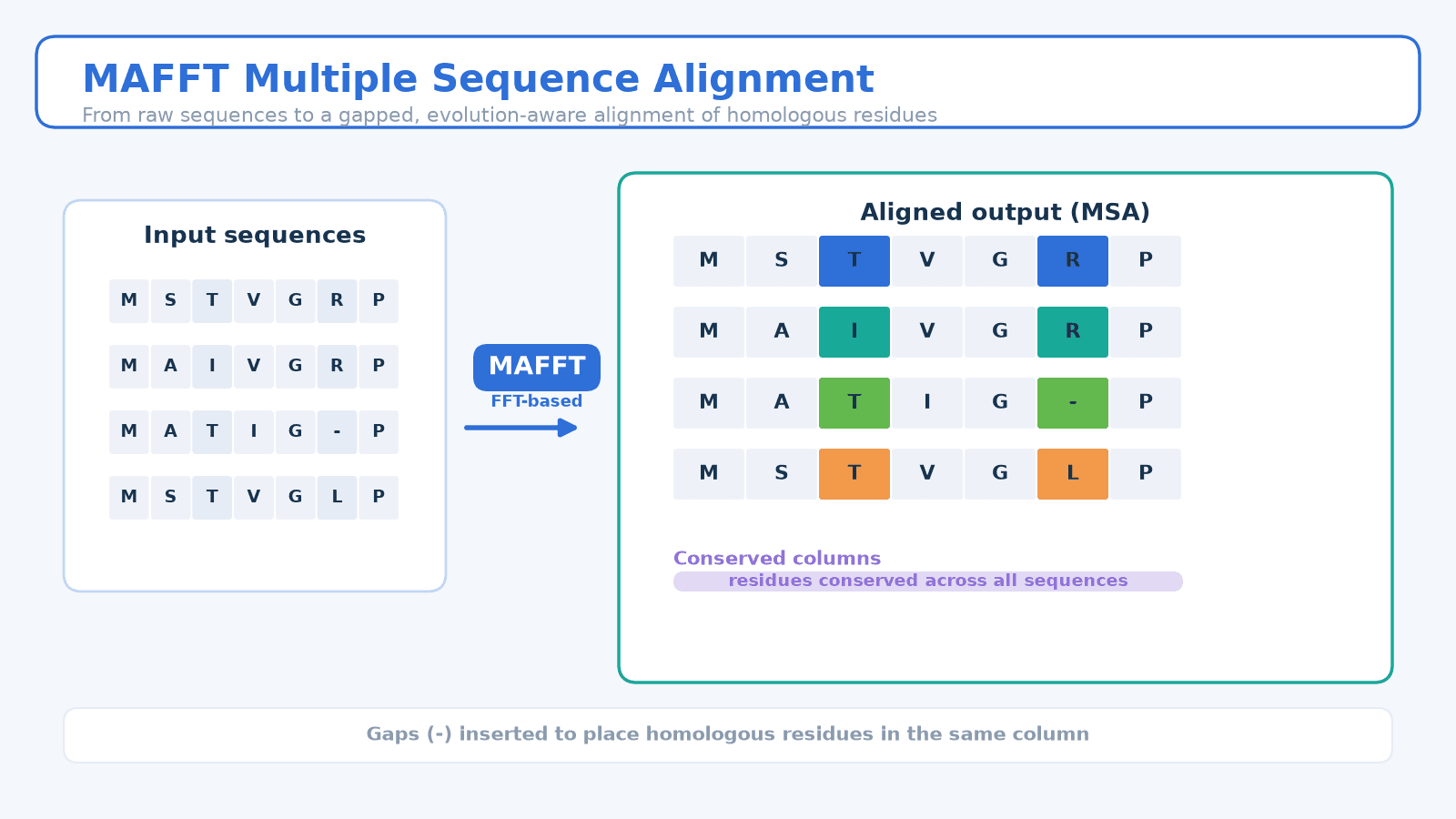
Figure 1 Overview of MAFFT multiple sequence alignment: gaps are inserted so homologous residues align into the same column
MAFFT Multiple Sequence Alignment: How a Fast Fourier Transform Makes Homologous Alignment Fast and Accurate
Multiple Sequence Alignment (MSA) is a cornerstone of bioinformatics: it lines up several homologous sequences column by column so that evolutionarily corresponding residues occupy the same column, revealing conserved sites, functionally critical residues, and evolutionary relationships. MAFFT (Multiple Alignment using Fast Fourier Transform) is one of the most widely used tools for this task, introduced by Katoh and colleagues at Osaka University in 2002 and still a go-to default that balances speed and accuracy.
1. Background: Why We Need Multiple Sequence Alignment
Multiple sequence alignment places two or more homologous sequences together and inserts gaps so that evolutionarily homologous positions line up vertically; it is the first step in interpreting a sequence's function and its evolutionary history. Its core goal is to balance "alignment quality" against "computational cost."
Without an MSA, a single sequence is just a string of letters. Once dozens or hundreds of homologous sequences are placed side by side, which positions matter and which vary becomes visible through vertical comparison. This is why MSA is a prerequisite for phylogenetics, functional annotation, and protein design.
· Reveals conserved sites: Residues that are highly conserved across species or homologs tend to carry key structural or catalytic roles and are the positions you should not disturb during design.
· Detects co-evolution signal: After alignment, residue-residue correlations can be computed, supporting structure and interaction prediction.
· Builds phylogenetic trees: Aligned columns are the basis for evolutionary distances and tree reconstruction.
· Supports homology modeling: A high-quality alignment is the prerequisite for mapping a known structure onto a target sequence to build a 3D model.
That said, multiple sequence alignment is a combinatorial optimization problem that is NP-hard in general: as the number of sequences grows, finding the globally optimal alignment is practically infeasible. Every practical tool therefore follows an "approximate heuristic" route, decomposing the problem into steps and approaching a high-quality solution greedily or iteratively. Understanding this explains the "speed vs. accuracy" trade-off between tools.
2. How MAFFT Works: FFT and Progressive Alignment
MAFFT uses the Fast Fourier Transform (FFT) to locate homologous regions quickly in the frequency domain, then completes the alignment with progressive and iterative refinement, reducing complexity from O(N²) to near O(N log N).
The idea is to encode each amino acid sequence as two numeric profiles: a volume profile and a polarity profile. When two sequences are cross-correlated, peaks indicate where homologous segments roughly lie. Using the convolution theorem of the Fourier transform, this cross-correlation can be computed quickly in the frequency domain, so candidate homologous regions are found across a whole sequence in near-linear time rather than by enumerating every offset.

Figure 2 MAFFT's FFT homology detection and its five-step alignment pipeline
MAFFT's overall flow can be summarized in five steps:
1. Pairwise alignment: FFT encodes each sequence as volume and polarity profiles, then locates candidate homologous segments via cross-correlation.
2. Distance matrix: Sequence-to-sequence distances are derived from pairwise similarity.
3. Guide tree: Distances are clustered into a tree that determines the order of alignment.
4. Progressive alignment: Beginning with the most closely related sequences, pairs are successively merged into the growing alignment following the tree.
5. Iterative refinement: The alignment is repeatedly rearranged to optimize the overall score, reducing the progressive method's inherent "misalignment gets locked in" defect.
The key point is that the FFT decides "where the homology is," while progressive alignment and iterative refinement decide "how to align it." The former delivers speed, the latter delivers accuracy, and together they are the source of MAFFT being both fast and accurate. Progressive methods are fast but have a known weakness: an early misalignment becomes "locked in" and propagates downstream. Iterative refinement repeatedly adjusts gaps and columns in later stages to recover from this accumulated error as much as possible.
3. Choosing a MAFFT Strategy
MAFFT is not a single algorithm but a family of strategies, and users choose between "speed" and "accuracy" based on data size and accuracy needs. Choosing the right strategy often matters more than tuning parameters.
Strategy | Traits | Suitable size | Typical use |
FFT-NS-1 | Very fast, fully progressive | >2000 seqs | ultra-large screening |
FFT-NS-2 | Fast, default | ≤ ~5000 seqs | routine default |
FFT-NS-i | Iterative refinement | small–medium | when more accuracy is needed |
L-INS-i | Local pairwise + iterative, high accuracy | ~<200 seqs | recommended high accuracy |
G-INS-i | Global pairwise + iterative | ~<200 seqs | similar-length sequences |
E-INS-i | Generalized affine gap + iterative | ~<200 seqs | large gaps / chimeras |
· Small set, high accuracy: choose L-INS-i (--localpair --maxiterate 1000), the official high-accuracy default that most readily yields a high-quality alignment.
· Large set, fast: use FFT-NS-2 (default) or the even faster FFT-NS-1.
· Not sure: use --auto to let the program choose between L-INS-i, FFT-NS-i, and FFT-NS-2 based on data size.
Why distinguish "local" from "global" information? L-INS-i uses Smith-Waterman local pairwise alignment, suited to cases where sequences share homology only over part of their length, or where variable regions and inserted fragments exist. G-INS-i uses global alignment, suited to similar-length, globally homologous sequences. Choosing the right "information source" is often more effective than simply stacking more iterations.
The MAFFT official rule of thumb is: within about 200 sequences and about 2000 columns, use L-INS-i; for larger sets use FFT-NS-2. This "size determines strategy" trade-off is the most practical selection logic when using MAFFT. For tens of thousands of sequences, an approximate guide tree method such as PartTree can further speed things up.
4. MAFFT Run Conditions and Parameters
When using MAFFT, the input format, gap penalties, and iteration count directly affect alignment quality; understanding these "process conditions" is what makes results stable and reproducible. Below are the most commonly asked settings.
· Input format: FASTA. The program auto-detects whether the sequences are amino acid or nucleotide.
· Gap penalty: Controls the cost of "opening" versus "extending" a gap and affects where gaps appear and how long they are; adjust carefully for data with large gaps or variable regions. Too high a penalty may suppress real gaps; too low may introduce excessive gaps.
· Iteration count (--maxiterate): More gives better accuracy but is slower; 1000 is the recommended value for L-INS-i, while 0 means fully progressive with no refinement.
· --retree: Controls guide-tree rebuilding level, influencing speed and stability.
· --thread: Multi-threaded parallelism can greatly accelerate large alignments. Note that iterative refinement methods may not be fully deterministic across threads; use --thread 0 when reproducibility is required.
· --auto: Let the program automatically choose the strategy by size.
In practice, one often first runs the whole library quickly with a default speed strategy, then finely aligns the subset of interest with L-INS-i.

Figure 3 From alignment to applications in phylogenetics and protein engineering
Moreover, alignment quality should not be judged by a single score alone. The proportion of conserved columns, whether gap distribution matches biological expectation, and whether known functional sites are correctly aligned are all key checks. Tools such as Jalview let you visualize the alignment and manually confirm whether key regions are reasonable. If the result feeds downstream prediction (co-evolution, structure prediction, mutation design), raise the iteration count and manually inspect conserved columns to avoid carrying misalignments into conclusions — this is the most typical safeguard against "garbage in, garbage out."
5. MAFFT MSA and Protein Engineering: A MatwingsVenus® (晓鹜®) Perspective
For protein engineering, multiple sequence alignment is not an endpoint but a bridge that injects "evolutionary information" into the design pipeline. The conserved sites and co-evolution signals extracted from an alignment are crucial evidence for deciding which residues cannot be touched and which positions tolerate mutation.
In MatwingsVenus® (晓鹜®) related workflows, multiple sequence alignment plays the role of "feeding evolutionary priors to AI models":
· Conservation map: Highly conserved columns warn the design to avoid structure/function-critical residues.
· Co-evolution residue pairs: Alignment-driven correlations can infer contact sites, providing clues for structure and function design.
· Fitness landscape: Combining evolutionary information with AI models, the inference of "which mutations might be accepted" can guide the next round of mutation design.
This is consistent with the mainstream paradigm of modern AI protein design: use the evolutionary information encoded by the MSA to constrain generative models, then close the loop through prediction and experimental validation. When you want to engineer an existing protein backbone — for example antibody humanization, enzyme stability optimization, or affinity enhancement — a high-quality MAFFT alignment often determines whether the subsequent design holds up. It helps you spend limited analysis time on the genuinely important conserved sites instead of blindly trial-and-erroring across the whole sequence.
6. FAQ
How does MAFFT differ from ClustalW and MUSCLE?
MAFFT uses the FFT to locate homologous regions quickly, keeping a progressive framework while greatly speeding things up and adding iterative refinement for accuracy. It is faster than ClustalW, and compared with MUSCLE it has different strengths in scale and accuracy; the best choice depends on your data size and precision needs. All three are mature methods, and evaluation should be dataset-specific rather than categorical.
How do I choose between MAFFT's L-INS-i and the default FFT-NS-2?
For small sets (about 200 sequences or fewer) where high quality matters, use L-INS-i (--localpair --maxiterate 1000); for large sets or speed, use the default FFT-NS-2. If unsure, use --auto to let the program pick by data size.
How many sequences can MAFFT handle?
· Progressive strategies (FFT-NS series) can handle several thousand sequences, and FFT-NS-2 can handle about 5,000.
· For very large sets (tens of thousands), approximate guide-tree methods such as PartTree help.
The exact limit depends on sequence length, input file size, and memory.
Can MAFFT results be used directly for protein design?
Yes, but note that an alignment provides evolutionary priors, not experimental or structural evidence. Treat the conserved sites and co-evolution signal from MAFFT as design constraints, then combine them with experimental data or prediction tools (such as MatwingsVenus® related workflows) to judge comprehensively, rather than treating computational similarity as a direct functional conclusion.
7. Summary
MAFFT accelerates "homology detection" with the Fast Fourier Transform, then produces a high-quality alignment with progressive and iterative refinement, winning on both speed and accuracy and becoming a common first choice for multiple sequence alignment. Understanding its five-step flow, choosing strategies by size, and setting gaps and iterations sensibly are key to a reliable alignment. Interpreting the result further — conserved sites, co-evolution signal, and fitness landscape — is exactly the bridge that turns evolutionary information into protein-engineering design decisions. In AI-driven protein-engineering workflows such as MatwingsVenus® (晓鹜®), a high-quality MAFFT multiple sequence alignment is often the first step "from sequence to design."
[One-line conclusion] MAFFT uses a fast Fourier transform to speed up multiple sequence alignment, balancing speed and accuracy, and supplies evolutionary priors for protein engineering.
