
Horseradish Peroxidase: The Heme "Signal Amplifier" from ELISA to Immunohistochemistry
Published on November 9, 2026
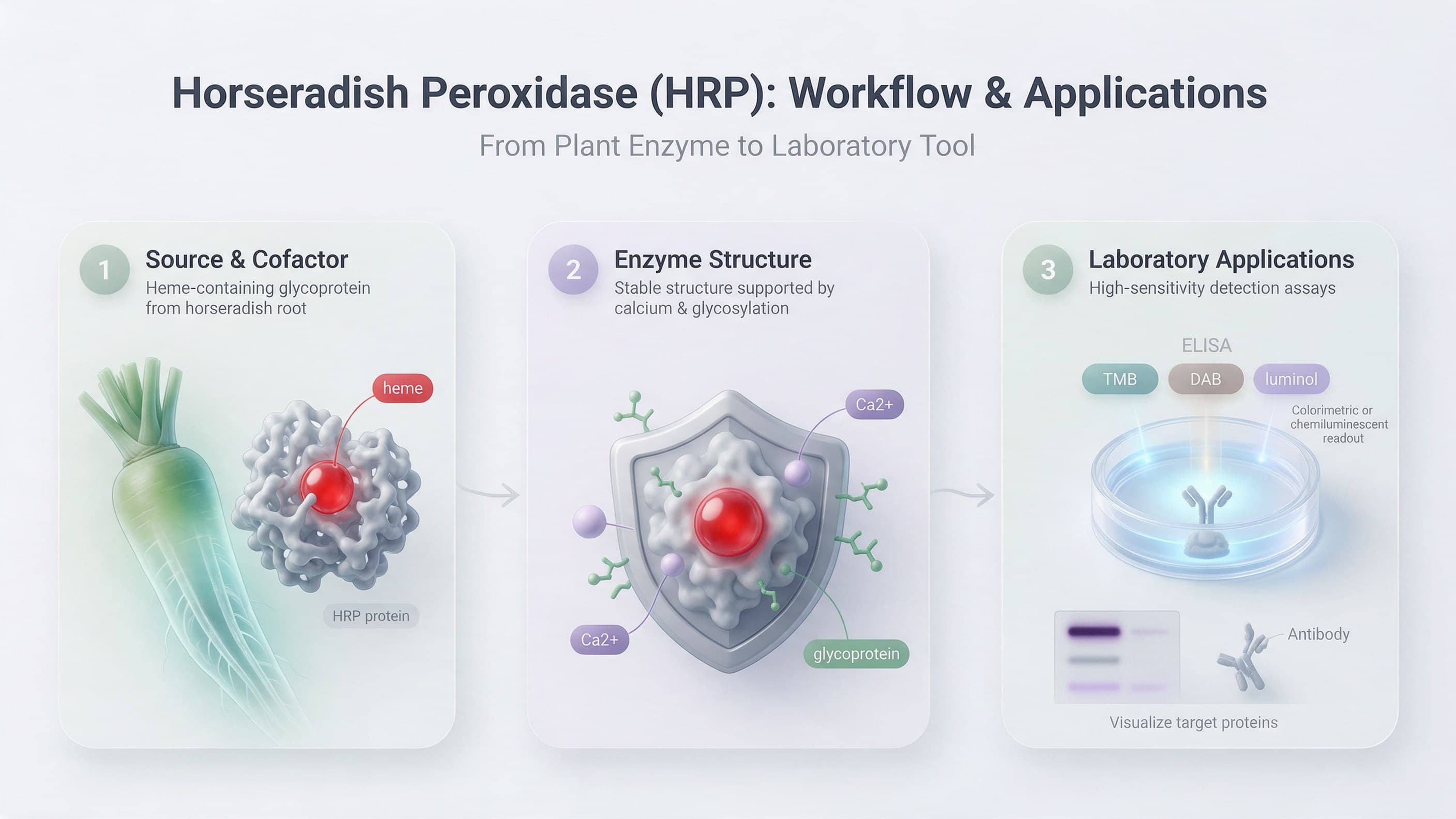
figure1. Overview of horseradish peroxidase source, structure and detection applications
Category: Enzymology and Enzyme Engineering (related: Detection & Analysis Biotechnology; Antibody Engineering & Immunobiotechnology)
1. Starting with "Horseradish": Why It Is Both an Enzyme and a "Signal Amplifier"
Horseradish peroxidase's job is to use a spark of hydrogen peroxide to turn an invisible molecular signal into a visible color or light. In detection it acts like a signal amplifier — give it an extremely weak signal and it returns a clear, readable color result.
1.1 A plain-language analogy: the flash of a camera in a dark room
Imagine photographing in a very dark room; one flash from your phone and the picture is instantly clear. HRP is that flash: the trace left by an antibody on a sample is minimal and invisible to the eye, but once HRP and its substrate are added, that faint trace is "lit up" into obvious color or light. This is why HRP is commonly attached behind antibodies as a reporter.
1.2 Standard definition and positioning
The standard definition: Horseradish Peroxidase (HRP; EC 1.11.1.7) belongs to the heme peroxidases, using hydrogen peroxide (H2O2) as electron acceptor to oxidize phenolic or aromatic-amine donor substrates. It is derived from horseradish (Armoracia rusticana) and is a typical class III plant peroxidase. In immunodetection and immunohistochemistry it is the classic and most widely used detection label.
2. Structural Features: Heme Cofactor + Two Calcium Ions + Glycans
The structure of HRP can be described as "a heme catalytic core, two calcium struts and a coating of glycans." Each part has its role; none can be dispensed with.
2.1 Plain-language breakdown
Heme is the part that actually works, with iron transferring electrons; the two calcium ions act like struts holding the protein backbone steady so the structure does not collapse; glycans are a protective "coating" on the protein surface, affecting stability, solubility and recognition.
2.2 Professional details
Professionally, HRP is a glycoprotein containing iron(III) protoporphyrin IX, with a molecular weight around 40 kDa, composed of about 308 amino acid residues, carrying 8 N-glycosylation sites, and sugar content around 18%–22%. The heme uses a histidine as the proximal ligand, and the resting-state iron is Fe(III). It also binds two calcium ions (Ca2+), which are essential for structure and activity.
2.3 Understanding snag: why "sugar" matters so much
Many assume glycans are just decoration. In fact, studies show that HRP N-glycosylation significantly affects stability: deglycosylation reduces its thermodynamic and kinetic stability. In other words, glycans are the "insulation" of HRP structure, which is why industrial production must attend to glycosylation uniformity.

figure2. Heme catalytic cycle of horseradish peroxidase
3. Catalytic Mechanism: The Three-Step Cycle from Compound I to Compound II
HRP catalysis is a repeating "three-step dance": resting state meets hydrogen peroxide to form Compound I, oxidizes one substrate to Compound II, then oxidizes another substrate to return to resting state. Throughout, only peroxide and substrate are "burned"; the enzyme is not consumed.
3.1 Plain-language description
Picture HRP as a relay runner: it first takes a high-energy baton offered by hydrogen peroxide (forming Compound I), passes that energy to one substrate molecule, then with halved energy (Compound II) passes it to a second substrate molecule, finally returning to its original state to wait for the next baton. Step by step, one enzyme can process thousands of substrate molecules.
3.2 Professional mechanism
Professionally, the overall reaction is: 2 phenolic donors + H2O2 → 2 phenoxyl radicals + 2H2O. The catalytic cycle successively goes: resting Fe(III) → Compound I (Fe(IV)=O with a porphyrin radical cation) → Compound II (Fe(IV)=O without the porphyrin radical) → resting Fe(III). Two substrate molecules are oxidized by Compound I and Compound II respectively. The proximal histidine ligand and distal residues jointly regulate catalysis and determine the iron spin state.
4. Influencing Factors: pH, Temperature, Peroxide Concentration and Substrate
For stable signal, consider pH, temperature, peroxide concentration and substrate type together. Too much peroxide "drowns" the enzyme; too little gives insufficient color.
4.1 pH and temperature
HRP is fairly stable at neutral to weakly acidic pH (roughly 4–7), but the optimum depends on the substrate. Higher temperature generally speeds up reaction but can inactivate at extremes. Industrial and detection processes usually run under mild conditions balancing activity and stability.
4.2 Peroxide concentration
Hydrogen peroxide is both an essential substrate and a potential inhibitor. At too-high concentration HRP enters a futile cycle or is oxidatively inactivated; at too-low concentration color develops slowly. Detection systems therefore use pre-mixed substrate buffers that control the H2O2-to-chromogen ratio.
4.3 Substrate selection
The substrate drives the "signal output form." Colorimetric types (TMB blue, DAB brown, ABTS) suit routine detection and visual reading; chemiluminescent types (luminol enhanced chemiluminescence) offer higher sensitivity for low-abundance targets; fluorescent types (Amplex Red) suit fluorescence platforms. Immunohistochemistry commonly uses DAB to produce insoluble brown precipitate. The first step is to decide the detection platform and sensitivity requirement.
4.4 Understanding snag: why substrate and enzyme must be matched
Different substrates give very different response curves, stability and sensitivity for HRP; they cannot be swapped at will. TMB suits solution colorimetry with terminable readout, while DAB suits tissue-section precipitate development. Matching substrate to platform and readout reproduces reliable results.
5. Engineering and Stability Directions
For different scenarios, HRP engineering focuses on improving stability, refining substrate specificity and reducing non-specific adsorption; recombinant expression and site-directed modification are the main routes.
5.1 Recombinant sources and glycosylation control
Recombinant HRP can be expressed in heterologous systems, but its glycosylation "persona" often differs from the native form, affecting stability and performance. Engineering therefore often targets glycosylation uniformity, or uses deglycosylation strategies to improve performance on specific platforms.
5.2 Site-directed mutagenesis and directed evolution
Site-directed mutagenesis of residues near the active site can change substrate preference and improve resistance to peroxide inactivation; directed evolution can systematically screen better variants. Both serve the goals of "more stable, faster, more specific."
5.3 Conjugation and immobilization
In detection, HRP needs conjugation to antibodies or streptavidin; conjugation chemistry and site control critically affect batch consistency. In industrial enzyme use, immobilized HRP improves recovery and reuse. Conjugate choice and labeling ratio are common engineering levers.
6. Industrial Adaptation and Applications
Large-scale HRP use spans diagnostics to wastewater treatment, but the core of industrialization remains "reproducible, scalable, releasable."
6.1 Diagnostics and detection
Diagnostic kits are HRP's largest market. ELISA, immunohistochemistry, immunoblotting and lateral-flow (strip) platforms use HRP heavily. Industrial needs center on high specific activity, low batch-to-batch variation, stable supply and compliance documentation.
6.2 Industrial biocatalysis and environmental use
HRP is also used to treat phenolic pollutants by catalytic oxidative degradation. This scenario values tolerance, substrate range and reusability, often combined with immobilization.
6.3 Scenario differences and difficulties
Detection emphasizes sensitivity and reproducibility; industry emphasizes tolerance and cost. The required metrics differ, so selection and scale-up must be calibrated separately, rather than applying a lab prototype directly to industrial parameters.
6.4 Sensitivity, background and batch consistency
In high-throughput diagnostics, sensitivity and background control directly set the limit of detection and the false-positive rate. HRP labeling ratio, conjugation site and substrate system jointly affect the signal-to-background ratio, so batch labeling uniformity is especially important. Industry typically introduces release criteria for labeling ratio, specific activity and batch coefficient of variation, combined with stabilizers and lyophilized formulations to preserve shelf-life performance.
6.5 Understanding snag: why "sensitivity" is not "stronger signal is better"
Many assume a brighter signal is always better, but an overly strong signal raises background and compresses the linear range, interfering with quantification. What really matters is the signal-to-noise ratio and the linear dynamic range. So selection should focus on substrate-system pairing, labeling ratio and batch consistency rather than simply chasing signal intensity.

figure3. Substrate and platform selection flowchart for horseradish peroxidase
7. Selection: Which Horseradish Peroxidase to Choose
The selection priority is "decide detection platform and substrate first, then specific activity and batch consistency, then supply and compliance."
• For ELISA or immunoblotting, prefer HRP paired with colorimetric or chemiluminescent substrates, attending to TMB/luminol compatibility and batch reproducibility.
• For immunohistochemistry, choose HRP suitable for DAB development, attending to sensitivity and background control.
• For lateral-flow or rapid tests, attend to label stability and long-term refrigerated storage.
• In all cases, request specific activity, purity, endotoxin, batch-consistency statements and conjugation details.
8. MATWINGS MALL Custom Tool Enzyme: System Adaptation from Substrate to Label
MATWINGS MALL offers custom development for horseradish peroxidase detection scenarios, focusing on conjugation/labeling systems and substrate matching rather than only supplying a single stock product.
8.1 Why custom development is needed
Detection platforms (ELISA, immunohistochemistry, lateral flow) differ in required labeling ratio, conjugation sites and color-development systems, so off-the-shelf HRP often cannot reconcile sensitivity with background control. Customization can design the conjugation process and substrate system per platform.
8.2 Focus of custom development
l Conjugation and labeling: site control and labeling-ratio optimization for batch consistency.
l Substrate matching: adapted to TMB, DAB, luminol and other platforms.
l Glycosylation and stability: engineering to improve thermal stability and shelf life.
l Sensitivity and background: signal-to-noise optimization for low-abundance detection.
8.3 From lab to industrialization
Around specific activity, batch consistency and release criteria, MATWINGS MALL helps you move from "it develops color" to "it is stable and reproducible" in diagnostic or industrial scenarios.
For platform-specific HRP adaptation or custom development, visit the MATWINGS MALL product page and expert center to discuss a solution.
9. Frequently Asked Questions (FAQ)
9.1 Why is HRP so common in ELISA rather than other enzymes?
HRP has high specific activity, good stability and many substrate choices, and it retains high activity after antibody conjugation, making it the most used reporter in ELISA. Paired with TMB or luminol it is sensitive and convenient.
9.2 What is the difference between TMB and DAB?
TMB is used for solution colorimetry, turning blue after reaction and yellow after stop solution, suitable for quantification; DAB produces insoluble brown precipitate suitable for immunohistochemistry localization. Their output forms differ, so they cannot be swapped.
9.3 Why is my HRP color development unstable?
Common causes include improper peroxide concentration, contaminated substrate, unsuitable pH or temperature fluctuation. Follow the substrate buffer instructions for ratio, keep buffers fresh and avoid metal-ion contamination.
9.4 What are HRP's "Compound I / Compound II"?
These are two intermediates in the HRP catalytic cycle. Resting Fe(III) is oxidized by H2O2 into Compound I (Fe(IV)=O radical), then reduced back by two substrates to the resting state, completing the oxidative-amplification cycle.
9.5 Is HRP safe in clinical testing?
HRP is a mature, widely used detection label; routine diagnostic and lab use follows standard operating procedures. It is used for signal amplification, not for in vivo human dosing, so risk is concentrated in operational norms.
Conclusion: Keep the "Flash" Burning Steadily
HRP long holds the central place among detection labels because it can amplify a tiny signal into a clear output with a pinch of hydrogen peroxide. Understanding the heme core, calcium stabilization and glycan protection, while matching substrate to platform, keeps this "flash" burning steadily.