
HMMER Protein Search: Using Profile HMMs to Find Distant Homologs with Precision
Published on November 8, 2026
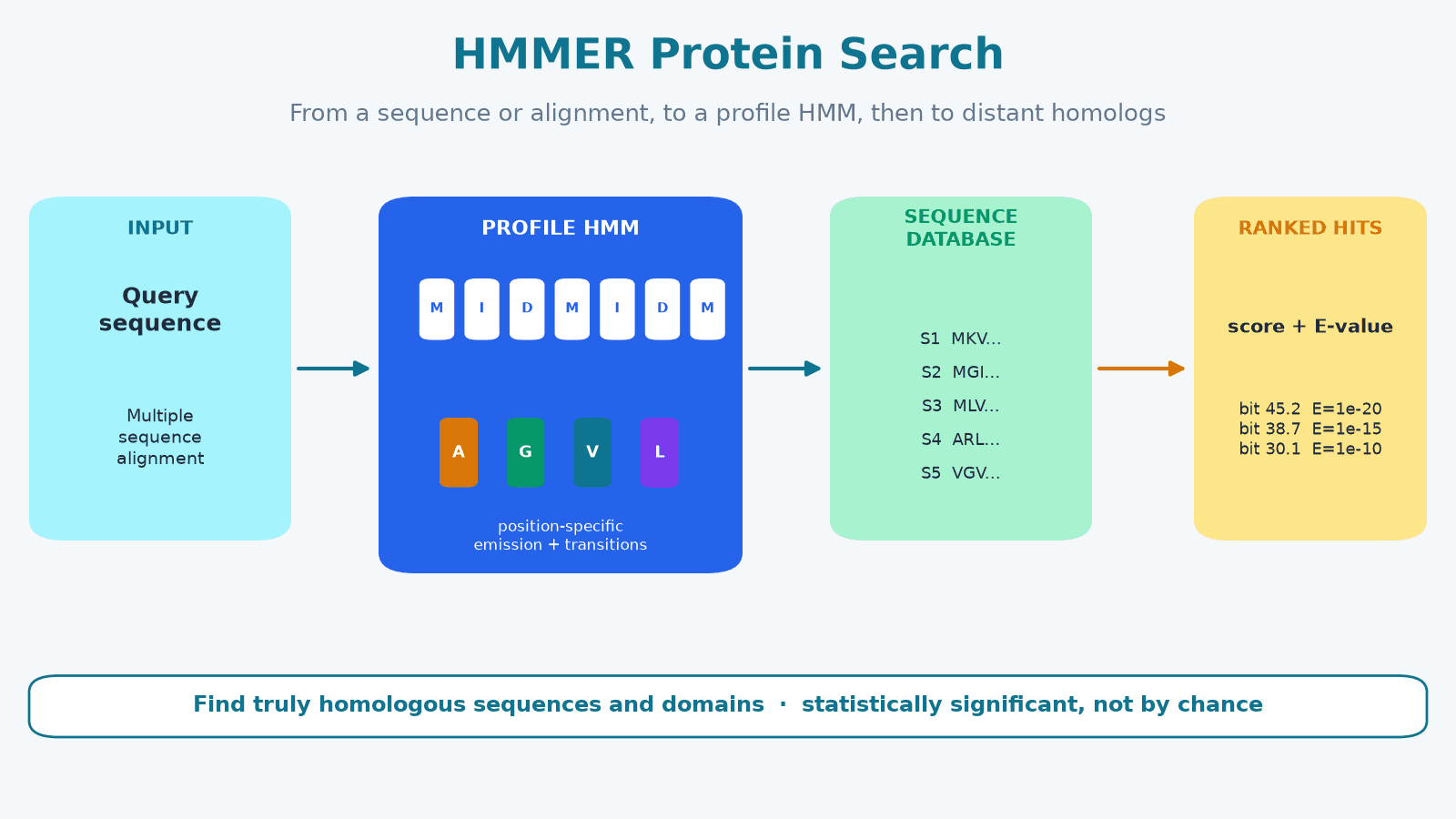
Figure 1 HMMER protein search concept overview
When we get a new sequence with unknown function, the first question is usually: which family does it belong to, and does it have any known homologs? HMMER protein search answers exactly this. It uses a hidden Markov model to turn a “multiple sequence alignment” into a position-specific scoring system, then scans large-scale protein databases for distant homologs — one of the most widely used methods for protein-family and domain annotation today.
1. Why Protein Search: From Classic BLAST to Profile HMM
The goal of protein search is to find sequences in a large database that are homologous to a query; classic BLAST relies on pairwise alignment, while HMMER’s profile HMM encodes the shared conservation of a whole family into a probabilistic model, making it more sensitive to distant homologs.
When we align a new sequence against a database one by one, the biggest problem is “missing things.” As homologs evolve, they accumulate mutations: some positions are highly conserved (for example, catalytic residues), while others change rapidly. Pairwise alignment with just one sequence often misses true homologs because of a few key mutations. A multiple sequence alignment (MSA) aggregates this information: dozens or hundreds of sequences within a family tell you both which positions “must be conserved” and which “can vary.”
Profile HMM takes this “aggregation” path. Instead of aligning each sequence separately, it first learns “what this family looks like,” then searches from there. The direct benefit: distant homologs with low sequence identity but related structure or function can still be retrieved.
For example, in a protease family the catalytic-triad positions almost never change, while surface residues vary widely. A profile HMM scores each position separately — conserved sites give high scores only to specific amino acids, while variable sites are far more tolerant. This “per-position scoring” is what lets it still hit in cases where sequence identity alone would miss.
2. How a Profile HMM Works: Turning an Alignment into a Searchable Probabilistic Model
A profile HMM converts a multiple sequence alignment into match / insert / delete states with emission probabilities at each position, producing a position-specific score; this model distinguishes positions that are highly conserved from those that tolerate change.
The core idea is intuitive. Imagine “standing up” the alignment of a protein family: each column is one residue position, and the residues in that column have a distribution — some columns are almost entirely one amino acid (conserved sites), others are varied (variable sites). A profile HMM encodes these distributions as emission probabilities (the probability of each amino acid at each position) and pairs them with transition probabilities among Match, Insert and Delete states, forming a position-specific probabilistic model.
How is a candidate sequence “scored”? By looking at how likely it is to be generated as it walks along the model’s “tracks.” Similar sequences take a smooth path and score high; divergent sequences keep “hitting walls.” To run over huge databases, HMMER3 adds acceleration heuristics (a three-stage MSV / Viterbi / Forward filter), pressing computation into an acceptable range while preserving sensitivity.
When scoring, HMMER compares “is this sequence more like the trained family model, or more like random background.” This comparison against a null model converts an absolute score into a more meaningful relative significance, and also explains why the same hit can carry a different E-value in different databases.

Figure 2 Profile HMM match / insert / delete states with position-specific emission probabilities
3. Choosing Among Four Searches: hmmsearch, hmmscan, phmmer, and jackhmmer
Choosing a search mode depends on “what is the query and what is the target”: hmmsearch searches a sequence database with a profile HMM, hmmscan searches a profile database (e.g., Pfam) with a sequence, phmmer searches a sequence database with a single sequence (BLASTP-like), and jackhmmer iteratively expands the homolog set (PSI-BLAST-like).
These four modes are easy to confuse. Keep one thread: “query” and “target” — which is a sequence and which is a profile.
phmmer: single sequence vs. sequence database. A more sensitive BLASTP; good for finding near homologs for one new sequence.
hmmsearch: a profile HMM (built from an alignment) vs. sequence database. Good for “which other members are in this family.”
hmmscan: a sequence vs. profile database (e.g., Pfam). Good for “which family does this new sequence belong to and which domains does it contain.”
jackhmmer: starts from one sequence, iterates search → adds hit homologs → rebuilds model → searches again. A modern PSI-BLAST, good for “digging deeper.”
How to read results? The key is the E-value. It represents “how many hits at this score or higher you would expect by pure chance across a database of this size.” A smaller E-value is less likely to be luck; the common reading is: below 0.01 can be considered significant, below 0.001 is even more reliable. The same sequence pair can get different E-values in different searches, because the search space differs — hmmsearch’s “space” is the number of sequences, hmmscan’s “space” is the number of models.
A simple rule helps: to ask “what is my sequence?” use hmmscan; to ask “who else is in my family?” use hmmsearch; to find near homologs quickly use phmmer; to dig deeper use jackhmmer. These searches often run on local clusters or cloud HPC, handling hundreds of thousands to hundreds of millions of sequences; the larger the data, the more you must balance sensitivity against speed, which is exactly why HMMER3 adds acceleration heuristics.
4. Conditions and Workflow: From Multiple Sequence Alignment to a Reliable Hit List
A typical run builds a profile HMM from an alignment with hmmbuild, then searches a sequence database with hmmsearch and ranks results by E-value; a smaller E-value is more significant, and a threshold around 0.01 is common, while calibrating score against database size and local score calibration matters too.
Turning the theory above into reproducible steps gives roughly this pipeline:
1. Prepare input: a high-quality multiple sequence alignment (e.g., Stockholm format) is the starting point. The cleaner the alignment, the more trustworthy the model.
2. Build the model: use hmmbuild to turn the alignment into a profile HMM. You can build one, or bundle several models into an HMM database.
3. Preprocess the database: compress and index the model library with hmmpress for fast hmmscan retrieval.
4. Run the search: hmmsearch searches a sequence database with a model; or hmmscan searches a model library with one sequence.
5. Interpret results: rank by bit score and E-value; set reporting thresholds (e.g., E-value = 1) and significance thresholds (e.g., E-value = 0.01), and apply a bias composition filter to discard low-complexity artifacts.
Choosing the database matters too: use profile libraries such as Pfam to annotate families; use large sequence databases such as UniProt or NCBI nr to find distant homologs. Threshold, database size and score calibration jointly decide “which hits make it into the final conclusion.” The rigor of this step directly determines whether downstream annotation or experimental validation is worth the investment.
Here it helps to separate two numbers: bit score is the absolute strength of a hit’s match to the model, while E-value converts that strength into the probability of a chance match given the current database size. So compare hit strength by bit score, but judge “is it credible” by E-value.

Figure 3 End-to-end HMMER search workflow
5. Connecting to AI Protein Engineering: A MatwingsVenus® (晓鹜®) Perspective
In an AI-driven protein engineering pipeline, profile HMM family/domain annotation is often the first piece of evidence: first anchor a candidate protein to a known functional family and identify the conserved core regions, so downstream AI design has an alignable coordinate system and assessable constraints.
Modern protein design is no longer “guess from one sequence,” but “evidence first, then generate.” On a platform like MatwingsVenus® (晓鹜®), which combines AI algorithms with structured computation, HMMER-style searching plays the role of an “evidence engineer”: it uses profile HMMs to anchor a protein to a known functional family, flags highly conserved catalytic/binding core regions, and also identifies variable regions that tolerate mutation. These position-specific constraints are precisely the “coordinate system” for downstream generative models and screening experiments.
This is why such tools deserve serious attention: they don’t replace experiments, they make experiments more accurate and economical. First use profile HMM search to narrow the candidate space to truly homologous, truly relevant hits, then hand them to AI and wet-lab validation, a widely validated, efficient path. Matwings Technology follows exactly this approach, bundling sequence-level evidence with AI capabilities into a complete protein engineering workflow.
6. FAQ
1. What’s the difference between HMMER and BLAST?
HMMER uses a profile HMM to model “the conserved pattern of a whole family”; BLAST primarily does sequence-to-sequence pairwise alignment. HMMER is therefore usually more sensitive for detecting distant homologs, while BLAST is lighter and better for quick first-pass screening.
2. What E-value counts as significant?
There’s no absolute standard, but usually E-value < 0.01 is significant and < 0.001 is very reliable. Remember it depends on search-space size: the larger the database, the larger the expected value for the same score.
3. How do hmmsearch and hmmscan differ?
hmmsearch is “use a profile HMM (or alignment) to search a sequence database”; hmmscan is “use a sequence to search a profile database (e.g., Pfam).” One searches sequences, the other searches models.
4. What is jackhmmer for?
It’s for iterative deep digging: after searching with one sequence, fold the hit homologs back into the alignment, rebuild the model, and keep looping to find even more distant homologs. Like PSI-BLAST, but based on profile HMMs for higher sensitivity.
7. Summary
The core value of HMMER protein search is compressing the “alignment information of a whole family” into a searchable probabilistic model, then efficiently finding truly homologous sequences and domains across large databases. Use the right mode, read the right E-value, and choose the right database, and this step reliably supports family annotation, domain identification and deeper functional inference. It is also a key link in modern AI protein engineering, helping “AI see the evidence.”
One-sentence conclusion:HMMER encodes position-specific conservation into a probabilistic profile model, catching distant homologs that classic alignment often misses, and is a standard tool for protein-family and domain annotation.
