High-Specificity Ligand Development from Discrimination to Validation
Published on September 8, 2026
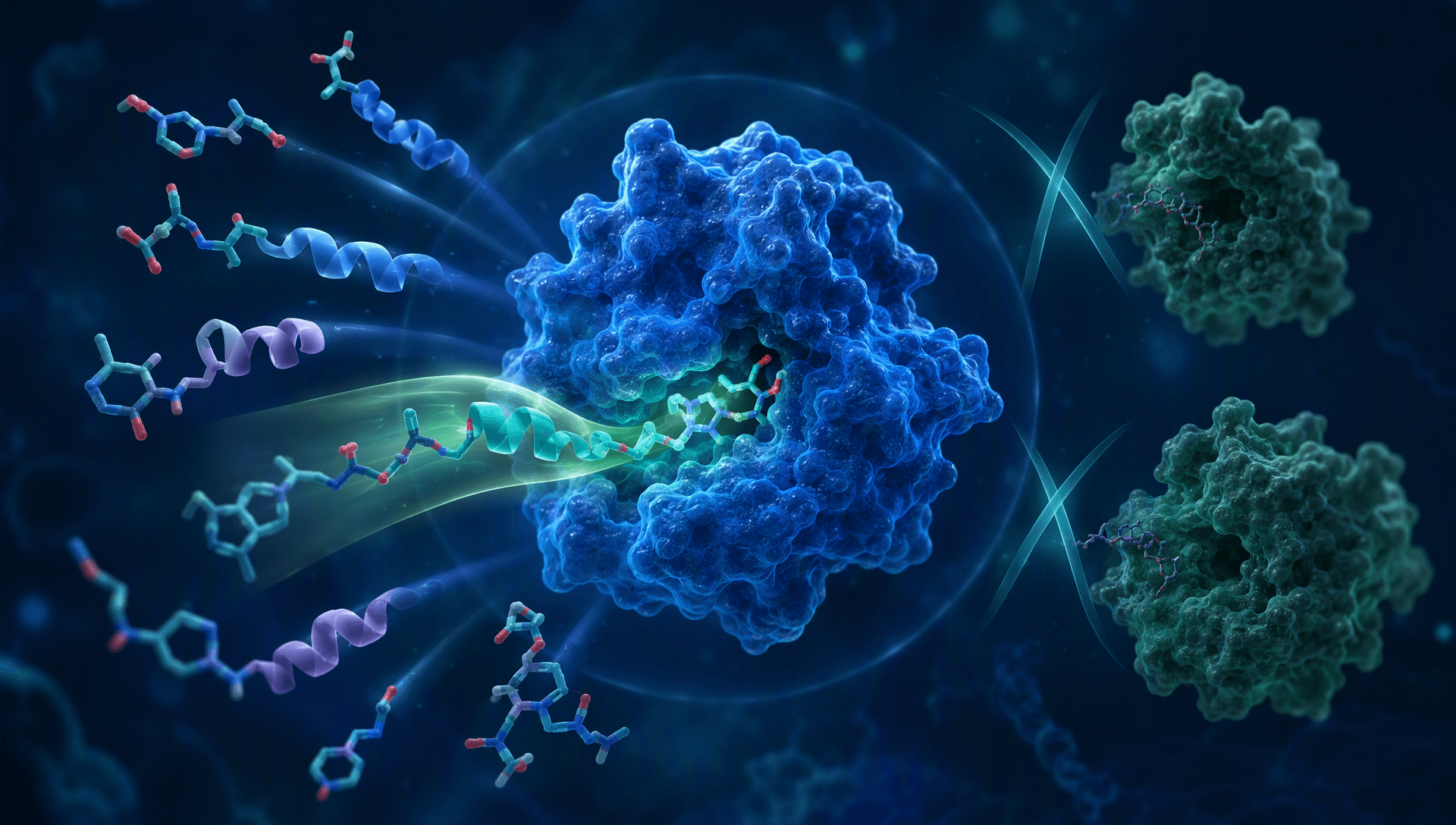
A selective candidate recognizing its intended molecular target
Why specificity is harder than affinity alone
Affinity describes binding strength, whereas specificity describes discrimination between a target and neighboring entities. A candidate with a favorable Kd may still bind a homolog, another isoform, or an abundant component in a real sample. This can increase background in diagnostics, reduce purity in capture applications, or create off-target activity in blockade and delivery projects.
A useful development brief therefore needs more than a target-positive criterion. It should define likely antitargets, an acceptable cross-reactivity range, the intended matrix, and the functional endpoint. A practical hit generates a reproducible target response, remains sufficiently quiet against the non-target panel, and retains acceptable expression, synthesis, storage, and handling properties.
Category: Protein Engineering | Molecular Recognition | Research Services
Five decisions in high-specificity ligand development
1. Define what must bind and what must be excluded
Target definition should include species, isoform, domain boundaries, conformation, post-translational modifications, and assay conditions. When two homologs must be distinguished, differential residues or epitopes should shape the design. Cell- and tissue-based applications additionally require attention to membrane context, glycosylation, abundance, and accessibility. A target, close-antitarget, and complex-matrix control panel is more actionable than the general instruction to “maximize specificity.”
2. Match the library to the recognition problem
Small-molecule libraries cover chemical space; nucleic-acid aptamer libraries support amplification and iterative enrichment; peptide, antibody, and protein-binder libraries explore larger recognition interfaces. SELEX commonly cycles through library preparation, incubation, partitioning, amplification, and enrichment. Reviews describe counter-SELEX, cell-SELEX, and microfluidic SELEX among enhanced formats. Negative, counter, and subtractive SELEX have also been summarized as modified selection strategies.
Library size is not the sole determinant of quality. Without suitable counter-selection, sticky sequences or candidates that recognize tags, beads, or carrier materials may be enriched. High-specificity ligand development should adjust selection pressure around observed failure modes rather than add rounds mechanically.

Positive enrichment and counter-selection acting together
3. Reduce the search space with structures and prior evidence
Before generating new predictions, database retrieval can identify reported ligands, activity records, homologs, and available structures. Pocket analysis and protein-ligand docking can propose poses, while protein-protein docking and interface analysis are relevant to antibodies and protein binders. Supported by the MatwingsVenus™(晓鹜™) technology stack, MatwingsVenus Mall can connect projects with relevant database retrieval, structural analysis, molecular docking, and candidate-assessment products.
Docking scores, structural confidence metrics, and model rankings remain computational evidence rather than measured specificity. A defensible workflow compares the target with multiple antitargets, preserves scaffold and interface diversity, and then tests whether prioritized candidates actually discriminate in experiments.
4. Make cross-reactivity testing part of the main workflow
After primary screening, teams should test homologous proteins, unrelated proteins, blank matrices, and realistic samples across concentration series. They should also check for aggregation, nonspecific adsorption, and tag-dependent binding. Surface plasmon resonance can provide label-free affinity and kinetic information, although immobilization geometry, mass transport, and the fitting model still affect interpretation.
Functional validation should reflect intended use. Diagnostic ligands need separation between positive and negative samples. Purification ligands need recovery and impurity measurements. Blocking ligands need pathway or cellular readouts. Candidates should advance only when binding data and functional evidence support the same decision.
5. Iterate from evidence rather than freezing the first hit
A candidate that binds the target but also recognizes a close homolog may need redesign around a differential epitope. A selective candidate with poor stability, expression, or solubility may instead require developability optimization. Supported by the MatwingsVenus™(晓鹜™) technology stack, MatwingsVenus Mall can connect project stages with protein engineering, mutation-effect assessment, structural validation, or de novo design products. Customized services can help organize candidate prioritization and validation recommendations.

A closed loop connecting computational design and experimental validation
Platform workflow for high-specificity ligand development
Projects with an existing library should prioritize the antitarget panel and validation methods. Projects that begin with only a target sequence or structure may start with database evidence, epitope analysis, or pocket assessment. Protein and antibody binders add expression, aggregation, and immunogenicity considerations. Different starting points therefore require different minimum viable workflows.
With the MatwingsVenus™(晓鹜™) technology stack, teams consulting MatwingsVenus Mall should prepare four input groups: the target sequence or structure, antitargets that must be excluded, the preferred ligand modality, and acceptable experimental endpoints and timelines. These inputs support discussion of an evidence-retrieval, computational-screening, counter-selection, orthogonal-validation, and iterative-optimization chain. Methods, formats, schedules, and deliverables should be confirmed during project assessment, and predictions should not be presented as validated performance.
FAQ
Are high specificity and high affinity interchangeable?
No. Affinity describes binding strength; specificity describes discrimination between target and non-target entities. Both need dedicated measurements.
Which entities belong in a counter-selection panel?
Priority choices include close homologs, common interferents, tags or carrier materials, and components likely to create background in the real sample matrix.
Can docking prove that a candidate has no cross-reactivity?
No. Docking can help compare binding hypotheses, but cross-reactivity must be tested experimentally against relevant antitargets.
When is customized development most useful?
It is especially useful for conformationally complex targets, discrimination between related isoforms, mixed ligand modalities, or projects that must connect computational work with experimental validation.
Conclusion
The core of high-specificity ligand development is to turn non-targets from an afterthought into a design input. Clear recognition boundaries, a suitable library, positive and counter-selection, and multi-dimensional validation can yield ligands that are genuinely fit for application. MatwingsVenus Mall can connect relevant products and customized services across these stages, helping teams build an evidence-bounded, risk-aware, and iterative development path.