High-Affinity Ligand Screening from Libraries to Validated Hits
Published on September 8, 2026
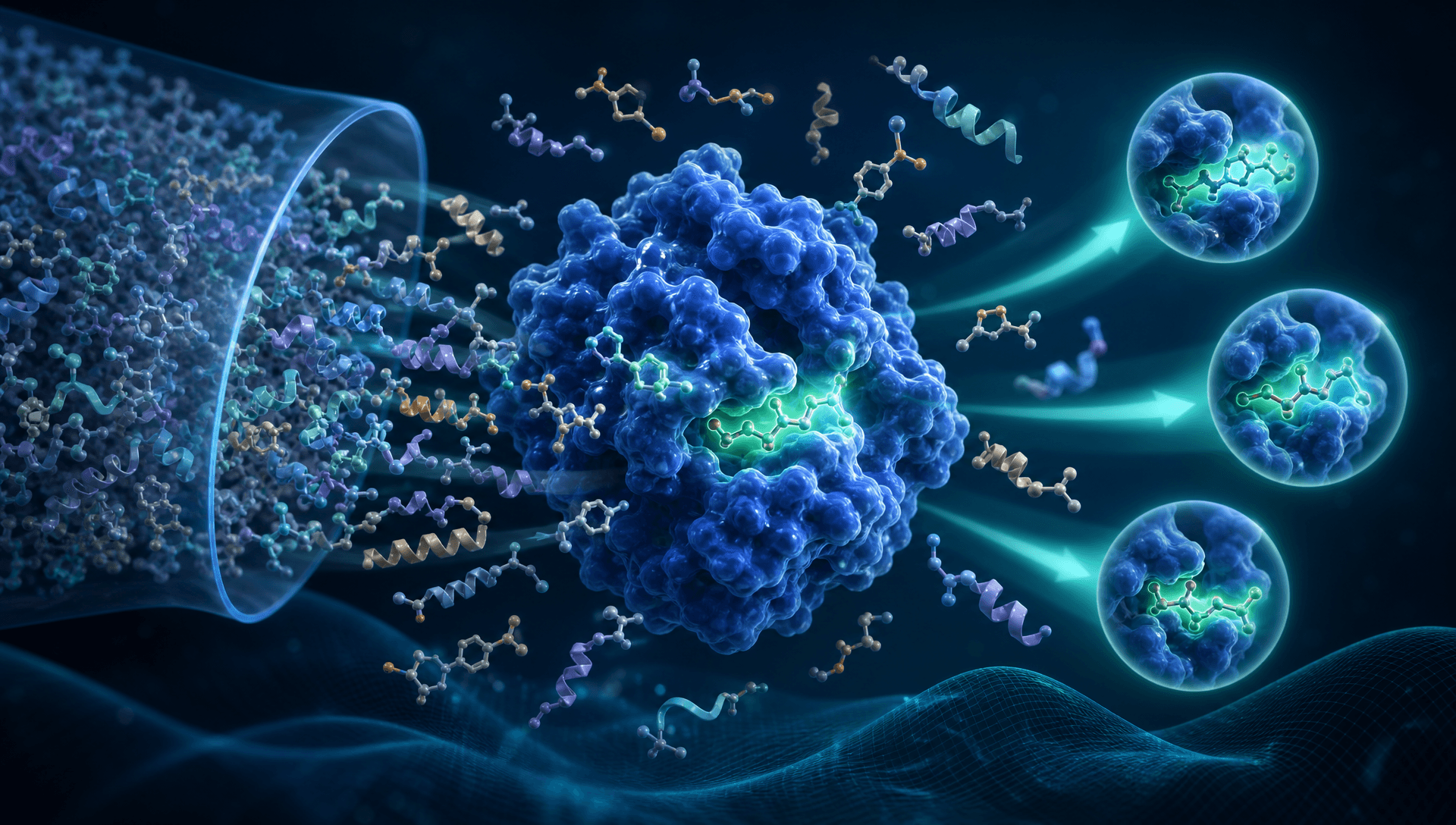
A diverse candidate library converging on high-affinity hits
Why tight binding alone is not enough
Affinity is important, but it is not the whole decision. Two candidates with similar Kd values can have very different association rates (ka) and dissociation rates (kd). One may bind quickly and leave quickly, while another may associate more slowly but remain in complex for longer. Diagnostic capture, affinity purification, receptor blockade, and in vivo delivery can therefore require different kinetic profiles.
Selectivity is equally important. A candidate that also binds homologous proteins, matrix components, or abundant serum proteins may produce background, off-target effects, or reduced recovery even when its target affinity appears impressive. Stability, solubility, expression, and manufacturability further determine whether a hit is useful. A practical screen should therefore use a multi-objective specification rather than rank candidates by one number.
A practical high-affinity ligand screening workflow
1. Define the target state and acceptance criteria
First establish whether the target is a soluble protein, membrane protein, complex, or specific conformation. Record species, construct boundaries, cofactors, post-translational modifications, and buffer conditions. Then define the primary endpoint: a desired Kd range, dissociation behavior, cross-reactivity ceiling, or functional readout. Clear requirements prevent the library and assay from drifting away from the intended use.
2. Build a library with relevant coverage
Small-molecule libraries emphasize chemical-space coverage and developability. Peptide libraries emphasize sequence diversity and conformational constraints. Antibody and protein-binder libraries must also account for interface diversity, expression, and aggregation risk. Phage display can enrich high-affinity and selective peptides from very large combinatorial pools through iterative biopanning and is one established experimental discovery route. Library size alone, however, does not guarantee useful hits; target quality, negative selection, and selection pressure matter as well.
3. Use computation to reduce experimental space
Database retrieval can identify reported ligands, activity records, and related scaffolds before new predictions are made. Binding-site analysis and molecular docking screening can then propose poses and prioritization hypotheses. Supported by the MatwingsVenus™(晓鹜™) technology stack, MatwingsVenus Mall can help connect a project with relevant database retrieval, protein-ligand docking, and analytical products. For an existing protein binder, a customized workflow may also combine functional-site mapping, mutation-effect assessment, and structural validation.
Computational output should be treated as a prioritization aid, not as measured affinity. Docking scores depend on receptor conformations, protonation states, water treatment, and scoring functions. A more defensible strategy preserves structural diversity and combines interaction plausibility, physicochemical properties, and synthesis or expression feasibility before sending a smaller set to experiments.

Complementary interactions inside a target binding pocket
4. Confirm binding with orthogonal experiments
Primary screening may use ELISA, fluorescence polarization, thermal-shift measurements, or cell-binding assays, but any single format can be affected by labels, immobilization, and matrix effects. Surface plasmon resonance is an established label-free method for biomolecular interaction analysis and can provide affinity and kinetic information. Sensor-based analysis has also been used directly to characterize antibody-antigen affinity and kinetics. Depending on the project, SPR, BLI, ITC, or a functional assay can provide orthogonal confirmation.
Controls should include blanks, unrelated proteins, homologous proteins, and concentration series. Apparently exceptional affinity should trigger checks for aggregation, nonspecific adsorption, mass-transport limitations, and rebinding. A number becomes decision-grade only when assay conditions, the fitting model, and reproducibility are credible.
5. Turn evidence into the next iteration
The endpoint is not merely a ranking table. It is a set of interpretable and reproducible candidates that can move downstream. Experimental hits may proceed to sequence optimization, interface mutation, molecular dynamics, or functional testing. If natural candidates are insufficient, de novo protein-binder design may be considered, but structural confidence metrics and computational scores must never be presented as measured Kd values.
Supported by the MatwingsVenus™(晓鹜™) technology stack, MatwingsVenus Mall organizes fragmented steps into a selectable project path. Teams can evaluate products related to database and structural analysis, molecular docking, protein engineering, and de novo design. Customized services can combine computational analysis, candidate prioritization, experimental validation recommendations, and expert coordination. Inputs, timelines, and deliverable boundaries should be confirmed during project assessment.

A connected workflow from computational triage to experimental validation
Configuring a high-affinity screening project
When a defined library already exists, the priority is assay design, controls, and kinetic confirmation. When only a target structure is available, pocket analysis, known-ligand retrieval, and virtual screening may form the first stage. Protein and antibody binders add requirements for epitope definition, sequence developability, and expression risk. If the starting information is incomplete, a short requirements assessment is usually safer than purchasing an isolated step.
With the MatwingsVenus™(晓鹜™) technology stack, teams consulting MatwingsVenus Mall about high-affinity ligand screening products or customized services should prepare four information groups: a target identifier, sequence, or structure; the intended ligand modality; required functional and selectivity criteria; and available experimental data, budget, and schedule. Better inputs make it easier to define a minimum viable “retrieve-compute-test-iterate” workflow and avoid investing in candidates that cannot be validated.
FAQ
Is Kd the only metric for ligand affinity screening?
No. Kd should be interpreted together with ka, kd, selectivity, functional effects, stability, and manufacturability.
Can molecular docking prove high affinity?
No. Docking proposes binding modes and prioritization hypotheses. Biochemical, biophysical, or cellular experiments are required for confirmation.
Can screening proceed without an experimental target structure?
Potential routes include sequence and database evidence, homologous structures, display libraries, or experimental screening. The appropriate method and uncertainty will differ.
When are customized services most useful?
They are particularly useful for unusual targets, mixed ligand modalities, multiple acceptance criteria, or projects that must connect computational screening with experimental validation.
Conclusion
The central idea of high-affinity ligand screening is to make each evidence layer improve the next decision: define the problem, reduce the search space, confirm candidates orthogonally, and continue optimization around the real application. MatwingsVenus Mall can connect relevant products and customized services across these stages, helping teams turn separate tools into a bounded and verifiable R&D workflow.