
Glucocerebrosidase: The Lysosomal Enzyme That Breaks Down Glucosylceramide
Published on November 8, 2026
Category: Enzymology and Enzyme Engineering (Related: Protein Engineering and Design, Biocatalysis and Biotransformation)
1. Structural Features and Localization
1.1 A Lysosomal Membrane-Associated exo-beta-Glucosidase
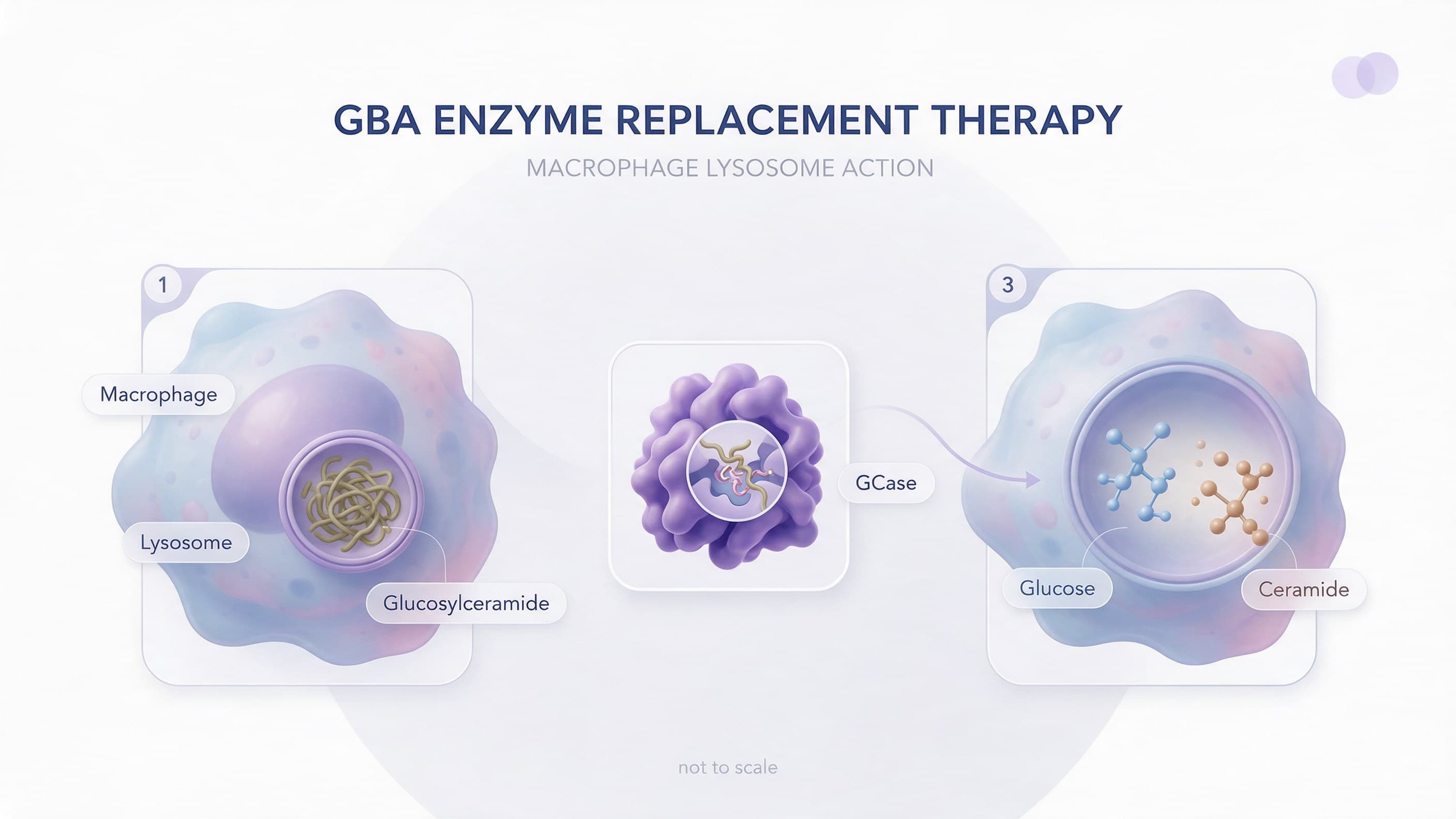
Glucocerebrosidase is a membrane-associated lysosomal glycosidase that removes sugar groups one at a time from the end of a substrate molecule, classifying it as an exo-beta-glucosidase. The mature protein has about 497 amino acids and is a glycoprotein, formed from a longer precursor (517 or 536 amino acids) after signal peptide removal during ER transit and glycosylation.
In plain terms, glucosylceramide is like a lipid chain with a sugar hanging on one end, and the lysosome is the cell's "digestion workshop." Glucocerebrosidase is the dedicated worker responsible for removing the terminal sugar. When this worker is absent or inactive, the lipid chains pile up in the cell.
1.2 Gene and Disease Association
The enzyme is encoded by the GBA1 gene. GBA1 mutations reduce or abolish enzyme activity, ultimately causing Gaucher disease. In addition, heterozygous or homozygous GBA1 mutations are associated with increased Parkinson's disease risk, though the mechanism is still under study.
2. Catalytic Mechanism

figure2. Mechanism of glucocerebrosidase hydrolyzing the beta-glycosidic bond
2.1 Hydrolysis of the beta-Glycosidic Bond
The core reaction catalyzed by glucocerebrosidase is hydrolysis of the beta-glycosidic bond of glucosylceramide, breaking the substrate into glucose and ceramide. This step occupies a key position in the sphingolipid degradation cascade, acting as the penultimate step before ceramide release, which is then cleaved by acid ceramidase.
2.2 Retaining Mechanism and Catalytic Efficiency
The enzyme uses a retaining hydrolysis mechanism, meaning the anomeric configuration of the glucose remains unchanged after reaction. For the natural substrate glucosylceramide, the catalytic efficiency (kcat/Km) is about 10^5 M^-1 s^-1, and it shows broad specificity across different acyl chain lengths. Understanding this mechanism helps guide substrate design, inhibitor development and protein engineering.
2.3 Comprehension Point: Why "Helpers" and an "Acidic Environment" Are Needed
This is an easily missed point. Glucocerebrosidase alone is not very efficient; it requires the activator protein saposin C and negatively charged lipids. Saposin C binds both the lysosomal membrane and the lipid portion of glucosylceramide, presenting the substrate in an accessible conformation to the catalytic machinery. Meanwhile, the lysosome is acidic, and the enzyme is maximally active near pH 5.5. This explains why the enzyme performs best in the specific lysosomal compartment.
3. Influencing Factors and Engineering Directions
3.1 Expression System and Glycoengineering
For ERT, expression system and glycoengineering are key. The recombinant enzyme must fold and glycosylate correctly in the cell, and is often modified to expose terminal mannose residues so it can be recognized by mannose receptors on macrophages and targeted to storage cells. Different expression systems give different glycoforms and pharmacokinetics: imiglucerase expressed in CHO cells differs from the endogenous human enzyme by one amino acid (histidine for arginine at position 495); velaglucerase alfa from human fibroblasts is identical in sequence to the native human enzyme; taliglucerase alfa from plant cells offers another production route.
3.2 Immunogenicity and Half-Life
Exogenous recombinant enzyme may trigger immune responses; anti-drug antibodies affect efficacy and safety. One engineering goal is to lower immunogenicity and extend in vivo half-life while preserving activity, so that intravenous infusion can maintain effective concentration for longer.
3.3 Stability and Purity
Lysosomal enzymes are sensitive to folding and stability. Point mutation, glycan optimization and formulation design can improve enzyme stability and recovery. Purity, host residue, endotoxin and batch consistency are directly tied to compliance and clinical safety.
4. Deficiency and Disease: Gaucher Disease
When GBA1 mutations reduce glucocerebrosidase activity, glucosylceramide accumulates in macrophage lysosomes, forming Gaucher cells and causing hepatosplenomegaly, anemia, thrombocytopenia and bone disease. Gaucher disease is the most common lysosomal storage disorder, classified by the presence and progression of neurologic involvement. ERT mainly targets non-CNS manifestations and effectively improves anemia and thrombocytopenia while reducing liver and spleen size.
5. Technical Route and Industrial Adaptation
5.1 Treatment Strategy Comparison
Gaucher disease has two main treatment lines.
· Enzyme replacement therapy (ERT) supplies recombinant enzyme intravenously, directly replacing the missing enzyme activity to degrade accumulated substrate.
· Substrate reduction therapy (SRT) inhibits glucosylceramide synthase by oral administration, reducing substrate production at the source so residual enzyme activity can cope.
Both aim to lower glucosylceramide accumulation, but differ in target population and route.
5.2 Industrial Adaptation Challenges
· Bringing glucocerebrosidase to industrial scale concentrates on a few issues:
· Efficient expression and correct folding in mammalian or plant cells;
· Performing the required glycoengineering for targeting;
· Purification to remove host residue, endotoxin and aggregates while ensuring high purity;
· Batch consistency and scale-up stability that directly determine cost and supply.
These steps are coupled and need to be planned together on a single process map covering upstream expression, midstream purification and downstream formulation.
6. Selection Plan

figure3. Glucocerebrosidase/glycosidase selection and evaluation workflow
For R&D and procurement, when evaluating glucocerebrosidase or related processes, consider these dimensions: whether activity and unit definition are clear; whether expression system and glycoform match the intended use; whether immunogenicity and anti-drug risk are controlled; whether purity, host residue and endotoxin meet the grade; whether batch consistency and scale-up stability are adequate; and whether formulation and route match the clinical or process scenario. Bring real samples and real buffers into testing rather than judging from a single activity label.
7. MATWINGS MALL Products and Custom Solutions
If your project needs a customized glycosidase for substrate hydrolysis, glycan processing or related research scenarios, MATWINGS MALL can support you from custom tool-enzyme development and protein engineering: redesign the enzyme molecule and perform directed evolution around the target substrate and pH window; optimize activity, stability and substrate preference; link computational design with wet-lab validation through an integrated R&D platform; then move through bioprocess development and scale-up to adapt to actual samples and production. When a standard glycosidase cannot meet the process on activity, specificity, batch consistency or compliance grade, a customized tool enzyme and protein engineering is a more system-matched route.
8. Frequently Asked Questions
1、Why does glucocerebrosidase need saposin C?
Because its substrate glucosylceramide is a lipid with limited accessibility in an aqueous environment. Saposin C binds both the lysosomal membrane and the lipid portion of the substrate, presenting it in an accessible conformation to the catalytic site, thereby markedly improving hydrolysis efficiency. Without this activator, enzyme activity drops significantly.
2、What is the optimal pH for glucocerebrosidase?
About 5.5, consistent with the acidic lysosome interior. Activity falls markedly away from this pH, which is one reason the enzyme is classified as a lysosomal enzyme.
3、What are the representative enzyme replacement products for Gaucher disease?
Mainly imiglucerase (Cerezyme), velaglucerase alfa (VPRIV) and taliglucerase alfa (Elelyso). They supply recombinant glucocerebrosidase intravenously to reduce glucosylceramide accumulation in macrophages, improving anemia and thrombocytopenia and reducing liver and spleen size.
4、What is the difference between ERT and substrate reduction therapy?
ERT supplies recombinant enzyme intravenously to degrade accumulated glucosylceramide directly; SRT inhibits glucosylceramide synthase orally to reduce substrate production at the source, letting residual enzyme activity cope. Both have the same goal but differ in target population and route.
5、How do you evaluate batch stability of a glucocerebrosidase?
Establish internal standards centered on activity and unit definition, expression system and glycoform, immunogenicity, purity and endotoxin, batch consistency and scale-up stability, and retain a reference sample for batch calibration. Batch consistency is a prerequisite for process reproducibility and clinical safety.
6、What if a standard glucocerebrosidase fails on activity or specificity?
When a commercial glycosidase cannot meet the need on activity, specificity, stability or compliance grade, turn to custom tool-enzyme development and protein engineering to rebuild the enzyme around the target substrate and process window, then move through process scale-up and production.
Conclusion
Glucocerebrosidase is a lysosomal membrane-associated exo-beta-glucosidase that specifically hydrolyzes the beta-glycosidic bond of glucosylceramide, producing glucose and ceramide. Its activity depends on the activator protein saposin C and negatively charged lipids, with an optimal pH near 5.5 and a retaining mechanism. GBA1 deficiency causes glucosylceramide accumulation in macrophages, leading to Gaucher disease; ERT supplies recombinant enzyme intravenously to reduce lipid accumulation, with representative products imiglucerase, velaglucerase alfa and taliglucerase alfa. For R&D and procurement, the main risk is not a weak enzyme but overlooking expression system, glycoengineering, immunogenicity and batch consistency. Using activity and unit definition, glycoform, immunogenicity, purity and endotoxin, batch consistency and scale-up stability as the evaluation baseline, and bringing real samples into testing, ensures correct and stable use. When a standard glycosidase cannot meet process requirements, a customized tool enzyme and protein engineering is the more system-matched route.