
Beta-Glucanase: Breaking the Cereal Viscosity Bottleneck from Brewing to Feed
Published on November 3, 2026
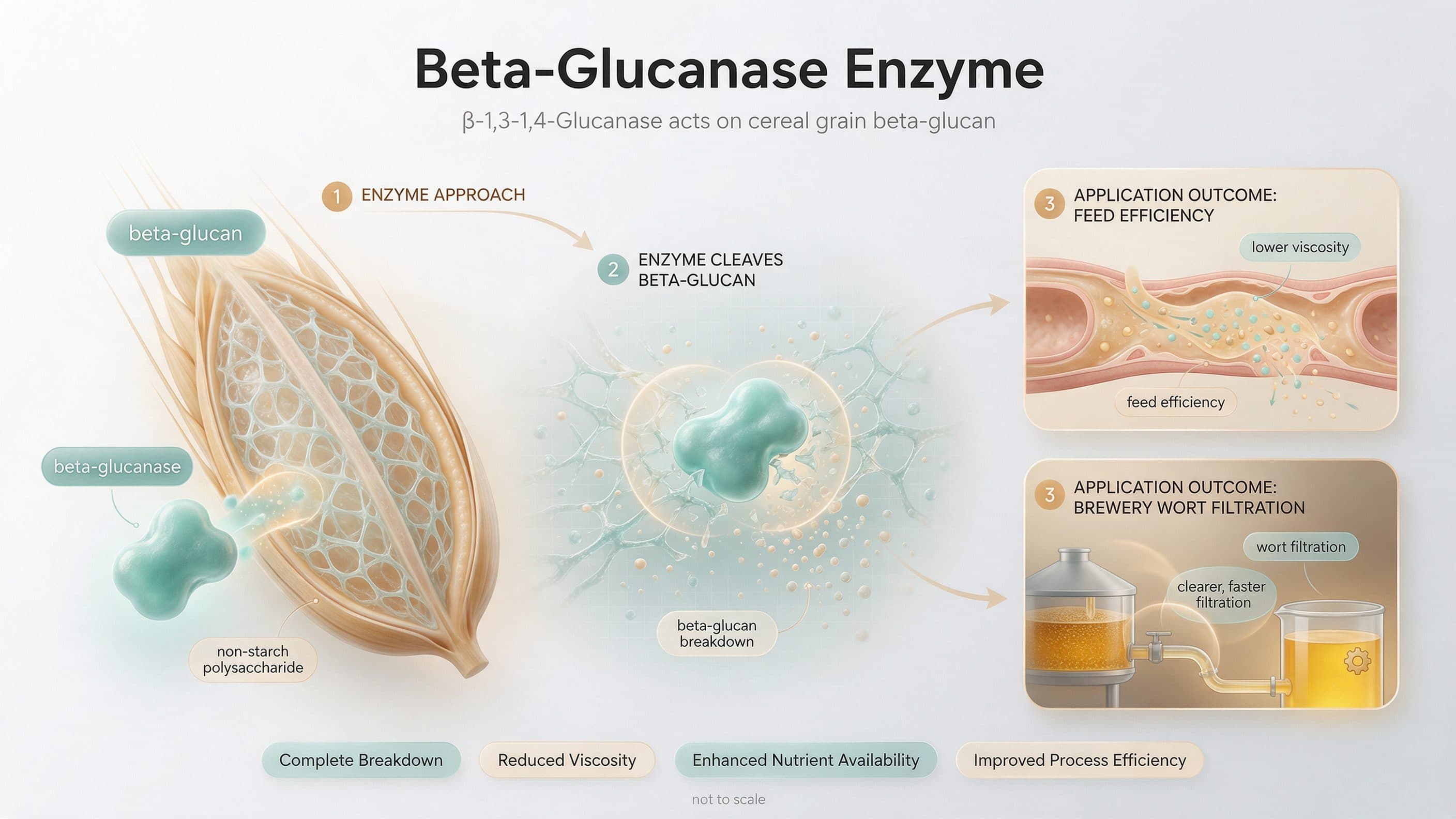
Category:Enzyme Science & Engineering (Related: Food Biotechnology; Glycobiology & Polysaccharide Engineering)
1. From a Sticky Porridge: How beta-Glucan Holds Back Grain Utilization
1.1 Think of beta-Glucan as Glue
If you have cooked oats, you know they get stickier as you stir. The cause is beta-glucan, a polysaccharide in the endosperm cell walls of grains such as barley, oat, sorghum and wheat. In water it swells into a high-viscosity gel, wrapping nutrients like glue.
1.2 The Nature of the Anti-Nutritional Factor: How Viscosity Hampers Digestion and Filtration
beta-Glucan is a non-starch polysaccharide (NSP) that monogastric animals cannot degrade with their own endogenous enzymes. In water it retains several times its own weight, keeping the digesta in a thick gel that slows transit through the gut and competes with starch and protein, hindering diffusion of sugars and amino acids to the intestinal mucosa and their contact with digestive enzymes. In brewing, residual beta-glucan raises wort viscosity, clogs the filter bed and causes cold turbidity.
1.3 Processes and Scenarios Dragged Down by Viscosity
The viscosity bottleneck shows up in several real steps: wort filtration rate, beer colloidal stability, feed pelleting and feed intake, and poultry gut health. Each needs a pair of scissors to cut the large beta-glucan molecules down to size.
2. The Precision Scissors of beta-Glucanase: Mechanism and Enzyme Identity
2.1 Enzyme Classification: EC Number and Glycoside Hydrolase Families
Glucanases are a class of glycoside hydrolases (GH) that hydrolyze beta-glycosidic bonds. The industrial workhorse for cereal beta-glucan is beta-1,3-1,4-glucanase, also called lichenase, EC 3.2.1.73; a related enzyme is EC 3.2.1.6 (endo-1,3(4)-beta-glucanase, laminarinase). Structurally resolved beta-1,3-1,4-glucanases belong mainly to the GH16, GH17 and GH26 families.

figure2. beta-Glucanase hydrolysis mechanism: specific cleavage and oligosaccharide generation
2.2 Cleaving Only beta-1,4 Bonds, But Next to a beta-1,3 Bond
beta-1,3-1,4-Glucan is a linear polymer of beta-D-glucose joined by a mix of beta-1,3 and beta-1,4 glycosidic bonds, with repeating cellotriosyl and cellotetraosyl units linked by beta-1,3 bonds. The enzyme is endo-acting and specifically hydrolyzes the beta-1,4 bond adjacent to a beta-1,3 bond, cutting the long chain into shorter oligosaccharides. The main products are 3-O-beta-cellobiosyl-D-glucopyranose (G4G3G) and 3-O-beta-cellotriosyl-D-glucopyranose (G4G4G3G).
2.3 A Common Misunderstanding: Why It Does Not Turn All beta-Glucan into Glucose
Many assume hydrolysis means complete conversion to glucose. In fact, beta-glucanase mainly reduces the molecular size to reduce viscosity, yielding mostly oligosaccharides with only small amounts of glucose. This matters: it lowers viscosity and releases nutrients without materially changing sugar levels or flavor, which is exactly why brewing and feed accept it.
2.4 High Activity Does Not Mean It Fits
Activity is usually expressed in U/g or U/mL, but high activity does not guarantee suitability. Real selection must be judged against the pH, temperature window and reaction time of the target process, otherwise high activity is meaningless if it falls outside the enzyme's stable window.
2.5 Dual Lens: The Essence of Viscosity Reduction Is Chain Breakage
A common misconception is that enzymatic hydrolysis removes beta-glucan. In fact it cuts long chains into short ones. Viscosity correlates strongly with molecular weight: longer chains and higher molecular weight mean higher viscosity; once the chain breaks, viscosity drops rapidly. So viscosity reduction is essentially chain breakage, not removal. This explains why a small amount of enzyme markedly improves filtration and digestion, and why the products are mostly oligosaccharides rather than glucose.
3. From Microbe to Industrial Formulation: Sources, Production and Key Performance
3.1 Main Enzyme-Producing Microbes
beta-Glucanases come mainly from bacteria and fungi. Common sources include Bacillus subtilis, Bacillus amyloliquefaciens, Aspergillus niger, Aspergillus aculeatus, Trichoderma longibrachiatum and Penicillium; rumen microbes also produce such enzymes, offering natural candidates for feed.
3.2 Fermentation and Formulation
Industrial strains are cultured by submerged or solid-state fermentation, then separated, concentrated and stabilized into liquid or solid formulations. Formulation must consider storage stability, dosing convenience and mixing uniformity; solids are usually carrier-adsorbed or coated, while liquids are often stabilized with polyols.
3.3 Performance Windows and the Thermostability Bottleneck
A typical commercial beta-glucanase has an optimum pH of about 4.0–5.0 and an optimum temperature of about 30–60 C. Because feed pelleting and beer mashing often involve high temperature, ordinary enzymes tend to lose activity, so thermostable beta-glucanases have become an important industry direction, making thermostability a core selection and engineering metric.
3.4 Recombinant Expression and Activity Standardization
Industry commonly produces beta-glucanase by recombinant expression, for example cloning genes into Escherichia coli, Bacillus subtilis or fungal hosts for higher yield and batch consistency. Activity is usually standardized by reducing-sugar (DNS) or viscosity methods using a uniform substrate (barley beta-glucan or lichenan) at fixed temperature and pH, so different batches and vendors are comparable. For procurement, activity data should be evaluated together with the operating temperature, pH and reaction time; looking at the number alone can mislead.
4. Technical Route Comparison: Single Enzyme, Multi-Enzyme and Engineering
4.1 Single beta-Glucanase vs Multi-Enzyme NSP Cocktail
When the substrate is dominated by beta-glucan, a single enzyme delivers precise viscosity reduction; when the feedstock also contains xylan, mannan and other NSPs, a multi-enzyme NSP cocktail adapts to several substrates for a more balanced overall effect. The choice depends on the raw-material system and the goal, not on which is universally better.
4.2 Endo vs Exo Action
Endo-acting enzymes cut randomly inside the chain for high viscosity reduction and are the industrial mainstream; exo-acting enzymes remove single sugars from the reducing end and reduce viscosity slowly. For a viscosity-reduction target, endo action fits better.
4.3 Native vs Thermostable and Directed-Evolution Engineering
Native enzymes are low-cost and widely available but easily lose activity at high temperature. Directed evolution, rational design or thermostabilization can yield variants with higher thermostability and a wider pH range. Whether the investment pays off depends on the temperature and duration of the process step.
4.4 Source Selection
Bacterial (Bacillus) sources tend to be neutral-to-acidic with better thermostability; fungal (Aspergillus, Trichoderma) sources are often more acidic with a wide activity window. Choose on measured optimum pH and temperature curves rather than on the source label alone.
5. Applications: Brewing, Feed, Baking and By-product Value
5.1 Brewing
In beer brewing, beta-glucanase loosens the barley endosperm cell wall, increases fermentable extract and improves saccharification efficiency, lowering wort viscosity, improving filtration rate and clarity, and reducing cold turbidity caused by beta-glucan, thereby enhancing colloidal stability and foam persistence.
5.2 Feed
Supplementing beta-glucanase in feed lowers digesta viscosity, speeds digesta transit along the gut and improves contact between nutrients and digestive enzymes, raising feed utilization, improving animal growth, reducing piglet diarrhea and lowering nitrogen and phosphorus excretion to ease environmental load.
5.3 Other Food and Industrial Applications
In baking it can improve the gluten network and texture; in juice and fruit wine, clarity and yield; it also has potential in textiles and biomass processing. These applications share one logic: degrade beta-glucan, lower viscosity and release small molecules. Note that substrate structure and pH differ across scenarios, so dosing and timing should follow lab-scale results to avoid over-hydrolysis affecting flavor or texture.
6. Industrialization Challenges and Optimization Directions
6.1 Lab to Pilot to Scale-up Differences
Lab work focuses on activity and viscosity reduction; pilot work introduces real feedstock structural differences, pH buffering and competing ions; scale-up considers dosing method, mixing uniformity, temperature gradients and enzyme residence time in the tank. Structured stage-wise validation is the key to avoiding cases where a successful lab run fails at scale.
6.2 Formulation Stability and Storage
An enzyme is a protein, so temperature, pH, metal ions and oxidation all affect its stability. Liquid forms must avoid freeze-thaw and excessive heat; solid forms must control moisture and water activity to avoid caking and activity loss.
6.3 Activity Assay and QC
beta-Glucanase activity is commonly measured by reducing-sugar or viscosity methods, which differ in sensitivity to the substrate (barley beta-glucan vs lichenan). QC should fix substrate, temperature, pH and reaction time so batches remain comparable.
6.4 Matching the Specific Process Step
Different process steps make different demands. In the mash tun, match mashing temperature and pH and consider synergy with other enzymes such as amylase. In the fermenter or maturation tank, remain stable at lower temperature. For feed pelleting, survive brief high temperature, making thermostability the top priority. Confirm the dosing point first, then derive the required optimum conditions and dose to avoid wasting enzyme by dosing at the wrong step.
7. Selection Logic and MATWINGS MALL Custom Tool Enzymes
7.1 Selection Evaluation Dimensions
For R&D and procurement, evaluate along four lines.
l First, substrate fit: confirm whether the feedstock is dominated by beta-glucan or mixed NSP.
l Second, process window: align the enzyme optimum pH and temperature with the actual mashing, pelleting or other step.
l Third, thermostability and inactivation risk, especially at high temperature.
l Fourth, compliance and batch consistency, confirming a consistent activity assay.
Finally, the actual dose should follow small-scale results on the real substrate, balancing cost and effect rather than relying only on the vendor recommendation.
7.2 Engineering Directions
When a commercial standard product cannot fit a complex system's pH, temperature or substrate-specificity needs, engineering can help: raise thermostability for pelleting and high-temperature brewing, widen the pH window for different grains and animal digestive tracts, or tune substrate specificity to match a particular NSP. These belong to protein design and directed evolution.

figure3. beta-Glucanase selection and scale-up workflow
7.3 MATWINGS MALL Custom Tool-Enzyme Development
Where no ready-made standard product matches, MATWINGS MALL custom tool-enzyme development can step in. Targeting real pain points of beta-glucanase in a given system, such as high-temperature inactivation in a particular malt system or the specific NSP profile of a feed ingredient, it offers enzyme mining, directed evolution and de novo design, iterated against measured process data to provide a better-fit solution for process engineers and raw-material procurement. More is available at the MATWINGS MALL product pages and expert center.
8. FAQ
8.1 Public Question: What Is the Difference Between beta-Glucanase and Cellulase
beta-Glucanase mainly hydrolyzes grain beta-1,3-1,4-glucan to lower viscosity, while cellulase acts on the beta-1,4 bonds of cellulose. They act on different substrates and for different purposes.
8.2 Public Question: Does Adding beta-Glucanase Increase Sugar in the Wort
It mainly cuts large beta-glucan into oligosaccharides to reduce viscosity and does not significantly increase monosaccharides, so it does not materially change sugar levels or flavor.
8.3 Selection Question: Single beta-Glucanase or a Multi-Enzyme Cocktail for Feed
For beta-glucan-dominated feedstuffs, a single enzyme delivers precise viscosity reduction; where several NSPs are present, a multi-enzyme cocktail gives a more balanced overall result.
8.4 Selection Question: How Important Is Thermostability for Pelleting and Brewing
Pelleting and mashing run at high temperature where ordinary enzymes lose activity, so thermostability is a key determinant of whether the enzyme is effective in those steps.
8.5 Conversion-Oriented: How Do I Get a beta-Glucanase Better Fitted to My System
Consider MATWINGS MALL custom tool-enzyme development, which tailors thermostability, pH window and substrate specificity to the real substrate and process window.
9. Conclusion: From Viscosity Reduction to Added Value
Beta-glucanase is, at heart, about turning the sticky into the flowing and releasing nutrients that were trapped. For the general reader, it is the enzyme that makes oats easier to digest and beer clearer. For R&D and procurement, it is an industrial tool that must be selected carefully across pH, temperature, thermostability and the process step. Understanding the mechanism is what allows it to deliver real value under the right conditions. For teams currently selecting, the effective order to reduce trial-and-error cost is to define the substrate first, then align the process window, and finally verify the thermostability requirement.
