
What Is Foldseek Structure Search, and Why Can It Carry Out Protein Structure Alignment in Milliseconds?
Published on November 8, 2026
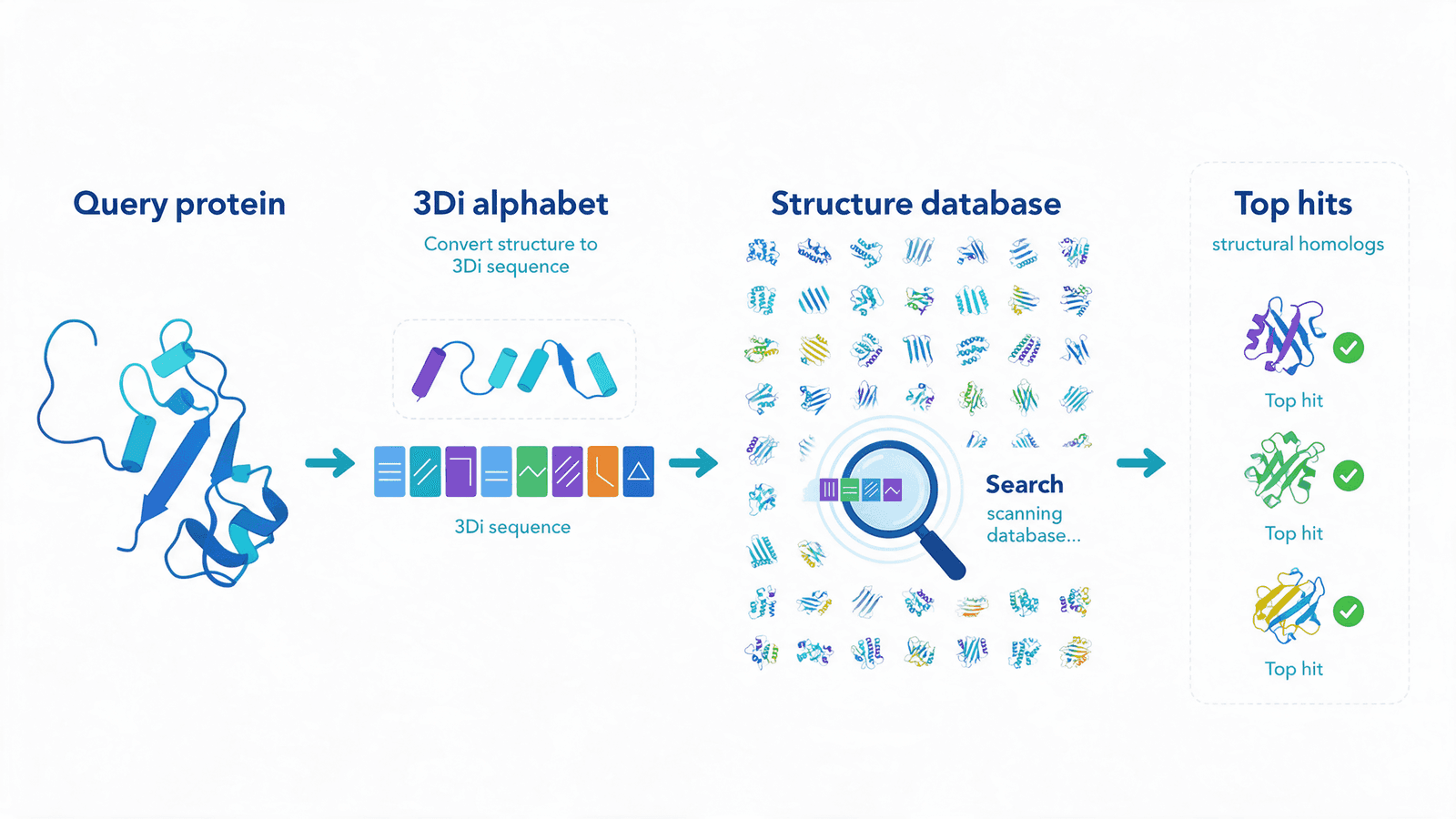
Figure 1: Foldseek structure search concept overview
As tools like AlphaFold pushed protein structure prediction into the "hundreds of millions" era, databases now hold more than 200 million predicted structures. The new bottleneck for structural biology and data science is how to quickly find proteins that "look like" your protein. Foldseek is the key built for solving "how to search a huge structure database fast": it comes from a team based at the Max Planck Institute and Seoul National University (Nature Biotechnology, 2024), and it compresses a full-database structural search that used to take days into a few seconds. Below, we start from "why it was slow" and unpack the secret of why it is both fast and accurate.
Background and Bottleneck: When Structure Databases Reach the "Hundreds of Millions," Classic Alignment Falls Behind
Once structure prediction pushed databases above the hundred-million scale, finding similar proteins across a huge structure database became the core bottleneck of a new generation of structural biology.
To understand Foldseek's value, you first have to understand the root of "slowness." Traditionally, judging whether two proteins "look alike" relies on 3D structure alignment, represented by algorithms such as TM-align, Dali, and CE. They score "similarity" by rotating, translating, and superimposing 3D coordinates, which is accurate but computationally expensive: a single full-database search can take days, or even up to ten days.
A decade ago this slowness was acceptable, because the total number of protein structures was only tens of thousands. Today, however, AlphaFold DB alone contains more than 200 million predicted structures, and the experimental structures in the PDB push the scale even higher. Exhaustively superimposing a query protein against every structure in such a database is computationally near-infeasible.
Here is an analogy: to find the most similar book among hundreds of millions, comparing them word-by-word and page-by-page is the most accurate, but it is far too slow to be usable. What you really need is a search engine that quickly builds an "index" and only then reads in detail. Foldseek is that search engine for the protein structure world — it does not compare word by word; it indexes first, then aligns.
Principle and Structure: The 3Di Structural Alphabet "Translates" 3D Structures into Alignable Sequences
Foldseek's core innovation is encoding protein structures as one-dimensional sequences: the 3Di structural alphabet describes the tertiary interaction between each residue and its nearest neighbor, so a structure can be aligned as fast as DNA.
The old way is slow because it insists on rotating, translating, and superimposing in 3D space. Foldseek takes a different route: rather than comparing coordinates, it compares topologies. It clusters the relative geometry (the virtual center distance and orientation) between each residue i and its nearest neighbor j into a discrete set of states, forming a "structural alphabet," the 3Di alphabet. A protein chain is thereby "translated" into a 3Di sequence — a sequence that records not the amino-acid type, but "which residue sits close to which, in which orientation."
With a sequence in hand, mature sequence-alignment engines can be reused, forming a two-stage workflow:
· First, an MMseqs2 k-mer prefilter rapidly shrinks hundreds of millions of candidates to a tiny set;
· Second, a vectorized Smith–Waterman local alignment combines both 3Di state scores and amino-acid substitution scores to produce high-quality alignments;
· If needed, an accelerated TM-align can serve as a global alignment complement.
As an analogy, this is like compressing a complex LEGO model into a parts list: comparing two finished models pixel-by-pixel is slow, but comparing their parts lists quickly tells you whether they belong to the same family. The 3Di alphabet is the structural world's "parts list."

Figure 2: The 3Di structural alphabet encodes structure into an alignable sequence
Measurement and Selection: Speed and Sensitivity — Is Foldseek Worth It?
Benchmark tests show that Foldseek reaches sensitivity close to or exceeding classic structural aligners on standard datasets, while being four to five orders of magnitude faster — a "fast and accurate" combination.
Does "fast" sacrifice "accuracy"? A set of core numbers from the paper (Nature Biotechnology, 2024) answers this:
· Sensitivity: on the SCOPe40 single-domain homology benchmark, Foldseek retains about 86% of Dali's, 88% of TM-align's, and 133% of CE's sensitivity — it is actually more sensitive than CE, and essentially on par with Dali and TM-align.
· Speed: on SCOPe40, Foldseek is over 4,000× faster than TM-align and Dali, and over 21,000× faster than CE; on the much larger AlphaFoldDB (version 1), it is about 184,600× faster than Dali and 23,000× faster than TM-align.
· Example: searching SARS-CoV-2 RNA polymerase (PDB 6M71 chain A, 942 residues) against AlphaFoldDB took about 10 days for Dali, 33 hours for TM-align, and only about 6 seconds for Foldseek.
Translated into everyday use, these numbers mean: a full-database search that used to run for a whole day now returns results within minutes, and the recovered hits are broadly consistent with those of classic methods. Selection advice: choose Foldseek when you need large-scale, systematic scanning of hundreds of millions of structures (for example, broad homology clustering or structural genomics screening); choose a slower but finer algorithm for local validation when you need extremely precise single-pair superimposition for publication-grade structural analysis. The two complement each other rather than replace one another. A caveat: on a few metrics (such as alignment precision on some HOMSTRAD families), Foldseek may be slightly below CE/Dali/TM-align; but for the goal of "fast retrieval," its cost-effectiveness is nearly unmatched.
Conditions and Workflow: Installation, Commands, and Data Selection
Foldseek installs with a single conda command, and its core easy-search subcommand completes a "query structure vs. structure database" search within a few arguments, outputting a standard TSV alignment table.
Before diving in, set up the environment:
· Installation: `conda install -c conda-forge -c bioconda foldseek`; alternatively use the official Docker image, or simply use the online server `search.foldseek.com` to upload a structure and search directly.
· Common commands:
· Search: `foldseek easy-search <query> <targetDB> <result.m8> <tmp>`, using `--format-output` to control output fields;
· Structure clustering: `foldseek easy-cluster` de-duplicates large structure databases;
· Complex analysis: `foldseek multimer` supports alignment and clustering of multi-chain complexes.
· Data: official prebuilt indexes (such as AFDB50, PDB, and Swiss-Prot) remove the need for local database building, so you can get started faster.
· Output fields: retain `query, target, evalue, bits, qstart/qend, tstart/tend` to read "which segment matched which segment." When judging hits, a smaller `evalue` is more trustworthy; usually `evalue < 1e-3` indicates a significant hit.
One more tip: the `-s` flag in the command controls search sensitivity — a larger value is more sensitive but also slower, so start from the default and raise it as needed.

Figure 3: Foldseek workflow for annotation, homologs and drug discovery
Combining with MatwingsVenus®(晓鹜®): Bringing Structure Search into a "Discovery–Design–Validation" Loop
On the MatwingsVenus®(晓鹜®) protein engineering platform, Foldseek structure search is a starting point, not an end: it helps you quickly lock in structural templates worth borrowing, then hands them to directed evolution and generative design for the next step.
The MatwingsVenus®(晓鹜®) platform abstracts protein engineering into a closed loop: natural candidate mining → structure search and localization → directed evolution / protein design → wet-lab validation → data feedback. In this pipeline, Foldseek handles the "structure-side" screening and localization: it finds known proteins homologous to your target from a hundred-million-structure database and quickly answers "whether an existing template or family member is available."
Why deliberately search by "structure" rather than "sequence"? Because classic pure-sequence search (such as BLAST) often fails on remote homologs (low sequence similarity but similar structure). Foldseek, relying on 3Di structural features, can "cross sequences" to find homologs, offering a broader candidate space for downstream design. This step also supports function annotation: mapping an unknown protein onto a protein of known function reduces trial-and-error when guessing function from scratch.
One step further, it can serve protein design: the "which positions and which modules are worth changing" information produced by structure search is combined with MatwingsVenus®(晓鹜®)'s active-site maps and AI mutation prediction, and converted into actionable mutation and design suggestions. In this way, structure search is no longer a one-off query but the starting point of an efficient "discovery–design–validation–learning" loop.
For example: you want to engineer an industrial enzyme but do not know where to start. Run a Foldseek structure search with its structure first, see which known proteins it most closely resembles in the database, and you can often immediately judge which family it belongs to and which homologous modules are worth borrowing — setting the direction for rational design downstream.
FAQ
What is the difference between Foldseek and BLAST?
BLAST aligns amino-acid sequences, whereas Foldseek aligns three-dimensional structures. The former is fast but insensitive to remote homologs; the latter encodes structure into 3Di sequences before aligning, so it can find proteins that differ a lot in sequence yet resemble each other in structure — better suited for "cross-family homology search."
Does "Foldseek" simply mean "structure search" in Chinese?
You can think of it that way. The name Foldseek combines "fold" (structure/folding) and "seek" (search). Foldseek structure search means "using structure to search a structure database," rather than searching with sequence.
Do I have to install a local environment to use it?
No. The official online server `search.foldseek.com` and Colab notebooks let you upload a structure and search directly; you only need bioconda or Docker for batch or local runs.
Can I use Foldseek if my structure is an AlphaFold prediction?
Yes. Foldseek is deeply integrated with AlphaFold DB (200+ million structures); both predicted and experimental structures can be built into searchable databases. The official prebuilt AFDB50 index is designed for large-scale predicted structure databases.
Summary
The core of Foldseek structure search is "turning 3D into 1D with a structural alphabet." It balances speed and sensitivity and is indispensable infrastructure for the hundred-million-structure era. For protein engineering and function annotation, it is both a fast retrieval tool and a starting point for reasoning "from structure to function." Hook it into the MatwingsVenus®(protein ai agent) platform, and you move from "blind trial and error" toward "evidence-based design." Next, pick a protein you truly care about and run a structure search yourself to feel the shift in perspective from "sequence similarity" to "structural similarity."
One-sentence takeaway: Foldseek encodes protein structures into "sequences" with the 3Di alphabet, delivering near-Dali/TM-align sensitivity at four to five orders of magnitude faster speed.
