De novo design: AI is rewriting the underlying rules of protein creation
Published on May 25, 2026
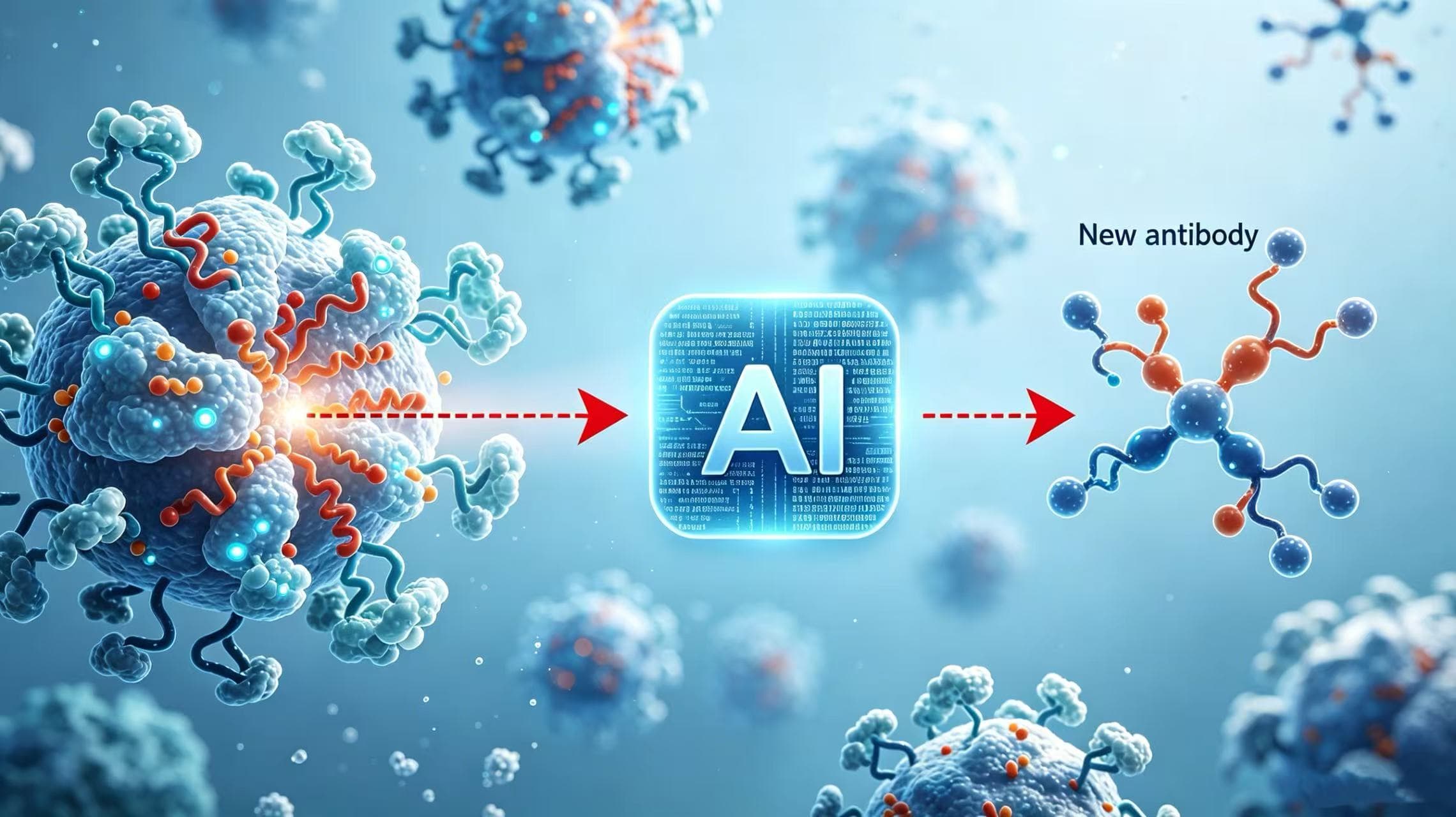
In 2025, the biopharmaceutical industry witnessed a turning point repeatedly mentioned by later entrants. Chai Discovery's AI large model Chai-2 completed the first public validation of 'zero-shot' antibody design in human history: when faced with a completely new target protein, the model did not require any known ligands as references and directly generated a brand-new antibody 'from scratch' based on the three-dimensional structure of the target, increasing the success rate from less than 0.1% by traditional methods to 16%, and compressing the development cycle from several years to two weeks. At the same time, Rentosertib, a drug for treating pulmonary fibrosis fully driven by a generative AI platform, was featured in Nature Medicine, and the world's first antibody drug entirely designed by AI also entered Phase III clinical trials.

De novo design
1. De novo design: Technological leap
The core logic of traditional R&D is 'search' — screening from a vast library of compounds for molecules that fit into the target pocket, like looking for a key of unknown shape in a dark room. De novo design reverses this logic: based on the three-dimensional structure of the target, a perfectly fitting key is forged from scratch.
In the field of protein engineering, De novo design can create entirely new protein scaffolds and functional interfaces that have never existed in nature, opening unprecedented possibilities for the design of antibodies, nanobodies, industrial enzymes, and more.

De novo design of novel antibodies
2. Crossing Fields: From Medicine to Materials, Agriculture, and Sustainable Manufacturing
The influence of de novo design far exceeds biomedicine. The representative advances in the following four fields illustrate how this technology is permeating broader industrial scenarios.
Industrial Enzymes and Green Catalysis: In 2025, researchers designed novel metal enzymes from scratch that can catalyze carbon-carbon bond formation, providing new tools for the green manufacturing of platform chemicals, materials, and drugs. The U.S. National Science Foundation invested $32 million to launch a bioeconomy program centered on AI protein design, covering recyclable plastics and renewable fuels.
Agriculture and Food: Teams combined deep learning to develop ultra-thermostable proteases, solving the challenge of high-temperature pelleting in aquatic feed; AI-guided design produced oyster peptides with antioxidant activity 703% higher than naturally extracted substances, reducing carbon emissions by 90%.
Plant Natural Products and Synthetic Biology: AI-driven de novo design is breaking through the bottleneck of microbial synthesis of plant natural products. By using structure prediction and molecular docking to screen for "orphan enzymes," high-value products such as terpenes and alkaloids can be produced efficiently.
Biomaterials and Regenerative Medicine: Researchers created NeoNectins microproteins, which, when fixed in hydrogels, promote tissue integration and bone growth more effectively than natural proteins; the Westlake University team designed reversible light-responsive microproteins from scratch for the first time, successfully applying them in optogenetic regulation.
These cases indicate that de novo design, as a platform technology, can be transferred to any scenario requiring customized protein functions.

AI-driven de novo binder design
3. From "single-point tools" to "integrated agents": AI is evolving
Supporting these cross-disciplinary breakthroughs is a technology stack composed of multiple AI tools. In recent years, researchers have had to manually orchestrate multiple independent single-point tools: using RFdiffusion to generate protein skeleton, designing sequences with ProteinMPNN, verifying structures with AlphaFold2, and then optimizing affinity with Rosetta...... Each tool is powerful, but they come from different labs, depend on different operating environments, and have various input and output formats. From design to validation, researchers often spend a lot of time on "tool scheduling" rather than "scientific thinking."
This is precisely the problem that "intelligent agents" want to solve. In 2026, Matwings Technology will launch the conversational protein R&D agent MatwingsVenus™ (Xiaowu ™). It is no longer a tool that requires manual calls, but an intelligent collaborator that understands natural language, autonomously plans tasks, and schedules underlying tools. Users only need to describe their goal in everyday language—"Help me design a heat-stable small enzyme that can catalyze XX reactions"—and MatwingsVenus™ (Xiaowu ™) can automatically complete it: calling the skeleton to generate models, executing sequence design, running structural verification, and even automatically linking design results to an automated wet experiment platform.
From a single-point tool to an integrated intelligent agent, AI is evolving from a "passive calculator" to an "active R&D partner." And this is just the beginning.
4. Conversational Wet and Dry Closed-Loop: Seamless Transition from Design to Verification
Connecting computing with wet experiments is the most difficult wall to overcome in AI-driven R&D, and it is also the core feature of MatwingsVenus™ (Xiaowu ™). Its "conversational wet and dry closed-loop" mechanism: after the agent completes its design, the platform uses a self-built communication mechanism to import results into plasmid ordering and experimental scheduling workflows, automatically connecting to subsequent experimental tasks, driving the robot to complete sample preparation, protein purification, and functional testing, and then feeds experimental results back to AI for the next round of iteration.
This means scientists sit in front of computers using natural language to describe goals, AI automatically design, experimental platforms conduct experiments automatically, and data feedback is automatically optimized. MatwingsVenus™ ™ not only outputs sequences but also considers manufacturability—the design addresses both "functional goals" and "whether it can be produced."
MatwingsVenus™ (Xiaowu ™) integrates resources from over 50 experts and can initiate consultations at any time. This "AI Agent Expert Network Automated Experimental Platform" architecture can cover a wide range of scenarios including pharmaceuticals, industrial enzymes, biomaterials, and synthetic biology.
5. Shared Laboratories: When R&D Capabilities Are No Longer the Privilege of Large Institutions
AI-driven De novo design solves the problem of "how to design quickly," and MatwingsVenus™ (Xiaowu™) also addresses "who will verify the designs."
In traditional R&D, AI design, automated experimental equipment, and expert experience are disconnected—large institutions have the financial resources, while small teams and individuals struggle to validate good ideas. MatwingsVenus™ (Xiaowu™) breaks this barrier: users do not need to build their own experimental platform, nor manually transfer data between multiple tools; they can access the full workflow from AI design to automated wet experiments simply through natural language conversations.
This model brings high-threshold protein R&D capabilities "down from the altar," inspiring more individuals and small teams to pursue personalized innovation. From industrial enzymes to biomaterials, from plant-derived products to sustainable manufacturing, De novo design is permeating various fields. MatwingsVenus™ (Xiaowu™)’s "conversational closed-loop of dry and wet experiments" outlines the potential form of next-generation R&D: AI actively understands needs, coordinates resources, and iterates continuously, while R&D capabilities spread to every creative individual in the form of a "shared laboratory."

Ai Driven Protein de novo design
6. Challenges and Prospects
Of course, challenges still exist, but there is no denying that AI is rewriting the fundamental rules of protein development at an unprecedented pace. When AI can 'forge keys' instead of just 'finding keys,' and when intelligent agents actively coordinate the entire computational and experimental process, the creative boundaries of humans in the field of protein engineering are being broadened like never before.
MatwingsVenus™ (Xiaowu™) agents are just a ray of light in this wave of transformation. But the direction they reflect—deep integration of AI and experimentation, real-time closed loops of design and validation, democratization and widespread access to R&D capabilities—is the most promising future of this revolution.