
What is cutinase? Serine esterase mechanism and industrial applications
Published on October 29, 2026
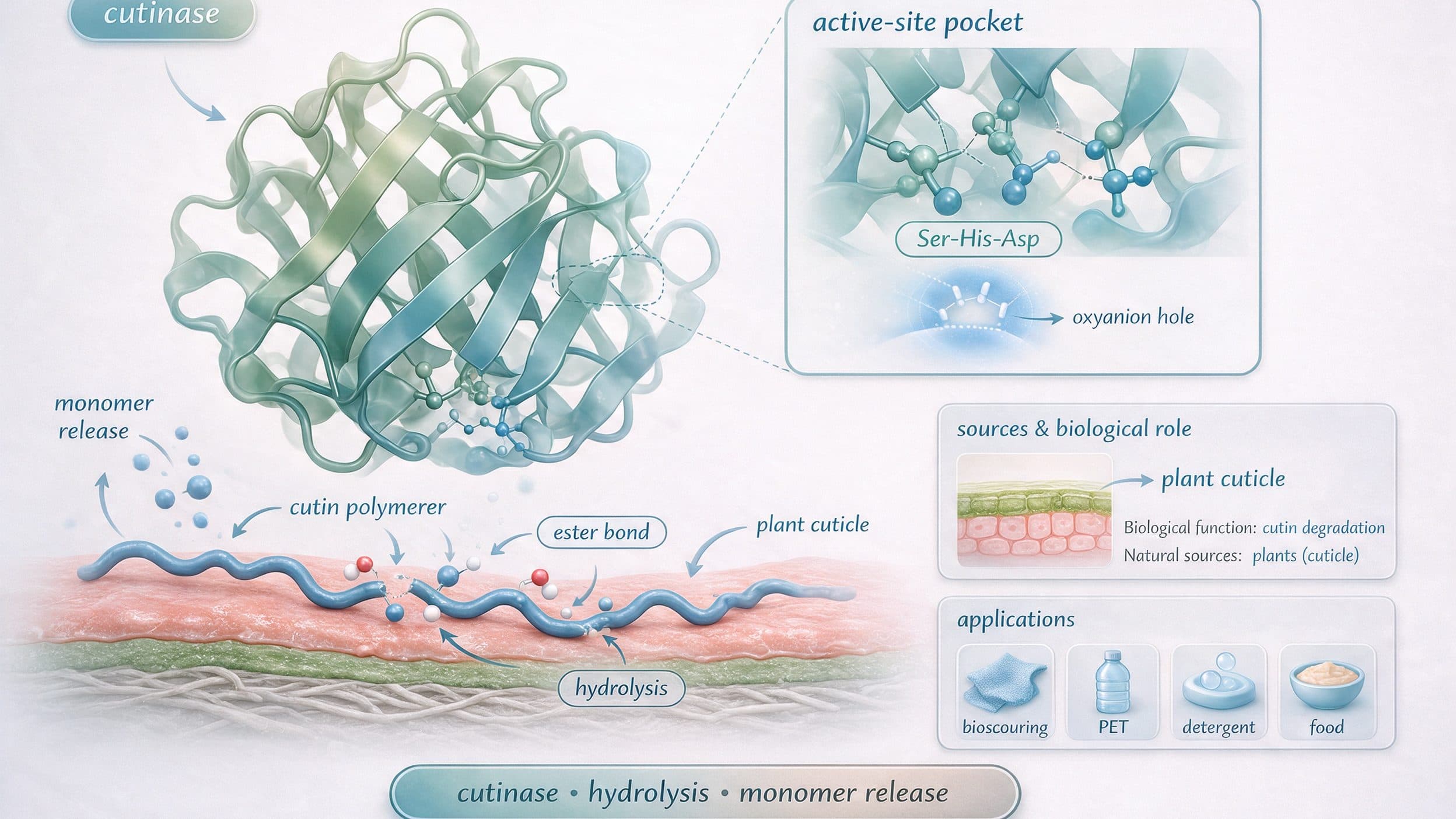
Category: Enzyme & proteolysis (A: mechanism + process control); secondary: Application & scenarios (G)
To keep the industrial value of cutinase, do not fixate on a single activity number. The same pNPB specific activity can differ by orders of magnitude on real cutin or polyester fabric. What decides process success is the match among substrate, optimum conditions and stability.
1. Understanding cutinase: choosing the right tool for ester-bond cleavage
1.1 Cutin and cutinase: from plant cuticle to polyester bond cleavage
Cutin is an insoluble polyester on plant surfaces, polymerized from C16 and C18 hydroxy fatty acids. Cutinase (cutin hydrolase, EC 3.1.1.74) hydrolyzes its ester bonds into monomers. It comes from fungi and bacteria; plant pathogens use it to invade the cuticle, while industry applies it to diverse ester processing.
Judging whether an enzyme is a cutinase should not rely on the name alone. Look for true cutin-hydrolysis capability and a serine esterase active site. These two facts matter more than a single activity value.
1.2 Catalytic mechanism: Ser-His-Asp triad and acyl-enzyme intermediate
Cutinase belongs to the alpha/beta-hydrolase fold and the serine hydrolase superfamily. Its active site holds a catalytic triad of nucleophilic Ser (Ser120 in Fusarium cutinase), His and Asp, plus a preformed oxyanion hole.
The reaction has two steps. The Ser hydroxyl attacks the ester carbonyl to form a covalent acyl-enzyme intermediate; then water enters and deacylates, releasing the alcohol and carboxylic acid. No external cofactor is needed, and conditions are mild.

figure2. Cutinase active site and two-step hydrolysis cycle
1.3 Boundary with lipase and PETase
Cutinase is often compared with lipase. The difference is that most cutinases have a relatively exposed active site and lack the mobile lid of lipases, so they act on both soluble esters and emulsified triacylglycerol.
PETase (e.g., from Ideonella sakaiensis) is essentially a cutinase-like enzyme. But a cutinase label does not guarantee efficient PET degradation; thermostability, substrate accessibility and crystallinity tolerance still decide.
1.4 Sources of cutinase: differences between fungi and bacteria
Cutinase sources broadly split into fungi and bacteria.
l Fungal cutinase (e.g., Fusarium solani f. sp. pisi) is the most studied and some variants rely on disulfide bonds for stability;
l bacterial cutinase (e.g., Thermobifida fusca Tfu_0883 and Tfu_0882) is sequence-similar but usually more thermostable. The source often hints at the approximate temperature tolerance.
Another group comes from metagenome mining of cutinase-like enzymes, such as LCC cloned from leaf-branch compost. These are not domesticated in a natural host, so activity and stability need systematic evaluation, yet they widen the candidate pool.
2. Core performance indicators: define three groups of numbers before selection
2.1 Assay substrate: the real difference among pNPB, cutin and polyester
Soluble ester pNPB (4-nitrophenyl butyrate) is common for screening: fast operation and stable signal. But many cutinases prefer short-chain esters, so a high pNPB specific activity does not mean strong degradation of real cutin or polyester.
Product quantification on real substrates builds a credible baseline. Screen with soluble esters, then validate on the real substrate.
Pick a substrate close to the real task. Use cutin or fabric models for textile wax removal, low-crystallinity PET film or polyester sheets for PET evaluation, and pNPB only for high-throughput ranking. The closer the substrate to real conditions, the more meaningful the assay.
2.2 Optimum pH and thermostability: hard constraints on the process window
Most cutinases act best in the alkaline range, around pH 8 to 9, but the exact value depends on source and substrate and should be measured on the specific strain [to be verified]. Thermostability varies much more: classic fungal cutinases are moderately tolerant, while Thermobifida fusca, Thermomyces insolens (HiC) and LCC are heat-tolerant and work at 70 to 80 C.
Once the process fixes a temperature window, the selectable enzyme range largely settles. Set the working conditions first, then screen.
Note that a heat-tolerant cutinase is not always an advantage in a temperature-sensitive step such as textile processing. Excess heat can damage fiber or add energy cost, so the optimum temperature should align with the process window rather than always chasing higher values.
2.3 Substrate selectivity and crystallinity tolerance: the ceiling of degradation
For the same polyester, higher crystallinity and molecular weight reduce water solubility and enzyme accessibility. Cutinase degrades semicrystalline PET far more weakly than the amorphous region, so crystallinity tolerance and substrate selectivity are key differentiators.
If high conversion is required on high-crystallinity or high-molecular-weight substrates, consider engineered variants rather than copying the conventional textile answer.
3. How to measure the indicators: from screening to real-substrate validation
3.1 Soluble-ester screening and specific-activity calculation
Measure absorbance increase with p-nitrophenyl esters and convert to specific activity (U/mg). Screening suits high-throughput comparison, but fix pH, temperature and substrate concentration, and watch short-chain ester preference so batches stay comparable.
3.2 Product quantification on real cutin and polyester
On real cutin or polyester, characterize degradation by product quantification, such as released fatty acids, terephthalic acid (TPA) or total soluble products. State temperature, buffer and substrate form so batches compare.
3.3 Stability and process-compatibility evaluation
Describe thermostability with Tm or residual-activity profiles. For process compatibility, test surfactants, metal ions (e.g., calcium/magnesium), additives and pH fluctuation. Cutinase is irreversibly inhibited by organophosphates, so verify compatibility before detergent or formulation use.
Batch consistency and method validation are also easy to overlook. Fix the same substrate, instruments and calibration, and recheck against a reserved control enzyme regularly to keep data comparable across sources.
4. How indicators map to needs: roles across four scenarios
4.1 Textile bioscouring: efficient low-temperature wax removal
The cuticle and wax on cotton need gentle removal. Cutinase bioscouring works at lower temperature than hot alkaline scouring, saving energy and reducing fiber damage. This scenario values low-temperature activity, fiber gentleness and one-bath compatibility with amylase and pectinase.
4.2 PET biodegradation: thermostability and crystallinity tolerance
PET recycling values thermostability and crystalline-region tolerance. HiC is most active at 70 to 80 C, and engineered LCC variants retain high activity at 75 to 80 C; higher crystallinity slows degradation. Weigh optimum temperature and crystallinity tolerance together.
PET degradation is also limited by molecular weight and mass transfer. Enzyme adsorption and diffusion on the polyester surface are constrained, so raising activity alone may not raise conversion, which is why engineering often targets adsorption and thermostability together.
4.3 Detergent and food: surfactant compatibility and regulation
Detergent formulations contain surfactants, so cutinase must stay active under alkaline, additive-rich conditions. Food and flavor-ester synthesis must meet process temperature and regulatory requirements, focusing on scalability and safety.
5. Selection and process implementation: from scheme to quality-control chain
5.1 Selection schemes under different indicator priorities
Textile favors low-temperature activity and fiber friendliness; PET favors thermostability and crystallinity tolerance; detergent and food favor surfactant resistance and regulatory compliance. Rank priorities first, then screen candidates.

figure3. Cutinase process chain and quality-control nodes
5.2 Feed, catalysis, separation and QC process chain
The full chain covers feed and pre-treatment, catalytic reaction, separation and purification, QC detection and product. Clarify substrate form, pH and temperature window, reaction endpoint criterion and product-quantification method at each step. Moving QC upstream reduces scale-up deviation.
Process control is about reproducible runs. Keep feed amount, enzyme-to-substrate ratio, pH buffer and temperature fluctuation within tolerance, and write the reaction endpoint as a quantifiable criterion so scaling follows the same logic.
5.3 Custom route when standard products do not match
When a standard cutinase cannot meet substrate selectivity, thermostability or process compatibility, custom development is more reliable. Define the target substrate and process window first, then evaluate candidates.
Custom development pushes uncertainty earlier. Rather than discovering a mismatch after scale-up, define substrate, window and indicators together up front and iterate with data.
6. How MATWINGS MALL products and custom services land
6.1 Custom tool enzyme development when standard enzymes are missing
When standardized products cannot match differentiated needs, MATWINGS MALL custom tool enzyme development can start from the target substrate and process window, evaluating expression, assay and stability to bring selection onto verifiable indicators.
6.2 The custom service pathway
MATWINGS MALL custom tool enzyme development can cover enzyme-library screening and evaluation, activity and stability characterization on target substrates, and adaptation advice for scale-up. Exact deliverables and timelines depend on project definition. Go to the MATWINGS MALL product page or expert center to discuss the scope.
7. FAQ
Q1; What is the difference between cutinase and lipase?
Both are serine esterases, but cutinase has a more exposed active site and lacks the mobile lid of lipases, so it acts on both soluble esters and emulsified triacylglycerol. Judge by active-site structure and substrate spectrum, not the name.
Q2: Why is pNPB activity high but cutin degradation poor?
High pNPB specific activity does not mean strong real-substrate degradation. Cutinase prefers short-chain esters, while real cutin or polyester is limited by crystallinity, molecular weight and accessibility, so validate with real-substrate product quantification.
Q3: Can cutinase degrade PET? What matters?
Cutinase-like enzymes can degrade PET, but efficiency depends on crystallinity, temperature and thermostability. Low-crystallinity PET is easier; crystalline regions need heat-tolerant enzymes at higher temperature. A cutinase label alone is not enough.
Q4: What should be considered when using cutinase for textile bioscouring?
Focus on low-temperature activity, fiber gentleness and one-bath compatibility with other scouring enzymes. Control pH and temperature window to avoid uneven wax removal or fiber damage.
Q5: If standard products are insufficient, how to choose custom tool enzymes?
Define the target substrate and process-window indicators first, then evaluate expression, assay and stability across candidate enzymes. MATWINGS MALL custom tool enzyme development can bring selection onto verifiable indicators.
8. Conclusion
The value of cutinase lies not in a single activity number but in the match among substrate, conditions and stability. Define three indicator groups, select against textile, PET, detergent and food scenarios, and validate on real substrates. For differentiated needs beyond standard products, MATWINGS MALL custom tool enzyme development offers a landing path.
MATWINGS MALL Product Zone and More Industry Insights
MATWINGS MALL tool enzyme products and custom services
MATWINGS MALL provides a wide range of biological and tool enzymes, and offers custom tool enzyme development for differentiated needs that standard products cannot satisfy. Browse more enzyme products and industry insights at MATWINGS MALL.
More industry insights
To learn more about enzyme catalysis, assay methods and industrial applications, visit the MATWINGS MALL expert center for selection and customization advice.