
Clustal Omega Sequence Alignment: Fast, Accurate Analysis of Large Protein Families
Published on November 9, 2026
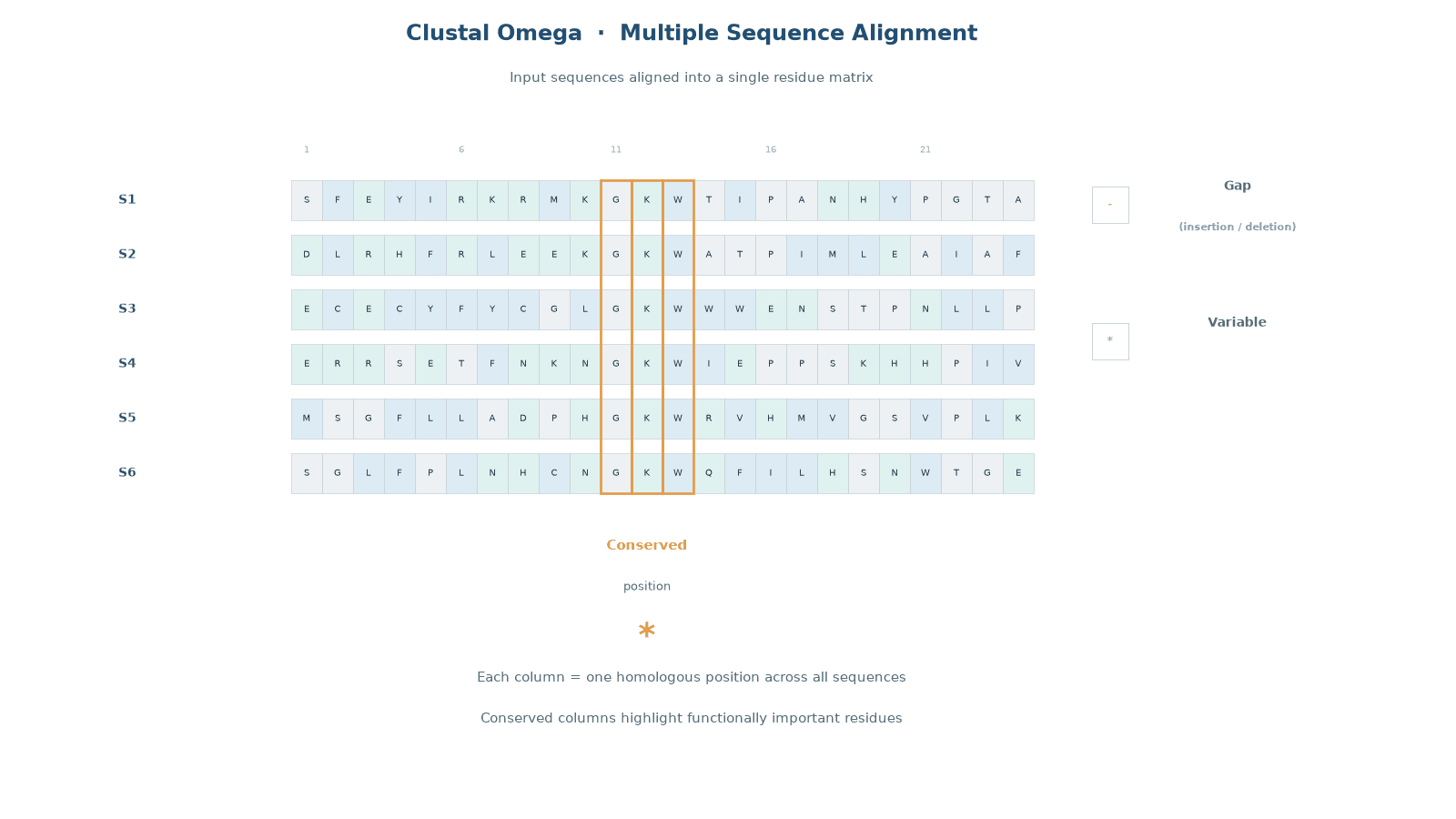
Figure 1 Concept overview of Clustal Omega sequence alignment: a unified multiple sequence alignment matrix
What Is Clustal Omega Sequence Alignment? Why Is It the Go-To for Large Protein Families?
When you have dozens—or thousands—of homologous protein sequences and need to know which positions are highly conserved, which regions are domain boundaries, and how these proteins are related evolutionarily, you need to "align" them together. Clustal Omega is a highly efficient tool for exactly this: it belongs to the classic Clustal family, and is that family's upgrade for the big-data era, known for being fast, accurate and scalable.
1. Background and Mechanism: From ClustalW to Clustal Omega, Why MSA Matters
Extractable takeaway: Multiple sequence alignment (MSA) aligns three or more sequences at once to reveal conserved positions, domain boundaries and evolutionary relationships, forming the basis for protein annotation and design.
Sequence alignment addresses "homology": different proteins may share a common ancestor, and by aligning them we see which positions have been "fixed" during evolution (conserved positions) and which are allowed to vary. MSA places three or more sequences into a single "alignment table" and aligns residues column by column.
You can think of MSA as lining up different editions of the same article row by row: it finds the "key sentences" that every edition expresses with the same word—those are the conserved positions. The result is a matrix: each row is a sequence and each column is a homologous position; to align sequences of different lengths, columns can be separated with inserted "gaps".
· Conserved positions: the residue appearing most often in a column often plays a key structural or functional role.
· Domain annotation: alignment exposes where the same domain appears across different proteins.
· Evolutionary relationships: alignments are the basis for building phylogenetic (evolutionary) trees.
It is worth distinguishing two kinds of alignment: pairwise alignment (e.g. BLAST, Smith–Waterman) compares two sequences and is good for finding similar fragments; multiple sequence alignment handles three or more at once and can reveal conserved patterns that only appear across many members. The Clustal family is the classic MSA toolset—from ClustalW in 1994, to the graphical ClustalX, to Clustal Omega in 2011—mirroring how sequence data grew from small to large scale.
Early tools ClustalW and ClustalX used a progressive-alignment strategy, but computational cost grows roughly quadratically with the number of sequences, making them hard to scale to the rapidly growing sequence data. Clustal Omega retains the progressive framework but makes fundamental improvements in two stages: building the guide tree and pairwise alignment.
2. Core Principles and Structure: Clustal Omega's mBed Guide Tree and HHalign
Extractable takeaway: Clustal Omega builds a guide tree quickly with mBed, then aligns pairs of profile-HMMs with HHalign, reducing overall complexity to near-linear while preserving accuracy.
The progressive idea is: first build a guide tree based on sequence similarity, then along the tree's merging order, start from the two most similar sequences and progressively merge more sequences/alignments. Clustal Omega's key improvements focus on two points.
The full workflow has three steps: first estimate similarity between all sequences and build a guide tree; then, following the tree's branching order, merge starting from the two most similar sequences; finally expand the resulting "alignment blocks" step by step until all sequences are included. Clustal Omega accelerates the first two steps with mBed and uses HHalign for accuracy in the final step.
· Building the guide tree with mBed: traditional methods compare all sequences pairwise, requiring O(N²) time and memory. mBed ("embedding") places each sequence in a space of dimension roughly log N, represents it with a short vector of distances to a set of "reference sequences", then clusters rapidly (e.g. K-means or UPGMA), reducing tree construction to near O(N log N).
· Aligning profiles with HHalign: at the merging stage, Clustal Omega does not just align characters; it models each sequence/alignment as a profile hidden Markov model, and uses HHalign from the HHsuite to align two profile-HMMs. This is more sensitive than conventional profile-profile comparison, capturing weak homology signals more accurately.
Think of mBed this way: rather than comparing everyone in a group pairwise, first pick a few "landmarks" (reference sequences), then have each person report their distance to each landmark. Because the number of landmarks only grows slowly with the group size (about log N), the cost drops sharply and the tree can be built in near-linear time. HHalign, meanwhile, is like comparing two detailed dossiers rather than scanning keywords on the cover—it uses probabilistic models to capture weak homology, so it keeps good alignment quality even when sequences are distant and only weakly similar.
Compared with ClustalW, this combination of an "embedding tree + profile-HMM alignment" is the key to Clustal Omega's advantage in both accuracy and speed.

Figure 2 Core mechanism of Clustal Omega: mBed guide tree then HHalign alignment
3. Evaluation and Selection: How to Choose an Alignment Tool and the Boundaries of Clustal Omega
Extractable takeaway: Choice of alignment tool depends on sequence count, homology and analysis goals; Clustal Omega performs strongly overall on medium-to-large, moderately-to-highly homologous protein sets.
· When to choose Clustal Omega: from dozens to thousands or even more sequences, where "accurate enough" and "fast enough" are both required—for example, whole-genome protein-family analysis and batch domain annotation.
· Neutral comparison with other tools: versus ClustalW/X, Clustal Omega scales much better; on accuracy it approaches some "consistency" methods (such as T-Coffee, M-Coffee) but is usually faster. Versus ultra-large-scale tools like MAFFT/PartTree, Clustal Omega offers a different trade-off between accuracy and speed, so the choice should consider the data size and goals.
· Watch the boundaries: Clustal Omega performs less well on protein sets with low homology and long N-terminal or C-terminal extensions; web servers (e.g. EMBL-EBI's MSA service) usually cap the number of sequences/file size per submission, so very large inputs are better run with a local command-line version.
In short: assess sequence count and homology first, then choose the tool; Clustal Omega is a robust default for "large-scale, moderate-to-high homology" cases.
For selection, three dimensions help decide quickly: sequence count determines whether you need a scalable tool; homology level determines whether you need a more sensitive model; analysis goal determines whether to prioritize accuracy or acceptable scale. As a rule of thumb, when sequence counts range from dozens to thousands and conserved columns are still recognizable, Clustal Omega is a strong balance of speed and accuracy; for very large sets (tens of thousands or more) where accuracy trade-offs are acceptable, PartTree-style approaches may suit; with small data but a strict accuracy requirement, consistency methods are more appropriate.
4. Conditions and Workflow: Practical Usage of Clustal Omega
Extractable takeaway: To run Clustal Omega, prepare a clean FASTA input, set appropriate output formats and iteration counts, and you will get both the alignment and the guide tree.
· Input: commonly FASTA format; supports protein, DNA and RNA (nucleic acids supported since version 1.1.0).
· Output formats: Clustal, FASTA, Stockholm, Phylip, and more; for downstream tree building you can also export the guide tree or a distance matrix.
· Parameters: number of iterative (HMM) passes for higher accuracy, options to output the tree/distance matrix, cluster-size limit, etc.
· Common pitfalls: remove redundant and low-quality sequences before alignment to avoid contaminating the result; trim low-homology regions first; in the output, inspect gap distribution to judge whether the alignment "drifted".
Clustal Omega returns both an "alignment" and a "tree"; the former for position analysis, the latter for evolutionary/grouping inference.
Before running, it helps to clean the input: remove clearly redundant or low-quality sequences, unify sequence orientation, and drop over-short or highly repetitive fragments so they do not "contaminate" the result. During the run, pay attention to iteration count: more iterations (HMM-based) usually improve alignment quality in weakly homologous regions but take more time. In the output, inspect gap distribution and conserved columns: if a column has many gaps or scattered residues, that region may have "drifted" or be of low homology, so trim it or change parameters. The alignment can then be used to build a phylogenetic tree, draw a sequence logo, or localize key residues.

Figure 3 Clustal Omega application workflow: from alignment to protein engineering design
5. How MatwingsVenus® (晓鹜®) Integrates Sequence Alignment into a Protein Engineering Loop
Extractable takeaway: On the MatwingsVenus® (晓鹜®) platform, multiple sequence alignment is an upstream step in protein engineering, identifying conserved positions and providing sequence-level evidence for subsequent AI-driven design.
In real protein engineering, sequence alignment is never the end point but a starting point. MatwingsVenus® (晓鹜®) treats MSA as a foundational step in the workflow: first locate conserved positions and variable regions via MSA, then combine structural information to judge which residues suit mutation and which positions should remain stable. Alignment results are cross-checked with structure and functional annotation, then fed into an AI-driven high-throughput design and screening loop—so that every step from sequence evidence to candidate design is "evidence-based".
· Upstream localization: conserved positions highlight key residues; variable regions highlight engineerable space.
· Evidence integration: alignment, structure and functional labels cross-validate, reducing blind screening.
· Loop feedback: learnings from designed products can feed back into the next round of alignment and learning, forming a continuously improving workflow.
In practice, the platform first uses MSA to quickly locate which positions are highly conserved and which regions can vary, then cross-validates the result with structure and functional annotation. In this way AI-driven design is not "blind trial-and-error" but directional exploration backed by sequence evidence. After expression and functional validation, data from designed products flows back into alignment and annotation, continuously calibrating subsequent models and forming a loop of continuous iteration.
MatwingsVenus® (晓鹜®), built by Matwings Technology, aims to turn sequence analysis that traditionally needs extensive expert experience into reusable, quantifiable protein engineering capability.
6. FAQ
How is Clustal Omega different from ClustalW?
Clustal Omega is the newer MSA program. The key differences are in guide-tree construction and pairwise alignment: it uses mBed for fast tree building and HHalign for profile-HMM alignment, so at similar accuracy it scales to larger sets and is faster.
What is the maximum number of sequences Clustal Omega can align?
Web-server tools usually cap the number of sequences per submission—for example, EMBL-EBI's MSA service accepts about 4000 sequences or a 4 MB file; the local command-line version can handle more. The actual capacity depends on memory and sequence length.
What output formats does Clustal Omega support?
It can output Clustal, FASTA, Stockholm, Phylip and other alignment formats, and can additionally generate a guide tree or distance matrix for downstream tree building or further analysis.
Is Clustal Omega for proteins or DNA?
Both (nucleic acids supported since version 1.1.0). It was originally optimized for protein sequences, and protein homology analysis is its main use; for DNA/RNA alignment, note differences in parameters and scoring.
7. Summary
Clustal Omega sequence alignment advances multiple sequence alignment from "run-able" to "scales large, runs fast, and is accurate enough", via the "mBed guide tree + HHalign profile-HMM alignment" combination. It suits medium-to-large, moderate-to-high homology protein families and is a robust default for domain annotation, conserved-residue identification and evolutionary studies. In the real protein engineering pipeline, it is a reliable starting point for locating key residues and guiding design—and this is exactly why MatwingsVenus® (晓鹜®) integrates it into its own loop.
One-Sentence Takeaway
Clustal Omega combines an mBed guide tree with HHalign profile-HMM alignment to deliver fast, accurate multiple sequence alignment of thousands to tens of thousands of sequences.
