
Automated Protein Research Platform: How Does Protein Research Move from Manual Experiments to a Fully Automated Workflow?
Published on November 10, 2026
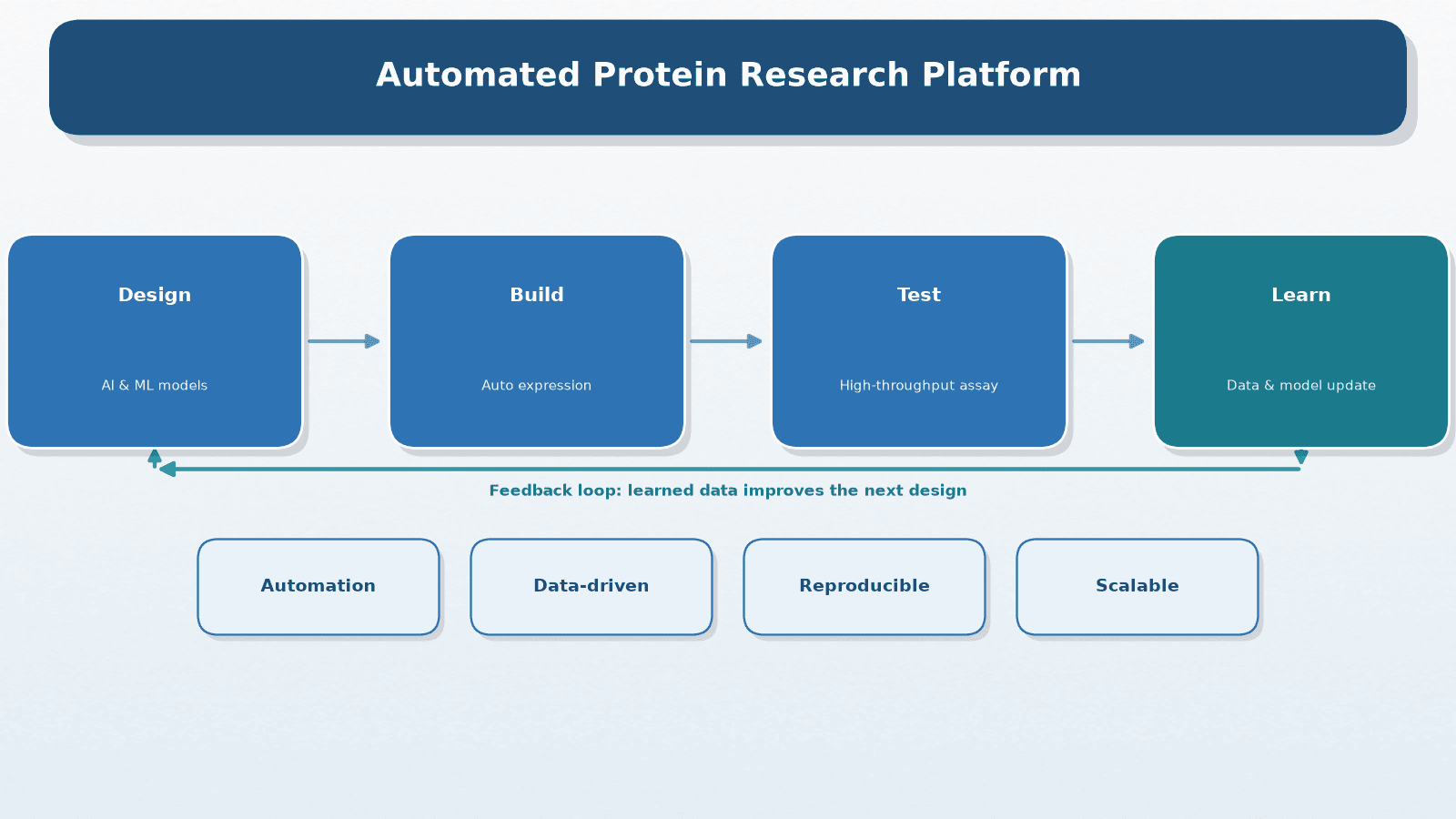
Figure 1 Automated protein research platform: an automated design-to-characterization closed loop.
An automated protein research platform is an intelligent R&D system that links Design–Build–Test–Learn into a data-driven closed loop. Traditionally, protein research relies on researchers performing repeated manual steps in the lab: construct and express, purify, then test activity. The steps are many, cycles are long, and results between batches often fluctuate. When AI algorithms and automated equipment truly work together, repetitive tasks go to machines, and researchers can focus their energy on judgment and innovation. Using a few diagrams, this article explains what this platform solves, how it works, which parts genuinely help, and how to bring it into real R&D with MatwingsVenus®.
Why Does Protein Research Need Automation?
Protein R&D is shifting from “experience-driven” to “data-driven,” but many teams are still stuck on these points:
· Manual experiment bottleneck: Expression, purification, and activity testing involve many repetitive operations, high labor cost, and human error from fatigue.
· Long iteration cycles: A single “design–test” round often takes weeks to months, making it hard to cover a large candidate space; many promising ideas go untested.
· Poor reproducibility: Manual variability is large, and repeated runs of the same batch often fluctuate, so it is hard to tell which direction really works.
· Data silos: Design tools, experimental records, and analysis software are fragmented; data is hard to accumulate and reuse, wasting earlier effort.
A useful analogy: if protein research is like “trial and error,” automation does not think for the scientist—it makes trial and error faster, cheaper, and more systematic, moving from testing one by one to screening batch by batch. This is why more enzyme-engineering and antibody-R&D teams adopt an automated protein research platform: it turns “people spending time on repetition” into “machines handle repetition, people handle decisions.”
Driving this shift is real cost pressure. A failed protein design often means weeks or months of experimental investment; if the candidate space can be broadened and screened faster, truly usable directions can be found sooner. Combined with machine learning, which makes “predict–validate–predict again” possible, the combination of automation and AI is turning a craft that once depended on expert experience into a replicable, scalable engineering process. For teams that need to deliver new proteins continuously, this is no longer just an “efficiency option”—it is a key capability that determines R&D speed and cost competitiveness.
Principle and Architecture: How Does an Automated Protein Research Platform Work?
Platforms typically use a modular “four-step loop” architecture, where each step is essential:
· Design: use machine learning, structure, or sequence models to generate candidate sequences and mutation combinations, thinking through “what to try” first.
· Build: automated synthesis, cloning, and expression to prepare candidates in batch, turning “what was imagined” into real samples.
· Test: high-throughput screening and characterization, measuring activity, affinity, stability, expression, and solubility, quantifying “what was made.”
· Learn: feed results back to the model and use active learning to pick the most valuable next experiment, making the next round smarter.
The key is whether data can truly close the loop. Many teams lack not AI but high-quality, structured experimental data. The value of a platform is not merely automating one step—it is collecting data from every step into a standardized, structured data foundation, so the model gets more accurate and iterations get faster. Design, build, test, and learn are not isolated tools; they are an interlocking system.
Two key concepts in plain language:
· Fitness landscape: think of protein performance as a topographical map where higher peaks mean better performance. Sequence/structure space is enormous, and the AI’s job is to find the highest peak, not wander blindly.
· Active learning: where the model is most uncertain is often where experiments are most worthwhile. Rather than sampling evenly, prioritize the most informative samples, doing less wasted work and approaching the optimum faster.

Figure 2 Platform core: a data-driven active-learning loop for protein engineering.
Measurement and Selection: What Can It Measure, and What Should Choose It?
Whether a platform helps a team depends first on what it measures and whether the measurements are reliable. Common automatable metrics include:
· Enzyme activity and substrate conversion;
· Binding affinity and kinetic parameters;
· Thermal stability and melting temperature;
· Expression level and solubility;
· Aggregation, degradation, and other quality attributes.
Scenarios better suited to automation often share these traits:
· Large candidate numbers: need to evaluate many candidates in batch (point-mutation combination libraries, directed-evolution libraries), where manual testing is impractical.
· Standardized metrics: key indicators can be measured reliably by automated equipment, with readings consistent with the process.
· Multiple iterations: need to iterate across rounds and want data to be traceable and reusable, rather than starting over each time.
Selection advice should be pragmatic: if only a couple of sites are being changed occasionally, manual point validation may be faster, so automating is unnecessary; automation suits “large-scale, iterative, data-driven” R&D. The criterion is not “others have it, so I should too,” but “does my project truly need batch, repetitive, sustainable measurement.” Another easily missed point: automation suits “repetitive, quantifiable” measurement. If an indicator depends on manual judgment and is hard to standardize, forcing automation introduces new bias. So ask first: can this indicator be measured stably and mechanically, again and again?
Conditions and Process: Bringing Automation into the Lab Workflow
Automation is not “buy the equipment and it works”; experimental conditions and process control must be in place, or machines will “amplify errors”:
· Pipetting and sample handling: automated workstations handle 96/384-well plates, reducing human error and batch variability—the first step toward stability.
· Stable process window: expression temperature, induction, purification buffer, and assay buffer must stay consistent under automation and be fully recorded, avoiding “results change when the person changes.”
· Quality control: keep QC samples in every batch and monitor key metrics and data quality to catch drift early.
· Data traceability: link from sample barcode to result automatically, so the process is auditable, results reproducible, and problems easy to trace.
Throughput and cost also need balancing. Higher throughput means more reagents, more consumables, and more complex data management; automation is not “the higher throughput the better”—it is about finding a balance among throughput, cost, and data quality that matches the project. When process is fixed and anomalies surface automatically, automation truly becomes “less worry,” not just “more equipment.”

Figure 3 Automated protein research workflow and process conditions.
How Does MatwingsVenus® Deliver Automated Protein R&D?
MatwingsVenus® focuses on intelligent, automated protein R&D. The core idea: with high-quality data as the foundation, combine advanced algorithms with automation tools so a team can collaborate on the same platform from sequence design, build, screening, to characterization, while accumulating and reusing data every iteration.
· Platform value: reduce repetitive experiments and give researchers more time for judgment and innovation; let data flow and inform the next design.
· Capability boundary: the platform provides algorithms and automation tools; any prediction should be validated experimentally; it does not replace experimental evidence or fabricate measured data.
· Enterprise deployment: for customized deployment and end-to-end solutions, contact Matwings Technology.
In practice, a team typically starts from existing sequences or structures, sets a target on the platform (e.g., improve activity or thermostability), and the platform proposes candidates using models; after automated build and high-throughput characterization, results return to the model, and the next round of candidates is more targeted. Over time, the platform accumulates not just a batch of results, but a reusable “R&D knowledge base”—where automation and AI create the most long-term value.
FAQ
Q1: What scenarios suit an automated protein research platform?
Scenarios that need batch screening of many candidates and multiple iterations, such as enzyme engineering, antibody optimization, and protein directed evolution. For occasional single-point validation, manual work may be faster.
Q2: Can the platform guarantee prediction accuracy?
No, and it should not promise that. The platform provides algorithms and automated computation; predictions are hypotheses and must be validated with experimental evidence—experimental data is the final basis.
Q3: Is automation costly? What conditions are needed?
It needs sample handling, detection equipment, and data systems to work together. For small, low-iteration projects, manual work may be faster; for large, continuous-iteration projects, automation is worth the investment.
Q4: How are data security and traceability ensured?
Keep QC samples, batch records, and data logs so the process is auditable and results reproducible; handle commercially sensitive data per enterprise compliance requirements.
Summary
The essence of an automated protein research platform is to systematize trial and error. It does not replace scientific judgment; it links design, build, screening, and characterization into a loop so each experiment informs the next. For large-scale, data-driven, continuously iterating protein engineering, this is a realistic path from “experience-driven” to “data-driven.” MatwingsVenus® is ready to work with R&D teams to bring automation into real R&D workflows.
One-line conclusion: An automated protein research platform closes the design–build–screen–characterize loop, making protein research faster, cheaper, and more reproducible.
