
What Is the AlphaFold Database (AlphaFold DB)? An AI Protein Library From Sequence to 3D Structure
Published on November 4, 2026
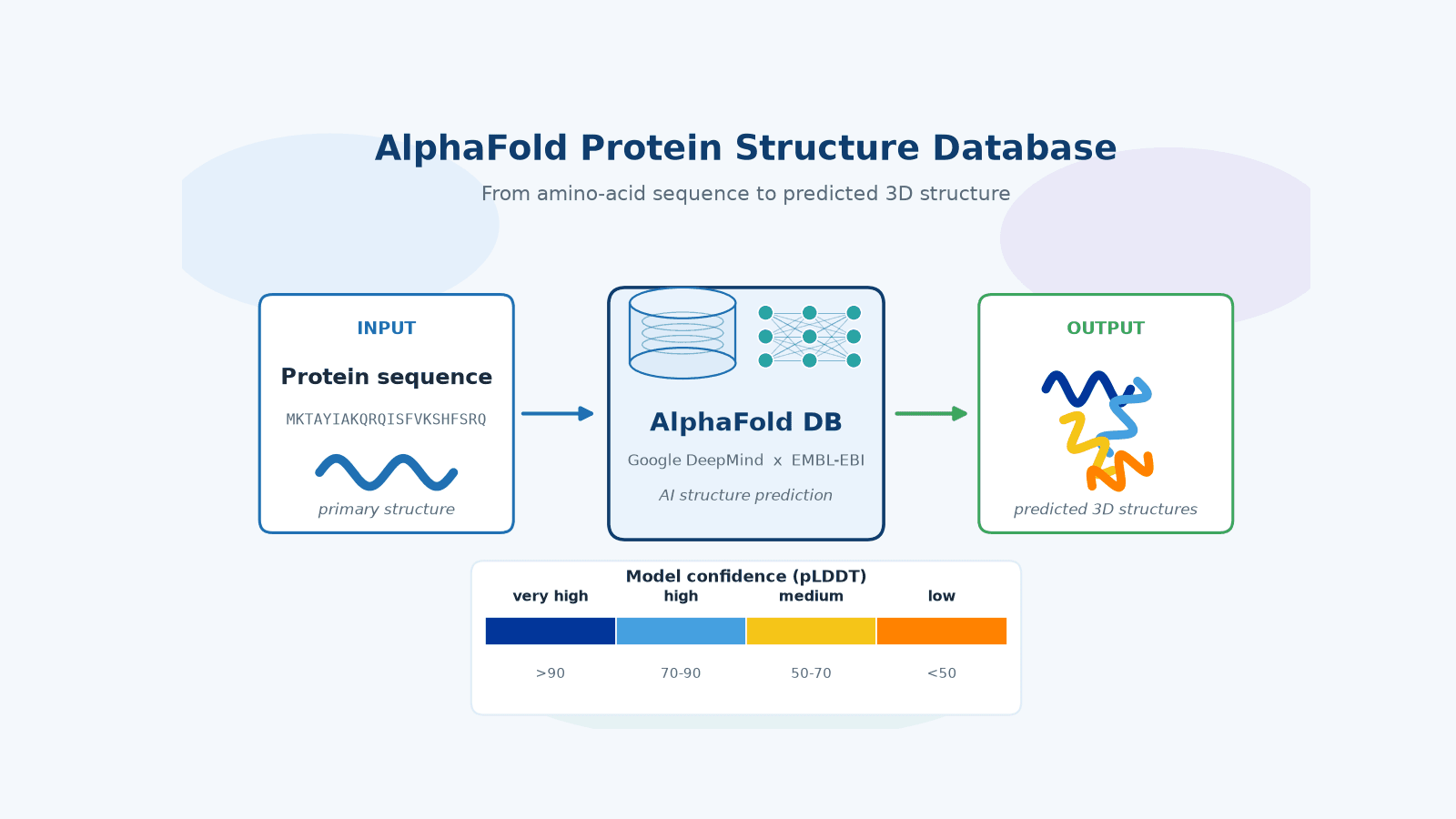
Figure 1: AlphaFold DB converts sequences into AI-predicted 3D structures.
Proteins are the “molecular machines” of life, and their 3D folded shape largely determines what they can do. For a long time, however, scientists have known far more sequences than structures. Closing that distance has been a decades-long challenge in structural biology — and it is the root reason AlphaFold DB became widely used so quickly.
Background: Why Protein Structure Is Scarce — and Why AlphaFold DB Exists
Protein function is determined by 3D structure, but experimental structure determination is slow and expensive, so known sequences vastly outnumber known structures — the very gap AlphaFold DB fills.
Why does structure matter so much? For a protein to actually work, it often needs to place specific amino-acid side chains at specific positions in space to bind substrates, transmit signals, or catalyze reactions. A subtle difference in folding can make a protein lose its function. Structure is, in effect, the “physical map” of a protein’s function and activity.
Why is experimental structure determination hard? Each mainstream method has limits: X-ray crystallography requires growing the protein into crystals, which many membrane proteins and flexible proteins cannot do; cryo-electron microscopy (cryo-EM) keeps improving in resolution but is costly and complex to process; NMR is limited by protein size. The common problem is “slow” and “expensive” — solving a structure often takes months or years.
So the “structure gap” persists: known protein sequences number in the hundreds of millions, while experimentally solved structures number in the hundreds of thousands, and many come from a few model organisms or have been solved repeatedly. That gap is what makes AI structure prediction so valuable. AlphaFold, developed by Google DeepMind, took first place at CASP14 in 2020 with accuracy approaching experiment; for that breakthrough, its core developers Demis Hassabis and John Jumper received the 2024 Nobel Prize in Chemistry. In 2021, Google DeepMind and EMBL-EBI launched AlphaFold DB together, turning predictions into openly searchable resources, later expanded to cover more than 200 million predicted structures.
Principle: How AlphaFold “Infers” a 3D Structure From a Sequence
AlphaFold uses deep learning to take a sequence plus the evolutionary signal in a multiple sequence alignment (MSA), pass them through the Evoformer and Structure Module, and output 3D coordinates with a confidence score for each residue.
Think of it as a “structure reasoner”: you feed it an amino-acid sequence, and it returns a 3D fold. It relies not just on the sequence itself, but on stacking on top of it Nature’s “billions of years of evolution.”
· Three inputs: ① the amino-acid sequence itself; ② the multiple sequence alignment (MSA), i.e., a set of evolutionarily related sequences — natural selection “remembers” the amino-acid constraints important for structure and function, so if two residue positions always change together in evolution (co-evolution), they are often physically close in space; ③ templates of known structures.
· Attention mechanism: this is how the model “reads” a sequence. It lets the model attend to residues that are far apart in sequence but may come close in 3D space, much like picking up on subtle connections while reading.
· The model works in two steps: the Evoformer uses attention to integrate sequence and pairwise information and infer interdependencies between residues; the Structure Module then “assembles” those relationships into 3D coordinates.
· The output is more than coordinates; it also provides two quality metrics.
· pLDDT: per-residue confidence (0–100), like “how sure the model is about this step.”
· PAE: the estimated error in the relative position of residue pairs, like “whether the relative position of these two parts is right.”
· One default assumption: AlphaFold usually returns a single most-likely static conformation. For regions that naturally move (flexible loops, disordered regions), pLDDT drops — which is the model telling you it is less sure there.

Figure 2: The Evoformer and Structure Module output coordinates, pLDDT and PAE.
How to Use AlphaFold DB: Retrieving Structures and Judging Confidence
In AlphaFold DB you can search a protein by UniProt accession, gene name or sequence, then use pLDDT and PAE to judge which regions are reliable enough to carry into downstream work.
· How to search: searching by UniProt accession or gene name is most direct; sequence-based search is also supported (typically requiring at least 20 amino acids). Recent additions include sequence-similarity search and structure clustering (Foldseek Cluster) to find structurally related proteins.
· How to judge confidence: predicted structures can be colored by pLDDT — dark blue (>90) very high confidence, light blue (70–90) high, yellow (50–70) medium, orange (<50) low. For structural analysis, focus on the dark/light blue regions.
· Watch PAE: if a pair of residues has high PAE, their relative position is uncertain; even if a single residue has high pLDDT, the overall fold may still be unstable.
· Coverage: the database covers UniProt and offers batch downloads for the human proteome plus several dozen model organisms; very long sequences (e.g., >2,700 residues) are split into fragments.
· Practical reminder: a predicted structure is a “single static snapshot”; it does not show conformational change, nor does it contain ligands, metal ions or post-translational modifications — these need other tools or experiment. In recent years the database has also integrated community datasets for bacteria and viruses, broadening coverage further.
· How to get data: each entry provides downloadable PDB or mmCIF coordinates, and the API is available.
Applications and Workflow: What AlphaFold DB Accelerates
Using AlphaFold DB’s predicted structure as a starting point, you can quickly shortlist candidates worth taking into wet-lab validation in drug discovery, enzyme engineering and antibody design, significantly shortening development cycles.
A typical workflow: define the target protein → retrieve the predicted structure → filter trustworthy regions by pLDDT/PAE → combine with downstream analysis (molecular docking, binding-site identification, functional annotation, etc.) → shortlist candidates → wet-lab validation.
· Drug discovery: when a target lacks an experimental structure, predicted structures support virtual screening and target analysis, narrowing candidates before lab confirmation. Note that a predicted structure is not binding affinity; it needs docking tools and experimental validation.
· Enzyme engineering: predicted structures help locate active sites, substrate channels and catalytic residues, giving point mutations clear targets.
· Antibody and protein design: predicted structures assist in designing new binding interfaces, though antibodies are flexible and need multiple judgments.
· Where the limits are: AlphaFold does not directly predict the stability change (ΔΔG) of mutations, and struggles with multiple conformations and ligand-bound states; these need specialized tools and final wet-lab confirmation. Treating a predicted structure as a high-quality “hypothesis” rather than a conclusion is key to using it well.

Figure 3: Predicted structures feed a protein-engineering workflow, integrated with the platform.
MatwingsVenus®(晓鹜®): How a Sequence Reaches Function Directly, Bypassing the Structure Step
MatwingsVenus® (晓鹜®) has taken a path that goes “directly from sequence to function” — without waiting for a structure, it uses the amino-acid sequence itself as input and, through fitness landscapes and active learning, turns AI’s sequence-to-function predictions into verifiable wet-lab plans.
Many protein R&D projects in fact begin with “a sequence in hand,” and a fair number of target proteins have neither an experimental structure nor a high-quality predicted one. That is exactly where MatwingsVenus® (晓鹜®) positions itself: it does not treat structure as a prerequisite gate, but uses the sequence directly to launch “function-aware” design.
Starting point: take the sequence itself as the design input and, based on sequence features, infer which positions may affect activity, stability or developability — directly defining the regions of key focus.
The loop: combine the fitness landscape — reflecting how different mutation combinations affect function — with active learning, letting the model select the most informative next round of experiments, so every wet-lab round has direction and wasted trials are reduced.
Function-aware screening: before entering the wet lab, run computational scoring based on a sequence–function model to filter out candidates that are clearly unreasonable or lack value.
Model → wet-lab → data → retraining: experimental data flows back into the model, forming an iterative, self-reinforcing loop.
Its value lies in turning “AI prediction” from a concept into an executable, verifiable and iterable R&D path: use the sequence to focus the effort, use learning algorithms to plan experiments, test hypotheses in the wet lab, then feed results back to the model — throughout, it never depends on structure; the sequence alone reaches function directly.
FAQs
What is the difference between AlphaFold DB and the PDB?
The PDB (Protein Data Bank) stores experimentally determined, validated real structures, limited in number. AlphaFold DB stores AI-predicted structures — more than 200 million and far broader in coverage — but they are predictions by nature and must be judged with confidence metrics.
Are AlphaFold predictions always reliable?
Not necessarily. Each entry carries pLDDT and PAE as quality signals: the higher the pLDDT, the more reliable — dark blue (>90) regions are often near-experimental, while orange (<50) regions are largely unreliable. Reliability must be judged against these metrics, and critical uses still warrant experimental validation.
Can I use AlphaFold DB for free?
Yes. AlphaFold DB is open and free to the worldwide community; you can search and download directly on the site, or pull data via the API or bulk downloads. AlphaFold’s open-source code and Colab tools also let you predict custom sequences not in the database.
Can AlphaFold DB completely replace experimental structure determination?
No. For high-confidence regions it greatly reduces experimental workload, but it cannot cover everything — multi-conformational states, flexible regions, post-translational modifications, ligand-bound states and more. Structures that drive conclusions still rely on experiment or careful validation.
Conclusion
AlphaFold DB turns AI structure prediction from a lab achievement into an always-queryable public resource, reshaping how structural biology and protein engineering are done.
It is free, open, and covers more than 200 million predicted structures; it dramatically lowers the barrier from sequence to structure, giving many more proteins “a structure to use.” But prediction is not fact, and pLDDT and PAE are the “user manual” for using it well. For teams that want efficient protein engineering, the loop of structure starting point + AI tools + wet-lab validation is a genuine accelerator.
One-sentence takeaway:AlphaFold DB is a free, open AI protein-structure library with 200M+ predicted structures, confidence-scored by pLDDT/PAE, accelerating drug discovery and protein engineering.
