AI Protein Laboratory: When Life Sciences Meet Artificial Intelligence, You Can Also Become the 'Hand of God'
Published on May 14, 2026
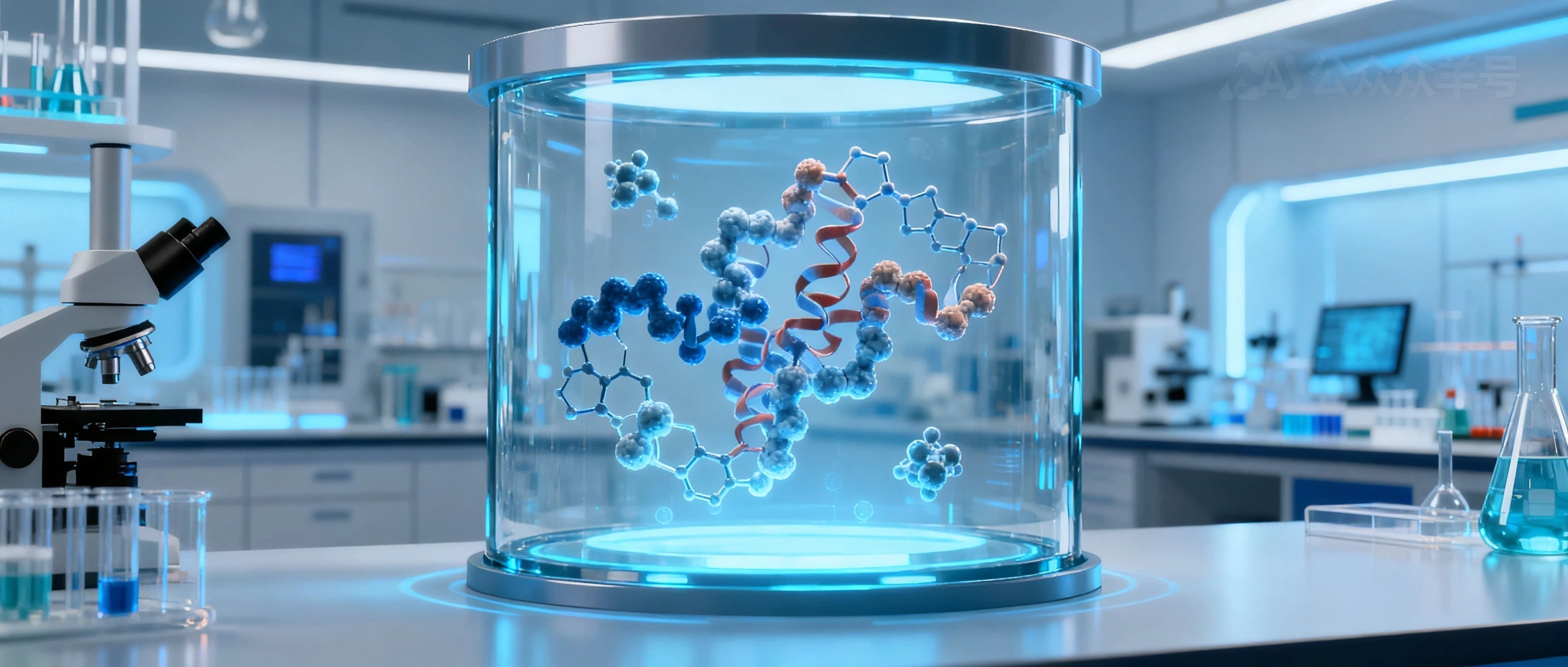
Preface
Not long ago, protein design was an exclusive domain of a few top scientists. Today, the involvement of AI is breaking down this barrier, turning a 'chasm' into a path.
01
Protein Design: From 'Trial and Error by Experience' to 'Intelligent Creation'
Protein, a term that seems obscure, is actually the core executor of life activities. Whether it is the medicine we take daily, the sugar substitutes on our table, or the catalysts used in industrial fermentation, behind all of them lies the precise work of proteins.
However, designing a protein capable of performing a specific function was once nothing short of a 'fantasy.'
Traditional protein research relies on directed evolution and high-throughput screening. Researchers must sift through tens of thousands of randomly mutated samples in long and tedious laboratory experiments to find the ideal 'top performer.' This approach is not only time-consuming and labor-intensive but also a tremendous test of human and material resources.
But all of this is being rewritten by AI.
In recent years, multiple reviews of cutting-edge domestic research have pointed out that AI technology has deeply penetrated the entire process of protein research—from data characterization, sequence and structure design, to final functional evaluation—the efficiency and accuracy of protein design have increased exponentially. This means that protein design has officially shifted from the highly uncertain 'trial-and-error era' of the past into a more efficient 'intelligent design era.'
02
'Wet-Dry Closed Loop'—The Core Solution of AI Protein Laboratories

AI蛋白实验室
Many readers might ask: AI design always exists in the virtual world of computers, so how can we ensure it works in the real world?
This is exactly the biggest dividing line between current AI protein design and traditional computer-aided design. Relying solely on “in silico” experiments simulated by computers is not enough; the key breakthrough lies in building a “dry-wet closed loop.”
It’s like a super hub that seamlessly connects the AI brain with automated machinery:
AI Brain (Dry Experiments)
Uses artificial intelligence to predict protein structures, analyzing how specific amino acid sequences fold and whether they can interact with target sites.
Automated Experimental Equipment (Wet Experiments)
Designing is just the first step. The platform will automatically transfer these design schemes to real automated shared laboratories. Here, robots carry out a series of life science experiments, including gene synthesis, protein expression, and purification.
Currently, truly hardcore platforms that achieve a “dry-wet closed loop” are rare in the market, and the newly released platform from Matwings Technology—MatwingsVenus™ (Xiaowu™)—is undoubtedly at the forefront in this field.
03
MatwingsVenus™ (Xiaowu™): Your AI Steward for Protein Design

MatwingsVenus™(晓鹜™)

Automated biological experimentation platform
As the core creation of Matwings Technology, an AI-driven full-stack protein research and development platform company, "MatwingsVenus" is not just a cold piece of software; it is more like a round-the-clock scientific research consultant.
Breaking the 'resource monopoly' and enabling small organizations to make a comeback
In the past system, designing a completely new protein or antibody required high-end experimental equipment, which was often only available in large pharmaceutical companies or top-tier research institutions' specialized laboratories. The release of MatwingsVenus™ (Xiao Wu™) is breaking this 'resource monopoly,' shifting protein research and development from being 'driven by large platforms' to 'accessible to individuals.'
On the "MatwingsVenus" platform, users do not need to master complex biological codes; they only need to input their task goals through natural language conversation, such as, "I want to design a new binding molecule that can treat a certain type of inflammation." After that, the system automatically breaks down the task for you. It integrates over 200 protein design tools, has a database of billions of real labeled proteins, and features more than 50 platform-certified experts along with over 30 skills fine-tuned by experts.
A closed-loop revolution from 'virtual' to 'real'
If AI design is the first step, the disruptive power of MatwingsVenus™ (Xiao Wu™) lies in the second step—the seamless connection between design and experimentation.
Once the AI completes the design plan, it is no longer just 'theory on paper.' Through a self-built communication mechanism, the platform directly sends these plans to robotic workstations, automatically completing sample preparation, protein purification, functional verification, and other processes, while feeding actual experimental data back to the AI.
This creates an extremely efficient intelligent R&D closed loop of 'design-as-validation, validation-as-iteration,' allowing the AI to rapidly learn and evolve from real physical experiments.
04
Real Case: Enabling Targeted Drugs to "Find the Right People"
Theories are dull; practical application skills are the touchstone to test the caliber of an "AI Protein Lab."
In a real immune regulatory receptor target development project, the team faced an extremely challenging problem: the target's surface was dominated by polar regions, lacking the binding hotspots needed for traditional drug molecule development. Designing a completely new protein molecule that can compete with the natural ligand and possess extremely high affinity under such difficulty is almost impossible.
However, relying on the MatwingsVenus™ (Xiaowu™) platform, researchers achieved dozens of new binding molecules with in vitro cellular blocking activity after only a few rounds of design and iteration.
This milestone achievement clearly validates one fact: with the support of an AI protein lab, humans now possess the extraordinary ability to create life components "from nothing".
05
From the 'Hand of God' to Shared New Infrastructure for Scientific Research
With the rapid growth of the AI protein design market in 2026, more and more visionary researchers and small to medium-sized enterprises are beginning to realize: whoever can design functional proteins faster and more accurately will gain an early advantage in the fields of pharmaceuticals, health, synthetic biology, and new materials.
In the future, platforms like MatwingsVenus™ (Xiaowu™) will continue to promote the democratization of protein research capabilities. When AI's predictive power is deeply integrated with automated execution capabilities, it represents not just the iteration of a tool, but the birth of a completely new research model.
In this new era, the barriers to innovation are no longer expensive equipment and profound knowledge reserves, but the unique ideas in your mind.