AI Automated Experimental Factory: Conversational Wet-Dry Closed Loop for Protein Design
Published on May 10, 2026
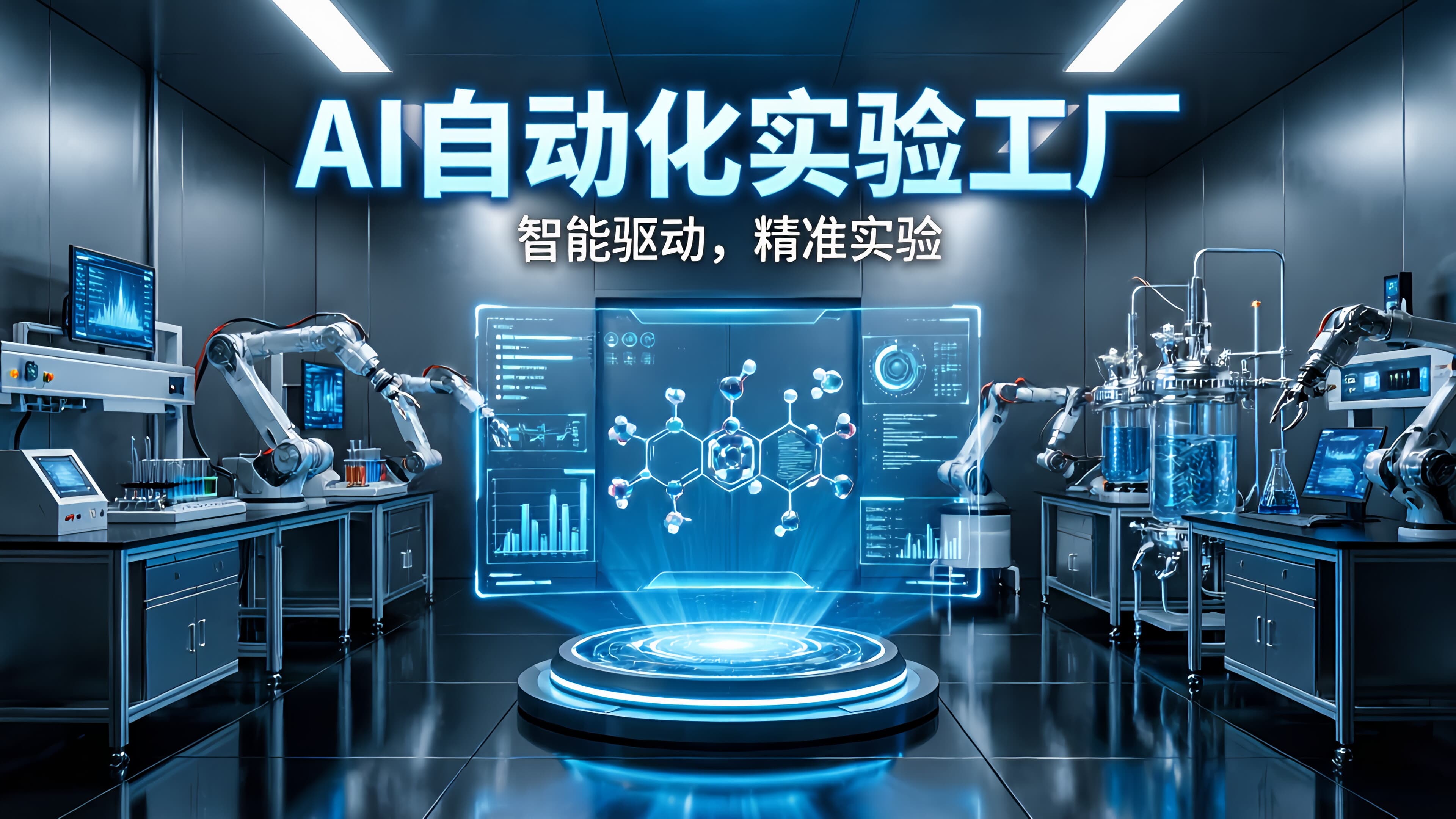
Researchers only need to "speak", and AI and robots can complete the whole process from design to verification - this is not science fiction, but a productivity tool that has been implemented.
How difficult is traditional protein research and development?
The daily routine of a postdoctoral fellow is: modeling with software in front of the computer in the morning, manually pipetting, running glue, and measuring activity in the laboratory in the afternoon, and being in a daze at the failed data at night, and repeating the next day. After a few months, you may not even get a potential candidate.
What is the problem? "Design" and "experimentation" are two sets of languages and two worlds.
designers use structural biology and computational tools to make their imagination in virtual space; Experimenters use pipettes and incubators to work hard in the physical world. A lot of inefficient manual translation, communication, and waiting are required between the two. An iteration cycle can take several weeks.
The AI automation experimental factory is to completely break this wall with a "conversational dry and wet closed loop".
What is an AI Automated Experimental Factory?
It is not a single device, but an integrated system that integrates AI agents, cloud design platforms, and automated experimental robots.
In simple terms, its workflow is:
1. You speak: Tell the system your R&D goal in natural language - "I want to design an enzyme that can remain active at high temperatures".
2.AI design: The system calls protein design tools, databases, and expert models to automatically complete computational tasks such as sequence generation, structure prediction, and functional screening.
3. Automatic ordering: The designed candidate molecular information is automatically translated into experimental instructions and sent to the automated laboratory.
4. Robot work: The collaborative robotic arm completes sample preparation, purification, and functional testing, and the whole process is unattended.
5. Data return: The experimental results are automatically returned, and the AI uses them as inputs for the next iteration, forming a closed loop.
You only need to make a request on the first day and see the real experimental data on the second day.
When the lab no longer needs a "gatekeeper"
Imagine a scenario: biomedical and synthetic biology researchers want to design a completely new protein. In the past, they had to spend months or even years in the lab, trying their luck in hundreds or thousands of pipetting, culture, and testing, with a little bit of trial and error.
But now, an even more fantastic scenario is happening.
When I got home in the evening, I found the official website of Shanghai Tianyu Technology on the Internet, registered a personal account, and then chatted with the agent "MatwingsVenus" on the platform, telling my thoughts - "I hope to get a new binder molecule with in vitro cell blocking activity". Then he went to sleep.
Early the next morning, an email lay quietly in the inbox: AI has completed the whole process of calculation from skeleton screening, interface design to sequence optimization and druggability prediction, dozens of high-quality candidate binder sequences have been automatically entered into the automated sharing laboratory process, the robot has completed sample preparation and functional testing overnight, and the experimental results have been issued.
Yes, this is the first personal experience of the "AI Automation Experimental Factory".

Cloud Design + On-site Execution = Dimensionality Reduction Strike
That's right, traditional high-end scientific research capabilities have now become a service that can be accessed and executed automatically at any time.
Unlike traditional computational AI (which provides AI design capabilities) or manual operations in physical laboratories, the MatwingsVenus platform by Tianyu Technology follows a path of "deep seamless collaboration between cloud design and physical experiments."
At its core is an intelligent agent, which, through natural language commands, can access more than 200 protein design tools, a database with billions of tags, and an expert-optimized skills toolset to complete the full process from industry research, enzyme mining, directed evolution, to de novo protein design.
More importantly, after AI completes the cloud-based design, the platform automatically channels results into plasmid ordering and experimental scheduling workflows using a constructed communication mechanism, sending them to an automated shared laboratory called "Blacklight." Collaborative robots seamlessly carry out subsequent experimental tasks, automatically preparing samples, purifying proteins, and performing functional assays, with complete data automatically returned. In this way, scientific outcomes, from idea to real samples and data, are fully automated within a closed-loop on the platform.

Finding AI Partners Using AI
Interestingly, the developers used a 'conversational' approach to utilize this system. Tan Yang, the head of the Agent project at Matwings Technology, commented:
The platform not only helps users complete frontend research and protein design but also connects the results to automated wet lab processes, allowing design plans to receive experimental feedback as quickly as possible and then enter the next round of optimization. In this way, research no longer stays confined to 'paper simulations,' but can form a closed loop more quickly.
MatwingsVenus adopts a strategy of 'Agent design—automated experiments—AI feedback—Agent redesign,' narrowing the search space step by step and gradually optimizing the candidate set. It can be said that it is an AI experimental factory built in the physical world that can communicate with humans in natural language.
Why use 'conversation'? Because developers’ needs are often vague and exploratory. Most platforms only provide fixed function buttons, but MatwingsVenus automatically organizes work paths around task objectives, integrating the AI agent’s reasoning capabilities, cloud-based design platform, and automated robotic laboratory into an organic whole. This allows the researcher’s imagination to seamlessly connect with the physical implementation stage, reducing one of the highest barriers in scientific research: intermediate layer loss.

Two practical applications of the 'conversational dry-wet loop' are shocking.
Is this paradigm really practical? Shanghai Matwings Technology has provided a solid answer with concrete cases.
The first case—In a de novo design project targeting a certain immune regulatory receptor, Matwings Technology, based on the MatwingsVenus platform, successfully obtained dozens of entirely new binder molecules with in vitro cellular blocking activity, completing a full closed-loop process from design to validation. It's worth noting that such targets are extremely novel, lack reference drug molecules, and their surfaces are mainly polar regions without typical druggable hotspots, making it practically hellishly difficult to design stable, tightly bound new proteins from scratch.
The second case involves modifying the protein-based sweet substance Monellin. MatwingsVenus, using a multi-round iterative strategy of 'agent design—automated experiment—AI feedback—agent redesign,' produced a highly sweet and heat-resistant high-quality candidate protein variant—the sweetness of multiple samples increased by more than tenfold compared with the wild type, while heat resistance remained at a high range of around 75°C.
From immunology to synthetic biology and protein design, these two typical scenarios have showcased the impressive results of this 'AI automated experimental factory.' According to the platform, MatwingsVenus has completed the full process of AI design, experimental validation, and result iteration in multiple real projects, indicating that the platform is no longer limited to the conceptual level, but has truly turned the 'conversational dry-wet loop'—virtual AI design interacting with real-world experimental validation—into a practical R&D capability.

The Death and Rebirth of Traditional Laboratories
It is well known in the industry that high-end research and development has always relied on a limited number of expensive facilities and 'top-tier' experts in the field with many years of experience. These resources are only in the hands of a few large research institutes or companies.
What MatwingsVenus is doing is transforming the R&D capabilities that were previously held only by large enterprises, major research institutes, and universities into infrastructure that individuals can also access, promoting protein research from being 'driven by large platforms' to 'available to individuals.' Researchers no longer need to repeat monotonous, low-level 'trial-and-error' tasks, and can fully dedicate themselves to higher-level creative work that intelligent systems cannot accomplish. And the result of more people having high-quality R&D capabilities means more possibilities for groundbreaking scientific achievements and commercial applications.
This transformation is, in turn, defining new rules for scientific research. Those who learn to interact with AI faster and connect the loop between 'computing results' and 'producing outcomes' will gain an advantage in the new round of technological competition. A brand-new technology research and innovation paradigm, led by AI and automated robots, is ushering in a new chapter in China's 'intelligent manufacturing' era.